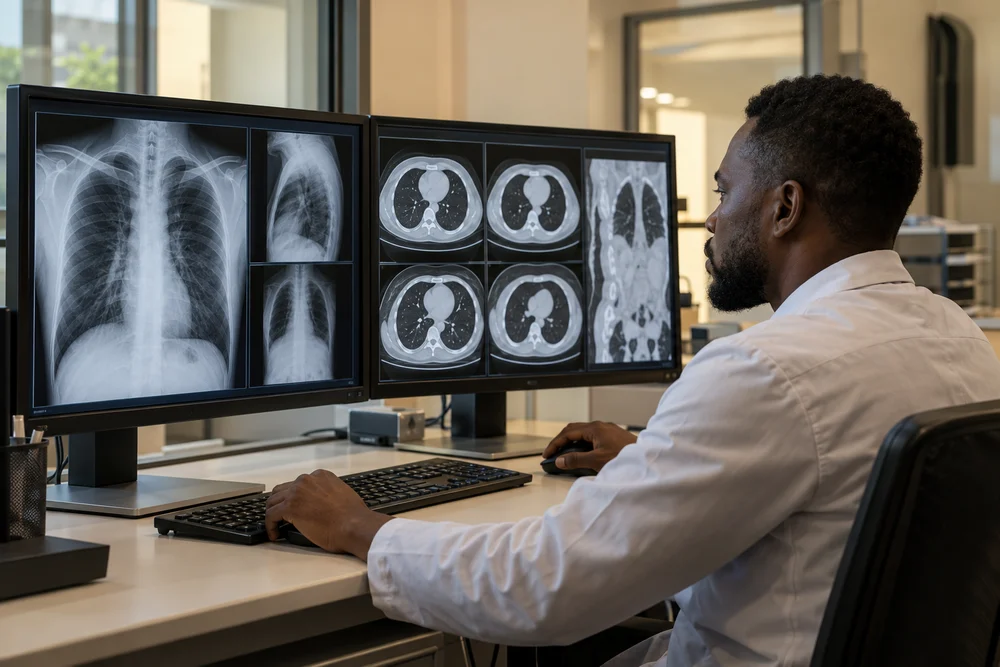
A practical guide to healthcare IT integration services in Nigeria

What do healthcare IT integration services in Nigeria cover?
Healthcare IT integration connects agreed workflows across systems such as EHR/HIS, PACS, RIS, LIS and medical equipment. Franance accepts enquiries about these integration and migration needs. A project begins by identifying the exact systems, information flows, owners and technical access, then agreeing a written assessment or implementation scope.
A request may involve sending imaging orders from a hospital information system to radiology, making images available in PACS, returning a report to an electronic record, or transferring laboratory results between an analyser, LIS and EHR. A medical device may also produce data that a department wants to review in another system. These examples describe possible workflows; they do not mean every product, interface or hospital setup is already supported.
Start with the actual workflow and product details: hospital systems, imaging or laboratory interfaces, medical equipment data, and any migration requirement. Franance can review the information and stakeholders needed for the request, then clarify an assessment or implementation scope. Provide available vendor documents and identify who can approve interface access, licensing, data mapping, testing and operational ownership.
How should a hospital plan an EHR, PACS, RIS or LIS integration?
Start with one workflow at a time. Name the sending and receiving systems, the event that starts an exchange, the data required, the expected response and the staff who act on it. Record the current process and the intended future process before choosing an interface.
A radiology workflow might map patient registration, order creation, scheduling, modality work, image storage, reporting and result delivery. A laboratory workflow may map orders, specimen identifiers, analyser results, flags, validation and report release. A device connection may be as narrow as forwarding a measurement or as broad as supporting a departmental record. Write the steps down with clinical, technical and administrative stakeholders so terms such as ‘integration’ do not conceal different expectations.
For each exchange, ask: what event triggers it; which system is authoritative for each field; how identifiers are matched; what acknowledgment or error is returned; whether staff review or correct data; and how duplicates or downtime are handled? Include normal, exception and recovery paths. This helps expose dependencies such as a vendor interface licence, a new network segment, a terminology mapping or a manual approval step before a project schedule is agreed.
Franance’s enquiry can begin with the workflow description, product/version list and available interface documents. The facility and system vendors remain essential participants: they confirm permitted methods, data meaning, access, licensing and operational ownership.
What should a PACS and RIS interface matrix include?
Document the modality, RIS, PACS and EHR participants; the order and image/report flows; the relevant DICOM or messaging functions; identifiers; acknowledgements; exceptions; network endpoints; and the party responsible for each interface. Confirm details against each system’s conformance and interface documentation.
DICOM is the standard for communication of biomedical, diagnostic and therapeutic information in disciplines that use digital images and associated data. It supports imaging data and related information exchange, but two systems both mentioning DICOM does not prove that a particular workflow will work without configuration. Review the exact services, objects, transfer syntax, storage behaviour, worklist functions, query/retrieve functions and any web-based interface the proposed systems claim to support.
A practical matrix has one row per interface and records source, destination, business event, data elements, protocol or profile, direction, trigger, acknowledgment, expected timing, error route, security requirements, test case, owner and vendor dependency. For modality-to-PACS, include how studies are identified and sent. For RIS/EHR-to-imaging workflows, record order and scheduling responsibilities. For report return, specify where the signed or final report is created and how its status is represented. Avoid assuming that an interface includes every workflow function.
Request current DICOM conformance statements and interface documentation from the relevant manufacturers. Include the product, software version and licensed options in the review. Franance can assess the proposed matrix and discuss a scope, but the exact endpoints and supported functions need confirmation by the system owners and vendors.
How do HL7 and FHIR fit into hospital system integration?
HL7 and FHIR refer to healthcare information exchange standards and frameworks, not a guarantee that two products share a ready-made connection. Identify the message or resource, version, implementation profile, field mapping, trigger, response handling and security arrangement required for each workflow.
HL7 Version 2 messages are used in many healthcare interfaces for events such as admissions, orders and results. FHIR is an HL7-published standard for electronic healthcare information exchange, with resources and exchange patterns for REST APIs, messaging and other interactions. Which version or implementation guide applies depends on the systems and the interface project. Do not treat ‘HL7 compliant’ or ‘FHIR enabled’ as a complete interface specification.
Build a field-level mapping for patient and encounter identifiers, orders, observations, reports, status values, timestamps, units and terminology where relevant. Record required versus optional fields, source of truth, transformations, acknowledgements, retries, duplicate handling and error ownership. Synthetic examples help stakeholders review mapping without sharing identifiable records. Where local custom fields or vendor-specific extensions are used, label them and document the system that owns their meaning.
Confirm the exchange mechanism, authentication, certificates or credentials, supported profiles, test environment and licensing with the product owners. The facility’s clinical and information-governance leads approve the clinical meaning and intended use of data. Franance can review an enquiry and discuss an integration scope around the available specifications; the actual compatibility must be established for the named systems and versions.
Can medical equipment connect to an EHR, LIS or PACS?
Some equipment provides data interfaces, but available functions vary by manufacturer, model, software version and licensed options. Identify the device and intended data flow, then request its interface documentation and the receiving system’s requirements before assuming that a connection is possible.
The old Franance hospital IT integration scope includes enquiries involving equipment as well as information systems. Depending on the exact devices and project, a facility may want to review laboratory analyser results to LIS, imaging studies to PACS, or other device information for a defined workflow. The enquiry should state what data should move, when it should move and which system or person reviews it.
Collect the device manufacturer, model, software revision, asset location, interface module, supported protocol, cable or network needs, data format, output examples and any vendor requirements. For a LIS connection, clarify test or procedure codes, units, reference ranges, flags, quality-control handling and result approval responsibilities with the laboratory and LIS owner. For imaging, use the modality’s conformance information and the receiving PACS requirements. These details are project questions rather than assumed capabilities of a category or product family.
The facility’s clinical or laboratory team decides how data are reviewed and released. The IT/security team approves the network connection and access. System vendors may need to provide configuration, documentation, licences or technical participation. Franance can review the request and clarify whether assessment or interface work can be included in a written scope.
Who is responsible for data security during healthcare integration?
The facility and each participating system owner must agree the data, access, hosting, network, security and support responsibilities before implementation. Put accountabilities, approvals and incident contacts in the project scope rather than assuming they are supplied by an integration protocol.
Begin with a data-flow and access review: what information is exchanged, where it is processed, which users or services can see it, how accounts are created and removed, and what audit records are available. Identify the hosting environment, network paths, firewalls, remote-access conditions, encryption requirements, backups, retention and recovery expectations. The facility should apply its own information-governance and cybersecurity policies and involve its privacy/security leads before access is issued.
Use least-privilege access, approved test data and documented change control. Define who holds service credentials, who can approve a production change, who monitors failures, who receives security alerts and how a connection is disabled if needed. If cloud hosting or remote support is involved, identify the service provider, data locations, subcontractors and contractual responsibilities for review by the facility.
A technical integration does not by itself establish compliance with a law, certification, data residency rule or cybersecurity standard. The facility and relevant providers determine the obligations that apply to their arrangement. Franance can include the stated security and access requirements in an enquiry review, then confirm the specific responsibilities and deliverables that can be offered.
How should PACS, RIS or EHR migration be tested and accepted?
Agree an inventory, mapping, migration plan, test dataset, reconciliation method, exception process, rollback approach and sign-off owners before moving production data. Test both normal and failure workflows, and retain results that show what was migrated, checked and accepted.
A PACS or RIS migration may involve images, reports, demographics, study identifiers, workflow states and metadata. An EHR or LIS move may include different records and relationships. Define the source and destination systems, date range, inclusion and exclusion rules, patient or study matching, transformation rules and archive requirements. Decide how counts and selected records will be compared, how duplicates or malformed items will be handled and how users can report a discrepancy.
Testing should trace end-to-end examples through the agreed workflow: create or receive an order, identify the correct patient and encounter, transfer the image or result, handle acknowledgements, display the expected report, and verify the exception route. Include access roles, downtime, retry and recovery cases. Use test environments and synthetic data where possible. A facility may require operational performance, user acceptance and business-continuity checks in addition to interface connectivity tests.
Define acceptance criteria before testing and identify who reviews each result. Keep configuration records, mappings, test scripts, outcomes, defects, approvals, migration logs, reconciliation reports, training and handover materials. The facility decides when the system is ready for use and when the legacy service can be retired. A successful transfer alone is not proof that every record is complete or clinically interpreted correctly.
What should I send Franance for a healthcare IT integration quote?
Send a system inventory, the workflow to connect, available interface documents, facility and network constraints, stakeholders, target dates and desired acceptance evidence. Franance can review the enquiry and return questions or a written scope for the assessment or project work that can be offered.
A useful first request can be short: identify the facility and sites, the EHR/HIS, PACS, RIS, LIS or equipment involved, each product version, and one example workflow. Explain the current problem or intended outcome, what data should move, which interfaces are already licensed and which vendors can participate. Attach diagrams or specifications if available, but remove patient names, images, identifiers, passwords and production credentials. For initial discussion, synthetic data and a redacted error message are safer than a live record.
Ask the proposed response to separate discovery, interface design, configuration or development, migration, testing, training, deployment and support if those elements apply. Identify assumptions, dependencies, exclusions, responsibilities, deliverables, acceptance criteria, costs and schedule. State whether the facility needs a one-time integration, a migration, or continuing administration so the scope can be framed accurately.
Franance will review the system details and enquiry and clarify what information is needed to assess the request. Compatibility, vendor access, project availability, commercial terms and timing must be confirmed for the named systems and destination. Use the links below to explore related system categories or service areas while preparing your enquiry.
Common questions about healthcare it integration in Nigeria
Does HL7 or DICOM support guarantee two systems will connect?
No. Confirm the exact versions, profiles, licensed functions, configuration, data mapping, network and vendor access for both systems.
Can Franance integrate any EHR, PACS or laboratory system?
The old Franance service pages describe enquiries for EHR, PACS, RIS and equipment integration. The exact system combination and work must be reviewed before a capability or quotation is confirmed.
What should I send for an integration assessment?
Provide the facility, system names and versions, workflow, interface documentation, network constraints, stakeholder contacts and target outcome. Use synthetic or redacted examples, not identifiable patient data.
Can a PACS/RIS integration include historical data migration?
Migration should be separately scoped with source and destination inventory, data mapping, reconciliation, exception handling, rollback and facility sign-off. Ask Franance to confirm which parts can be quoted.
Who approves clinical data and go-live?
The facility’s authorised clinical, operational, IT and information-governance owners approve data meaning, security, acceptance and the decision to use the integrated workflow.
Tell us what your facility needs.
Send the equipment details, your requirement and the facility location. We’ll discuss the information needed to review the scope and prepare the next step.
Contact Franance