
TrakCare Healthcare Information System
Healthcare information system and electronic patient record software
Price on request

Medical equipment and biomedical engineering.
Abuja, Nigeria.
Buy hospital information system software in Nigeria through Franance. The current HIS category lists InterSystems TrakCare and MEDITECH Expanse. Both are enterprise EHR/HIS software platforms whose licensed modules, release, deployment, interfaces, migration and implementation scope must be confirmed for your facility. Request a scope-based quotation; the catalogue is not an online checkout or confirmation of local availability.
2 models
Healthcare information system and electronic patient record software
Hospital electronic health record and information system software platform
You can request a quotation through Franance for the two listed HIS platforms: InterSystems TrakCare and MEDITECH Expanse. These filtered listings show the product records assigned to this category. They are not proof that either vendor has authorised Franance as a reseller, that a specific release is available in Nigeria, or that an implementation team is contracted locally.
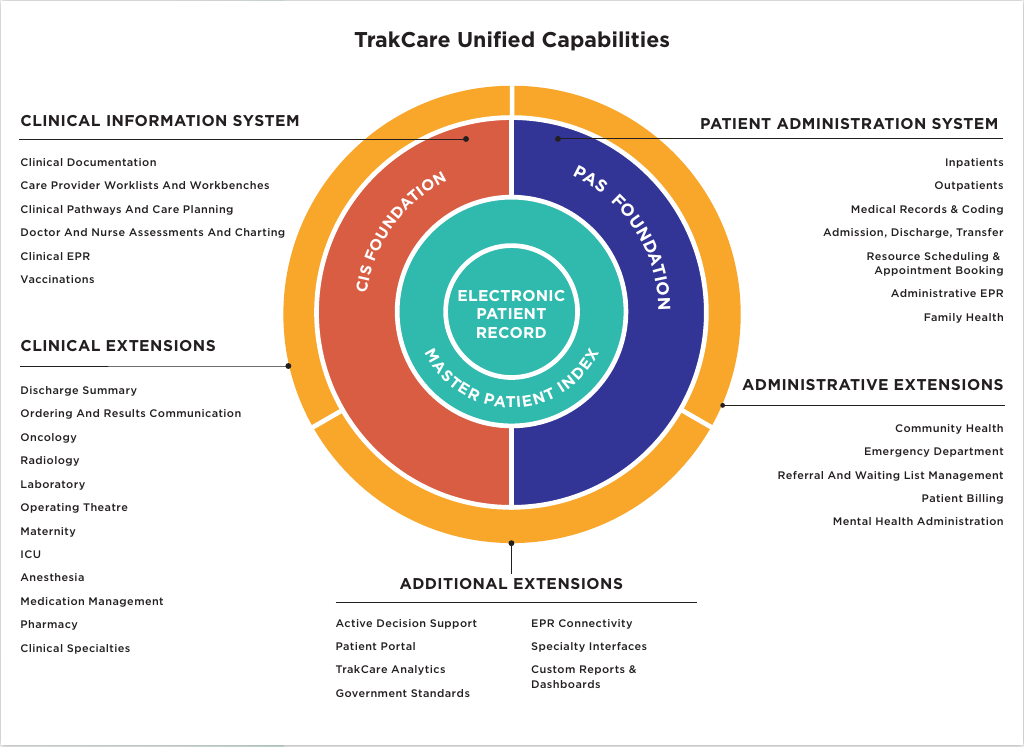
Read moreThe current HIS category has two assigned products. InterSystems describes TrakCare as a unified healthcare information system and electronic record platform. Its product materials distinguish Patient Administration System (PAS) and Clinical Information System (CIS) foundations from extension products. MEDITECH describes Expanse as an electronic health record platform with clinical, diagnostic, administrative and business solutions across care settings. Product-family breadth does not mean every function is included in every proposed deployment.
Read moreBegin with a workflow and stakeholder map, not a feature checklist copied from a brochure. Include registration and medical records, outpatient and inpatient flows, emergency, theatre, maternity, pharmacy, laboratory, imaging, billing, claims or payer processes, reporting and patient-facing services only where relevant to the organisation. Identify the staff roles involved at each step, the information they create or use, approvals, handoffs and exceptions.
Read moreBuy hospital information system (HIS) software in Nigeria through Franance by first defining the facility workflows, modules, integrations and implementation scope you need. Franance currently lists two HIS platforms: InterSystems TrakCare and MEDITECH Expanse. Both are broad healthcare information systems, not boxed devices. Their product families include clinical and administrative functions, but the exact modules, release, licensing, deployment, interfaces and services must be confirmed for the proposed project. Franance can help route a quotation request with your requirements; this page does not claim a local implementation, reseller appointment or confirmed availability. A hospital-wide system is a multi-year operational programme. Before comparing platforms, document what the organisation needs to do: register patients, manage appointments and encounters, record care, place and track orders, connect diagnostic services, support billing and reporting, and exchange information with other providers. Then ask each vendor to map those requirements to a proposed configuration and show what is included, optional, dependent on another module or supplied by a third party.
You can request a quotation through Franance for the two listed HIS platforms: InterSystems TrakCare and MEDITECH Expanse. These filtered listings show the product records assigned to this category. They are not proof that either vendor has authorised Franance as a reseller, that a specific release is available in Nigeria, or that an implementation team is contracted locally.
For a useful enquiry, include the organisation type, number of sites, services, user groups and the outcomes you want the system to support. State whether you are replacing an existing system, starting from paper, or adding a platform alongside existing applications. A quotation for enterprise HIS software should follow requirements discovery; a single headline price would omit major scope drivers such as licensing, configuration, migration, infrastructure, integration, training and support.
The current HIS category has two assigned products. InterSystems describes TrakCare as a unified healthcare information system and electronic record platform. Its product materials distinguish Patient Administration System (PAS) and Clinical Information System (CIS) foundations from extension products. MEDITECH describes Expanse as an electronic health record platform with clinical, diagnostic, administrative and business solutions across care settings. Product-family breadth does not mean every function is included in every proposed deployment.
Review each record and ask for a vendor-confirmed product and scope schedule:
- Buy InterSystems TrakCare in Nigeria — clarify whether the proposed foundation is PAS, CIS or both, and which extensions are licensed and implemented.
- Buy MEDITECH Expanse in Nigeria — clarify the release, selected solutions, deployment model, interfaces and services for your setting.
Neither listing is a generic hospital bundle with a fixed bill of materials. The request for quotation should name the exact software release and distinguish software subscriptions or licences from hosting, implementation and ongoing services.
Begin with a workflow and stakeholder map, not a feature checklist copied from a brochure. Include registration and medical records, outpatient and inpatient flows, emergency, theatre, maternity, pharmacy, laboratory, imaging, billing, claims or payer processes, reporting and patient-facing services only where relevant to the organisation. Identify the staff roles involved at each step, the information they create or use, approvals, handoffs and exceptions.
For each workflow, describe the required outcome and acceptance evidence. Examples include creating a unique patient record, recording an encounter, routing an order, receiving a result, reconciling a patient identity, and producing a report with an agreed definition. Avoid vague requirements such as “fully integrated” or “supports all departments”; name the systems, messages, data and user actions that must work.
A practical discovery group can include clinical leadership, medical records, nursing, diagnostics, pharmacy, finance, operations, information technology, information security, procurement and biomedical engineering where connected equipment is involved. Include representatives from more than one facility or shift if local workflows vary. Franance can help organise these needs into a quotation brief, while each vendor must confirm platform capability and implementation responsibilities.
The TrakCare product record describes a healthcare information system and electronic patient record software. InterSystems’ materials describe PAS and CIS foundations and extension products. Specify which foundation or foundations are required and list each requested administrative, clinical or departmental capability separately. The manufacturer’s extension terms identify prerequisites for different extension products, so the proposed dependency chain must be checked against the selected modules.
Ask the vendor to provide a module-by-module response: included, optional, dependent, excluded or requiring a third-party product. Confirm the supported release, licensing metric, user and site assumptions, environments, hosting, data residency options, migration scope and supported upgrade path. For interfaces, request the exact endpoint or message capability, version, direction, data fields, error handling, security controls, test environment and party responsible for each connection.
TrakCare’s official overview describes interoperability capabilities, but a general standards statement does not establish that a specific Nigerian laboratory, PACS, pharmacy, payer or government service can connect without configuration. Confirm the intended use case and test it with the actual counterpart system and versions.
MEDITECH positions Expanse as an EHR platform and publishes a portfolio spanning clinical, diagnostic, administrative and business solutions. The exact offer should be broken down by care setting, department, user role, workflow and release. Ask which named Expanse solutions are in scope, which are licensed separately, and whether any external systems or services are required to complete the workflows you have requested.
Confirm how the proposed deployment is hosted and operated, who supplies infrastructure, what environments are available for testing and training, and how upgrades, backups, monitoring and support are handled. If the facility expects a certain patient-facing, analytics, pharmacy, revenue-cycle or diagnostic function, name it explicitly and ask for a demonstration using a representative workflow rather than assuming it follows from the platform name.
The vendor’s published interoperability and exchange offerings may have geographic or programme limits. For example, a named exchange service should not be treated as available in Nigeria without written confirmation. Ask which interfaces can be contracted for the proposed geography and what implementation, connectivity, licensing and partner dependencies apply.
Compare like for like. Give each vendor the same written scenarios, user groups, sites, volumes, systems to connect and acceptance tests. Ask vendors to show the workflow from the staff member’s point of view, including exceptions and failure states. A presentation of a broad product family is not evidence that a particular licensed configuration contains the requested capability.
Use a weighted evaluation matrix that reflects the facility’s priorities: workflow fit, usability, configuration effort, reporting, interoperability, security and operational controls, scalability, migration approach, implementation plan, support model and total cost over the intended period. Separate mandatory requirements from preferences. Record evidence for each score and identify whether it comes from a live demonstration, documentation, a contractual commitment or an assumption requiring validation.
Ask for references relevant to facility scale and care setting, but do not treat a reference in another country as proof of local support, localisation, regulatory compliance or performance in your environment. Request named project roles and escalation paths for the proposed engagement.
Create an interface inventory before requesting an integration estimate. Include the existing and planned laboratory information system, radiology/PACS, pharmacy, finance or accounting, identity directory, patient portal, claims or payer systems, medical devices and national or regional exchanges where applicable. For each connection, name the owner, data exchanged, direction, frequency, expected response, error workflow and whether historical data must be migrated.
HL7 FHIR is a standard for exchanging electronic healthcare information, but naming FHIR alone does not guarantee that two applications can exchange the required data. Confirm the FHIR release, profiles, resources, terminology, authentication, API operations, workflow, conformance evidence and test responsibility. Some interfaces may instead use other HL7 versions, DICOM, vendor APIs, files or a separately licensed interface engine. Require a system-specific interface specification and end-to-end test plan.
For each proposed connection, agree who will configure both endpoints, provide credentials and test data, resolve mapping issues, monitor failures and support changes after upgrades. Test normal operation, rejected or incomplete messages, duplicate identities, downtime and recovery before production acceptance. A supplier should not promise an integration based only on a logo or a general standards claim.
Ask the vendor for deployment architecture and sizing based on the proposed sites, users, concurrency, transaction and storage estimates, retention, availability objectives and data-protection requirements established by the organisation. Confirm the network requirements at every location, including bandwidth, latency, redundancy, remote access and contingency procedures. For cloud or hosted services, document the service boundary, hosting locations, connectivity dependencies, backup arrangements and responsibility for monitoring and incident response.
Assess facility power continuity for the network, server or edge equipment, workstations and connected services. The needs vary by architecture and site; request a vendor-reviewed power and environmental schedule rather than applying a generic equipment specification to a software programme. Include local IT capacity, endpoint replacement, secure configuration, printing, barcode or identity devices and support access where relevant.
Plan for intermittent connectivity or utility outages if they are credible operating conditions at a site. Ask whether essential workflows have a documented downtime procedure, what information remains available, how offline activity is reconciled, and how staff are trained to return to normal operations. Do not assume that a mobile or web interface automatically provides offline operation.
Treat migration as a defined workstream. Inventory source systems, databases, paper records, document stores, identifiers, code sets, data quality and retention obligations. Decide what will be migrated as structured data, what will be retained as a view-only archive, what will be scanned, and what will remain in the source system. Define duplicate resolution, patient matching, consent and access rules with the organisation’s responsible teams.
Request a field-level mapping, transformation rules, test cycles, reconciliation reports, exception handling and sign-off criteria. Use representative datasets to test counts, key clinical values, dates, attachments, identities and cross-system links. Keep cutover, rollback and continuity plans explicit. A statement that migration is “included” is incomplete without named sources, volumes, scope boundaries, responsibilities and acceptance evidence.
Ask each vendor to explain its supported import and export formats and the practical process for retrieving records if the contract ends. Define the data ownership and access arrangements contractually. A platform description or standards support statement does not by itself prove that every data type can be exported in a useful form.
The facility should set its security and privacy requirements with qualified legal, information-security and clinical-governance advisers. Ask the vendor to document identity and access management, role design, privileged administration, audit logging, encryption, key management, vulnerability handling, backup and recovery, security monitoring, incident notification, subcontractors and data-location options. Confirm which controls are delivered by the platform, hosting provider, implementation partner and customer.
Request current technical and organisational evidence appropriate to the proposed service, such as architecture diagrams, security documentation, independent assurance reports where available, incident processes and a responsibility matrix. Establish how user accounts are provisioned and removed, how access is reviewed, and how audit records can be searched and retained. Agree how test environments and support access will protect patient information.
Standards and vendor statements are not a substitute for the organisation’s own risk assessment, configuration review, contractual review or validation. The guide does not certify any listed product or configuration as compliant with Nigerian law or a facility’s policy.
There is no single useful price for an HIS platform without a defined scope. Cost may depend on the selected product and release, modules, facilities, users, licence model, hosting, infrastructure, interfaces, data migration, configuration, training, project management, support and future upgrades. Currency, taxes, travel, connectivity and contract terms can also affect the total proposal; ask the vendor to identify its assumptions and applicable commercial terms.
Request a staged, itemised quotation that separates one-time implementation from recurring licence, hosting and support charges. Show optional modules and third-party costs separately. Ask what is excluded, what triggers a change request, the payment milestones, renewal terms, service-level commitments and the approach to price changes. Compare total cost over a common evaluation period and include staffing, infrastructure and ongoing system administration that may sit outside the vendor quote.
Franance’s listings show price on request. The listed products are software platforms, and no price, Nigerian stock or local support coverage is stated. A quotation is prepared after requirements and commercial scope are reviewed.
Send a concise project brief with facility locations, facility and care settings, current software, department list, approximate user groups, target workflows, existing systems, desired interfaces, migration needs, hosting preference, connectivity constraints and desired project timeline. Note which decisions are still open. Do not send patient-identifiable records in an initial enquiry.
Ask Franance to route a scope-based request for the selected platform or platforms. Before treating a proposal as comparable, request the vendor name, exact release, modules, licence basis, implementation responsibility, interface schedule, hosting scope, training, support, assumptions, exclusions and staged costs. For larger programmes, organise a discovery workshop and a documented demonstration against the facility’s real requirements.
Franance can help you request and compare a quotation for TrakCare or MEDITECH Expanse. Platform selection, vendor authorisation, local delivery, implementation and integration must be confirmed in writing for the specific opportunity.
No. Franance does not sell these enterprise platforms through an online checkout. The catalogue displays the products and supports a quotation request. After receiving your scope, the relevant team can contact you to discuss requirements and the vendor-reviewed proposal. Commercial availability, final price, licensing and delivery or implementation terms are confirmed during that process.
This guide is based on the two current Franance product records, official manufacturer product information and the published HL7 FHIR overview. InterSystems identifies TrakCare as a unified healthcare information system and describes PAS/CIS foundations, extensions and interoperability capabilities. MEDITECH identifies Expanse as an EHR platform with clinical, diagnostic, administrative and business solutions. HL7 describes FHIR as a specification for electronic healthcare information exchange. WHO guidance on technical specifications concerns medical-device procurement; it is used here only for the general principle of defining functional and operational requirements, not as an HIS software standard.
The source material does not establish a specific Nigerian offer, local implementation team, price, reseller relationship, release availability, deployment location, support coverage, legal compliance, cybersecurity certification or compatibility with any facility’s existing systems. Confirm each point with the vendor and the facility’s responsible teams before procurement.
Tell Franance whether you are evaluating InterSystems TrakCare, MEDITECH Expanse or both, and share your facility scope, workflows, interfaces, migration and implementation questions. Franance can route the enquiry for a quotation discussion. The vendor must confirm the proposed configuration, availability, licensing, deployment, integration, implementation and support terms in writing.
It includes two enterprise HIS/EHR software platforms, InterSystems TrakCare and MEDITECH Expanse. The listings do not define complete implementation scope or included modules. Confirm release, licences, hosting, migration, interfaces, training and support with the vendor for your project.
No. Confirm the supported FHIR release, profiles, operations, data, security, workflow and counterpart-system version, then agree an integration and acceptance test.
The catalogue does not establish Nigerian availability or implementation coverage. Request written confirmation of commercial availability, delivery or deployment scope, named implementation responsibilities and local support arrangements.
No. The listed software is quotation-led. Submit facility and project requirements so the proposed configuration and commercial terms can be reviewed.
Tell Franance which platform you are evaluating and share your sites, workflows, current systems, integrations, migration and implementation requirements. The vendor must confirm the proposed configuration, availability, licensing, deployment and service terms.
Request a quotationAdd the models you need to a quote order, or send us your equipment list.