Franance helps buyers in Nigeria source bone curettes. Compare exact article codes, manufacturer descriptions and the dimensions or pattern your specification requires, then request a written quotation for the precise items.
To buy bone curettes in Nigeria, send Franance the exact article reference, quantity and delivery destination for a written quotation. This national category can include different manufacturers and patterns. The B. Braun/Aesculap examples below show why the full product title and both end dimensions should stay attached to each code.
The examples are drawn from eight manufacturer product pages covering LUCAS ERGOPERIO, MILLER, JANSEN and HEMINGWAY patterns. Some listings give figure numbers as well as dimensions. Use the source page for the exact item when preparing a purchase schedule, especially if the required widths or geometry are specified.
How do I buy bone curettes in Nigeria?
Start with the approved specification or the article code already identified by your procurement team. A general request for “bone curettes” does not say whether the buyer wants a straight or angled model, which length is required, or whether both working ends must have equal widths. If the specification names a pattern such as MILLER or JANSEN, preserve that name with the model code.
Send a separate quote line for each article and quantity. For a double-ended instrument, include the first and second width in the order shown by the manufacturer; a single width can hide a difference between the two ends. Ask Franance to return the manufacturer code and complete description on the written quotation so the offer can be checked against the requested model.
Which B. Braun/Aesculap bone curette examples are listed?
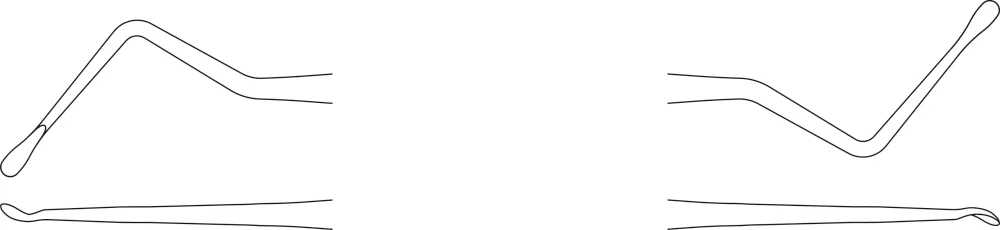
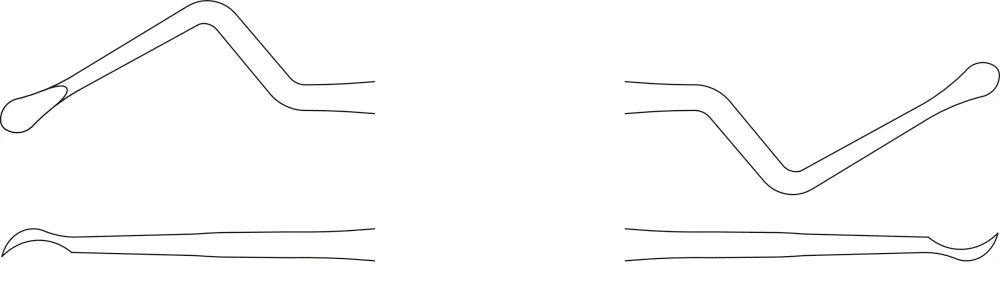
The eight selected product records and their listed attributes are shown below. The second cell retains the manufacturer title and its separate detail fields, including both jaw widths where supplied. The exact wording helps distinguish products that share a broad family name but have different geometry, length, or working-end dimensions.
How should the two working-end widths be compared?
All eight records describe double-ended curettes, but paired widths are not always equal. DO606R lists 2 mm and 3 mm; DO651R lists 2.80 mm and 3.80 mm; DO656R lists 3.70 mm and 4.80 mm. In each case, the order of the values matters because the source distinguishes the first and second width fields. Preserve both rather than summarising them as a single “width range.”
Other records list equal pairs: DO607R has 2 mm/2 mm, DO609R 3.10 mm/3.10 mm, and the three selected HEMINGWAY ERGOPERIO models have equal widths of 1.40 mm, 1.60 mm and 2 mm. These equal pairs still represent two working ends. If the buyer’s schedule has only one width column, add a clearly labelled second-end value in the description or an adjacent field.
The source wording uses “jaw width” in the title and separate “Jaw/Blade width” detail labels. Keep the manufacturer’s labels with the measurements when copying them into a comparison. Do not round 3.10 mm to 3 mm or replace 2.80 mm/3.80 mm with a neighbouring pair; retain the precise reported values.
What do the HEMINGWAY ERGOPERIO figure numbers identify?
The HEMINGWAY ERGOPERIO entries list figure/size designations #0, #1 and #2. In these selected records, DO670R is #0 at 1.40 mm/1.40 mm; DO671R is #1 at 1.60 mm/1.60 mm; and DO672R is #2 at 2 mm/2 mm. Each is listed at 170 mm overall and angled. The figure number is a manufacturer designation, while the paired widths are measurements. Keep both in a purchase line instead of treating the figure number as a substitute for dimensions.
Do not infer a continuous size series beyond the three records shown or assume the same figure convention applies to another curette family. The table records the items shown in the comparison table. If a request names a figure number but not an article code, verify the exact model on its manufacturer page before sending the quote request.
How do pattern, geometry and length differ?
The selected LUCAS ERGOPERIO and JANSEN examples are angled; MILLER DO606R is listed as straight. HEMINGWAY DO656R and the #0, #1 and #2 HEMINGWAY ERGOPERIO models are angled. Overall lengths in the set are 160, 170, 180 and 185 mm. These fields distinguish records independently of the end widths.
DO607R and DO609R are both LUCAS ERGOPERIO products, yet the source lists different lengths and paired widths. The HEMINGWAY entries include one model without an ERGOPERIO designation and three numbered ERGOPERIO models. Similar author names therefore do not identify an exact article by themselves. Compare the complete title and code, then check the dimensions listed for that code.
The records describe sharp/sharp working ends. Preserve that manufacturer wording if the approved specification requires it. The guide does not turn the title into clinical selection advice; the relevant buyer task is to confirm that the quoted product description matches the organisation’s approved purchase line.
How should a buyer review an alternative article?
If a quotation proposes another article, compare its manufacturer record against the requested code field by field: named pattern, straight or angled geometry, total length, both end widths, sharp/sharp wording and figure/size where stated. Show the requested item and proposed item on separate lines. A shared category or author name does not establish equivalence.
Ask the technical reviewer or person responsible for the approved specification to assess any difference. If a source page omits a required attribute, label it “not stated in reviewed source” and request exact-item clarification. Do not fill that gap with a value from another article, and do not silently accept an alternative because its dimensions appear similar. Record who reviewed the change and which source page they used.
What should the quotation and receiving record confirm?
Ask Franance for a written quotation that identifies each code, offered description, commercial unit, quantity, package details, price and delivery terms for the destination. The manufacturer records used here identify articles and features but do not establish current price, availability, pack quantity or included accessories. If package or presentation details matter to the order, request them for the exact article rather than assuming they are common across the family.
For internal comparison, retain the requested code, quote line, manufacturer source URL, first and second width, length, geometry, quantity and any unresolved question. If an alternative is approved, keep the original request visible and document the approval. This makes review and receiving checks traceable, particularly when multiple patterns or HEMINGWAY figure sizes appear in one purchase.
Send the itemised schedule and Nigerian destination through the Franance quote cart. Current price and delivery terms should be confirmed in the resulting quotation.
How should a mixed-pattern bone curette schedule be reviewed?
Keep each named pattern on its own line even when lengths overlap. The listed source set includes LUCAS ERGOPERIO, MILLER, JANSEN and HEMINGWAY examples. Several are 170–185 mm long, but they differ in straight or angled geometry, figure designation, and paired working-end widths. A similar length is not evidence that one article satisfies a request for another pattern. The article code and complete title should therefore lead the comparison, with both widths recorded separately for each double-ended item.
For an internal review, place the requested specification beside the offered source description and flag any changed field rather than calculating a supposed equivalent. A value such as 3.10 mm should remain 3.10 mm, and an unequal pair such as 2 mm/3 mm should not become a single width range. If the quote proposes a different article, ask the requester or technical reviewer to approve the specific change before treating it as acceptable.
What is a reliable way to record double-ended dimensions?
Use labelled columns or a single clearly labelled description that preserves “first end” and “second end.” The product pages distinguish Jaw/Blade width from Jaw/Blade width 2; retaining both labels protects unequal pairs and makes equal pairs explicit. For example, the listed MILLER record DO606R reports 2 mm and 3 mm, while LUCAS ERGOPERIO DO607R reports 2 mm and 2 mm. Both are double ended, so a single width cell would omit useful source detail even when the two values happen to match.
Retain the manufacturer’s notation for geometry and tip profile alongside the dimensions. The manufacturer examples use angled or straight geometry and sharp/sharp descriptions. These are catalogue descriptors for identity checking; they should not be expanded into clinical claims. Before sending the schedule to Franance, verify that every line has a code, both end-width values where stated, length, requested quantity and destination. Ask the written quotation to repeat the exact article and commercial unit, then compare the received label with that approved line.
How should an order handle equal and unequal end pairs?
A paired width can be equal or unequal, and both cases should be written as two ends. DO607R and DO609R have equal pairs in their listed manufacturer pages, while DO606R, DO651R and DO656R have unequal pairs. That distinction is easy to lose if a buyer writes a single width, a rounded range or “double-ended” without the values. Keep the exact source notation alongside the code and identify the first and second end if the purchasing form separates those fields.
When a quote returns a different pair, compare each value in order and record the difference rather than treating it as a minor rounding change. The manufacturer pages use values such as 3.10 mm, 2.80 mm and 4.80 mm. Preserve the reported precision. If the department’s specification lists only one width, ask whether it refers to one end or both before sending the final line. Keep the measurement question separate from the instrument name.
Common questions
Where can I buy bone curettes in Nigeria?
Request a written Franance quotation with the exact article code, quantity and delivery destination. Include any required geometry or working-end dimensions.
Which B. Braun/Aesculap examples have unequal end widths?
DO606R is listed at 2 mm/3 mm, DO651R at 2.80 mm/3.80 mm, and DO656R at 3.70 mm/4.80 mm.
What do HEMINGWAY ERGOPERIO #0, #1 and #2 refer to here?
They are figure/size labels on DO670R, DO671R and DO672R. The respective listed paired widths are 1.40 mm, 1.60 mm and 2 mm; all three selected records state 170 mm length.
Does a shared HEMINGWAY or LUCAS name identify a matching product?
No. Compare the full article code, title, geometry, length and both listed end widths for the exact product.
What should happen if the quotation omits a required dimension?
Mark the point unresolved and ask for written clarification for that exact article. Do not copy a value from another model.
Request a quotation for bone curettes in Nigeria
Send the exact article code, requested quantity and destination through the Franance quote cart. Review the quoted model and written commercial terms before confirming an order.