

Buy Crash Cart (Emergency Trolley) in Nigeria.
Browse crash cart (emergency trolley) and request a quotation for your facility in Nigeria. Include the configuration, quantity and delivery location you need.
Products
2 models
Which crash cart models are listed in Nigeria?
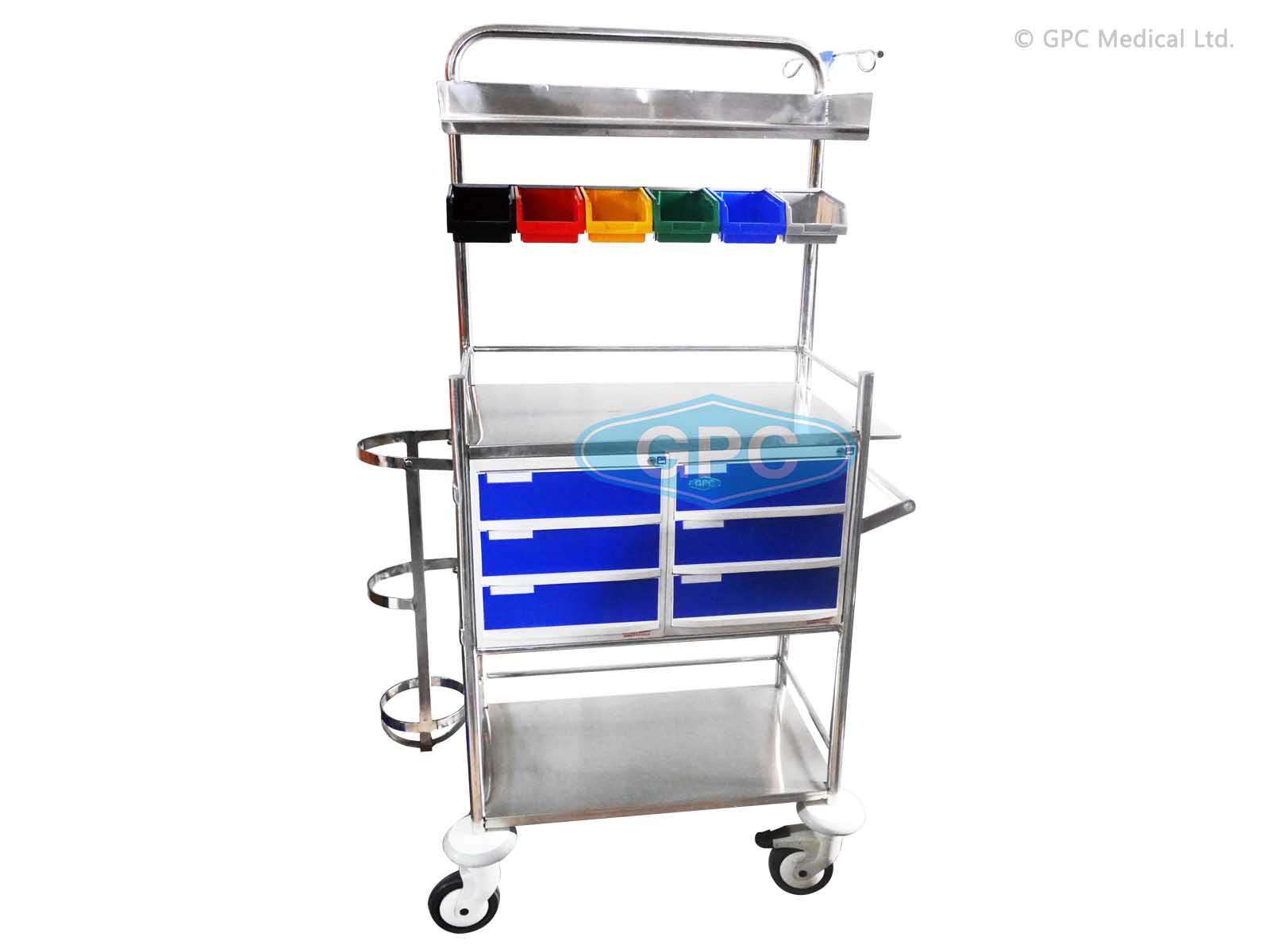
Two exact products are assigned to the current Franance crash cart emergency trolley category. GPC Medical GHF92.01 is a crash cart trolley with a steel tubular frame, six drawers, upper medicine containers, oxygen-cylinder provision, rubber guards and four castors, two with brakes, according to the manufacturer. Capsa Healthcare’s standard-height blue Avalo Series emergency cart is listed under ordering reference AM-EM-STD-BLUE. Capsa’s manufacturer brochure describes the Avalo as a configurable cart: select a base height and color, then specify an accessory package or custom build.
Read moreWhat makes a crash cart different from a general utility trolley?
A crash cart is an organized, mobile storage unit that a facility configures for an approved emergency-response workflow. The trolley helps store and move equipment and supplies; it does not itself define which items are stocked, how they are arranged, who may access them, how readiness is checked or how the clinical response is performed. Those decisions belong to the facility’s clinical governance and operational procedures. The buyer should specify cart requirements without copying patient-care protocols into a product specification.
Read moreWhat should I know about GPC Medical GHF92.01?
GPC Medical’s product page names model GHF92.01 as a Crash Cart Trolley. The listed features are a steel tubular framework on four 12.5 cm diameter castors, two castors with brakes, six drawers, medicine containers fitted to the upper platform, provision for an oxygen cylinder and rubber guards. GPC identifies GHF92.011 as a pre-treated and epoxy powder-coated finish option. Confirm whether that finish code is required and whether it is available in the exact quoted build.
Read moreBuy Crash Carts and Emergency Trolleys in Nigeria through Franance
To buy a crash cart or emergency trolley in Nigeria, specify the response workflow, cart dimensions, drawer layout, locking and seal approach, accessory package, cleaning requirements and destination before requesting a quote. Franance currently lists two products in this category: the GPC Medical GHF92.01 Crash Cart Trolley and the Capsa Healthcare Avalo Series Emergency Cart, standard-height blue model AM-EM-STD-BLUE. Both are mobile storage carts, but their published configurations and accessory systems differ. Review the exact model, then submit a quotation request to Franance. The team follows up by phone or email; the catalogue does not support online checkout. This procurement guide helps hospitals, clinics, emergency departments, biomedical teams and procurement staff define an equipment request. It is not a clinical emergency-response protocol and does not specify medicines, treatment, resuscitation steps, staffing or patient-care decisions. Facility clinical leadership must define those requirements. The product records and manufacturer materials do not establish Nigerian stock, local registration, price, delivery time, warranty entitlement, supplier authorization or local maintenance coverage.
Which crash cart models are listed in Nigeria?
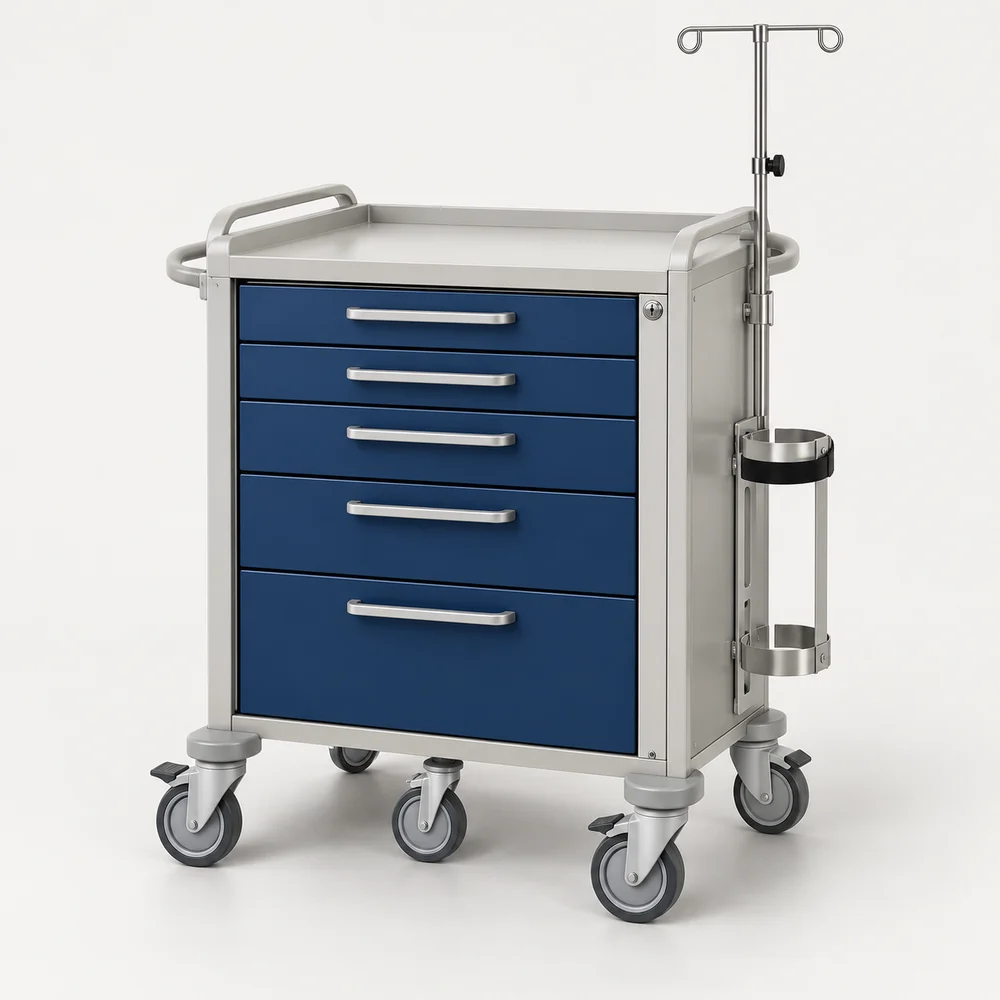
Two exact products are assigned to the current Franance crash cart emergency trolley category. GPC Medical GHF92.01 is a crash cart trolley with a steel tubular frame, six drawers, upper medicine containers, oxygen-cylinder provision, rubber guards and four castors, two with brakes, according to the manufacturer. Capsa Healthcare’s standard-height blue Avalo Series emergency cart is listed under ordering reference AM-EM-STD-BLUE. Capsa’s manufacturer brochure describes the Avalo as a configurable cart: select a base height and color, then specify an accessory package or custom build.
Open the GHF92.01 filtered listing or the Capsa AM-EM-STD-BLUE filtered listing to see each assigned model. The category currently has two products; it does not represent every available make or cart configuration in the Nigerian market. Request the exact offered reference and current specifications rather than treating the product-family name as a complete configuration.
What makes a crash cart different from a general utility trolley?
A crash cart is an organized, mobile storage unit that a facility configures for an approved emergency-response workflow. The trolley helps store and move equipment and supplies; it does not itself define which items are stocked, how they are arranged, who may access them, how readiness is checked or how the clinical response is performed. Those decisions belong to the facility’s clinical governance and operational procedures. The buyer should specify cart requirements without copying patient-care protocols into a product specification.
A general utility or instrument trolley may have shelves or drawers but lack the organization, access-control or accessory arrangement needed by the facility’s approved crash-cart process. Conversely, a cart called an “emergency cart” is not ready for a particular department until the cart, drawer inserts, seals or lock, accessories, labeling, contents and local readiness procedures have been reviewed. Ask the procurement team to confirm which items are part of the cart quotation and which are separately sourced or supplied by the facility.
Franance also lists other equipment in the broader emergency transport and stations category, including ambulance stretchers, patient stretchers and wheelchair-stretchers. These products have different functions. Do not substitute a storage cart for a patient transport device or assume a crash-cart accessory package includes clinical contents.
What should I know about GPC Medical GHF92.01?
GPC Medical’s product page names model GHF92.01 as a Crash Cart Trolley. The listed features are a steel tubular framework on four 12.5 cm diameter castors, two castors with brakes, six drawers, medicine containers fitted to the upper platform, provision for an oxygen cylinder and rubber guards. GPC identifies GHF92.011 as a pre-treated and epoxy powder-coated finish option. Confirm whether that finish code is required and whether it is available in the exact quoted build.
The manufacturer page does not specify all practical details needed to approve a cart for a department. Ask for the current overall dimensions, drawer dimensions and layout, individual or central locking details, available dividers, accessory compatibility, empty and loaded weight limits if stated, cleaning method, assembly and maintenance instructions. Confirm how the oxygen-cylinder provision is configured and whether its holder is included, optional or excluded. The product page says provision to hold a cylinder; that phrase alone does not establish that a cylinder, restraint or related accessory is supplied.
For the drawer system, provide the facility’s own non-clinical storage plan to the supplier: how many drawers, what internal dimensions, which divider format and what labeling or tamper-evident approach the organization requires. Have the clinical owner review any final drawer map and equipment list. Do not infer which supplies belong in which drawer from a generic product photograph or manufacturer marketing description.
What should I know about Capsa Avalo AM-EM-STD-BLUE?
Capsa identifies AM-EM-STD-BLUE as the standard-height blue Avalo Series Emergency Cart base configuration. Its official convenient-packages brochure lists three base heights in blue and red. Standard height is 43.5 in (111 cm) to the work surface, 24 in (61 cm) deep and 31 in (79 cm) wide; intermediate is 39.5 in (100 cm) high, and compact is 36 in (91 cm), with the same brochure depth and width. The brochure describes precision-welded steel, high-impact panels, an Avalo quick-access breakaway lock for emergency carts, smooth panels and drawers designed to support cleaning, and accessory packages selected separately from the base cart.
The brochure depicts certain carts with an accessory package, but the image does not mean the accessories are included in AM-EM-STD-BLUE. Capsa’s package sheet lists different package contents, including tamper-evident seals, oxygen-cylinder holder, cardiac board, IV pole, defibrillator shelf, drawer dividers, writing surface, sharps container and glove box depending on package. State the desired package by exact manufacturer reference and ask for itemized inclusion. If the department wants a custom combination or a different cart height or color, ask whether the base configuration must change; do not assume the current catalogue record represents that alternate SKU.
Capsa’s brochure states specifications and components may change. Obtain current documentation and written confirmation for the exact unit and accessories. Do not assume another Avalo family member—such as a medication or treatment cart—has the same lock, drawer layout, accessory fit, warranty or cleaning instructions as this emergency-cart configuration.
How should I choose the drawer layout, lock and accessories?
Start with the facility’s approved workflow, not a generic drawer count. The clinical lead defines the required cart contents and local organization; procurement translates that into drawer quantity, height, dividers, labels, seals and accessory requirements. Request a dimensioned drawer schedule. For every insert, shelf, holder or mounting component, record its manufacturer reference, compatible cart model and quantity. Identify items supplied with the base cart, items supplied in a package, separately ordered accessories and items the facility will provide itself.
For locking, describe the operational requirement and access-control policy. The Capsa emergency cart brochure describes a breakaway locking handle and tamper-evident seal workflow; the exact lock and seal supply should be confirmed in the offer. GPC’s product information reviewed here lists drawers and a cart, but does not establish the lock type or whether seals are included. If a lock is needed, ask the manufacturer or supplier to confirm supported choices and access method for the exact model. The facility must decide who controls access, how a broken seal is handled and how readiness is documented.
Accessories may include an oxygen-cylinder holder, IV pole, cardiac board, defibrillator shelf, drawer dividers, sharps container or writing surface. Availability and fit differ. Ask for approved part numbers and installation instructions; confirm whether accessories obstruct corridor movement, cleaning access, drawer opening or the cart’s turning envelope. The presence of a mount does not establish the equipment attached to it is included. Never assume a cart includes medicines, a defibrillator, consumables or other clinical devices unless they are itemized in the quotation.
What room, movement and cleaning checks matter?
Measure the cart’s path and parking location: doorway clear widths, corridor turns, lifts, thresholds, ramps, floor transitions, storage alcoves and clearance around adjacent beds or equipment. Compare these measurements with the exact cart width, depth, work-surface height, accessory projection and caster arrangement. A supplier’s base-cart dimensions may not include accessory protrusions. Ask for the dimensioned configuration or a site fit review if the route is tight. Consider whether drawers can open fully in the chosen parking position and whether the work surface remains accessible.
Confirm the caster type, brakes and steering details for the exact cart. The GPC manufacturer specifies four castors with two brakes; the specific Capsa ordering code has configuration details that should be verified from the current documentation. Do not infer braking performance, loaded maneuverability or stability from a photo. Ask whether there are approved limits for loaded operation and how staff should inspect brakes, castors, drawers and accessories under manufacturer instructions.
Cleaning is another procurement check. Capsa describes smooth surfaces and seamless drawers as supporting simple cleaning for infection prevention, but a marketing statement is not a disinfectant compatibility table. Request the current cleaning instructions and approved agents for the cart surface, seals, drawer liners, accessories and lock. Obtain equivalent documentation for GPC GHF92.01. Clarify who performs routine inspection and preventive maintenance, where spares are obtained and how the unit is kept available when servicing is due.
What documentation should I request before purchase?
Request a current technical data sheet, exact model and accessory schedule, user or maintenance instructions, cleaning guidance, warranty terms, spare-parts information and any project or tender documents required for the equipment. Have biomedical engineering, infection prevention, facilities and clinical owners review the documents relevant to their responsibilities. Confirm that the documents match the model number and configuration in the proposed quotation; a family brochure may show options not present in the quoted item.
The current listing does not establish Nigerian registration, import status, local stock, delivery timeline or authorized service. Ask the supplier to state which requested documents are available and to confirm the scope and validity in writing for the exact offered cart. If the cart will be incorporated into a hospital-wide standard, request consistent model, color, lock, drawer and accessory codes so procurement can compare like with like across departments. No warranty duration is claimed here for either product; request the applicable written terms.
What should a crash cart quotation in Nigeria include?
Send Franance the manufacturer, exact model code, quantity, cart height and color, department, destination state and city, drawer layout, lock or seal requirement, divider specification, requested accessories and any required documents. Identify the facility’s use and storage constraints without including patient-identifying information. For GPC, specify whether the GHF92.011 finish option is requested and ask about current dimensions, lock, accessory inclusion and load information. For Capsa, state AM-EM-STD-BLUE and the desired package code or custom accessory schedule; confirm whether the base cart alone or a configured package is being priced.
Ask the quotation to show the base cart and every accessory as separate line items, along with model references, quantities, unit and total price or starting-price basis, currency, taxes, validity, availability, delivery scope, assembly, documents, warranty and service terms. Ask it to name exclusions, assumptions and any substitutes. A starting price is not the final cost of an unspecified cart build. If the delivered location has restricted access or unloading requirements, include them so the quotation can state how delivery is handled.
Use the Franance contact form to request a crash cart quotation. This is a quote order, not an online checkout. Franance will follow up by phone or email to clarify the requirement and prepare the written proposal. Compare the final proposed configuration against the facility-approved schedule before ordering.
Frequently asked questions about crash carts in Nigeria
### Which crash carts are currently listed?
The category lists GPC Medical GHF92.01 Crash Cart Trolley and Capsa Healthcare Avalo Series standard-height blue Emergency Cart AM-EM-STD-BLUE. Confirm whether the current catalogue or quotation has changed before purchase.
### Does GHF92.01 include an oxygen cylinder?
GPC describes provision to hold an oxygen cylinder; the product details reviewed do not say a cylinder is included. Ask whether the holder, restraint and cylinder are included, optional or excluded.
### Does AM-EM-STD-BLUE include the pictured accessories?
Not necessarily. Capsa describes selecting an accessory package separately from the base cart, and its brochure illustrations show configured examples. Request each desired package and accessory by reference and ask for itemized inclusion.
### Does the guide recommend what supplies go in each drawer?
No. The facility’s clinical leadership must define contents and readiness processes. This guide helps specify the cart and its configurable storage components only.
### Can I order a crash cart online from Franance?
No. Request a quote order. Franance will contact you by phone or email to confirm the cart configuration, destination and terms; there is no online payment or checkout.
Manufacturer sources and limitations
The guide uses GPC Medical’s GHF92.01 product information and Capsa Healthcare’s official Avalo Emergency Cart convenient-packages specification sheet, plus WHO medical-device procurement and maintenance resources for the general purchasing framework. Manufacturer product literature supports the model-specific features and dimensions stated above. It does not establish that a particular package is included in Franance’s quotation or available in Nigeria. Confirm current documents, model references, accessory compatibility and written offer terms before procurement.
Common questions
Which crash carts are listed?
The current catalogue lists GPC Medical GHF92.01 Crash Cart Trolley and Capsa Healthcare Avalo Series standard-height blue Emergency Cart AM-EM-STD-BLUE.
Does GHF92.01 include an oxygen cylinder?
GPC describes provision to hold an oxygen cylinder. The source reviewed does not establish that a cylinder or restraint is included; ask for explicit inclusion in the quotation.
Does AM-EM-STD-BLUE include pictured accessories?
Not necessarily. Capsa documents configurable accessory packages selected in addition to the base cart. Request the exact package and accessories by code and ask for an itemized offer.
Does the guide recommend drawer contents?
No. The facility's clinical leadership defines the contents and readiness process. This guide covers procurement of the cart and its storage configuration.
Can I buy a crash cart online from Franance?
No. Submit a quote order and Franance will follow up by phone or email to clarify configuration, destination and commercial terms.
Request a crash cart quotation from Franance.
Send the exact model code, base cart and accessory package, drawer schedule, quantity, destination and document requirements. Franance will follow up by phone or email to clarify the quote order.
Request a crash cart quoteNeed an equipment quote?
Add the models you need to a quote order, or send us your equipment list.