

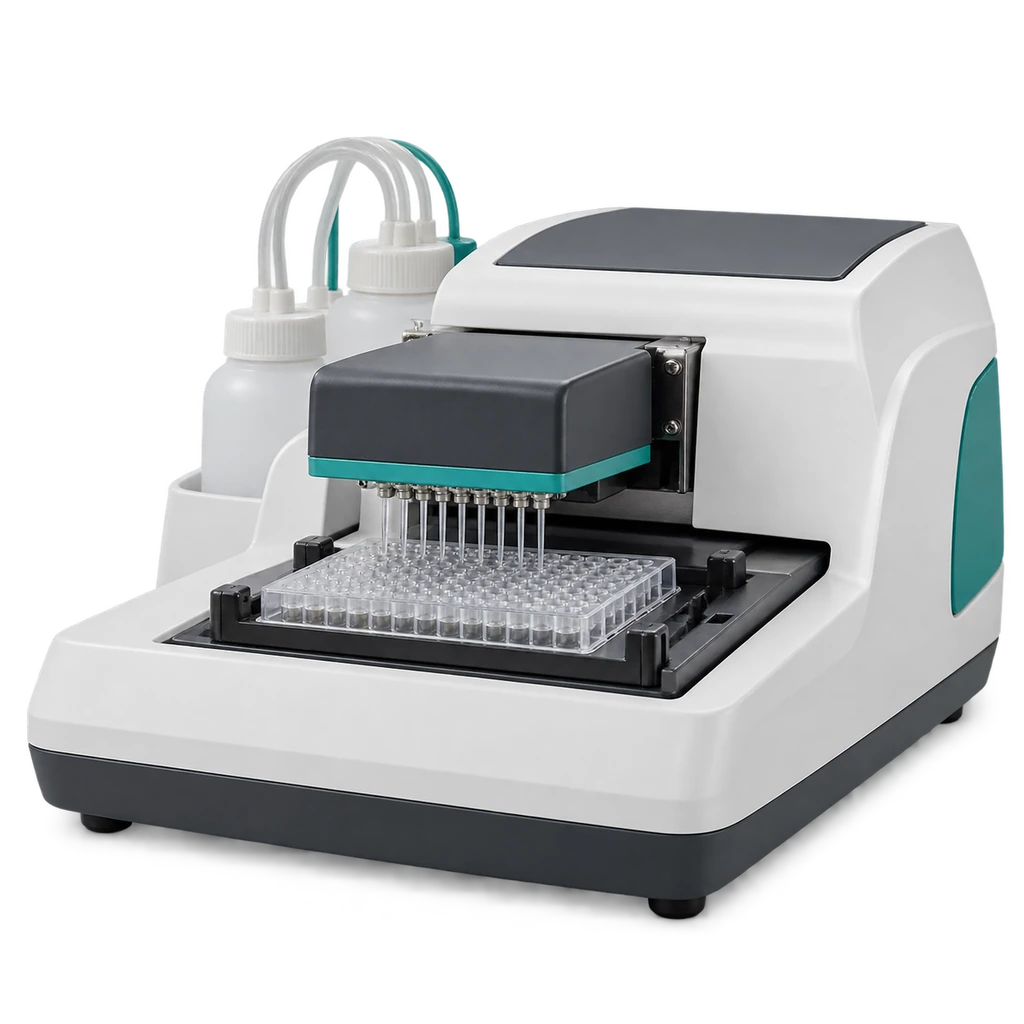
Buy Agilent BioTek 50 TS8 ELISA Washer in Nigeria
Buy the Agilent BioTek 50 TS8 microplate washer in Nigeria through Franance by matching the listed 50TS8 configuration to your plate format, manifold, wash protocol and fluid-handling requirements. Agilent identifies 50TS8 as a 96-well-only configuration. It supports programmed wash volumes from 25 to 3,000 µL per well and 1–10 wash cycles, while the manifold and protocol determine fit, residual volume and cycle time. Buffer switching, biomagnetic separation and vacuum filtration are configuration-dependent features; the 50TS8 listing does not by itself include them. Send Franance the exact part number and required accessories for a written quote.
Where can I buy the Agilent BioTek 50 TS8 in Nigeria?
Browse the Agilent BioTek ELISA washer listing filtered to 50TS8 to see the catalogue item. The category page is the ELISA washer category. Franance handles equipment requests as quote orders, not online checkout. Send the intended plate and method, number of plates, wash volumes and cycles, manifold requirements, buffer count and any special separation or filtration step through the 50 TS8 quotation enquiry.
Include the laboratory’s city and state in Nigeria, quantity, delivery route, power supply details, desired accessories and whether you need commissioning, familiarisation, documentation or maintenance. Ask the response to identify the exact part number and all supplied items. Availability, price, lead time, import responsibilities, warranty territory, installation and local service are confirmed in the quote; they are not established by a global product page.
What does the BioTek 50 TS8 washer do?
The BioTek 50 TS is an automated microplate washer. In a wash protocol, a selected manifold dispenses liquid into wells and aspirates liquid out according to programmed steps. The user defines parameters such as volume, number of cycles, soak or shaking steps where supported, and other method-specific choices. Agilent describes the 50 TS family for applications including ELISA, cell-based assays, biomagnetic particle separation and filtration-to-waste protocols. That is an equipment-use description, not evidence that a particular assay has been validated on your washer.
The locally listed product is the 50TS8 configuration, which is specified for 96-well plates. It has a touchscreen interface and one positive-displacement syringe drive, with a USB connection for computer control listed by Agilent. It performs washing; it does not read absorbance or fluorescence. If your workflow also needs measurement, specify a compatible reader separately. The Agilent BioTek 800 TS, for example, is a separate absorbance reader and is listed in the ELISA reader category.
Is 50TS8 the same as 50TS8V, 50TS8M or 50TS8F?
No. The suffix identifies a different configuration. Agilent’s technical details and ordering table identify plain 50TS8 as a 96-well configuration. A V suffix, as in 50TS8V, adds automatic switching among up to three buffers. M variants include the biomagnetic separation configuration, and F variants include the vacuum-filtration configuration. Combinations such as 50TS8MV or 50TS8MF combine selected options. Agilent indicates that magnetic and vacuum functions may require an available accessory module sold separately.
The local catalogue item is identified as 50TS8. Do not assume that features described across the 50 TS product family are installed on this base configuration. If the method needs more than a single buffer, biomagnetic separation or filtration, ask Agilent to confirm the exact part number and required accessory module. The written offer should identify what is installed in the washer and what is separate equipment. A broad “50 TS” name is not enough to establish the option set.
Which plate and manifold does the 50TS8 support?
Agilent lists the 50TS8 as a 96-well-only configuration. A manifold aligns the washer’s dispense and aspiration tubes with wells or strips, so manifold choice has to match the plate and method. The manufacturer describes 96-well manifold types including 8-well, short-tube 8-well, 2 × 8-well and 12-well versions. Its technical sheet lists example washing of strips and full plates, with times that vary by manifold and protocol.
The accessories guide lists, for example, the 4070513S 1 × 12 manifold as compatible with 50TS8, 50TS8V and 50TS8F. It also lists the 1550501S 2 × 8 manifold for 50TS8, 50TS8V, 50TS8F, 50TS12 and 50TS12V. Other choices include large-bore or short-tube manifolds for particular plate or fluid requirements. These are accessory compatibility examples, not a declaration that the part is included with the 50TS8.
Provide the exact plate manufacturer and product number, plate type, well count, strip/full-plate use, well geometry, skirt and any lid or adapter requirement. Ask Agilent to confirm the plate/manifold pairing and any method-specific configuration. If you use 24- or 384-well plates, identify that before purchase: those formats are not the standard 50TS8 configuration. The family includes alternative 50 TS part numbers, but do not assume a different plate format can be achieved by changing only a manifold.
What wash volume and cycle range should I specify?
Agilent lists a volume range of 25–3,000 µL per well and 1–10 wash cycles for the 50 TS. Those ranges describe programmable settings; they do not select the correct parameters for a particular assay. Use the protocol validated by your laboratory or assay manufacturer to specify the target volume, cycle count, aspiration behavior, soak time, shaking and any partial-plate steps. Include any required dispense and aspiration height or residual-volume acceptance criteria in the enquiry.
Cycle time depends on the selected manifold, number of wells, wash volume, number of cycles and soak setting. Agilent provides example times under stated conditions, such as 96 wells with a 2 × 8 manifold, three cycles and 300 µL per well, or with an 8- or 12-well manifold under similar assumptions. The published example is not a guaranteed time for a different plate, buffer, protocol or local installation. If throughput is important, give the expected plate count and target workflow and request a model-specific estimate.
Agilent also publishes dispense precision and residual-volume figures under specified testing conditions using defined plates, manifolds, volumes and test fluids. Treat these as technical specifications under those test conditions, not a universal result for every liquid or assay. Ask the supplier for the current technical sheet and discuss any acceptance limits with your laboratory team before purchase.
How should I choose manifolds, bottles and tubing?
Choose the manifold based on the exact plate, wells or strips to be washed, and the liquid-handling behavior required by the assay. Confirm whether the method needs a standard 1 × 8 or 1 × 12 manifold, 2 × 8 configuration, low-volume short tubes, large-bore tubes or another option. Agilent’s liquid-handling accessories guide maps accessory part numbers to compatible models. Use it together with the current 50 TS technical sheet and a written compatibility confirmation for the actual order.
List the number and type of dispense bottles, waste bottle capacity, tubing, connectors and liquid-level sensing required. Agilent identifies 2 L supply bottles in the technical sheet and 4 L bottles as optional. The accessory guide lists a complete 4 L dispense/waste system for the 50 TS and a separate system with buffer switching for V variants. This means bottle and tubing scope differs by configuration; do not assume bottles are included because a product image shows them.
Name the wash buffers and any special handling needs, such as surfactant, magnetic beads or filter-bottom plates. Confirm chemical compatibility, cleaning and disposal procedures with Agilent and the reagent documentation. The washer’s described functions do not prove compatibility with every buffer, solvent, bead type or plate. Keep the waste-bottle capacity and disposal route aligned with the laboratory’s operating procedures.
Does 50TS8 include buffer switching, magnetic separation or vacuum filtration?
Do not assume so. In Agilent’s configuration table, buffer switching is associated with V configurations; biomagnetic separation with M configurations; and vacuum filtration with F configurations. Agilent states that magnetic-separation and vacuum-filtration functions use an available accessory module sold separately. A plain 50TS8 listing does not establish that these options are installed or that the required module, magnet, vacuum source, manifolds, plate carrier, waste system or tubing is included.
If buffer switching is needed, specify the number of buffers and ask whether the quote should use a 50TS8V or another V model, what bottle set is supplied and how the switching system is configured. For magnetic separation, state the bead type, plate and desired immobilization pattern, then have the vendor confirm the M configuration and correct module/magnet. For vacuum filtration, identify the plate and filtration protocol, required F configuration, vacuum equipment, manifold and waste arrangement. Ask for every associated part number and an explicit inclusion/exclusion schedule.
These are configuration questions, not guarantees that the equipment will meet a particular assay outcome. Confirm the intended operation and method performance with the assay developer, Agilent and your laboratory quality team.
What software and controls should I plan?
Agilent lists a 4.3-inch colour touchscreen and onboard protocol creation and execution. The technical details describe optional Liquid Handling Control software for PC wash-protocol programming and execution, with protocols also run from the instrument. The 50 TS is not dependent on the PC software for every operation, but confirm which software, licence, computer requirements, cable and setup assistance are supplied in the proposed package.
For routine work, record how protocols are created, named, backed up and restricted; how users choose a wash protocol; and how wash results or exceptions are documented. If the laboratory requires electronic records, user permissions or audit controls, state those needs separately. The technical sheet refers to an LHC2 Secure software option for a specific compliance capability; that product statement does not certify a configured laboratory workflow or replace the lab’s quality and validation responsibilities.
The manufacturer lists built-in maintenance routines to help clean and prevent buildup that can block tubing. Ask for the current user manual, startup procedures, routine flush/cleaning steps, maintenance schedule and recommended consumables. Discuss who will train users and service the instrument at the intended location. Do not assume a software licence, service contract or maintenance visit is bundled with a base washer.
What should I check about installation and power in Nigeria?
Agilent lists a footprint of about 35.6 × 40.6 × 16.5 cm, weight of about 9.8 kg, and an external 24 VDC supply compatible with 100–240 VAC at 50–60 Hz. It uses a USB connection for computer control. Confirm the exact adapter, power cord and plug variant included in the offer. Have facility engineering check the site outlet, grounding and circuit, and follow manufacturer electrical instructions. Do not rely on an unverified plug adapter or presume the supplied cord is right for a specific laboratory.
Measure the bench area and allow room for the instrument, manifold changes, dispense and waste bottles, tubing, computer and routine access. Specify whether bottles will sit level with the washer as required by the installation instructions and how waste will be collected and removed. Confirm a stable, level bench, suitable room conditions, splash protection and sufficient space to clean around the fluid path. These details are especially important when fitting a washer into a crowded bench area or moving it between rooms.
Ask whether the order includes delivery, unpacking, removal of shipping hardware, installation, user familiarisation and operational checks. Clarify who will connect and prime the fluid system, verify the manifold and set up protocols. Commissioning, method validation, qualification and user training are distinct activities; list any required scope explicitly.
How should I assess compatibility with an ELISA or cell-based workflow?
Start with the assay protocol, not a generic promise that the washer is “for ELISA.” Confirm plate format, plate geometry, strip/full-plate use, wash buffer, target volume, number of cycles, soak and shaking, aspiration behavior and any required residual volume or throughput. Match those needs to the 50TS8's 96-well format and compatible manifold. Have the assay or method owner determine whether the proposed wash steps are suitable.
For cell-based assays, specify cell type only as needed to convey the protocol and detail the gentle-wash conditions required by the validated method. Agilent describes the 50 TS for cell-based washing and lists programmability for shaking and soak steps. The exact achievable settings and a successful assay outcome depend on the protocol, manifold, plate and laboratory conditions. Do not rely on a family-level application claim as proof of method performance.
For bead-based or filtration workflows, check the corresponding M or F configuration and accessory module. Confirm whether magnet or vacuum hardware, specialized manifold, plate carrier, tubing and waste components are part of the offer. If the workflow also requires measurement, specify a separate reader and its wavelength, plate and software requirements. The 50 TS washer and 800 TS absorbance reader are separate products; Agilent describes them as a possible pairing, not as one inseparable included package.
What should a Franance quotation include in Nigeria?
Send the exact model and part number (50TS8 for the currently listed 96-well configuration), destination, quantity and intended application. Include plate make/model, format and profile; manifold choice; buffer count and type; wash volume/cycle/soak/shaking needs; desired throughput; waste capacity; bottle and tubing needs; liquid-level alert request; PC/software requirement; and any M or F function. If a required function needs a different suffix or module, ask for the revised part number and a full configuration schedule.
Request the quote to list the washer, manifold, plate carrier, bottles, waste bottle, tubing, connectors, power adapter and cord, USB cable, software/licences, optional modules, magnets/vacuum equipment, manuals, test materials, installation, commissioning, training and service separately. Ask the supplier to confirm compatibility and current documentation for every part number. Specify any testing or acceptance checks required by your quality system and identify who will perform them.
Confirm itemized price and currency, quote validity, availability, lead time, shipping, insurance, import/customs responsibilities and delivery terms for Nigeria. Ask for warranty territory, support contact, response route and spare-part availability. These terms vary by country and supply route and are not established by the manufacturer’s global page or the Franance catalogue. Franance will follow up by phone or email to clarify the quote order; no online payment is taken.
How do I place a BioTek 50TS8 quote order?
Open the 50TS8 exact filtered listing, then submit the Franance 50TS8 quotation enquiry with your plate, manifold, protocol, fluid-handling accessories, quantity and Nigeria destination. Franance can follow up to clarify the selected configuration and commercial scope. This is a quote request, not online checkout.
Manufacturer sources and scope limits
Technical facts here come from Agilent’s 50 TS technical details and configuration table, 50 TS product page, single-sheet product specification and liquid-handling accessory compatibility guide. Agilent describes broad product-family applications and options; the local Franance item is specifically identified as 50TS8.
The 50TS8 is specified for 96-well washing. Other plate formats, buffer switching, biomagnetic separation and vacuum filtration use different suffixes or additional modules. Confirm the exact offered part number, accessories and method compatibility before order. Manufacturer performance figures are conditional on stated test setups; they do not validate an assay or promise a result for your laboratory. This guide does not assert Nigerian stock, price, regulatory status, warranty territory, installation, service availability or a specific clinical or research outcome.