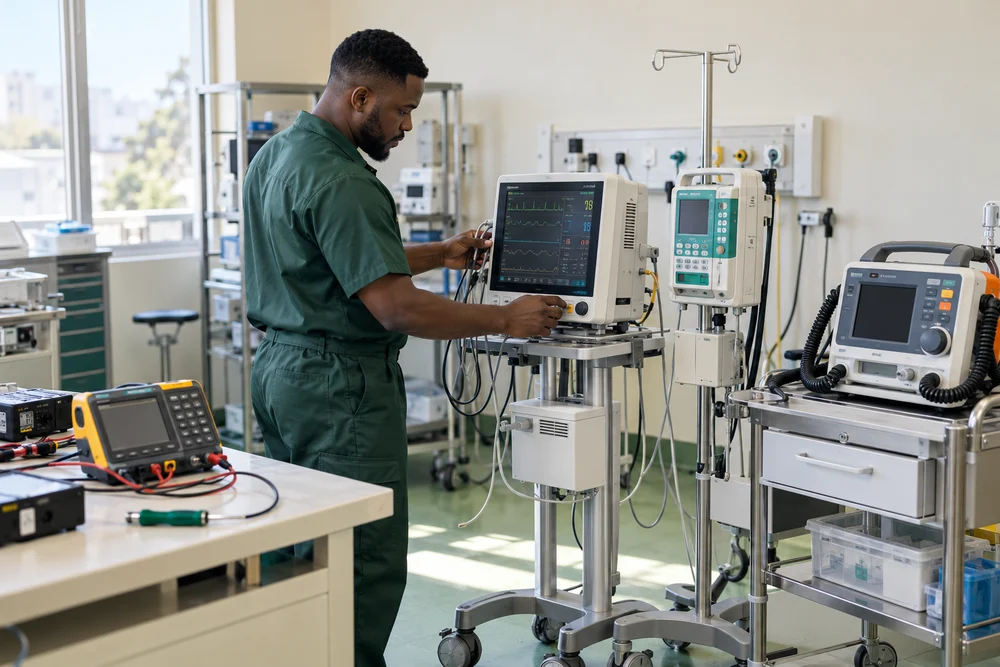
Stryker equipment service enquiries in Nigeria

Stryker emergency-care and transport service enquiry in Nigeria
Identify the exact Stryker product, model, serial or asset ID, site and requested result. The current range spans emergency-care devices and patient transport or ward equipment, so use a separate asset line for LIFEPAK units, stretchers, chairs, beds and support surfaces.
Start with a separate inventory line for each Stryker equipment family and its exact reference. LIFEPAK emergency-care devices, stretchers, beds, chairs and support surfaces have different asset records and accessory sets. Include model, serial or facility asset ID, department and requested result. If an enquiry covers both transport equipment and an emergency-care device, do not merge them into one “Stryker service” request. The model-specific reference helps Franance review the scope and helps procurement compare a written response against the asset register without assuming a shared part or service task across product families. Include fleet quantity and site in separate columns so an emergency-care device is not counted under the same equipment line as transport furniture.
Stryker LIFEPAK and stretcher repair assessment in Nigeria
Describe the observable condition and when it occurs. For a LIFEPAK device, note the model and non-patient-specific display or readiness message. For a stretcher or bed, identify the affected wheel, brake, control, side rail, mattress support or movement. Keep patient data out of the initial request.
For a reported concern, describe the observed condition and time without a diagnosis. A LIFEPAK request should identify the model and non-patient-specific message or readiness indication; a stretcher or bed request should name the affected brake, wheel, movement, rail, mattress support or control. Keep patient data out of the enquiry. Ask the written response to separate initial assessment from corrective work and list any parts assumptions against the actual device. Stryker’s Tech Web organizes technical information by product and model or serial range, so providing that exact reference is more useful than describing a device only by department. For a repeat concern, include the date and relevant case reference; avoid sharing patient events or conclusions that are not equipment observations.
Stryker emergency-care and patient transport maintenance in Nigeria
For fleet planning, list model, serial, location, last service, known findings and available maintenance window. Ask for each asset and requested task to be shown separately so that biomedical engineering can track the work and procurement can compare scope.
For preventive planning, prepare a model-by-model schedule with serial, location, last documented service, known observation and an available access window. Keep LIFEPAK units separate from patient transport and ward equipment, and distinguish accessories from the host device. If a facility already has a Stryker plan or service case, include the reference and scope for comparison. Ask the written proposal to identify the equipment and tasks covered on each line, the records to be returned and any inspection dependency. The schedule should follow the applicable product documentation and facility process, not a generic interval copied across different Stryker families. Ask for asset-level reporting so a fleet manager can reconcile the proposed maintenance activity to each LIFEPAK or transport-device record.
Stryker bed and stretcher installation planning in Nigeria
For a relocation or room project, provide dimensions, route, receiving room, access constraints, quantity, facility contacts and requested handover. Connected or powered systems may require facility-side coordination; keep network credentials and security details out of attachments.
For a room move or equipment project, provide the current and destination locations, route, access constraints, dimensions, quantity, receiving contact and target date. Beds and stretchers may involve different room or transport interfaces from a LIFEPAK unit; list each equipment group separately. For powered or connected equipment, name the facility contact who can coordinate relevant room or network questions, without sending credentials. Ask the quotation to distinguish transport, placement, installation planning, configuration and handover so procurement can see which tasks are included and which remain facility responsibilities. List mounting or room constraints only where relevant to the exact product, and identify the facility contact who can confirm site details.
Stryker LIFEPAK, bed and stretcher service in Nigeria
Stryker Tech Web organizes technical information by product family and model or serial range. Use the exact reference when describing a concern. Its US support channels are not evidence of Nigeria availability or a local Franance arrangement; confirm the proposed service party in writing.
Stryker’s product families span emergency-care equipment and patient transport or ward equipment. Use the actual LIFEPAK model, stretcher or bed reference from the label or asset record. For a mixed fleet, include each model and serial rather than inferring common accessories from a brand name. If the request concerns a specific configuration, installed module or accessory, provide its suffix or reference and ask for it to be named in the written scope. The manufacturer’s technical library is organized by product/model ranges, reinforcing the value of matching the enquiry to the exact device record before procurement approves a service or parts line. Where an accessory is already installed, record its label or reference separately; the device model alone may not identify the complete offered configuration.
Stryker’s catalogue spans emergency-care equipment and patient transport or ward systems, so an enquiry should start with the product family. LIFEPAK defibrillators need a different asset description from a stretcher, transport chair, bed or support surface. Provide model, serial and location, then describe the observed display or readiness message, movement concern or project outcome. If accessories are relevant, list pads, batteries, cables, mattress or fittings by their own references and host equipment. Keep clinical identifiers and event records out of an initial request. An existing support case, service agreement or prior report can help define context; include only its reference and relevant non-sensitive details.
For multi-unit planning, create one row per asset and record its current location, service history, availability window and requested task. For a relocation or room project, supply safe dimensions, route, mounting or power context and the facility contact. Ask a written proposal to identify the provider, assessment, maintenance or repair tasks, parts assumptions, documentation, access and downtime separately. The facility can then compare a proposal for the exact equipment rather than relying on a brand-wide description, and can review any additional findings before approving further work.
Stryker equipment parts and accessories in Nigeria
For LIFEPAK, identify any separate pads, battery, cables, charger or data connection as its own reference. For stretchers and beds, list mattress, rail, transport or mounting accessories separately. Ask for compatibility and inclusion confirmation before a part is ordered.
List pads, batteries, cables, chargers and data connections separately from a LIFEPAK device; for a stretcher or bed, identify mattress, rail, transport and mounting accessories as distinct references. Ask for compatibility and package contents to be confirmed against the host model before ordering. Do not assume that one accessory fits every generation or configuration. If the facility is replacing an item, provide the part marking and a focused photograph of the label or fitting, with patient information removed. The offer should say whether it covers identification, supply, installation or a broader assessment and should state any uncertainty clearly. If procurement is replacing a part, request the exact part number and included quantity in writing before comparing vendor pricing or placing an order.
Stryker asset records and service coordination in Nigeria
Include relevant service reports, case or warranty references and non-sensitive error text. Ask whether the request is for assessment, repair, planned maintenance, parts, software/connectivity or records. Separate the equipment from accessories and any third-party interface.
Include prior reports, support-case, warranty or contract references, and a concise non-sensitive chronology for each asset. Keep patient information, account credentials and data from connected systems out of the initial enquiry. For LIFEPAK equipment, identify the model and record reference; for transport or ward equipment, note the relevant serial, department and visible concern. Ask that the resulting report or written scope associate each finding with the correct Stryker unit. This helps biomedical engineering and procurement follow the same item through any assessment, parts decision or planned maintenance discussion. A single service case can mention a shared event, but retain individual serials and observations so reports are not attributed to the wrong unit.
Stryker equipment service quotation in Nigeria
Compare each proposed line by asset, provider, work, parts, access, downtime, records and price basis. Stryker’s own service plans describe the manufacturer’s offering; Franance should state its actual proposal and terms without implying OEM authorization or a confirmed visit.
Compare the offer by exact asset, proposed provider, task, parts, access, downtime, records and price basis. Stryker describes service plans for its own products, but those pages do not establish a Nigerian service commitment or Franance OEM authorization. Ask the written response to state the actual proposed provider and terms, and distinguish an initial inspection from corrective work or parts. For a fleet, request separate lines for LIFEPAK units, beds, stretchers and accessories. That makes exclusions, approvals and any timing assumptions visible before the facility commits. Ask which findings trigger a revised estimate and how additional scope will be approved; do not treat a manufacturer plan as Franance’s commercial offer.
Name a facility contact who can confirm asset identity and access, plus a procurement contact for the written response. Include the city, department and preferred callback window. If the request involves both emergency-care and transport equipment, ask for the response to group like assets while preserving individual model and serial details. That makes it easier to compare scope and coordinate access without confusing devices, furniture or replacement accessories. For urgent fleet planning, identify the specific assets and requested review window without implying a response commitment.
Common questions about stryker equipment services in Nigeria
What details should I provide first?
Send the exact model, serial or asset ID, site, department, requested outcome and relevant service history. List each unit separately.
Can one request cover several equipment families?
Yes. Separate each family and asset so the proposed tasks, parts and records can be reviewed independently.
What happens after I send an enquiry?
Franance reviews the equipment details and requested work, then can prepare a written response with scope, assumptions and commercial terms for the listed assets.
What should a written quote include?
Ask it to identify equipment, tasks, parts assumptions, access and downtime, deliverables, exclusions and price basis.
How do I request a callback?
Use the Franance service enquiry and callback form and include a facility contact, department, city and convenient time.
Tell us what your facility needs.
Send the equipment details, your requirement and the facility location. We’ll discuss the information needed to review the scope and prepare the next step.
Contact Franance