
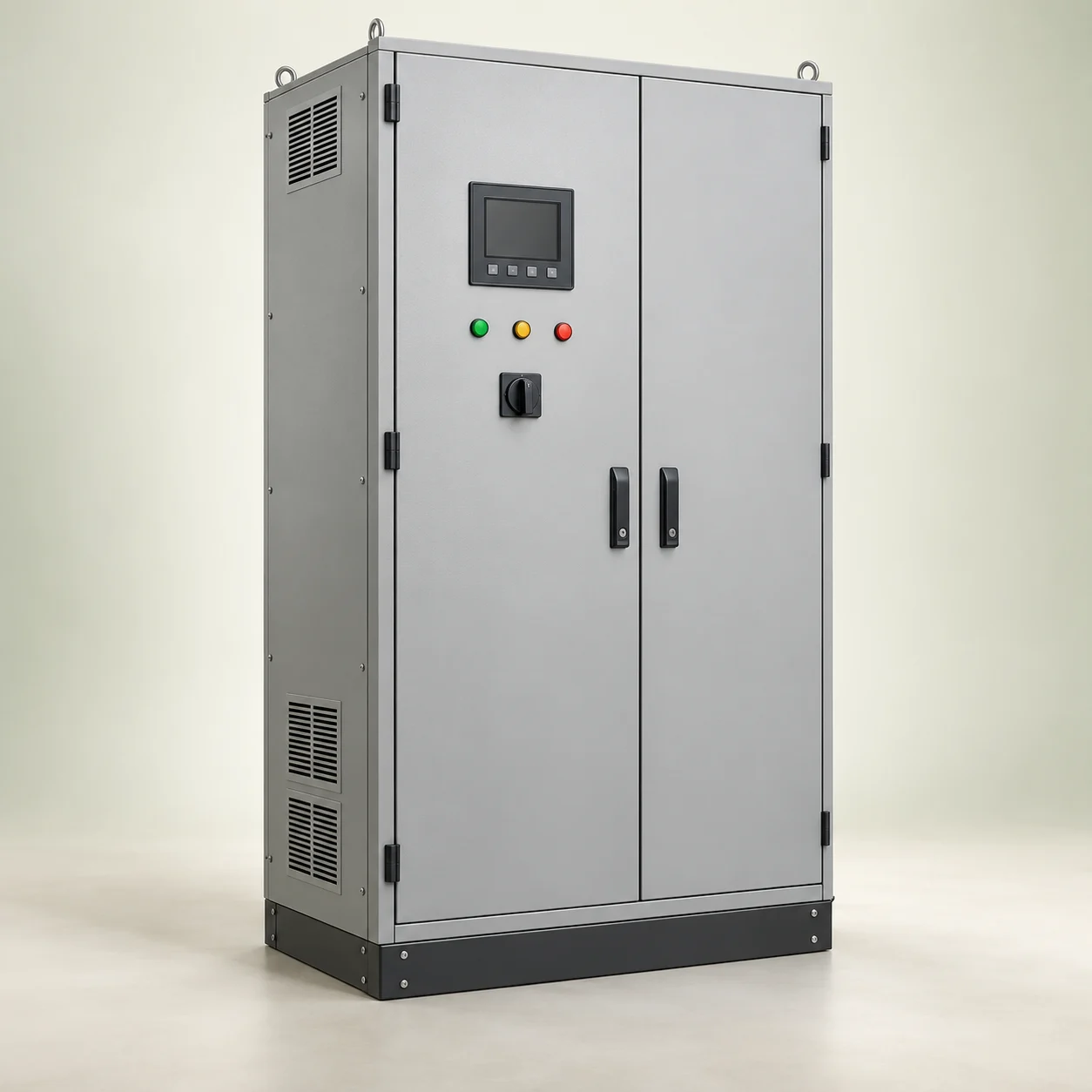
ATyS p 87734020 4-Pole 200 A Automatic Transfer Switch
Enclosed automatic transfer switch
Price on request

Medical equipment and biomedical engineering.
Abuja, Nigeria.
Buy an automatic transfer switch panel in Nigeria through Franance by matching the device to the facility's normal and alternate sources, load, fault level and required transfer behavior. This category contains two Socomec enclosed 4-pole, 200 A models: ATyS g 87534020, with programmable-for-genset control, and ATyS p 87734020, with automatic programmable control. An ATS switches between sources; it does not generate backup power or guarantee no-break continuity. Send the one-line diagram and generator details for a written quotation; Franance follows up by phone or email.
2 models
Enclosed automatic transfer switch
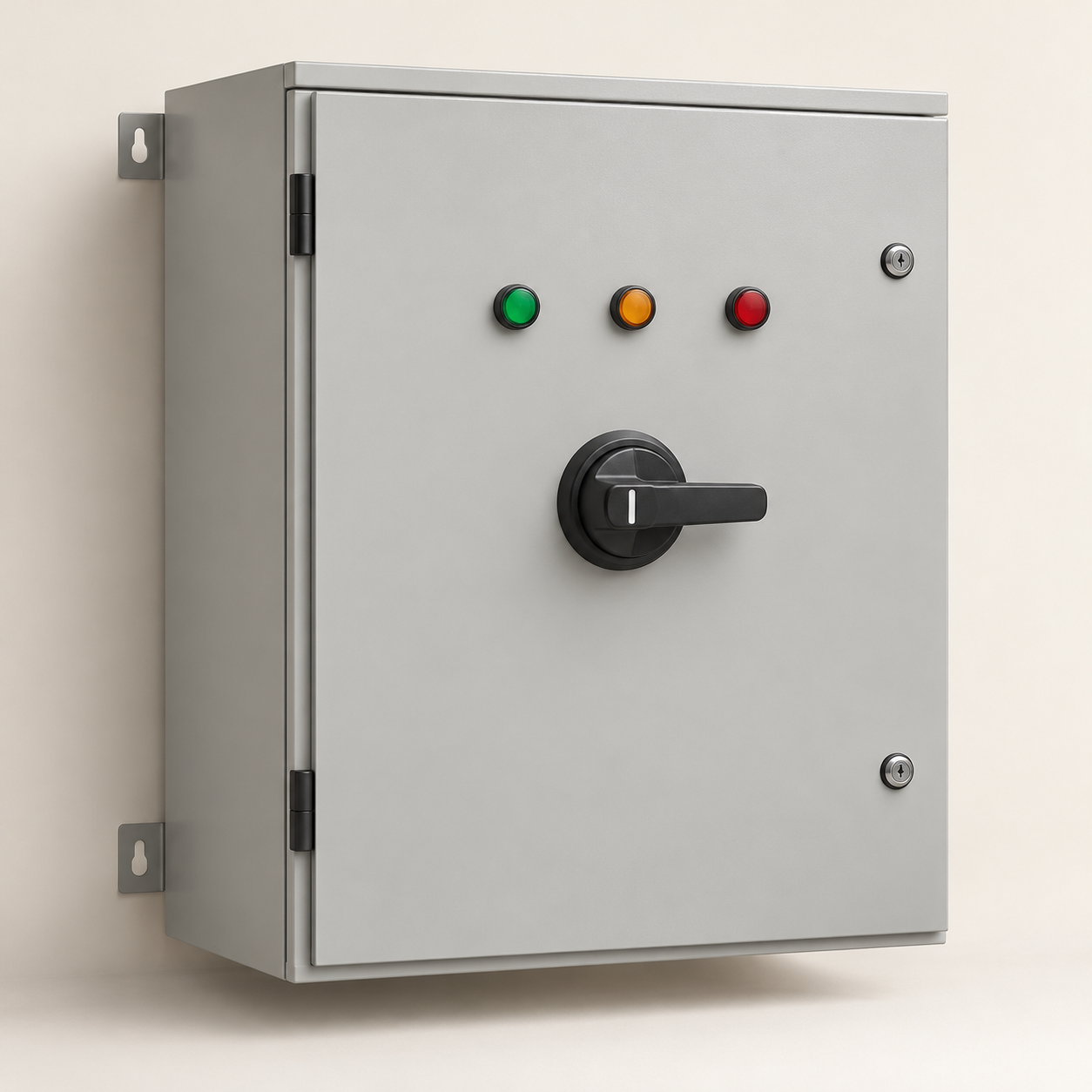
Enclosed automatic transfer switch
An automatic transfer switch connects a load to one of two power sources according to configured source-monitoring and control logic. In a common facility arrangement, the normal source is utility power and the alternate source is a generator, but the actual design may use other sources. Socomec describes its enclosed ATyS range as monitoring low-voltage source conditions and automatically changing over to an available supply. For ATyS g, the manufacturer identifies a programmable control operator for generator applications. Confirm the source pair, generator start/stop interface, sensing, return-to-normal behavior, alarms and any manual operating method for the exact design.
Read moreBoth assigned references have four poles, a 200 A rated current, B3 frame, steel enclosure, IP54 designation and published dimensions of 500 × 600 × 300 mm with a 27 kg product weight. Socomec’s exact reference pages list rated operating voltage from 400 to 690 V AC and maximum rated operational voltage of 690 V AC. These are manufacturer catalogue characteristics; they do not replace checking the facility’s actual source voltage, system frequency, application category, short-circuit conditions or switchboard design. The product pages also list a 12 kA rated short-time withstand current and 50 kA conditional short-circuit current; the protection conditions and coordination assumptions must be checked in the exact documentation and project study.
Read moreFour-pole (4P) identifies the product’s four switched poles; it does not decide by itself whether a facility should switch its neutral. The designer must assess the earthing arrangement, source bonding and neutral treatment, generator configuration, protective devices and governing electrical requirements before selecting 3-pole or 4-pole equipment. Both products in this category are the 4-pole versions. Do not replace them with a different pole count based only on the catalogue title or a verbal description of the site.
Read moreBuy an automatic transfer switch (ATS) panel in Nigeria by matching the switch to the facility’s normal and standby sources, load, fault level, transfer behavior and installation design. Franance currently lists two Socomec enclosed 4-pole, 200 A references: ATyS g 87534020, with programmable control for generator applications, and ATyS p 87734020, with automatic programmable control. They share key enclosure and current ratings but are different control families. An ATS changes the load connection between power sources; it does not generate backup power, condition the supply like a UPS or guarantee no interruption during transfer. Provide the electrical one-line diagram and generator details for a project-specific quotation. Franance follows up by phone or email; these are quote-order listings rather than online checkout. The current automatic transfer switch panel category contains two model records. Open the exact Socomec ATyS g 87534020 listing and Socomec ATyS p 87734020 listing. The category is part of broader power quality equipment for healthcare facilities, but ATS, UPS and voltage stabilizer functions are distinct and should be specified separately.
An automatic transfer switch connects a load to one of two power sources according to configured source-monitoring and control logic. In a common facility arrangement, the normal source is utility power and the alternate source is a generator, but the actual design may use other sources. Socomec describes its enclosed ATyS range as monitoring low-voltage source conditions and automatically changing over to an available supply. For ATyS g, the manufacturer identifies a programmable control operator for generator applications. Confirm the source pair, generator start/stop interface, sensing, return-to-normal behavior, alarms and any manual operating method for the exact design.
The current Franance category lists two specific 200 A products, not an arbitrary choice of panel size. The ATyS g 87534020 is specified as a 4-pole, 200 A automatic transfer switch in a steel IP54 enclosure, with programmable-for-genset control. The ATyS p 87734020 is a 4-pole, 200 A automatic transfer switch in a steel IP54 enclosure with automatic programmable control. Exact product pages and filters: ATyS g 87534020 and ATyS p 87734020.
These product listings do not include a site-specific load calculation, generator, upstream circuit breaker, cables, bypass arrangement, installation, commissioning or acceptance test unless the written quotation says so. Ask for the complete equipment reference, current manufacturer datasheet, declared standards, included control accessories and the proposed installation scope. Have the facility’s electrical design authority determine whether either 200 A reference fits the intended system.
Both assigned references have four poles, a 200 A rated current, B3 frame, steel enclosure, IP54 designation and published dimensions of 500 × 600 × 300 mm with a 27 kg product weight. Socomec’s exact reference pages list rated operating voltage from 400 to 690 V AC and maximum rated operational voltage of 690 V AC. These are manufacturer catalogue characteristics; they do not replace checking the facility’s actual source voltage, system frequency, application category, short-circuit conditions or switchboard design. The product pages also list a 12 kA rated short-time withstand current and 50 kA conditional short-circuit current; the protection conditions and coordination assumptions must be checked in the exact documentation and project study.
The control designation differentiates the records. Socomec lists ATyS g 87534020 as “automatic programmable for Genset,” while ATyS p 87734020 is listed as “automatic programmable.” Socomec’s wider ATyS p family includes additional power-management and communication functions compared with simpler family variants, but do not assume every family feature, communication module or software option is installed in the exact 87734020 enclosure. Request the exact enclosed model’s documents and a written schedule of controller, inputs/outputs, communication accessories, settings and any external controls.
The manufacturer lists the ATyS g and p enclosed product family against IEC 60947-3, IEC 60947-6-1 and IEC 61439-2. This is information about the manufacturer’s product range and documentation; it is not proof of Nigerian project approval or evidence that every complete assembly and installation complies. Confirm the precise declarations, applicable editions, voltage and rating data, enclosure scope, installation environment and acceptance requirements with the responsible electrical engineer.
Four-pole (4P) identifies the product’s four switched poles; it does not decide by itself whether a facility should switch its neutral. The designer must assess the earthing arrangement, source bonding and neutral treatment, generator configuration, protective devices and governing electrical requirements before selecting 3-pole or 4-pole equipment. Both products in this category are the 4-pole versions. Do not replace them with a different pole count based only on the catalogue title or a verbal description of the site.
The 200 A rating is a switch reference value, not a substitute for calculating the actual load and duty. Assess continuous and peak load, motor starting, nonlinear loads, future expansion, source capacity, ambient temperature, enclosure conditions, fault current and coordination with protective devices. Manufacturer pages list additional electrical characteristics, including operating voltage and short-circuit values, but the circuit engineer must verify the correct rating and conditions against the selected unit’s documentation and site design. Never use a 200 A switch as a reason to assume a 200 A circuit is automatically safe or suitably protected.
Socomec describes the enclosed models as IP54 and lists front-side IP54 protection in technical characteristics. Confirm the enclosure’s rating in its installed orientation and the intended exposure to dust, moisture, heat and cleaning conditions. IP54 does not mean waterproof, washdown-proof or suitable for every plant room or outdoor location. The product dimensions and 27 kg weight should be considered for access, wall support, working clearances, cable entry, heat dissipation and future maintenance. The manufacturer’s enclosed-switch catalogue describes wall mounting for lower current enclosure sizes; verify mounting brackets and conditions for the exact reference.
Provide the one-line diagram with normal and alternate sources, nominal voltage and frequency, phase arrangement, earthing, generator rating, protective devices, load schedule and the ATS’s proposed position. State which source has priority and how the system should respond when the normal source fails, voltage or frequency leaves permitted limits, the generator is starting, the alternate source becomes available, or the preferred source returns. The responsible engineer should define acceptable delay settings and retransfer behavior for the installation. Do not select settings from generic examples without reviewing the local generator, load and electrical design.
For generator operation, document how the ATS commands generator start, which dry contacts or communications are needed, what the generator controller expects, and how failed start, not-ready and shutdown conditions are handled. Confirm terminal assignments and control power from the exact manual. Coordinate source sensing, interlocks, remote status, alarms and any BMS or SCADA interface with the controls contractor and facility IT/engineering teams. Socomec describes auxiliary inputs and outputs and remote monitoring possibilities across the enclosed family, but exact connection, module and license scope must be checked for the selected model.
The transfer mode also matters. A typical open-transition transfer momentarily disconnects one source before connecting the other; the load may experience an interruption. Confirm whether the equipment uses the required transfer type and whether a brief interruption is acceptable for all connected equipment. Do not assume a closed-transition or synchronized paralleling capability from the generic term ATS. If a special transition, bypass/isolation or maintenance mode is needed, it must be explicitly specified, engineered and quoted with the appropriate equipment.
Selection starts with load and system data, not an online ampere value. Prepare a load schedule identifying essential and nonessential circuits, demand and diversity, continuous loads, motor or transformer inrush, power factor, harmonics, phase imbalance and planned growth. Confirm the generator’s kVA/kW, voltage regulation, frequency behavior, transient response and source protection. The design should determine which circuits transfer together, what load shedding or sequencing is required, and whether the selected switch and controller support the intended operation.
The engineer must assess available short-circuit current at the ATS, the upstream protective device and coordination, cable sizes, bus/conductor terminations, switching duty and installation method. Compare the manufacturer’s short-time withstand and conditional short-circuit ratings to the actual tested combination and protection conditions. A catalogue number such as “200 A” or an IP rating does not establish fault withstand or protective coordination by itself. Request manufacturer data and the project calculation for the exact configuration.
Check whether 4-pole switching is required, how neutrals are managed, whether the source arrangement has separate or common neutral bonding, and how earth-fault protection functions with the proposed changeover. These decisions can affect protective-device operation and must be made by the project electrical designer. Confirm applicable Nigerian requirements, utility or generator interface rules, and the authority responsible for inspection and commissioning before procurement. A product standard cited by a manufacturer does not automatically settle a project’s local compliance obligations.
An ATS is not a UPS. It can change a load from one source to another, but normal changeover generally involves a transfer interval, and an available generator may need time to start and stabilize. If a load must ride through that interval, assess an appropriately selected UPS or another continuity solution separately. Coordinate the ATS, generator, UPS and downstream loads so they operate together as intended; do not assume a component can compensate for an incompatible or undersized upstream source.
An ATS is also not a voltage stabilizer, surge protector or medical isolation transformer. These devices have different functions. A power-quality plan may include more than one technology, but each has to be selected for the load and electrical design. See the broader power quality category and the dedicated medical-grade UPS category for separate product roles. You can also browse all medical and laboratory products. A product category placement does not mean that a transfer switch itself provides medical electrical isolation, patient protection, voltage regulation or no-break power.
For hospitals, determine which circuits and clinical areas are supported, the applicable electrical requirements, risk classification, required continuity and essential electrical system architecture. Involve biomedical engineering, facilities engineering and clinical operations where relevant. The final design must account for all sources, distribution, protective devices, UPS systems and connected equipment. Neither the catalogue nor this guide declares the two listed switch products suitable for a specific patient-care area or compliant with a particular Nigerian facility design.
For a Nigerian site, provide the facility address, city and state, project phase, electrical room or mounting location, ambient conditions, route and access constraints, delivery access, power source details and required outage windows. Confirm whether the proposed 500 × 600 × 300 mm, 27 kg enclosure can be brought through the route and mounted with proper support and working clearance. Verify the supply voltage, frequency, phase and earthing against the exact product data and site measurements. Confirm cable entry, conduit, lug/termination requirements, protective-device coordination, labeling and upstream/downstream isolation.
State who is responsible for installation, source wiring, generator interface, programming, settings, testing, commissioning, staff training, as-built drawings and handover records. Acceptance should follow the approved project design and applicable standards, using qualified personnel. Include a plan for functional tests that covers source fail and restore, generator start, transfer, retransfer, alarms, manual operation, interlocks and any communications. Test procedures and allowable interruption must be approved for the actual facility; do not interrupt a live critical load as a casual demonstration.
Maintenance scope should identify inspection intervals, operating tests, cleaning, contact and mechanism inspections, controller/settings backup, spares, responsible service team, response targets and support escalation. Ask whether preventive maintenance, commissioning, travel, parts and training are included. Socomec’s manufacturer materials describe product-family features and support channels, but this catalogue does not confirm in-country stock, local authorised support, Nigerian warranty entitlement, price, delivery time or an installer. Obtain those commercial commitments in writing for the exact destination.
Send Franance the project one-line diagram, normal and standby source characteristics, generator data, system voltage/frequency, phase and neutral scheme, load schedule, fault study or available fault-current data, upstream protection, required transfer behavior, enclosure location and mounting constraints. Identify whether the intended reference is ATyS g 87534020 or ATyS p 87734020 and state the reason for any special controller, communication, bypass, remote monitoring or manual operation requirement. Include the facility location and project schedule.
Ask for a written, itemized quote naming the manufacturer reference, four-pole/200 A model, enclosure and controller, all included accessories, control terminals, communication modules, required protection or wiring parts, installation scope, settings, testing, commissioning, documentation, warranty, delivery, price/currency, taxes and exclusions. Request current manufacturer datasheets and declarations for the exact model, plus a statement of any assumptions about voltage, fault level, neutral switching and generator compatibility. Have the electrical design authority review the exact offer before ordering.
Franance accepts quote orders and follows up by phone or email; these listings do not indicate online purchase, confirmed stock or automatic installation. Start with the two-product ATS category, share the exact ATyS g product reference or ATyS p product reference, and request an ATS quotation with the drawings and design details.
### What is the difference between ATyS g 87534020 and ATyS p 87734020?
Both are 4-pole, 200 A enclosed Socomec ATS references. The g reference is identified by Socomec as programmable for generator applications; the p reference is automatic programmable and belongs to a family with additional power-management and communication features. Confirm exact model-level functionality and options in the current documentation.
### Does a 200 A ATS mean my generator should be 200 A?
No. The switch rating does not size a generator or determine the facility load. The electrical engineer must calculate load, starting currents, generator capacity, protection and source behavior for the actual system.
### Will an ATS keep sensitive equipment running with no interruption?
Not by itself. Transfer can create a supply interruption, and generator start/stabilization adds time. If a load needs ride-through, select and coordinate a suitable UPS or continuity system separately.
### Are the listed panels approved for every Nigerian hospital?
No. Product family standards and catalogue ratings do not determine site suitability or Nigerian project approval. Confirm applicable requirements, installation, protection and acceptance with the design authority and relevant project stakeholders.
Manufacturer sources reviewed: Socomec ATyS g 87534020 reference, Socomec ATyS p 87734020 reference, Socomec ATyS g enclosed switch family, Socomec ATyS p family, and Socomec enclosed transfer-switch catalogue pages. The IEC 60947-6-1 standard describes the scope of low-voltage transfer switching equipment; the project designer must identify the applicable edition and confirm the exact product documentation and local requirements.
This guide covers the two existing Franance assignments only. Manufacturer specifications and range statements may vary by configuration and region. The listed products are 200 A, four-pole references, not evidence that a 200 A switch is appropriate for a specific facility. Confirm source voltage, fault levels, protection coordination, neutral/earthing design, generator control, enclosure siting, complete supply scope and local commercial/service terms before ordering. No Nigerian stock, price, approval, warranty, installation or authorized-distributor status is implied.
Both are 4-pole, 200 A enclosed Socomec ATS references. The g reference is identified as programmable for generator applications; p is automatic programmable and belongs to a family with additional power-management and communication features. Confirm exact model-level functionality and options in current documentation.
No. The switch rating does not size a generator or determine the facility load. The electrical engineer must calculate load, starting currents, generator capacity, protection and source behavior for the actual system.
Not by itself. Transfer can create an interruption, and a generator may need time to start and stabilize. If a load needs ride-through, select and coordinate a suitable UPS or continuity system separately.
No. Product family standards and catalogue ratings do not determine site suitability or Nigerian project approval. Confirm applicable requirements, installation, protection and acceptance with the design authority and project stakeholders.
Send Franance the one-line diagram, source and generator details, load/fault data, required transfer behavior, exact model and Nigerian site details. Franance will follow up by phone or email to clarify the quotation.
Request an ATS quotationAdd the models you need to a quote order, or send us your equipment list.