

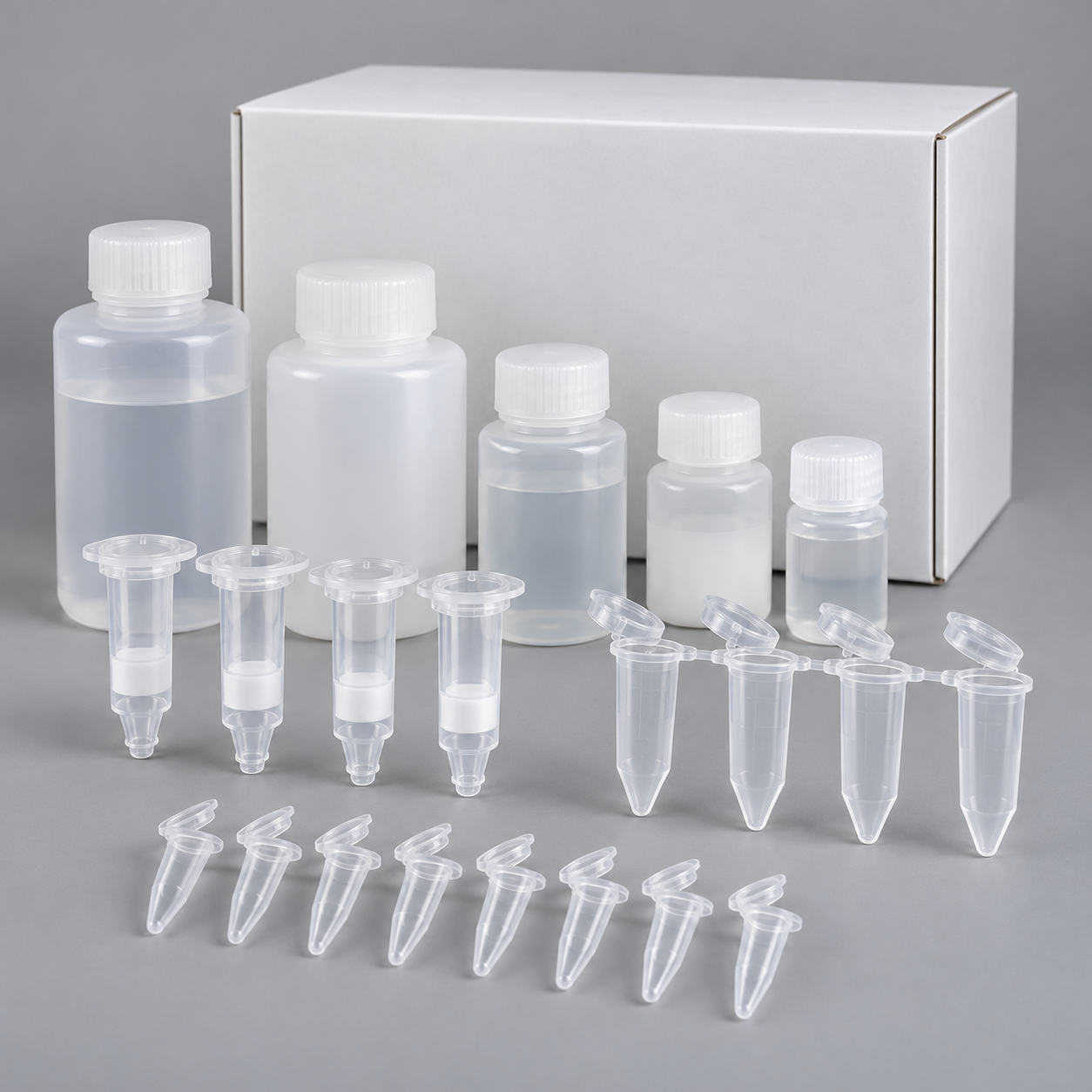
Buy Nucleic Acid Extraction Kits in Nigeria.
Buy nucleic acid extraction kits in Nigeria through Franance. Browse QIAGEN DNA, RNA, miRNA and combined purification kits by sample type and target, then request an itemised quotation for your laboratory.
Products
27 models
Where can I buy nucleic acid extraction kits in Nigeria?
Send Franance the exact QIAGEN kit name or catalogue reference, quantity, sample material, target nucleic acid and the workflow you need to support. Franance can review the requirement and prepare a quotation for the listed kit or ask for details needed to identify the right product family.
Read moreWhich DNA extraction kits are listed for Nigeria?
The current QIAGEN selection includes QIAamp kits for genomic, viral, circulating and specialized DNA purification, and DNeasy kits for animal, plant and environmental materials. Select among them using the starting material and the manufacturer’s stated purpose, not a broad “DNA kit” label.
Read moreWhich RNA and miRNA extraction kits are listed?
The listed RNA families address total RNA, small or low-input samples, plant or challenging tissue, cell-free RNA and miRNA purification. The appropriate family depends on the sample material and RNA target described in its current manufacturer documentation.
Read moreBuy Nucleic Acid Extraction Kits in Nigeria
Request a quotation from Franance for QIAGEN DNA, RNA, miRNA and combined nucleic acid extraction kits in Nigeria. Browse the listed kits by sample type and target, then send the exact product reference, pack requirement, intended workflow and facility destination. Franance will review your quote order and follow up to confirm the offered configuration, price and supply terms. This category brings together 27 QIAGEN kit families for different starting materials and purification goals. It includes kits for blood, tissue, cells, plants, stool, soil, filtered water, serum or plasma, and specialized samples, plus kits that purify more than one analyte from the same input. The families are not interchangeable: each manufacturer document defines its own sample scope, kit format and compatible workflow. This guide helps laboratories and procurement teams frame the purchase; it does not provide extraction instructions or substitute for the current kit handbook.
Where can I buy nucleic acid extraction kits in Nigeria?
Send Franance the exact QIAGEN kit name or catalogue reference, quantity, sample material, target nucleic acid and the workflow you need to support. Franance can review the requirement and prepare a quotation for the listed kit or ask for details needed to identify the right product family.
The catalogue groups kits under nucleic acid purification equipment in Nigeria. This new leaf will collect nucleic acid extraction kits in Nigeria, with a corresponding QIAGEN kit listing. Choose a product card to review its manufacturer reference and request a quote order. Adding a product to the quote order records your request; it does not charge you or confirm stock or an order. Franance contacts you to confirm the proposal and next steps.
When you already have an approved specification, send the kit name and catalogue number as written in the manufacturer documentation. If you are choosing between families, describe the sample type, analyte, number of preparations and downstream application so Franance can help identify what information the laboratory should verify. The laboratory’s scientific lead decides whether a kit’s documented scope and performance fit its method.
Which DNA extraction kits are listed for Nigeria?
The current QIAGEN selection includes QIAamp kits for genomic, viral, circulating and specialized DNA purification, and DNeasy kits for animal, plant and environmental materials. Select among them using the starting material and the manufacturer’s stated purpose, not a broad “DNA kit” label.
Listed DNA-focused kits include QIAamp DNA Mini Kit, QIAamp DNA Blood Mini Kit, QIAamp DNA Micro Kit, QIAamp DNA Investigator Kit, QIAamp Fast DNA Stool Mini Kit, QIAamp DNA FFPE Advanced Kit, QIAamp Circulating Nucleic Acid Kit, QIAamp UCP Pathogen Mini Kit, and QIAamp UCP DNA Micro Kit. The QIAamp MinElute Virus Spin Kit is described by QIAGEN for simultaneous purification of viral DNA and RNA, so consider it with the combined-target products rather than treating it as a DNA-only family.
The DNeasy group covers additional source materials: DNeasy Blood & Tissue Kit, DNeasy Plant Mini Kit, DNeasy Plant Pro Kit, DNeasy PowerSoil Pro Kit, and DNeasy PowerWater Kit. For each one, verify the relevant sample description, starting material and kit handbook before selection. Plant, stool, soil and filtered-water kits address distinct matrices; a product name that sounds similar does not establish a shared protocol or compatible input.
These are example family categories, not a recommendation to use a particular kit on a clinical specimen. Confirm the product’s intended use, current regional labelling, sample scope and downstream compatibility from the exact product documentation.
Which RNA and miRNA extraction kits are listed?
The listed RNA families address total RNA, small or low-input samples, plant or challenging tissue, cell-free RNA and miRNA purification. The appropriate family depends on the sample material and RNA target described in its current manufacturer documentation.
QIAGEN’s selection includes QIAamp Viral RNA Mini Kit for viral RNA purification from cell-free body fluids; RNeasy Mini Kit, RNeasy Micro Kit, and RNeasy Plus Mini Kit for distinct total RNA workflows; RNeasy Plant Mini Kit; RNeasy Lipid Tissue Mini Kit; RNeasy Fibrous Tissue Mini Kit; and RNeasy UCP Micro Kit. “Micro,” “Plus,” “Plant,” “Lipid Tissue” and “Fibrous Tissue” indicate distinct family designs; compare the exact source and handbook rather than transferring sample claims between products.
For microRNA-related work, the listed miRNeasy Serum/Plasma Kit and miRNeasy Mini Kit are different products for their documented sample scope. The serum/plasma family concerns cell-free total RNA, including miRNA, from serum or plasma, while the Mini family is described for total RNA including miRNA from other stated sample types. Verify the current manual, pack reference and intended sample before placing a request.
For viral targets, compare the QIAamp Viral RNA Mini Kit with the MinElute Virus Spin Kit using the exact input and DNA/RNA scope stated in the manufacturer pages. Their product descriptions differ; this guide does not generalize one family’s viral sample types to the other. Send the exact name or catalogue number in your quotation so the proposed line item stays unambiguous.
When should a laboratory consider a combined DNA and RNA kit?
Consider a combined kit when the approved study or laboratory workflow requires multiple analytes from the same stated sample. QIAGEN lists AllPrep DNA/RNA Mini Kit for simultaneous purification of genomic DNA and total RNA from the same cell or tissue sample, and AllPrep DNA/RNA/Protein Mini Kit for a workflow that also includes protein.
The decision is not simply “one kit saves time.” Confirm whether the documented sample type is appropriate, which analytes are retained, what outputs the laboratory needs, whether the input and preparation format fit the application, and what downstream methods will use the purified material. A combined purification workflow may not replace separate extraction when the target, sample or downstream method needs a different validated approach.
State the required analytes and the exact sample in your enquiry. Ask Franance to quote the actual AllPrep reference and pack format, and compare its current product instructions with the laboratory’s approved requirements. Do not assume that a kit described for cells or tissue is suitable for another matrix because it yields more than one analyte.
How do sample type and downstream requirements shape kit selection?
Start with four decisions: the sample material, the target (DNA, RNA, miRNA or a combination), the downstream method, and the required preparation format or throughput. Then match that list to the exact manufacturer kit document and catalogue reference.
The QIAGEN families in this catalogue span whole blood and other body fluids, cells and tissues, formalin-fixed paraffin-embedded material, stool, swabs, plant material, soil, filtered water, serum and plasma. Those categories represent different matrices and do not imply that every kit supports all collection formats or sample conditions. State the precise source and condition of the material at a high level—for example, the tissue category or whether the material is cell-free—without sending patient identifiers or sensitive records.
Next, specify what the laboratory needs from the purified material: genomic or viral DNA, total or cell-free RNA, miRNA, both DNA and RNA, or DNA/RNA/protein. The laboratory should define the downstream workflow and the required quality or quantity criteria. Franance can help ensure the quote identifies the product family and reference, but a purchasing discussion cannot establish scientific suitability or replace method validation by the laboratory.
Finally, check format and throughput assumptions. A single-sample spin-column kit, a micro-scale kit and a multi-well format are not automatically equivalent. Confirm the pack size, number of preparations, consumables and any equipment needs for the exact catalogue number. A kit’s nominal preparation count is not a promise of usable results for every starting material or method.
Are nucleic acid extraction kits manual or compatible with automation?
Some QIAGEN kits are intended for manual workflows, while selected kit references are compatible with specific automated instruments or dedicated formats. Never infer automation compatibility from a brand, family name or the fact that another kit in the same range runs on an instrument.
QIAGEN publishes kit and instrument compatibility documents, including a QIAcube Connect-compatible kit list. The manufacturer also states that the QIAcube Connect is intended for use with QIAGEN kits in the applications described in their respective handbooks. This makes the precise kit reference and protocol important. Other automated platforms have their own kit families, modules, software and format requirements. The products on this page are extraction kits, not a guarantee that the laboratory already has a compatible instrument or that the kit can be transferred to any automation platform.
When automation is required, tell Franance the instrument model, software or module where relevant, sample count per run, plate or tube format and exact kit reference. Request written confirmation of compatibility, required adapters and consumables, licensed protocol and supplied contents. If the instrument is not part of the request, keep equipment and kit line items separate so the quotation does not imply an included platform.
The laboratory should verify the protocol against current manufacturer instructions and its internal method requirements before purchase or use. This page intentionally does not provide extraction steps, operating settings or troubleshooting instructions.
What should a Nigerian laboratory confirm before ordering?
Ask the written quotation to identify the manufacturer, exact kit name, catalogue reference, pack size, quantities and any consumables or equipment specified for the offer. Confirm price, availability, delivery, warranty and other commercial terms for the actual destination in Nigeria rather than assuming catalogue availability equals local stock.
For each kit, compare the quotation with the current manufacturer label, product page and handbook. Check intended sample type, DNA/RNA target, manual or instrument compatibility, format, preparation count, storage or transport requirements, documentation and intended-use statements. For research, clinical research or diagnostic workflows, confirm the exact product’s current regulatory status and scope; this page does not imply that any listed kit is an in-vitro diagnostic product or approved for clinical testing in Nigeria.
For institutional purchasing, identify the laboratory contact who will verify technical fit, the procurement contact who will review the commercial offer, and the receiving site. Provide any documentation required for internal supplier approval or purchase orders. Keep sensitive patient information out of the quotation request; Franance needs the kit and procurement specification, not patient-level results.
Where several kits are being considered, request separate line items rather than a substitute kit presented as equivalent. State which options are acceptable and which require written review. The final proposal should make assumptions and exclusions visible so that the laboratory and procurement team can approve the same configuration.
How can Franance quote nucleic acid extraction kits in Nigeria?
Send Franance the product names or catalogue numbers, quantities, pack requirements, sample categories, target nucleic acid, manual or automation context and facility location. Franance can review the quote order, follow up by phone or email and confirm the exact proposed kit, price and supply terms in writing.
If you are not sure which family fits, describe the sample and the laboratory’s intended output at a high level and include the relevant instrument model if automation is involved. Ask your laboratory lead to confirm the method and product scope using the current manufacturer documentation. Franance can then help make the quotation request precise and identify information that still needs confirmation; it will not choose a clinical method or provide an extraction protocol.
Browse the future nucleic acid extraction kits category page or the QIAGEN-filtered kit listing to compare models. The parent nucleic acid purification category covers the broader equipment group, including extraction instruments. Submit your selected products and requirements through the quote-order flow; Franance will contact you to discuss the request rather than taking an online payment.
Common questions
Which nucleic acid extraction kits can I request from Franance in Nigeria?
The QIAGEN range includes DNA-focused, RNA/miRNA and combined analyte kits. Choose the exact sample and product reference, then request a written quotation from Franance.
Can one extraction kit be used for every sample type?
No. QIAGEN describes different kits for specific materials and targets. Verify the exact sample scope in the current product documentation and have the laboratory approve its method.
Are all QIAGEN spin-column kits compatible with QIAcube Connect?
No. Use QIAGEN's current compatibility list and the relevant kit handbook to confirm the exact kit reference and protocol for the instrument.
Are these kits approved for clinical diagnostic testing in Nigeria?
This catalogue page makes no blanket diagnostic or Nigerian authorization claim. Confirm the exact product label, intended use and local regulatory requirements before selecting a kit for a regulated workflow.
How do I get a price for a QIAGEN nucleic acid kit?
Send Franance the product name or catalogue number, pack quantity, requirements and delivery destination. The team will follow up with a quotation and confirm current price and supply terms.
Request a nucleic acid extraction kit quotation
Send Franance the kit reference, sample category, DNA or RNA target, quantity, workflow requirements and facility location in Nigeria.
Request a kit quotationNeed an equipment quote?
Add the models you need to a quote order, or send us your equipment list.