

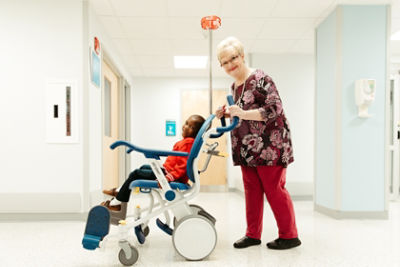
Buy Hospital Wheelchair in Nigeria.
Buy hospital wheelchairs in Nigeria through Franance. Compare the GPC Medical WC502 and WC504 folding wheelchairs and the Stryker Prime TC transport chair, then request a quotation with your configuration, quantity and delivery destination. Franance follows up by phone or email; checkout and online payment are not offered.
Products
3 models
Where can I buy a hospital wheelchair in Nigeria?
Request a quotation from Franance through the hospital wheelchair enquiry form. Start from a listed model or send the specification your department has approved. The three current product listings are GPC Medical WC502, GPC Medical WC504 and Stryker Prime TC 1460. Each link filters the catalogue by brand, category and model reference.
Read moreWhich hospital wheelchair models are listed?
Three records are assigned to the category, and they cover two different equipment types.
Read moreWhat is the difference between a wheelchair, a transport chair and a commode chair?
The category name hides three jobs. A folding wheelchair such as the WC502 has large rear wheels and a folding frame and suits patients moved around a facility. A transport chair such as the Prime TC is designed for a caregiver to push a seated patient through a facility, with a nestable frame and a brake that staff operate by foot. A commode wheelchair such as the WC504 adds toileting capability to a wheelchair frame, which changes how it is cleaned, stored and used.
Read moreBuy Hospital Wheelchairs in Nigeria: Compare Manual and Transport Chair Options
To buy a hospital wheelchair in Nigeria, start by deciding what the chair must do on your wards: move a patient to imaging or discharge, give a commode option beside the bed, or serve as a nesting transport chair at a hospital entrance. Franance's current category lists three assigned products: the GPC Medical WC502 Super Deluxe folding wheelchair, the GPC Medical WC504 folding wheelchair with commode, and the Stryker Prime TC transport chair, model 1460. They are not three versions of the same chair. Compare the hospital wheelchair category, then ask Franance for a written quotation. Requests are quote orders, not online checkout; the team follows up by phone or email. This guide is procurement information, not a clinical prescription. It explains how to separate the listed models, which manufacturer details are published, which are not, and what to put in a quotation request so the offers you receive can be compared line by line.
Where can I buy a hospital wheelchair in Nigeria?
Request a quotation from Franance through the hospital wheelchair enquiry form. Start from a listed model or send the specification your department has approved. The three current product listings are GPC Medical WC502, GPC Medical WC504 and Stryker Prime TC 1460. Each link filters the catalogue by brand, category and model reference.
A listing is not a promise of stock. Franance's records do not state a Nigerian stock level, price, lead time, warranty or service scope for these items, and neither do the manufacturer pages. Ask the written quotation to state the exact model and item reference, what is included, the regional configuration, the delivery destination and the commercial terms. If the chair you need is not listed, send the specification anyway; Franance can tell you whether it can quote against it, but that should not be assumed.
Which hospital wheelchair models are listed?
Three records are assigned to the category, and they cover two different equipment types.
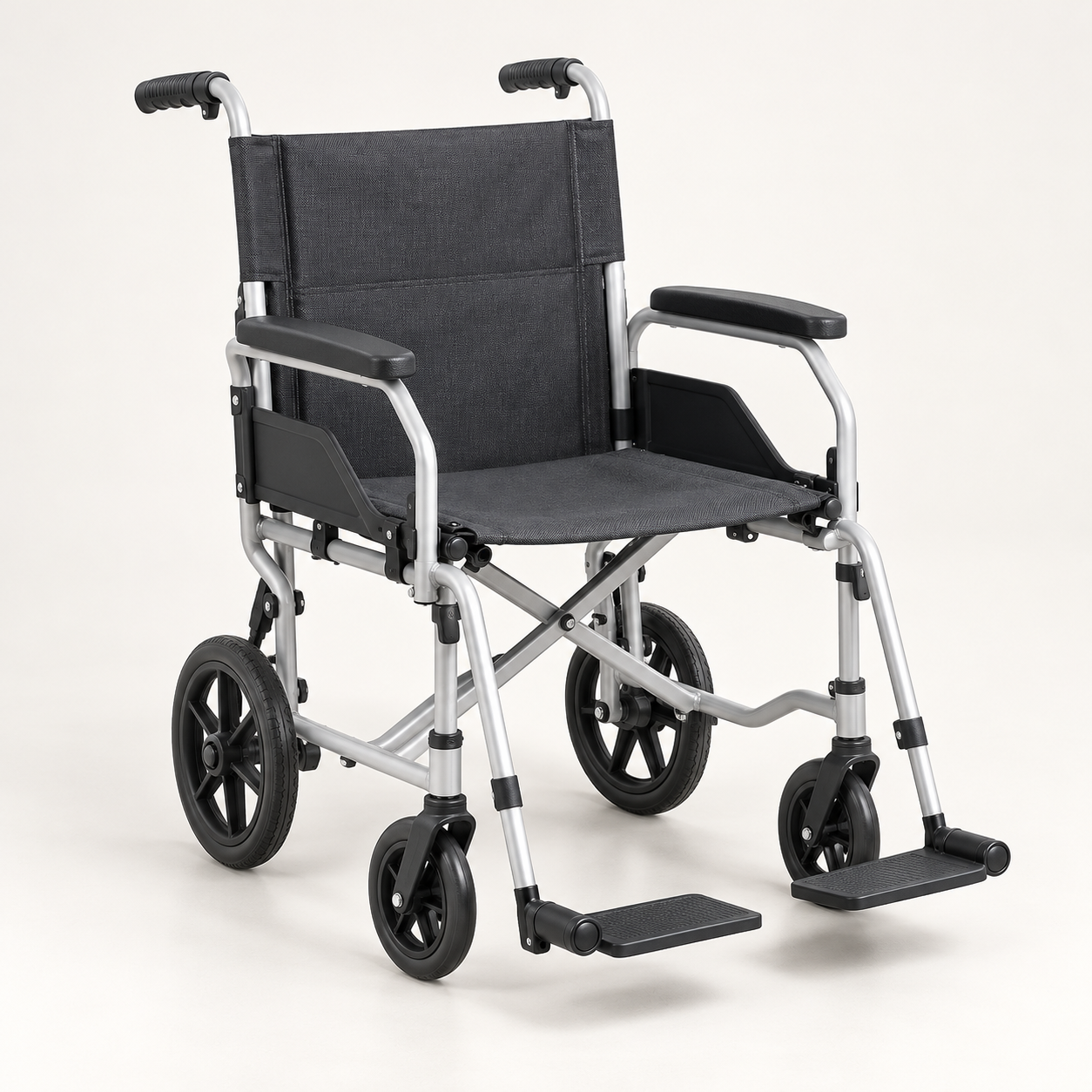
GPC Medical WC502, Invalid Wheel Chair (Folding) Super Deluxe. GPC's product page lists an epoxy-coated folding frame, non-detachable foam-padded armrests, a tetron seat, a plastic handle, a fixed ABS plastic footrest and solid wheels with brakes. It gives rear castors of 66 cm, front castors of 13 cm, rim-to-rim width of 68 cm, folding size of 33 cm and height of 88 cm.
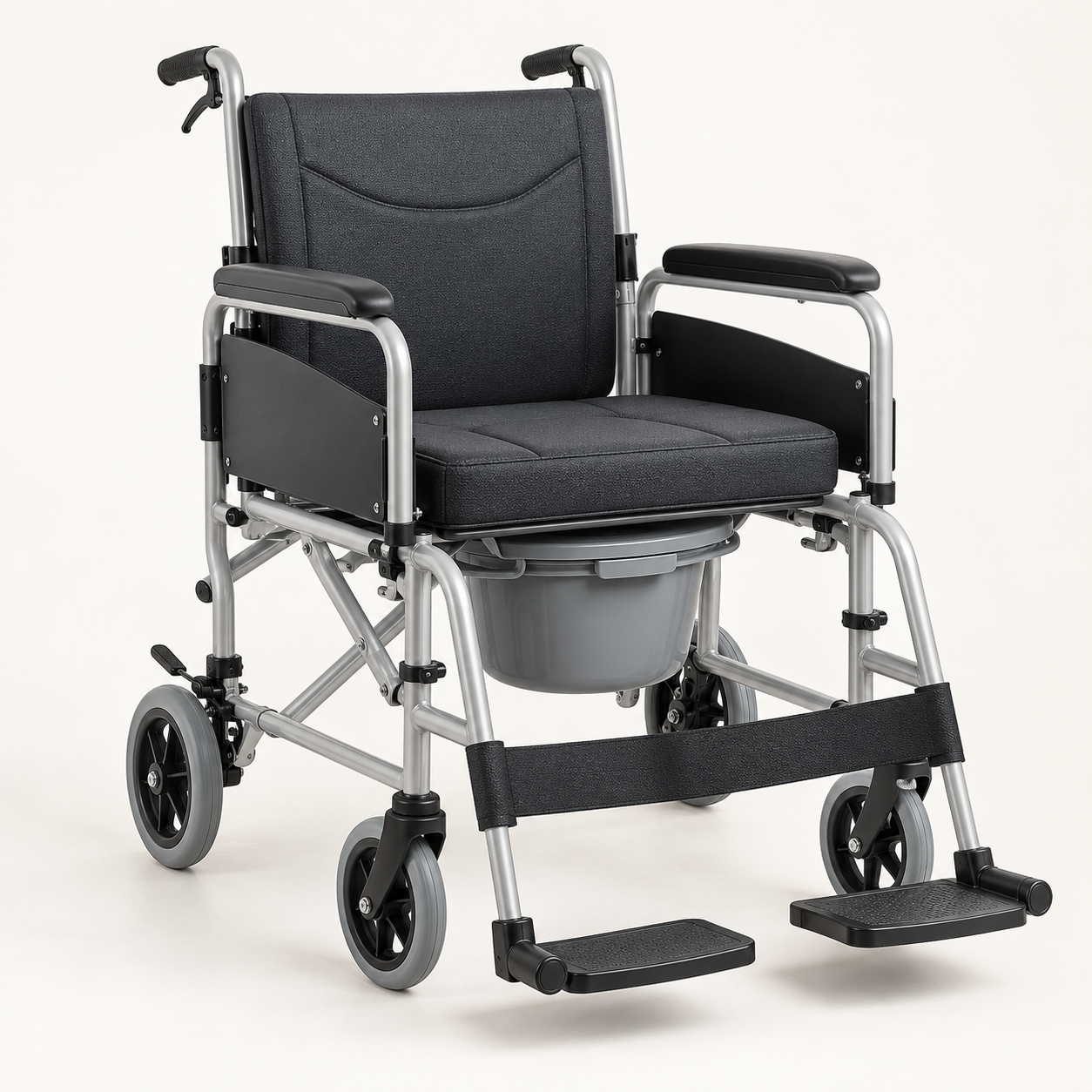
GPC Medical WC504, Invalid Wheel Chair (Folding) With Commode. The page lists the same frame, armrest, seat, handle, footrest and solid-wheel features, with rear castors of 62 cm, front castors of 15 cm, rim-to-rim width of 71 cm, folding size of 37 cm and height of 91 cm. The model name indicates a commode function; the specification list does not describe the commode vessel, seat opening or how it is removed.
Stryker Prime TC, model 1460. Stryker describes a seated patient transport chair with a rigid, nestable steel frame with molded plastic components, a one-touch central foot brake, integrated anti-tip wheels, upright push handles, stand-assist armrests that fold back, flip-up footrests, a swing-away footrest function and a power-washable frame. Stryker's page cites patient capacity up to 500 lb (226.8 kg); its specification sheet lists a 54.6 cm seat width and 71.8 cm overall width. An upright oxygen bottle holder is listed as an accessory.
GPC's range also includes a plain WC501 folding wheelchair, which Franance lists under rehabilitation wheelchairs alongside Drive Medical models. It is not assigned here, so use that category if you need it.
What is the difference between a wheelchair, a transport chair and a commode chair?
The category name hides three jobs. A folding wheelchair such as the WC502 has large rear wheels and a folding frame and suits patients moved around a facility. A transport chair such as the Prime TC is designed for a caregiver to push a seated patient through a facility, with a nestable frame and a brake that staff operate by foot. A commode wheelchair such as the WC504 adds toileting capability to a wheelchair frame, which changes how it is cleaned, stored and used.
Do not treat them as interchangeable in a tender. A ward that needs a chair beside the bed for toileting is asking for something different from an emergency department that needs a fleet of nesting chairs by the door. State the use case in your request, then let each offer show how its chair meets it. If the real need is a person lying down, look at patient stretcher trolleys; for seated transport and sit-to-stand aids, use patient transfer chairs; for patients who cannot bear weight, ask about patient lifting hoists.
Which chair suits which hospital area?
Match the model to the route and the user group, not to the price alone.
For outpatient reception, imaging and discharge, a folding wheelchair or nesting transport chair saves floor space. Folded sizes matter: GPC lists 33 cm for the WC502 and 37 cm for the WC504, which helps if chairs are stored in a corridor bay or carried in a vehicle. The Prime TC is designed to nest, which suits parking at an entrance, but nested stacks still need floor area and a clear route to the stack.
For inpatient wards with shared toilets, a commode chair can reduce movement, but it creates a cleaning task between patients. Ask what parts are removable, how the vessel is emptied and which disinfectants the manufacturer approves.
For larger patients, ask for the stated safe working load of the exact model. Stryker states patient capacity up to 500 lb for the Prime TC. The GPC pages reviewed do not publish a weight rating for the WC502 or WC504, so do not assume one; request it in writing before quoting for a patient group that needs it.
For paediatric or very small patients, GPC's range lists a separate paediatric folding wheelchair, which is not assigned to this category. The listed models are not a substitute.
How should I check dimensions, doorways and lifts?
Compare three widths. Rim-to-rim width (GPC lists 68 cm for the WC502 and 71 cm for the WC504) tells you the width of the wheelchair body. Overall width (Stryker lists 71.8 cm for the Prime TC) tells you what must fit through a door. Seat width (Stryker lists 54.6 cm) tells you what the patient sits on, which is a separate question. GPC's pages do not list a seat width, so ask.
Then measure your own route. Walk from the farthest ward to imaging, pharmacy and the main exit and note door clear widths, lift cabin depth, ramp slopes and sharp turns. Older buildings can have narrow doors or uneven thresholds; a chair that suits a new block may not fit an old one. Ask suppliers to state overall dimensions in the quotation and, where possible, test a demonstration unit on your route.
Also compare height. The WC502's published height is 88 cm and the WC504's is 91 cm, which affects handle position for staff of different heights. Stryker describes upright push handles designed to suit a range of caregiver heights; check this against your own staff.
What should I check about brakes, footrests, armrests and wheels?
These features decide how safely a patient can get into and out of the chair.
Brakes. GPC lists solid wheels with brakes. Ask which wheels are braked and whether a caregiver standing behind the chair can reach them. Stryker describes the Prime TC's central brake as one-touch and foot operated.
Footrests. The GPC pages list a fixed ABS plastic footrest. A fixed footrest can be in the way during a transfer, so ask whether it is removable or swings clear. Stryker lists flip-up footrests and a swing-away function, designed to give clear entry and exit.
Armrests. GPC lists non-detachable, foam-padded armrests. Non-detachable armrests can make side transfers harder; ask whether they can be moved out of the way. Stryker lists stand-assist armrests that fold back for patient access.
Wheels. GPC lists solid wheels, which cannot puncture but differ from pneumatic wheels in ride comfort and rolling effort. Confirm the wheel type for the offered unit. Stryker lists integrated anti-tip wheels on the Prime TC.
How do cleaning, infection control and durability affect the choice?
Wheelchairs are shared equipment, so cleanability matters. Stryker describes the Prime TC as having seamless molded plastic and a power-washable frame. The GPC pages describe an epoxy-coated frame and a tetron seat; they do not state which cleaning agents the surfaces tolerate. Ask each supplier for the manufacturer's cleaning and disinfection instructions and use those, not a generic policy, when you set ward procedures. Ask whether seat and back covers can be replaced separately so that a torn seat does not take the whole chair out of service.
For durability, ask about the frame material and coating, the expected duty cycle and the spare parts available for wheels, brakes, footplates and upholstery. Hospital use is harder than occasional use: chairs are pushed daily, stored in corridors and cleaned repeatedly. Do not assume that a general specification will hold up in a busy ward.
What should a Nigerian hospital or NGO consider before ordering?
Think about the whole supply chain. Ask who will deliver to your state and city, who will inspect the chairs on arrival, who handles spare wheels, brakes and upholstery, and who a ward can call when a chair fails. A quotation that covers only the unit price leaves these questions open.
Ask what Nigerian regulatory documentation applies to the offered product. NAFDAC publishes guidelines for registration of medical devices in Nigeria, but a catalogue listing or manufacturer page does not establish that a particular chair is registered, cleared for import or eligible for a particular tender. Request the relevant documents in writing instead of assuming them.
For multi-unit orders, ask whether quantity changes the price, whether all units will ship together and how freight damage will be handled. For NGO and donor-funded projects, ask Franance what documentation it can provide for your reporting needs. Standardizing on one or two models across a facility makes spares and staff training simpler.
Finally, remember the user. The World Health Organization's wheelchair provision guidelines state that no single model or size of wheelchair can meet the needs of all users, and they emphasize assessment, fitting, training and follow-up by trained personnel. A hospital loan fleet for short trips is a different case from a chair issued to one person for long-term use; for the latter, involve a qualified wheelchair service before ordering.
What should I include in a hospital wheelchair quote request?
Send the following so Franance can prepare an offer you can compare:
- The exact model or the required function: folding wheelchair, commode wheelchair or transport chair.
- Quantity, and whether you want a single unit or a phased supply.
- The patient group, including any weight requirement, and the area of use.
- Seat width, overall width and door constraints for your routes.
- Accessories wanted, such as an oxygen bottle holder for the Prime TC, and replacement parts.
- Delivery state, city and facility, with any access restrictions.
- Requested documentation, including cleaning instructions and regulatory papers.
- Training, warranty, spares and service expectations, and who will perform them.
Ask the quotation to state the exact model reference, the regional configuration, what is included and excluded, the validity period, payment terms and delivery terms.
What is the price of a hospital wheelchair in Nigeria?
Franance's records do not publish a verified Nigerian price for the three listed models, and this guide does not state one. Price depends on the model, the configuration, accessories, quantity, freight to your destination, exchange rates and the supply scope. A commode wheelchair, a folding wheelchair and a nesting transport chair serve different roles and will not be priced alike, so compare like with like. Where a listing shows a starting price, treat it as a reference for the stated package, not as an order total. The written quotation is the document that confirms your price, so ask for line items for each chair, accessory, delivery and any training.
Which hospital wheelchair should my facility request a quote for?
Use the job as the guide.
Ask for the GPC WC502 if you want a folding manual wheelchair for general ward and outpatient use and are willing to confirm its seat width, weight rating and footrest details with the supplier. Ask for the GPC WC504 if a commode function is part of the requirement and you have a cleaning process for it. Ask for the Stryker Prime TC 1460 if you want a caregiver-pushed, nestable transport chair with a stated 500 lb capacity, a central brake and flip-up, swing-away footrests.
If you are unsure, send Franance two or three candidate models, your door and lift measurements and a short description of the patient groups. Compare the offers on the same terms. For related equipment, see mobility and transfer equipment and the wider hospital furniture category.
Request a hospital wheelchair quote from Franance
Send Franance the model or function you need, quantity, patient group, door and route dimensions, accessories, delivery city and state, and any documentation, training or service you expect. Ask the quotation to confirm the exact model, what is included, availability, regional configuration and commercial terms. Franance will follow up by phone or email; checkout and online payment are not offered. Use the hospital wheelchair enquiry form to begin.
Common questions
Which hospital wheelchairs does Franance list in Nigeria?
The category currently lists the GPC Medical WC502 Super Deluxe folding wheelchair, the GPC Medical WC504 folding wheelchair with commode and the Stryker Prime TC transport chair, model 1460. Confirm the exact item and configuration in a written quotation.
Can I buy a hospital wheelchair online from Franance?
No. Send a quote request with the model, quantity and delivery destination. Franance follows up by phone or email; checkout and online payment are not offered.
What is the difference between the WC502, WC504 and Prime TC?
The WC502 is a folding manual wheelchair, the WC504 is a folding wheelchair named as having a commode, and the Prime TC is a nestable, caregiver-pushed transport chair. They suit different jobs and should not be treated as interchangeable.
What weight can these chairs carry?
Stryker's page cites patient capacity up to 500 lb (226.8 kg) for the Prime TC. GPC's WC502 and WC504 pages reviewed do not publish a weight rating, so request it in writing for the exact unit.
Are these models confirmed in stock or registered in Nigeria?
No source reviewed confirms Nigerian stock, price, registration, warranty or service. Ask Franance to state availability, applicable regulatory documents and terms for the exact model in a written quotation.
What should I include in a hospital wheelchair quote request?
Include the model or function, quantity, patient group and weight requirement, door and route dimensions, accessories, delivery city and state, required documents and any training, warranty or service scope.
Request a hospital wheelchair quotation from Franance.
Send the model or function you need, quantity, patient group, door and route dimensions, accessories, delivery destination in Nigeria and any documentation, training or service you expect. Ask the quotation to confirm the exact model, inclusions, availability and terms. Franance follows up by phone or email.
Request a hospital wheelchair quoteNeed an equipment quote?
Add the models you need to a quote order, or send us your equipment list.