

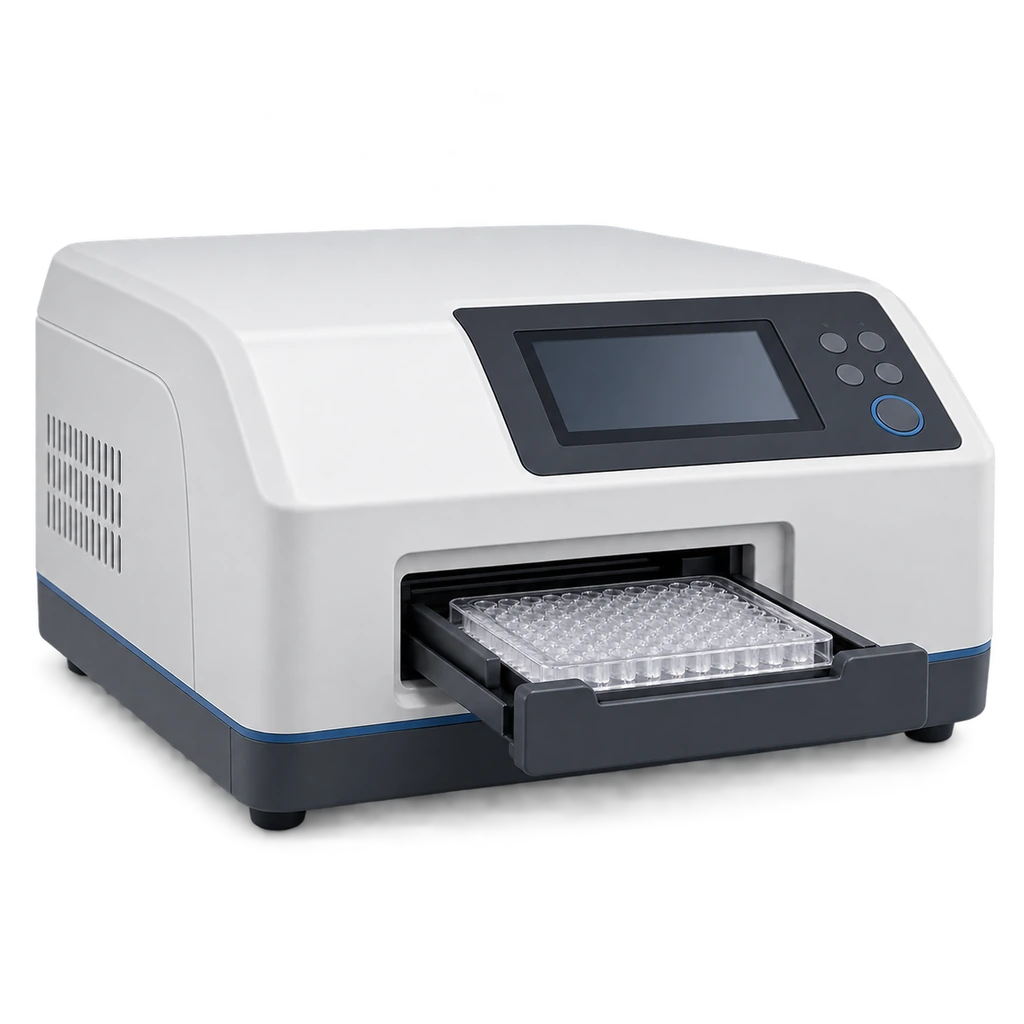
Buy Agilent BioTek 800 TS Absorbance Reader in Nigeria
Buy the Agilent BioTek 800 TS absorbance reader in Nigeria through Franance by confirming that the listed 800TS configuration matches your assay wavelengths, plate format, measurement method and laboratory workflow. This is a filter-based absorbance microplate reader used for workflows such as ELISA and protein assays. The catalogue record is for the plain 800TS configuration: Agilent documentation lists 400–750 nm, 6- to 96-well plates, linear shaking and no incubation for that configuration. The 800TSI, 800TSUV, 800TSUVI and 800TSNB suffixes change capabilities. Specify the exact suffix and installed filters in the quotation rather than relying on the broader 800 TS family name.
Where can I buy the Agilent BioTek 800 TS in Nigeria?
Use the Agilent BioTek 800 TS exact catalogue listing to review the current record, then request a quote from Franance. Franance treats the listing as a quotation enquiry rather than online checkout. Include the exact model configuration, assay type, wavelengths, plate format, installed filters, software and any accessories or qualification materials required by your laboratory.
Before asking for a final price, confirm the intended application with the laboratory lead. A reader may be used in many absorbance workflows, but the catalogue does not establish compatibility with a particular reagent kit, local diagnostic method, validation protocol or regulatory requirement. Ask the quote to identify the instrument model and suffix, filter set, power supply and cord, software, included accessories and the scope of delivery to your Nigerian facility. Stock, price, lead time, local warranty and service arrangements must be confirmed in writing for the actual order.
What does the BioTek 800 TS measure?
Agilent describes the 800 TS as a filter-based absorbance microplate reader. Absorbance measurement illuminates a sample at a selected wavelength and measures the transmitted light through the well; the instrument reports optical density or absorbance. Agilent identifies ELISA, protein quantification, enzyme kinetics and cell-based assays among application workflows for the family. This describes instrument capabilities and examples, not a claim that any particular diagnostic assay is validated on the unit or that the instrument supplies assay reagents or interpretation.
The selected catalogue record is titled “Agilent BioTek 800 TS Absorbance Reader” and identifies the 800TS configuration. It is not a fluorescence, luminescence or multimode reader. If the method requires those detection modes, ask Franance to identify a different product class rather than assuming that the 800 TS can be expanded into a multimode instrument. If you are considering absorbance methods that require UV wavelengths, distinguish the plain 800TS from the UV configuration before ordering.
Which configuration is listed, and what do the suffixes mean?
The current Franance product record identifies the 800TS configuration without an I, UV, UVI or NB suffix. Agilent's model-specific technical details and Instructions for Use separate those options. In the IFU configuration table, the standard 800TS-SI version is shown with 400–750 nm wavelength range, standard 6- to 96-well plates, linear shaking and no incubation. The exact region-specific suffix on an offered unit should still be confirmed against its part number.
The other suffixes represent materially different options. Agilent lists an 800TSI configuration with incubation, 800TSUV with UV-range measurement, 800TSUVI with both UV and incubation, and 800TSNB for selected 384-well configurations. The UV models include a 340 nm filter and wavelength range beginning at 340 nm. The NB configuration supports 384-well plates and does not include the same shaking behavior listed for standard configurations. These are family options; they are not included merely because a broad product page describes the product family.
The manufacturer’s broader product page advertises the 800 TS family for formats from 6 to 384 wells and lists incubation and shaking. Read this alongside the model-specific configuration table: those family-level statements cover more than one suffix. For the locally listed 800TS configuration, use the specific plain-model limits unless the written quotation identifies another suffix and confirms its capabilities.
Which wavelengths and filters should I specify?
Write down each wavelength required by the assay protocol, including the primary and any reference or secondary wavelength. The standard 800TS configuration is filter-based, has a five-position filter wheel and the manufacturer’s standard filter set lists 405, 450, 490 and 630 nm, with the remaining position occupied by a plug. The installed filter set determines which wavelength selections are available. The instrument cannot use an arbitrary wavelength merely because a method document specifies it.
Compare the assay requirement with the exact filter set offered. If additional wavelengths are needed, ask Agilent or the supplier whether the corresponding filters are compatible, what part numbers are required, whether they are installed, and whether the reader’s filter table and software configuration will be updated. Agilent’s IFU warns that the instrument filter table and software filter table must match the contents of the filter wheel. Request the installed-filter list and verify it during installation or handover.
If a method needs a wavelength below 400 nm, check the 800TSUV or 800TSUVI variant rather than assuming the listed standard configuration will measure it. Agilent describes a 340–750 nm range for UV versions, while the standard 800TS version is listed at 400–750 nm. Confirm filter availability at each required wavelength and check the method’s plate material and volume requirements with the assay documentation. Do not substitute a filter or plate solely because it has a similar label.
Which microplate formats fit the 800TS configuration?
For the plain configuration, Agilent lists 6-, 12-, 24-, 48- and 96-well plates. The Instructions for Use lists a maximum plate height of 0.9 inches (22.86 mm). The technical details reserve 384-well and Terasaki plate support for NB configurations; Agilent states that Terasaki use on an NB configuration requires adapter part number 7330531. Check the exact plate standard, skirt, lid, height and any adapter against the instrument manual and assay workflow before ordering.
Do not infer 384-well compatibility from the broad 800 TS product family page. If your laboratory uses 384-well plates, identify them as a requirement in the enquiry and request confirmation of an 800TSNB configuration and compatible accessories. Likewise, list the exact 6- to 96-well plate types used in routine procedures. Plate footprint and well count alone do not prove compatibility if plate height or geometry differs.
Ask whether plates, plate adapters or lids are included. The reader is an instrument and does not include assay plates or kits by default. If your method uses specialty labware, provide the part number and manufacturer documentation so the exact configuration can be checked before purchase.
Does this 800TS include shaking or incubation?
The plain 800TS configuration supports linear shaking according to Agilent’s configuration information, but it does not include incubation. The 800TSI configuration adds temperature control; the UV suffixes change the wavelength range, and the UVI variant combines UV and incubation. Do not count on incubation when the requested product is the plain 800TS listed in the catalogue.
If your assay requires kinetic readings, specify the read mode, time interval, total measurement period, wavelength sequence, plate type and whether samples must be mixed or held at a controlled temperature. Kinetic reading and incubation are separate questions: the reader may take kinetic measurements without the incubator option, while an assay requiring a temperature-controlled plate needs the matching incubated configuration. Confirm the exact capability and any method-specific limitation with Agilent.
Agilent's IFU and technical sheet include performance specifications under defined conditions, such as wavelength, plate, read mode and optical-density range. Those figures are not a substitute for the laboratory’s method validation or acceptance testing. If timing, accuracy or repeatability is critical to your use case, provide the assay acceptance criteria and request the current specification and an agreed verification plan for the exact model.
What software and data outputs are included?
Agilent documentation lists onboard touchscreen operation, user-programmable protocols and USB result export. The technical details identify Gen5 data-analysis software for the 800 TS family. Agilent’s current product page says the reader can save onboard results to a USB drive and import them into Gen5 for expanded analysis and reporting. Confirm the supplied Gen5 version, licence, computer requirements, operating-system support and any installation assistance in the quote; software scope can vary with the package and region.
The 800 TS has USB connectivity for computer control and ports for USB storage and an optional printer, according to the technical details. If results need to move into a laboratory information system, electronic record, spreadsheet or regulated data environment, define the required file format and data path before purchase. A USB export function does not guarantee compatibility with a specific LIS or automated workflow. Ask who will configure and test any software connection.
If your quality system requires controlled accounts, audit trails or electronic-record controls, state those requirements explicitly. Agilent identifies a Gen5 Secure software option for 21 CFR Part 11 support in the technical data, but that statement alone does not establish that a configured system or laboratory process complies with a regulation. Confirm the precise product/licence, intended-use environment and validation responsibilities with Agilent and your quality team.
What laboratory and power conditions should I check in Nigeria?
Agilent’s Instructions for Use specifies operation in an ambient temperature range of 18–40°C and relative humidity from 10–85% without condensation. It instructs users to place the reader on a level, stable surface and avoid excessive humidity, bright ambient light and dust. These are product installation conditions, not a claim that every Nigerian laboratory environment is suitable. Measure the actual room conditions and discuss ventilation, dust control, bench space and environmental stability with the laboratory and facility teams.
The manufacturer lists an external 24 VDC power supply compatible with 100–240 VAC at 50–60 Hz. The technical details list 40 W maximum for non-incubated models and 150 W maximum for incubated models. The plain 800TS is non-incubated according to the model-specific configuration table, but the supplied adapter, cord and product suffix still need confirmation. Ask the supplier to identify the actual power supply and cord set and have facility engineering confirm the outlet, grounding and circuit requirements. Do not use a plug adapter in a way that compromises protective earth; follow the manufacturer's instructions and qualified electrical advice.
Agilent lists dimensions of approximately 41.9 × 38.1 × 17.8 cm and weight below 10 kg. Allow space to open or access the plate carrier, connect the computer and reach power and USB ports. Check that the bench is stable and away from sources of vibration, direct light and dust. During delivery planning, ask whether installation, startup checks or user orientation are included; do not assume these are part of the instrument price.
What accessories and performance checks should I quote?
List every needed filter by wavelength and part number, compatible plate formats, adapters, power cord, USB cable, computer, software licence, printer and any qualification or test plate. Agilent lists an absorbance test plate and product qualification package as options. If the lab needs documented acceptance testing, specify the requested package, calibration certificate, records, service provider and test scope. Verify what is included versus separately quoted.
For the initial setup, Agilent’s IFU describes checking the filter-wheel contents and matching the software filter table, running an instrument system test and using an absorbance test plate to verify performance. Ask for the model-specific installation checklist and user manual. A test plate or manufacturer performance specification does not validate a laboratory method or ensure that every assay is fit for clinical use; the laboratory must follow its own quality procedures and applicable requirements.
Ask for the current manual and training on plate loading, filter configuration, software export, routine cleaning, lamp and maintenance expectations. The installation instructions specify environmental conditions and describe system-test steps. Clarify whether the quote includes commissioning, familiarisation, qualification documentation or ongoing maintenance. These are distinct scopes and should be named rather than assumed from the word “installation.”
What should a Franance quotation include in Nigeria?
Send Franance the exact product name and the selected 800TS suffix/part number; state your assay class, wavelength list, required standard filters, plate format and maximum plate height. Identify whether kinetic reads, shaking, incubation, UV wavelengths, 384-well plates or Terasaki adapters are required. If any need changes the model, ask for the compatible suffix and an updated model-specific specification before accepting the quote.
Include your laboratory location, city and state, quantity, bench and environmental conditions, site power, computer/software requirements, data-output workflow, needed accessories and documentation. Ask the supplier to list the exact reader configuration, installed filters, power adapter and cord, software version/licence, USB and printer accessories, manuals, test plate, installation, training, qualification or maintenance scope as included, optional or excluded. Ask Agilent or its channel to confirm the filter set and plate support against your method requirements in writing.
Request itemized price and currency, quote validity, availability, estimated lead time, freight, insurance, import responsibilities and final delivery terms. Confirm warranty coverage for Nigeria, the route for technical support, service availability, consumables and spare parts separately. Neither the product listing nor the manufacturer’s global documentation confirms local stock, price, delivery schedule, warranty territory or field service. Franance will follow up by phone or email after receiving the enquiry; the process is a quote order, with no online payment.
How do I place an 800 TS quote order?
Open the Agilent BioTek 800 TS filtered listing and use the Franance quotation enquiry. Include your exact configuration, filters, plate format, assay and site requirements so the proposed unit can be checked. The catalogue supports a quotation request rather than online buying.
Manufacturer sources and scope limits
This guide uses Agilent's BioTek 800 TS product page, technical details and configuration table, and Instructions for Use. Agilent's microplate reader FAQ explains absorbance measurement, filter-based versus monochromator-based wavelength selection, and general reader applications.
The selected catalogue item is the 800TS configuration. Family-level descriptions that mention UV range, incubation or 384-well plates refer to other model variants and should not be applied to this item unless the supplier quotes the corresponding suffix. Manufacturer specifications do not validate an assay, guarantee performance at a particular site, establish Nigerian registration or confirm local stock, price, import status, warranty, service or support. Confirm the exact part number, configuration, current documentation and commercial terms with Agilent and Franance before ordering.