Anaesthesia workstation repair assessment in Nigeria
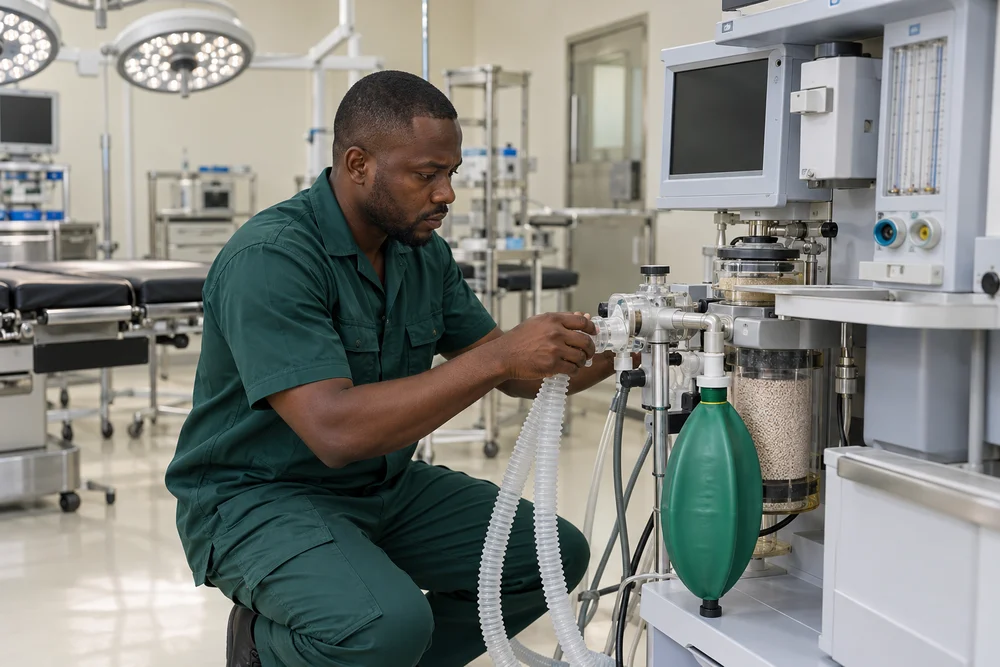
How do I request anaesthesia workstation repair in Nigeria?
Use Request an assessment or Request callback and identify each workstation separately. Include the manufacturer, model, serial number, software version if displayed, asset tag, theatre or department and the date the issue began. State whether the unit is unavailable, operating with a reported fault, due for planned work or being reviewed after a prior repair.
Attach a concise, non-patient-specific fault log, recent service report and applicable user or service manual. Remove patient identifiers, anaesthetic records, waveforms and other clinical data. If an alarm or event code is visible, transcribe its exact wording and when it appeared; do not try to diagnose the cause from a code alone.
Tell Franance what you need the review to resolve: a fault assessment, a repair proposal, a post-repair verification record, or a defined combination. A written quote should make these tasks visible as separate items where their methods or deliverables differ.
Which workstation details affect the repair scope?
Workstations that share a family name may differ in software generation, gas module, ventilator architecture, vapour delivery, monitoring, trolley, auxiliary outlets and connectivity. Record the installed options and visible software revision rather than describing every device as simply “an anaesthesia machine.”
Include the installed gas supply arrangement and known interface dependencies at a high level, such as pipeline or cylinder source, scavenging connection, facility monitoring or network link. This helps the reviewer understand the context; detailed engineering checks belong in the agreed service scope and relevant manufacturer documentation.
List accessories and components only when they are part of the request: vaporizer, breathing system, gas measurement module, patient monitor, display, trolley, battery or accessory arm. Identify each by model or asset number where available. Keep separate rows for units with different options, revisions or service histories.
For catalogue context, review the anaesthesia workstation category and the exact product record. A product listing helps identify equipment; it does not replace the unit's data plate or service documentation.
What should I include in a workstation fault report?
Describe the observed symptom, date, operating mode or workflow when it occurred, whether it is reproducible, and any action already taken by the facility under its approved procedures. Include exact displayed messages and whether the issue affects a particular subsystem, but avoid suggesting a part replacement before assessment.
Record the circumstances that help organize access: the last known working date, recent movement or installation, software change, gas or power interruption, cleaning event or previous maintenance. Do not include the procedure name, patient details or sensitive theatre records.
If the unit has been removed from service under facility policy, say so. If it remains in use, the hospital's clinical and biomedical leads should decide whether and how it is used. A web enquiry is not a clinical risk assessment or a substitute for the facility's device incident process.
How should manufacturer service instructions shape the work?
Use the instructions and service documentation for the exact model and revision. Dräger's Perseus A500 instructions distinguish user, reprocessing and service activities, and state that product-specific service work requiring knowledge or tools belongs to specialized service personnel trained for those activities. Mindray publishes A8/A9 operator resources and product training information for its workstation family.
When requesting a quote, provide the relevant manual and ask which work is proposed against it. If your procurement requires manufacturer authorization, specific training or OEM status, ask for evidence relevant to that model and activity. Authorization for one product family does not automatically cover another workstation, software generation or repair task.
If the current service manual is unavailable, identify that before scheduling. Ask whether the limitation changes the proposed work, parts path or verification record. Do not use a general user guide to infer service procedures or permissions.
How is a repair different from maintenance or verification?
Repair addresses a reported fault. Preventive maintenance is planned work, while electrical-safety testing, calibration or performance verification answer different questions and may have separate methods and records. An anaesthesia workstation can involve gas measurement, ventilation, alarms, power, vapour delivery and integrated monitoring; a single generic “service” description may hide which function is being assessed.
State the deliverable your facility needs. If a fault was repaired, ask what post-repair checks and documentation are included. If a separate safety test, calibration or acceptance test is required, identify the governing procedure, acceptance criteria, test instruments and report format.
The facility should confirm whether its quality or regulatory process requires a particular standard, accredited scope or manufacturer-issued record. Ask Franance to identify the exact work and evidence available before approval. Do not treat a routine maintenance record as proof of every separate verification requirement.
An integrated workstation can combine ventilation, gas measurement, vapor delivery, alarms, power and monitoring interfaces. A fault in one subsystem can affect a different reported feature, so describe what staff observed without selecting a component for replacement. Ask the quote to show which subsystems were assessed, which checks were completed and which were outside scope. This makes the report useful to the biomedical team when it updates the asset record or compares the present findings with a later service visit.
How can a theatre plan access and downtime?
Share the theatre or department, preferred access window, local access and infection-control requirements, and the contact who can coordinate equipment release. The facility should decide how the workstation will be covered during any time out of service and should not include patient schedules in the enquiry.
For multi-room sites, list each unit and identify whether a workshop assessment, on-site review or follow-up is being requested. Do not assume these activities are interchangeable or included in one visit. If the unit is difficult to move or has connected accessories, say so before a quotation is prepared.
Ask the written proposal to state any expected downtime assumptions, access prerequisites and dependencies on facility utilities or third-party contractors. The hospital's engineering and clinical leads can review the proposed window before authorizing work.
What repair records should the hospital request?
Ask for a service record tied to the model, serial number and asset tag. It should state the reported fault, scope performed, documentation consulted, findings, parts or software changes if applicable, checks completed, limitations and unresolved actions. The hospital can then update its own asset history and incident record.
If the unit has a recurring problem, attach previous reports and dates so the reviewer can distinguish a new event from an ongoing issue. The service record should not contain patient information. Confirm who receives the report and whether it is suitable for the facility's maintenance system.
If the workstation is connected to monitoring or hospital systems, state whether the request includes any interface review. Do not assume network configuration, clinical systems integration or cybersecurity testing is included in a mechanical or electrical repair quote.
For a high-value or integrated workstation, ask that the handover identify equipment options, software version, documentation revision and any removed or replaced component. If a part is returned to the facility, request its identity and disposition in the report. These details help distinguish a like-for-like replacement from a configuration change and support the facility's future procurement and maintenance decisions.
What should the quotation confirm before approval?
Review the exact model and option set, reported fault, proposed work, service documentation, access assumptions, timing, charges and deliverables. Confirm whether travel, parts, software access, third-party work, separate testing or return visits are included. Ask how newly discovered faults or unavailable parts will be handled.
Where your policy requires credentials, OEM authorization, a specific calibration or accredited safety-test scope, ask for current evidence and confirm it covers the work at hand. A marketing statement about a brand or a catalogue relationship is not a substitute for a model-specific service scope.
Use Request an assessment or Request callback to send the equipment details. Franance can review the requirement and return a written scope for the work it confirms. Approve the quote only after the facility's responsible staff have checked documentation, access, exclusions and handover records.
If a workstation is part of a wider theatre project, separate repair of the unit from gas-source work, scavenging, electrical installation, room infrastructure and network configuration. Identify which contractor owns each connection and who coordinates the final acceptance. A service quotation can then remain focused on the workstation while listing any dependencies that need to be resolved by the facility or another supplier.
Common questions about anaesthesia workstation repair assessment in Nigeria
Can Franance assess a specific Dräger or Mindray workstation?
Send the exact model, software revision, serial number and location. Franance will review the documentation and confirm the model and work scope it can include in a quotation.
Should we send patient or anaesthetic records with the repair request?
No. Share equipment fault codes and service history only. Remove patient identifiers, waveforms and clinical records.
Does a repair quote automatically include calibration and electrical-safety testing?
Those are separate deliverables. Ask which checks and records are included and identify any additional requirement before approving the proposal.
Can a workstation remain in use while a fault is assessed?
The facility's clinical and biomedical leads decide device use under local policy. Include the equipment status and follow the hospital's reporting and removal-from-service process.
What information helps Franance prepare a quotation?
Provide model, serial number, software version, configuration, fault description, service history, theatre location and preferred access window.
Tell us what your facility needs.
Send the equipment details, your requirement and the facility location. We’ll discuss the information needed to review the scope and prepare the next step.
Contact Franance