A guide to medical equipment electrical safety testing in Nigeria
Where can you request medical equipment electrical safety testing in Nigeria?
Send Franance the equipment make, exact model, serial number, test purpose and facility location. We will review the device and requested standard or procedure, then confirm whether a suitable electrical safety test can be scoped and quoted.
A hospital or laboratory may request testing after repair, during periodic inspection, before putting a device into service or after a concern has been reported. The event changes the question the facility needs answered and the records it expects. A recurrent check may follow a maintenance programme, while a post-repair test may need to address the work completed and safety checks affected by it. An incoming device may require acceptance steps beyond electrical testing.
Franance's enquiry process starts with asset identity and the reason for testing. The proposed quotation should state the method and scope that can be offered, site or workshop arrangements, who performs the work and the report deliverable. No page can establish the correct method for every product family or a blanket service capability. The device, current instructions, applicable procedure and qualified delivery route must be checked before a test is promised.
What does electrical safety testing assess?
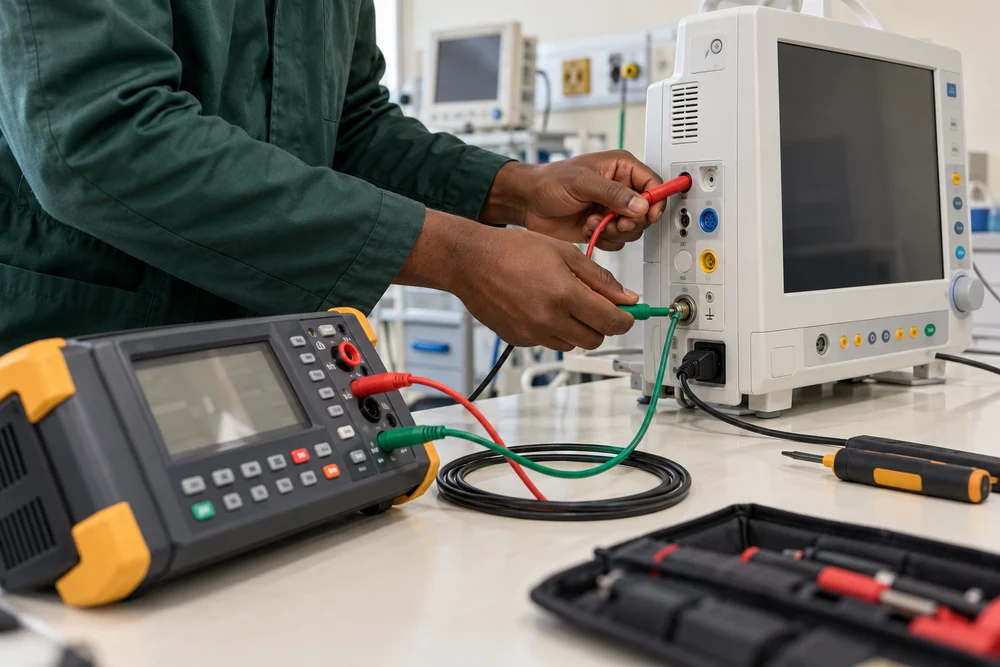
Electrical safety testing uses a defined method to assess selected safety characteristics under specified conditions. Measurements and acceptance limits depend on equipment design, applicable standard and test purpose; they should be stated in the agreed scope.
Medical electrical equipment can have different protective arrangements, applied parts, accessories, power supplies and connections to other devices. The test plan needs to reflect the actual configuration. A test on a detached monitor does not automatically cover every connected module, trolley, accessory or assembled system. Manufacturer instructions and technical information help determine suitable test sequences and conditions.
Before approval, ask what is included and excluded. The quotation should identify test activities, configuration, acceptance criteria and how results are reported. Do not infer that an electrical check includes functional performance, calibration, software validation, image quality, installation inspection or facility-wiring certification. If those are required, list them so Franance can review whether they belong in this offer or need a separate specialist scope.
When is IEC 62353 relevant to medical equipment safety testing?
IEC 62353 covers recurrent testing and testing after repair for medical electrical equipment and systems within its stated scope. Applicability to a device must be reviewed with product instructions, design requirements, test purpose and facility procedures.
IEC describes 62353 as a standard for recurrent and post-repair testing of medical electrical equipment and systems, including testing during maintenance, inspection and servicing. Its published scope states that it does not assess whether equipment complies with its applicable design standards and does not define repair or modification requirements. That helps separate in-service testing from design certification or a complete commissioning package.
Identify whether your procurement specification calls for IEC 62353 or another procedure and whether it applies to the system or particular device. Product instructions, protective class, applied parts and modifications may affect the method. Franance can review the requested basis and clarify it in a quotation; referencing the standard does not mean every device falls under it or that a provider holds a certification simply by naming it.
Should medical equipment be tested after repair?
A post-repair test may be appropriate when work affects safety or electrical integrity. Define the repair, relevant instructions, method and acceptance criteria, then document results before the facility makes its return-to-use decision.
Send the repair report or describe the work completed, including replacement parts, modifications or changes to the enclosure, power supply or applied-part connections. Service history helps determine relevant checks. A parts replacement and a change to electrical design can have different review requirements. A technician should not assume that one generic test covers every intervention.
A safety check and performance verification answer different questions. If a repaired device also measures, monitors or delivers therapy, the facility may need functional or calibration checks as well. List each requested check and ask for each deliverable separately. The report should identify device and work context, record agreed measurements and note unresolved issues. Facility-authorised personnel decide whether equipment returns to clinical service.
What should an electrical safety test report include?
Agree a record that identifies the equipment, configuration, test purpose, method, instrument, conditions, measurements, acceptance criteria and result. Limitations, failures, corrective action and excluded components should be clear to the facility reviewer.
A pass/fail label without context can be hard to interpret. Request asset identity, date, procedure and revision, relevant instrument details, measured values, applied limits and the basis for the decision. If a component or accessory was excluded, the record should say so. For several devices, one record per asset or a traceable schedule reduces ambiguity when equipment moves between departments.
Decide who reviews the report, where it is stored and how failed or inconclusive results are escalated. An electrical safety result does not prove the equipment is calibrated, clinically suitable, infection-safe or compliant with every regulation. Report language should stay within the test scope and avoid broader certification claims. Ask the provider to explain terminology that could imply accreditation or manufacturer endorsement before the facility accepts the document.
How should a Nigerian facility prepare for equipment safety testing?
Prepare an asset list with locations, test purpose, service history and access limits. Agree the test window, isolation and handover process, site power, contact, transport responsibility and report needs before arranging a visit.
For a batch, group assets by department or type while preserving a separate model and serial or asset number for each unit. Mark whether each device is available, in use, repaired or already out of service. Identify equipment that cannot be moved easily or must remain available for care. Facility staff should plan downtime and alternatives through their own procedures; an enquiry does not reserve a visit or establish a response time.
City, state, access rules, security, power and transport affect how work can be arranged. If equipment may move, agree packaging, custody and return responsibilities. Confirm whether testing is proposed at the facility or in a workshop. The quotation should disclose assumptions about travel, logistics, partner involvement and additional work. This is useful when the facility is coordinating testing as part of a wider maintenance or commissioning project.
What qualifications should you check for electrical safety testing?
Ask who performs the specific test, what training applies to the equipment, which procedure and instruments will be used, and whether accreditation is required for that scope. Confirm evidence and limits before authorising work.
Testing requires a method appropriate to the equipment and a person able to apply it, interpret results and recognise when further assessment is needed. Request relevant competence evidence and the intended procedure. Check that the measuring equipment is suitable for the stated tests and that its calibration or control records meet the method's requirements. If the work depends on manufacturer tools or restricted information, ask how that requirement will be met.
Where accredited testing is required, verify the accreditation body, validity and exact scope. Ask who performs the work, who issues the report and how the facility can review any specialist’s competence. The proposed test method, instrument controls, relevant qualifications and delivery responsibilities belong in the written scope. Franance can review the requirement and identify whether the proposed arrangement involves direct work, a confirmed specialist or further capability assessment. This gives the facility a basis for approval without inferring credentials from an equipment brand or a generic service label.
How does safety testing differ from calibration, maintenance and commissioning?
Electrical safety testing assesses selected safety characteristics. Calibration relates measurement results to references, preventive maintenance covers planned service tasks, and commissioning addresses installation and acceptance requirements. A project may need more than one scope.
The words testing, inspection and service are broad. A monitor due for routine maintenance may need planned inspection; a measurement accuracy concern may need calibration; a repaired unit may need post-repair safety and function checks. A new system may also need site readiness, configuration, acceptance and user handover. Combining needs in one request is reasonable, but each activity should be named in the quotation and report.
This separation prevents gaps and double counting. Ask which tasks are included, whether any check depends on completed repair or installation, who provides site utilities and which records are returned. If a test uncovers a fault, agree how the facility authorises further diagnosis or repair. A passing electrical result does not establish that other maintenance, performance or regulatory requirements have been met.
Common questions about electrical safety testing in Nigeria
How much does medical equipment electrical safety testing cost in Nigeria?
Cost depends on the device, method, number of assets, location, configuration and report needs. Send Franance the model list and purpose for a scoped quotation.
Does a passing test certify the device?
No. It records results for the specified in-service test. It does not certify original design or guarantee future safety, performance or regulatory compliance.
Is IEC 62353 correct for every medical device?
Not automatically. It concerns recurrent and post-repair testing within its stated scope. Applicability and method must be reviewed for the device and test purpose.
Can you test equipment after a repair?
Request post-repair testing and share the repair details. Identify any additional performance or calibration checks so each activity can be reviewed and quoted.
What should I send Franance?
Send manufacturer, model, serial or asset number, test purpose, repair history, requested standard, facility city/state and report fields. Do not send patient data.
Tell us what your facility needs.
Send the equipment details, your requirement and the facility location. We’ll discuss the information needed to review the scope and prepare the next step.
Contact Franance