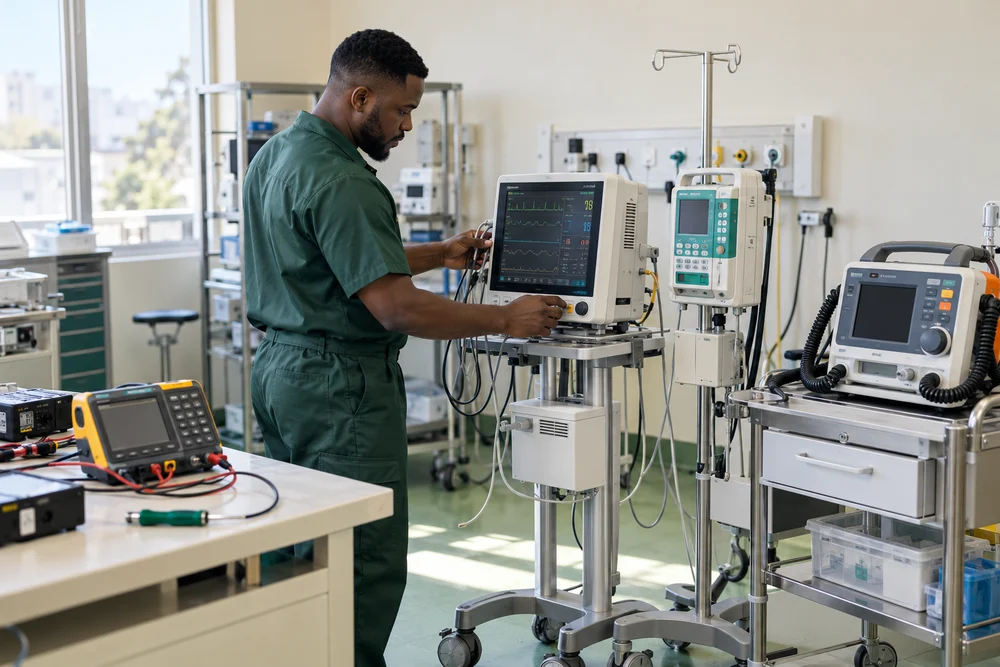
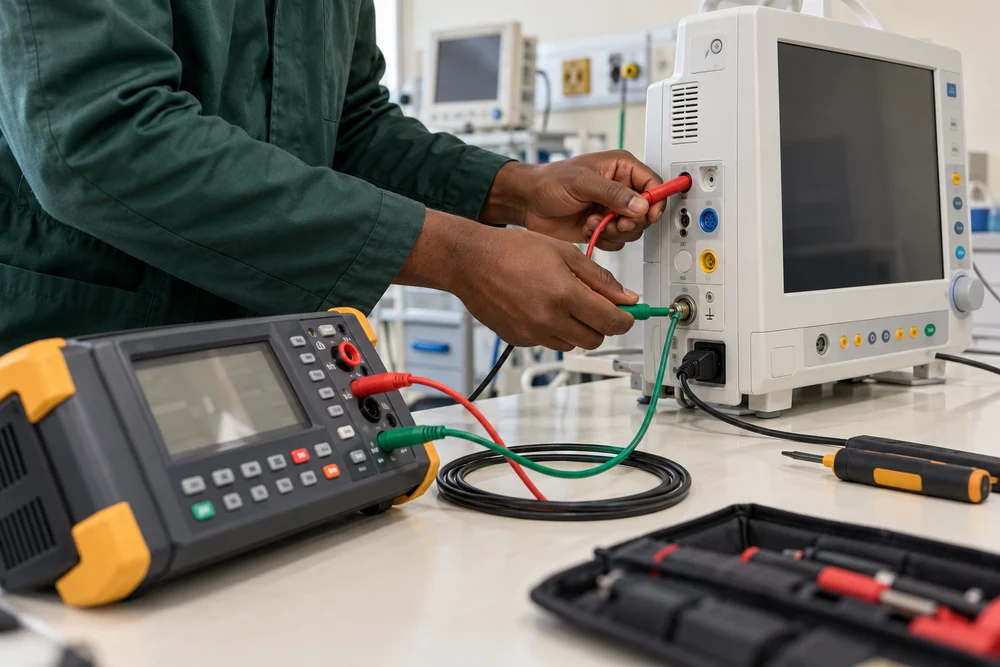
Planning patient monitoring and infusion equipment maintenance in Nigeria
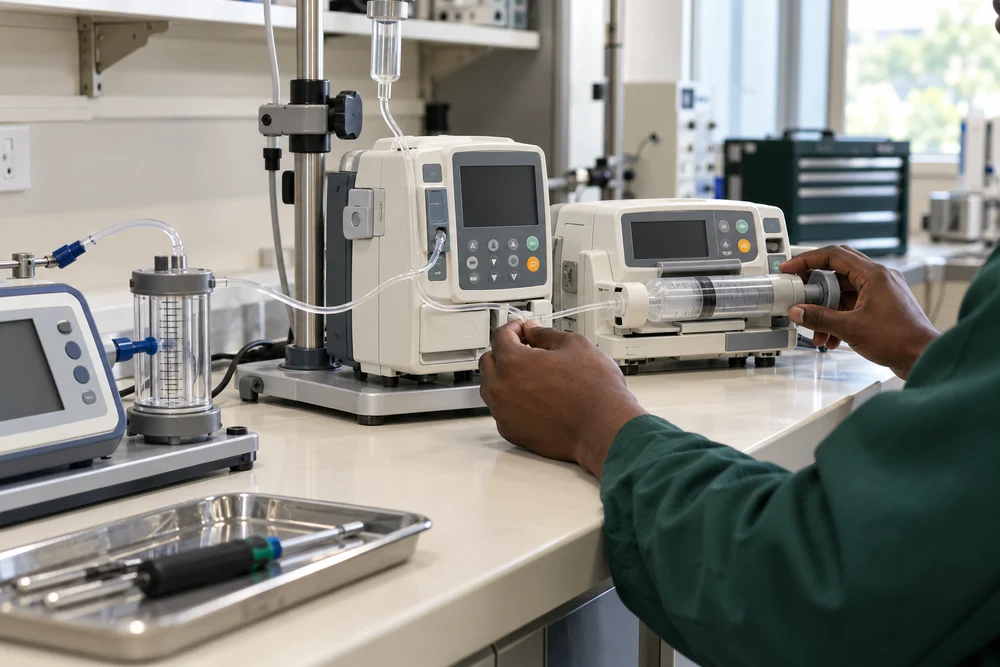
How do I request preventive maintenance for bedside equipment in Nigeria?
Use Request an assessment or Request callback on this page to discuss patient monitors, pumps or defibrillators with Franance. Send one asset line per device, with the manufacturer, full model, serial number, facility location and available maintenance history.
A group name such as “ICU monitors” is useful for an initial count, but it is not enough to define a maintenance plan. Identify whether the asset is a bedside or transport monitor, a central station, a volumetric or syringe pump, or a manual or automated defibrillator. Give each asset its own serial number and department. If your list is incomplete, say what is known and what still needs inventory; do not guess an identity from a product family or catalogue category.
Attach the applicable user or service documentation when available, plus previous visit records and a short description of the maintenance outcome you need. Remove patient names, identifiers, waveforms or clinical records from documents and photos. The enquiry allows Franance to review information and ask clarifying questions. It does not itself confirm model support, an engineer visit, a fee, response time or a service contract.
- Separate the monitor, pump and defibrillator inventory rather than combining device types.
- Mark units with open faults separately from assets due for planned care.
- List each module, battery or accessory only if it is part of the requested scope.
Which details identify monitors, infusion pumps and defibrillators?
Record the rating-label manufacturer, model and serial number for each main unit, then list any module, accessory or software configuration that changes the proposed scope.
Patient monitors may have different measurement modules, transport options, central-station connections and accessories even within one model family. Note the installed configuration and the department that uses it. For pumps, distinguish syringe from volumetric units and record the model, channel or module arrangement and any docking or communications accessories included in the maintenance request. For defibrillators, identify the device class and installed configuration without sending patient event data. The exact manufacturer documents for the model should govern any configuration-specific requirements.
A photograph of a rating label can help resolve an uncertain model, but capture only equipment identifiers. Do not send patient screens, stored events or records containing identifiable health information. If the label is inaccessible, provide the asset-register entry and say that the serial number still needs confirmation. Franance can use the information to clarify the assessment scope; it should not infer compatibility between accessories merely because connectors or product names appear similar.
- Main unit: brand, model, serial number, asset code and department.
- Monitor: measurement modules, central station or transport configuration if applicable.
- Pump: pump type, module or channel configuration and battery identity if recorded.
- Defibrillator: exact model and accessories included in the maintenance request.
How often should bedside monitoring and infusion equipment be maintained?
There is no single interval that can safely be applied to every monitor, pump or defibrillator. Base the proposed schedule on the exact manufacturer instructions, configuration, service history, use and facility requirements.
The World Health Organization describes a maintenance strategy as including inspection, preventive maintenance and corrective maintenance, with inspection and safety work serving different purposes. A schedule therefore needs a defined basis, not an arbitrary promise of monthly, quarterly or annual visits. Ask the supplier to identify the document and device version used to recommend a frequency. Where a manufacturer gives separate schedules for different components or operating conditions, those distinctions should be retained in the proposed asset plan.
Battery guidance is a useful example of why model-specific instructions matter. Mindray’s operator manuals explain status indicators and charging information for particular patient-monitor models; BD’s Alaris manuals and technical materials likewise distinguish specific pump models and service tasks. Those examples are not universal schedules for other brands. For the actual equipment, confirm the current manual, safety notices, warranty conditions and the facility’s maintenance policy before agreeing due dates.
- Document the source and version used for each device group’s interval.
- Record whether a schedule is manufacturer-recommended, facility-set or required by another rule.
- Review overdue maintenance and unresolved faults before setting a recurring calendar.
Does preventive maintenance include calibration, performance testing or electrical safety testing?
Not automatically. Name maintenance, performance verification, calibration, electrical safety testing and repair as separate activities when the facility needs them, then confirm the personnel, method, instruments, results and documentation for each.
Preventive maintenance is planned work on an identified device. It is not by itself proof that every measurement channel, alarm, delivery function or safety characteristic has been tested. A performance check should state what output is assessed, what reference or method is used, what acceptance criteria apply and who reviews the result. Calibration is a separate metrological activity with its own reference and traceability requirements; do not use “calibrated” as a general label for a maintenance visit.
For monitors, pumps and defibrillators, the selected checks depend on device type, configuration and intended maintenance document. A pump flow or alarm check is not interchangeable with a monitor parameter check or a defibrillator energy-output test. The scope should also state whether external test equipment, consumables, accessories, software or service access is needed. If Franance cannot evidence the requested method or qualification for a particular test, the proposal should exclude it or identify the appropriate external route rather than implying that it is included.
- List each requested inspection, maintenance task and test separately.
- Ask for the method, acceptance reference and result record for each test.
- Do not treat a maintenance report as calibration accreditation or regulatory sign-off.
What maintenance scope should I request for each equipment group?
Ask for a model-specific work plan that names the equipment covered, the applicable manufacturer source and the record produced. The maintenance plan should distinguish monitors, pumps and defibrillators rather than assuming one generic checklist covers all three.
For patient monitors, define whether the request includes the main monitor only or also modules, cables, batteries, stands, docks and central-station connections. Identify the measurement functions or alarms that the facility wants reviewed, while leaving the technical check method to the current model documentation and the agreed qualified scope. If a monitor is used for transport, include that context because battery condition and portable accessories may be relevant to planning; do not use the listing here as an operational assessment.
For pumps, identify syringe versus volumetric type and any modules, docking components or battery items included. The manufacturer documentation governs allowed service tasks and replacement components; a visual visit is not proof of delivery accuracy or alarm performance. For defibrillators, distinguish the main unit and accessories, and state separately whether any performance testing is requested. The facility should identify required test evidence and the proposed qualified method before accepting that work. Nothing on this page claims Franance currently holds a particular simulator, service software, parts supply or manufacturer authorization.
- Monitors: main unit, modules, probes or sensors, batteries and connectivity scope.
- Pumps: device type, channel/module arrangement and any requested performance verification.
- Defibrillators: model and separate requests for battery, accessory or output checks.
How should a facility schedule preventive maintenance without losing needed capacity?
Agree the asset list, site access, department contact, equipment availability and allowable downtime before a visit is proposed. The final visit cadence and sequence depend on the reviewed devices and the written scope.
Hospitals can group work by department or model to reduce scheduling friction, but grouping must not hide which individual devices were actually included. Identify any assets that cannot be unavailable at the same time and provide the department’s preferred maintenance window. If the facility expects a loan unit, urgent response or a fixed turnaround, state the requirement clearly; those are commercial and operational terms to be confirmed, not standard promises made by a general maintenance enquiry.
Before the agreed date, update the asset list for units that have moved, been replaced, developed a fault or become subject to a new warranty or service arrangement. The facility should coordinate access with its biomedical engineering team and responsible clinical departments. If a device cannot be made available or a required document or accessory is missing, the work record should show what was not completed and how it will be followed up. No visit frequency or attendance location is guaranteed until the scope and logistics are agreed in writing.
- Keep critical devices available according to the facility’s own continuity plan.
- Schedule unresolved fault assessment separately from routine planned work.
- Agree transport, custody and return terms before any asset leaves the facility.
What should the maintenance record and follow-up plan include?
Request one record per asset with its identity, work actually performed, findings, limitations, any agreed test results and outstanding actions. The report should distinguish completed maintenance from work not performed or additional work awaiting approval.
WHO maintenance-programme guidance describes documentation of activities and equipment history as part of a managed programme. For your own asset records, agree in advance which fields Franance will return: date, model and serial number, reported condition, source procedure, tasks completed, results where tests were included, parts or consumables used, and recommendations. Make sure that every limitation is explicit—for example, if a check could not be completed because the unit was in use, an accessory was unavailable or a fault needs separate diagnosis.
The facility should review open findings and assign internal owners. A recommendation is not a confirmed fault diagnosis; a quotation is not authorization to proceed; and a maintenance label does not replace required test evidence. Keep the report with the manufacturer manual, warranty papers and previous service history. If the facility requires specific acceptance criteria or a particular form, send it before quotation so the deliverable can be reviewed and agreed rather than assumed after the visit.
- Asset-specific record and date of work.
- Completed tasks, results and limitations identified separately.
- Open findings, responsible decision-maker and next agreed action.
What should a patient-monitoring preventive maintenance quotation include?
Ask the written quotation to identify covered assets, planned tasks, schedule basis, site or workshop arrangement, reports, exclusions, price and approval process for additional work.
Do not compare proposals only by the words “PPM”, “AMC” or “comprehensive”. Those terms can describe different inclusions. Ask whether the amount covers labour, travel, parts, consumables, software, accessories, testing, batteries or only the specifically listed maintenance tasks. The supplier should name charges that may arise if a fault is discovered or work cannot be completed during the agreed visit. If a recurring contract is proposed, establish how asset additions, substitutions, overdue work and renewal changes affect the cost.
Any response time, emergency attendance, uptime level, loan equipment, regional coverage or replacement-parts commitment is a promise that must appear in the specific signed terms. The presence of a brand in the Franance catalogue does not verify service capability for that make or model. Share the facility location and required commercial arrangement so Franance can assess what can be proposed. Do not rely on an assumed rate, turnaround or manufacturer status; request a line-item proposal with exclusions and an explicit approval step before extra work.
- Check asset count, device types and excluded accessories against the submitted list.
- Separate recurring maintenance charges from repair, parts, travel and testing.
- Require written approval before additional work or costs are added.
Brand-specific equipment support in Nigeria: ICU Medical infusion pump equipment service enquiries – Spacelabs Healthcare patient monitoring and ambulatory cardiology equipment services
Choose the manufacturer to review its equipment-specific enquiry requirements and available documentation before requesting a written service scope.
The brand pages explain which model, configuration and fault details to include. A listing does not establish that every service, part or manufacturer programme is available for a particular unit; the written response defines the proposed scope.
Common questions about planned care for patient monitors, pumps and defibrillators in Nigeria
Does Franance offer a fixed maintenance interval for every device?
No universal interval is stated. Send the exact model and available manual so the schedule can be reviewed against manufacturer guidance, condition, use and facility requirements.
Are batteries and accessories automatically included?
No. Identify batteries, modules and accessories in the asset scope. Their inspection, replacement and any costs need to be confirmed in writing for the exact device.
Does a preventive maintenance visit certify that the equipment is safe for use?
No general certification is implied. Any performance or safety test needs a defined method, qualified scope, acceptance criteria and report; facility decisions remain with the responsible personnel.
Can one proposal cover monitors, pumps and defibrillators?
You can submit a combined asset schedule, but the scope should identify each model and device type separately, including distinct tasks, exclusions and records.
Will the maintenance plan include repairs found during a visit?
Not by assumption. Findings and corrective work should be documented, quoted and approved separately unless the written terms explicitly state otherwise.
Tell us what your facility needs.
Send the equipment details, your requirement and the facility location. We’ll discuss the information needed to review the scope and prepare the next step.
Contact Franance