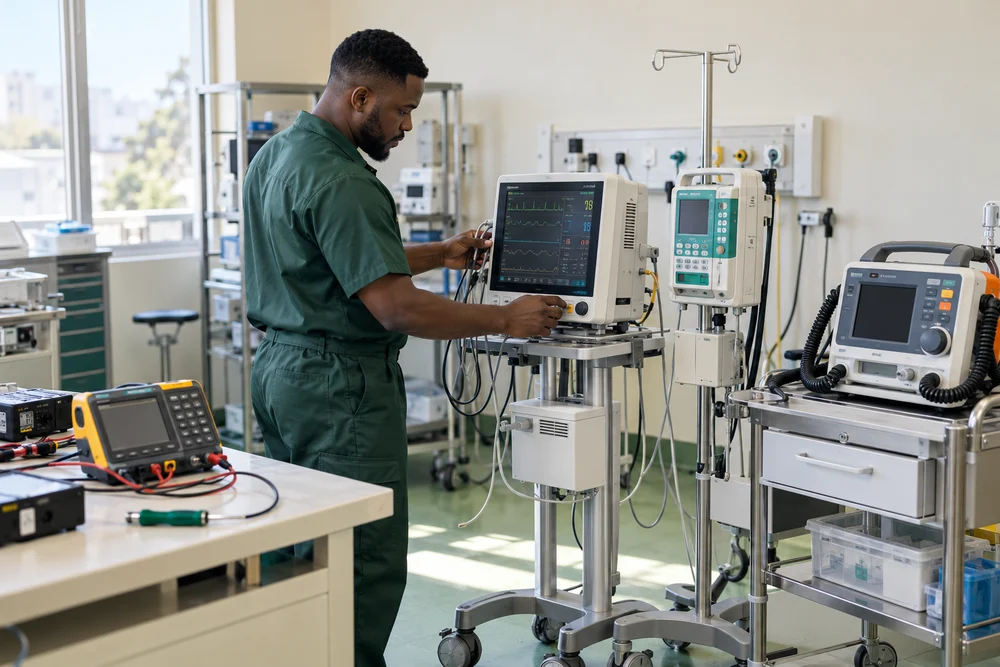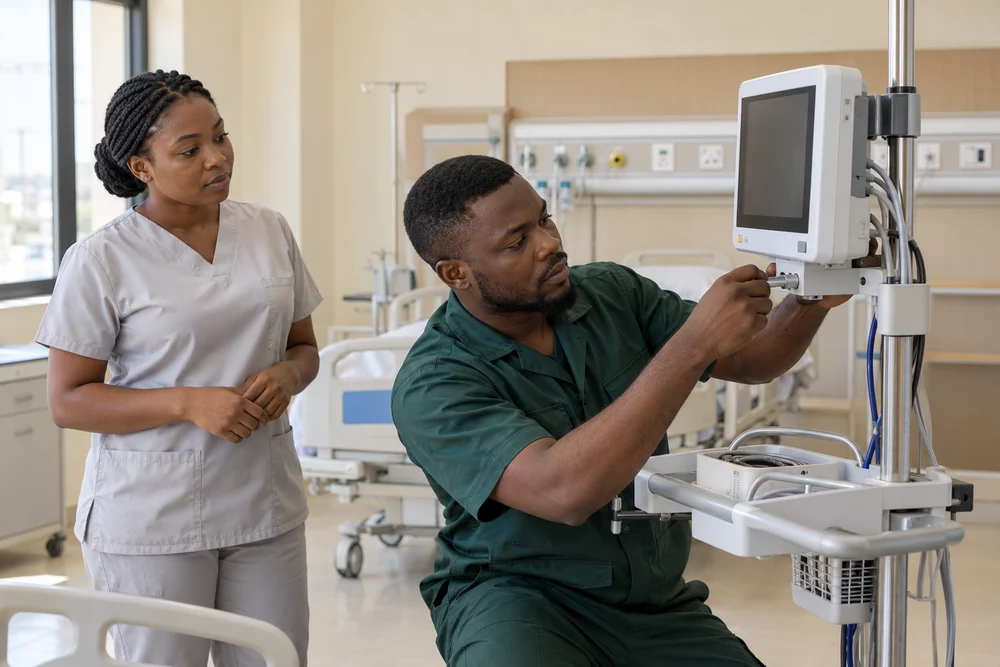
Planning preventive maintenance for ultrasound and digital X-ray equipment in Nigeria
How do I request imaging preventive maintenance in Nigeria?
Use Request an assessment or Request callback on this page and identify whether the enquiry concerns an ultrasound system or digital X-ray equipment. Provide the model, serial number, facility location, maintenance history and intended scope.
Send a separate inventory line for every system and separately tracked component. For ultrasound, identify the scanner and each probe involved, including model or serial markings where readable. For digital X-ray, specify fixed or mobile system, generator or detector configuration where known, workstations and any detector panel included. This page intentionally excludes CT and MRI. A product listing, supplier relationship or general service enquiry does not establish that a particular system can be maintained by Franance.
Include the current user or service manual, prior service reports, installation details and QA records that your facility is able to share. Describe whether you need manufacturer-scheduled service, a fault assessment, component inspection, image-quality testing or documentation for a facility quality system. These are not interchangeable outcomes. Do not send patient images, DICOM files, names, identifiers or clinical records. The shared page controls let you request an assessment or callback; the enquiry is not a diagnosis, appointment, radiation-safety approval or service-coverage promise.
- State the facility city and state and identify the responsible equipment contact.
- Mark an unresolved fault separately from routine maintenance due.
- Name separately any image-quality, acceptance, calibration or radiation-safety work required.
Which details identify ultrasound systems, probes and digital X-ray detectors?
Use rating-label details for the system and component, then describe the installed configuration without inferring compatibility. Model, serial number, software generation and accessories help define which manufacturer documents and work scope apply.
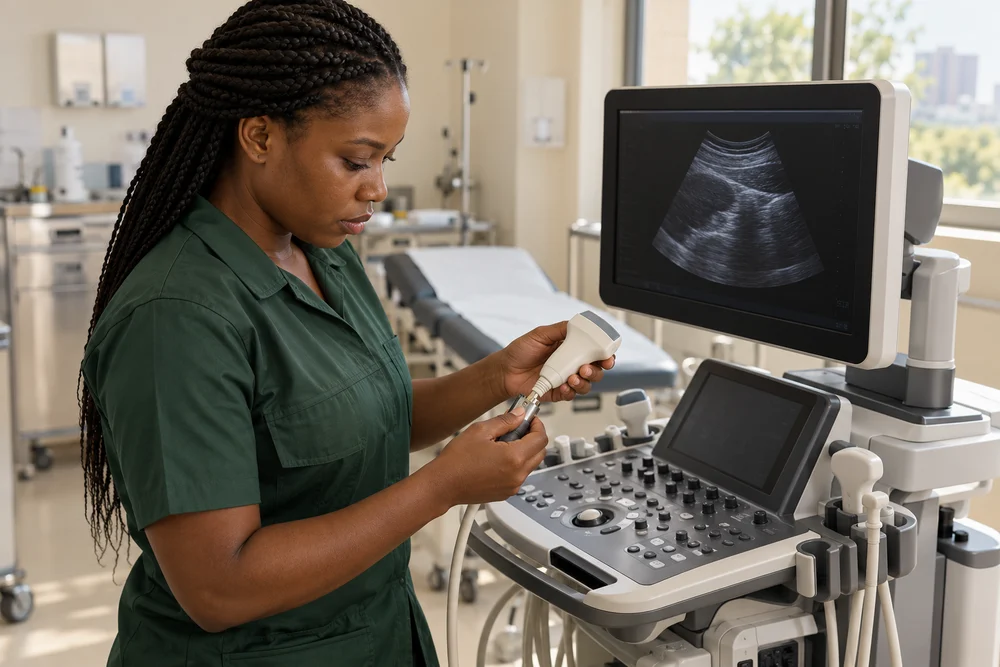
For an ultrasound system, record the platform model, serial number, software version when available and whether it is portable or room-based. List each probe separately with its printed model or part number and serial number. Record whether the request concerns a probe, its cable or connector, the scanner, or more than one item. A probe family name alone is not enough to establish that it is compatible with a scanner or that one probe can be substituted for another. Philips’ care guidance emphasizes that system and transducer handling and cleaning instructions are model-specific; use the exact manufacturer instructions for the installed equipment.
For digital X-ray, identify fixed or mobile system, generator/system model, detector model and workstation/software context when available. Separate a system fault from a detector-specific issue, image artefact, workstation issue or network-transfer problem. If a part label is difficult to read, provide a non-patient photo of the label or list what is unknown. Never attach patient images to illustrate a fault. These details support review and quotation; they do not constitute an engineering diagnosis or confirm parts availability.
- Record main-system and component identities separately.
- State whether equipment is fixed or mobile and note recent relocation.
- Share only equipment labels and non-patient technical information.
How often should ultrasound and digital X-ray systems be maintained?
Use the maintenance schedule and operating instructions for the exact system and components, together with facility requirements and service history. Do not apply one interval to every manufacturer or assume that a catalogue page defines the schedule.
WHO’s maintenance-programme guidance distinguishes inspection, preventive maintenance and corrective maintenance as related but separate parts of equipment management. The manufacturer’s instructions for the installed model should set technical requirements; the facility can then incorporate those requirements into its equipment schedule and local quality system. Ask a supplier to identify the source and version used for a proposed interval, and how it applies to the system, probes or detectors listed. A repair, relocation, repeated fault or change in configuration may require a separate review rather than simply waiting for the next routine visit.
For ultrasound, keep system and transducer instructions together. Philips’ official care information says ultrasound systems and transducers require proper care, cleaning and handling, and directs users to the exact care instructions with their warnings and cautions. For X-ray, FDA information states that systems should be properly maintained and tested and facilities should implement regular quality-control tests. These sources do not set a universal Franance visit cadence. No interval should be invented from the modality label alone; record whether the schedule comes from the manufacturer, facility policy or a specific rule applicable to the site.
- List the model-specific source and revision used for each proposed schedule.
- Track probes and detectors with separate service histories where applicable.
- Reassess after relocation, major work, recurring issues or configuration changes.
Does routine imaging maintenance include image-quality or radiation-safety testing?
Not by assumption. State whether you need routine maintenance, image-quality or performance testing, acceptance checks or radiation-safety work. Each requires an agreed method, applicable personnel and an explicit report.
FDA says health-care facilities employing ultrasound should conduct regular quality-control tests to ensure the equipment functions properly. For X-ray, FDA likewise describes regular quality-control tests and appropriate maintenance as part of facility quality assurance. Those are facility-level responsibilities and references; they do not mean that routine servicing by a supplier automatically satisfies your QA programme. Ask what will be tested, against which criteria, using which phantoms or instruments, by whom and with what record. Do not call an activity an acceptance test, calibration, radiation survey or QC sign-off unless that exact scope and qualification are confirmed.
In Nigeria, NNRA publishes authorization requirements for diagnostic and interventional radiology facilities, including equipment and quality-control documentation. The facility should check its own current requirements directly with NNRA and its radiation-safety personnel. This maintenance enquiry does not replace licensing, shielding, radiation-protection programme, dose monitoring, acceptance testing or QC responsibilities. Ultrasound does not use ionizing radiation, but its equipment remains subject to the manufacturer’s instructions and the facility’s quality and safety processes.
- Write down each requested test and its acceptance basis before quotation.
- Separate maintenance findings from formal QA, acceptance and regulatory documents.
- Confirm the facility’s applicable NNRA and radiation-safety requirements independently.
What should an ultrasound maintenance request say about probes?
Treat each transducer as an individually identified component with its own handling, cleaning and service history. Include the probe model and serial number, the scanner it is used with, and any visible condition or service concern.
Probe accessories are often handled and cleaned under dedicated manufacturer instructions. Philips states that its ultrasound systems and transducers require proper care, cleaning and handling, and that users should follow the specific instructions and warnings for the product. Ask the facility to provide the applicable instructions and describe the routine it currently follows; do not improvise a disinfectant, cleaning method or immersion step based on generic advice. If the probe has a damaged cable, connector, lens or housing, disclose that fact to the facility’s responsible person and to Franance when requesting assessment.
Keep probe questions distinct from system maintenance. A problem that appears on one probe may lead to a different assessment than a symptom affecting several probes or the entire platform, but only a qualified assessment can determine the cause. Record which probe was involved and the scanner configuration without moving parts between systems merely to test them. Do not request user-performed repair from this article. The approved service scope should state whether the probe itself, the host system, or both are included and who is responsible for manufacturer-specific inspection or replacement decisions.
- List probe model and serial number separately from the scanner.
- Provide the manufacturer’s care instructions and disclose any damage history.
- Ask the quotation to identify probe assessment separately from system work.
What should a facility clarify before planned digital X-ray maintenance?
Identify the system, detector, access conditions, facility radiation-safety contact and requested deliverables. Any work or tests involving radiation must be separately planned under the facility’s applicable rules and confirmed personnel scope.
A fixed system, mobile system, detector panel and workstation have different access and configuration needs. State whether the equipment can be made available without clinical work in progress, whether the room requires an authorized escort, and whether the facility’s radiation-safety officer must approve or supervise any planned testing. The facility should not assume that a general preventive-maintenance visit includes exposures, dose measurements, image-quality testing or acceptance work. If these are needed, name them explicitly and ask who will perform them, with what instrument and under which documented method.
NNRA’s published diagnostic and interventional radiology requirements describe facility responsibilities concerning authorization, equipment, quality-control evidence and radiation-protection arrangements. A maintenance supplier’s visit does not establish that the facility meets those requirements. FDA’s materials are US references and should not be substituted for Nigerian requirements; they reinforce the distinction between properly maintained equipment, facility QC and trained personnel. Franance makes no claim here to hold NNRA accreditation, radiation-safety authorization, a calibrated survey meter or qualified imaging-testing personnel. Confirm the named provider, equipment and qualifications in writing before relying on a test deliverable.
- Name the facility contact who controls radiation-safety arrangements.
- Separate service access from any radiation-producing test or acceptance work.
- Confirm the written method, test instruments, personnel and report before approval.
How should a hospital schedule planned imaging maintenance?
Agree system availability, room access, department contact, expected downtime and any component custody arrangements before accepting the proposal. The facility’s users and safety personnel control operational readiness and return-to-use decisions.
For ultrasound, coordinate access to the console, probes and relevant documentation and state if the room is booked for clinical work. For digital X-ray, coordinate with radiology and the person responsible for radiation safety before any proposed test. If the detector or another removable component is to be transported, record its model and serial number and agree who packs it, holds custody, insures it and returns it. A workshop option is not assumed and may not apply to an installed system. Confirm the actual location and logistics proposed for your case.
Before the visit, reconcile the inventory against any recently moved or replaced equipment and tell the reviewer about new faults or service events. Plan for units that cannot be unavailable at the same time under the facility’s own continuity arrangements. If access, system passwords, service software or manufacturer assistance are needed, agree who will provide them and whether they are included. No turnaround, attendance date, emergency response or nationwide coverage is promised until the specific terms are reviewed and accepted in writing.
- Coordinate equipment availability with the relevant department and site contact.
- Agree any transport and chain-of-custody terms before components leave the site.
- State any downtime or scheduling constraints during the initial assessment.
What should a preventive-maintenance proposal and handover include?
Request an itemized proposal and an equipment-level record that identify exactly what was covered, what was tested, what remains open and what follow-up requires a separate decision.
The written scope should list each system and component, tasks, schedule basis, access requirements, downtime assumptions, required documentation and exclusions. Separate labour, travel, parts, consumables, software or manufacturer dependencies, quality testing, calibration or radiation-safety activities where relevant. If a service cannot be completed because an accessory, manual, room access or test instrument is unavailable, the record should identify the limitation instead of marking the asset fully maintained. A proposal should also specify how new findings are quoted and approved before costs are added.
At handover, request system and component identifiers, date, work performed, applicable instructions, results for any separately agreed test, observed condition, outstanding actions and any return-to-use limitation for the facility to review. A completed maintenance report is not proof of image quality, radiation safety, regulatory compliance or clinical readiness. Those judgments belong to the facility’s responsible qualified personnel under its procedures. The facility may connect a planned-maintenance enquiry to a separate repair, installation or imaging-quality assessment, but each scope and price should remain visible.
- Require model-specific asset lines and specific tasks, not only a modality label.
- Show maintenance, parts, travel, testing and documentation separately.
- Record limitations and open actions for each asset.
Common questions about planned care for ultrasound and digital x-ray in Nigeria
Does this planned-maintenance scope include CT or MRI?
No. This page covers ultrasound and digital X-ray only. CT and MRI require separate source review and a distinct service scope.
Does maintenance automatically include image-quality testing?
No. Identify the required tests, method, qualification, acceptance criteria and report as a separate scope before the quotation is approved.
Will Franance perform radiation-safety checks on an X-ray system?
No capability is promised here. State the requirement and confirm the personnel, instruments, applicable Nigerian authorization and written deliverable before relying on it.
Should ultrasound probe cleaning follow a generic schedule?
Follow the current manufacturer instructions for the exact system and probe. Provide those documents with the enquiry; this page does not give cleaning procedures.
Can the maintenance visit be booked at a fixed interval?
The schedule is reviewed against the exact model manuals, facility requirements and service history. A visit cadence or booking is only confirmed in writing for the agreed scope.
Tell us what your facility needs.
Send the equipment details, your requirement and the facility location. We’ll discuss the information needed to review the scope and prepare the next step.
Contact Franance