A practical guide to digital x-ray and ct repair enquiries in Nigeria
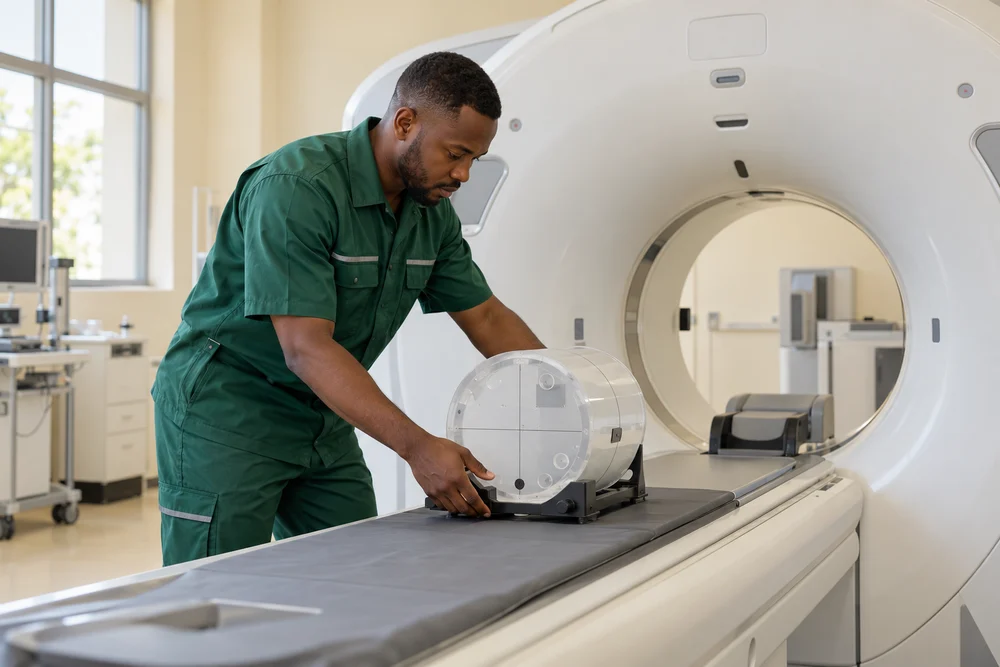
Where can I send a digital X-ray or CT repair enquiry in Nigeria?
Use the Request an assessment control at the top of this page, or choose Request callback to discuss the repair enquiry directly with Franance with the equipment details and fault description set out below. Franance reviews each request against the actual system, fault and site before anything is promised or priced. The national medical equipment repair page describes the process: identify the equipment, document the fault, agree an assessment, then approve a written scope.
A catalogue listing does not establish repair support. Franance's catalogue includes systems and components such as the Shimadzu RADspeed Pro XF, the Carestream DRX-Revolution mobile system, the Carestream DRX Plus 2530C detector and the Siemens SOMATOM go.Top as a 64-slice CT listing. Whether Franance can assess a particular installed system, in a particular configuration and software generation, is confirmed after review. Nothing in this draft claims manufacturer authorisation, OEM status, a qualified-person capability or blanket coverage for a brand. For imaging, any statement about who will attend, and with what qualification, belongs in the written scope and needs supporting evidence from Franance before it is relied on.
An enquiry is not an emergency booking. Your facility decides whether equipment stays in use under its own procedures.
What identification details does Franance need for an imaging system?
Brand and room name are not enough. Collect, for each asset:
Photograph rating labels and the error screen. Remove or crop out patient names and images. Do not send clinical images.
- Manufacturer, full model name, serial number and year of installation.
- For X-ray: whether the system is fixed room or mobile, plus the make and model of the X-ray tube and housing, generator, collimator, table or wall stand where visible on labels.
- For DR: detector make, model and serial number, size or format, wired or wireless type, and the acquisition software name and version.
- For CT: scanner model, software version, and whether a workstation, injector or reporting software is part of the enquiry.
- Which parts are installed together. Detector, software and host system are separate configuration elements, and a detector is a component, not a complete system.
- Existing warranty, service agreement or manufacturer support arrangement.
- Previous service reports and any recent change such as relocation, power event, detector replacement or software update.
How should I report a digital X-ray or DR detector fault?
Describe what happened and when, not the part you suspect. Useful questions to answer:
Manufacturers describe detectors as separate products from the systems they work with. Carestream's detector portfolio page, for instance, lists detectors in several sizes and states no universal compatibility, and points to general service contacts rather than detector-specific terms. Provide the exact detector and host system so compatibility is checked rather than assumed.
Please do not open housings, remove covers, disconnect high-voltage components or attempt cleaning beyond your manufacturer's instructions. That belongs inside an agreed, qualified assessment.
- What exact message or error code appears, and at which step: system start-up, detector connection, exposure, image preview or image export?
- Is the problem with the system as a whole, with one detector, or with one workstation?
- For a wireless detector: does the fault occur when it connects, when it is charged, or after handling? Has it been dropped or exposed to liquid, and is there visible damage to the casing?
- Do image artefacts appear (lines, blocks, ghost areas, unusual noise)? Describe them in words; image examples must be non-patient test images only.
- Does the fault occur with every detector, or only one?
- Did something change beforehand: relocation, network change, power outage, software update, detector swap?
- Is the fault constant or intermittent?
- Is the system currently out of use, partly used, or awaiting a decision?
How should I report a CT fault?
CT is a distinct section because of its scale, site services and software dependence. The FDA's CT overview describes CT as a noninvasive exam using specialised X-ray equipment to produce cross-sectional images; the equipment is complex and is regulated and operated within quality assurance programmes. For a repair enquiry, answer:
CT sites also depend on cooling, stable power, network and room conditions. Include whether any of these were affected, but do not attempt to fix site services or reset equipment outside your facility procedures.
- What is the scanner model, software version and installation date?
- What error message or system status is shown, and during which stage (power-up, gantry or table operation, scan, reconstruction, network transfer)?
- Does the fault affect scanning, table movement, image reconstruction, workstation use or only data export?
- Is it constant or intermittent, and has it happened before?
- Have there been recent site events: power fluctuations, cooling or air-conditioning issues, network changes or relocation?
- Is the scanner out of use, limited, or running with a restriction?
- What do the last planned service report and any recent quality-control record say?
- Is a service agreement or manufacturer arrangement in force?
Where is the boundary between tube, detector, generator and software?
A reported fault can sit in different places, and the scope should reflect that:
Ask Franance to state in the written scope which of these boundaries the assessment covers, which are excluded, and which depend on a manufacturer route or specialist. Where a part depends on manufacturer-restricted software, tools or documentation, the scope should say who provides them. The US FDA's 2024 servicing and remanufacturing guidance draws a general distinction between servicing that restores original specifications and changes that alter performance or safety specifications. It is US guidance, but it explains why repair scope must be explicit.
- X-ray tube and generator: fall under high-voltage and radiation-producing parts. A symptom such as no exposure or an exposure error does not itself show which component has failed. Tube and housing references must be confirmed for the installed system; a tube listing for one system does not imply compatibility with another.
- Detector: image-capture, communication and battery or charging behaviour. A detector fault is not a tube fault. Replacement detector offers also need host-system, software and calibration requirements checked.
- Collimator, grid, table and stand: mechanical and positioning parts that influence images and workflow.
- Software and workstation: acquisition software, image processing, network and storage, where image problems may come from configuration rather than hardware.
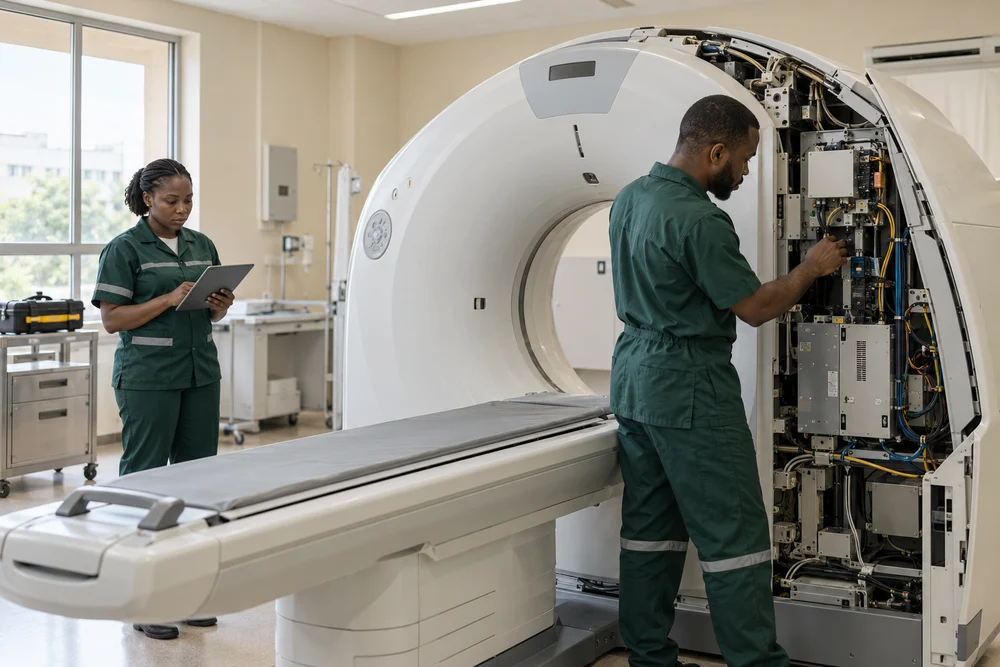
- CT subsystems: gantry, table, cooling, workstation and reconstruction software, each needing identification before a quotation.
What are the radiation-safety limits of a repair enquiry?
This guide is not radiation-protection advice, and an enquiry does not replace your facility's regulatory duties. In Nigeria, the Nigerian Nuclear Regulatory Authority (NNRA) states that authorisation of diagnostic and interventional radiology facilities is governed by its minimum requirements and the Nigerian radiation safety regulations. Those requirements include an NNRA-accredited Radiation Safety Adviser, a designated Radiation Safety Officer, staff trained for installation and acceptance tests, quality control tests on radiation-generating equipment, and a shielding assessment. Check your own authorisation position directly with NNRA; Franance does not issue, replace or vouch for it.
The FDA's overview of medical X-ray imaging states that equipment should be properly maintained and tested, and that regular quality control tests should confirm equipment works properly. Those are facility responsibilities that continue alongside any repair.
Practical consequences for your enquiry:
- Do not request or expect exposure tests, dose measurements or quality-control sign-off as an assumed part of repair. If you need them, name them in the enquiry and ask who would perform them and with what qualification.
- Any work that may produce radiation should be arranged with your Radiation Safety Officer under your local rules.
- Franance should provide evidence of qualified personnel before any imaging delivery statement is relied on. None is asserted here.
- Return to clinical use, and any acceptance or QC decision, remains with your facility and its qualified experts.
What should the assessment, quotation, location and handover include?
Ask Franance to set out in writing:
On-site versus workshop is an item to confirm, not a standard offering. A fixed X-ray room or CT scanner cannot be moved, so any workshop element would likely apply to removable parts such as a detector, if proposed at all; a mobile system or a detector might be considered differently. Confirm who packs and ships components, who takes custody, what site access and radiation-area arrangements apply, and how city, state and site logistics are handled.
For handover, request a record naming the asset, reported fault, work completed, parts replaced, checks carried out with results, open limitations and any checks left to your facility's qualified experts.
- Assessment scope: what is examined, what information and access are required, and whether an assessment charge applies and is credited against later repair.
- Findings record: what is documented if the fault is confirmed, not reproduced or outside scope.
- Quotation: labour, parts, travel, freight, software items and testing shown separately, with exclusions such as consumables, accessories and pre-existing faults.
- Parts identification: how the exact part will be matched to the installed system, and what depends on manufacturer supply.
- Change control: how additional findings are approved before extra work.
- Repair or replace information: enough for your facility to compare options. See the catalogue pages for fixed digital X-ray, mobile digital X-ray, DR detector panels and 64-slice CT, which show listings without establishing repair support.
How do I submit several imaging assets or related work?
Send one row per asset: facility asset number, manufacturer, model, serial number, department, status and fault. Keep digital X-ray, detector and CT lines separate. Identical detectors can have different histories, so list serial numbers. Mark units needing assessment apart from those included for inspection or a second opinion.
Related work should be a separate package: installation and commissioning for a move or new system, preventive maintenance for planned care after repair, and imaging quality and radiation safety for quality-assurance questions that need their own scope.
Common questions about digital x-ray and ct repair in Nigeria
Does a catalogue listing confirm imaging repair support?
No. It identifies an equipment listing, not confirmed service coverage. Provide the installed model, configuration, fault and location for review.
Can a detector be assessed separately from the X-ray system?
The enquiry can identify a detector as a separate asset or component. Any compatibility, software, calibration or host-system dependency must be confirmed for the installed configuration.
Is a repair enquiry an emergency response or booking?
No. Tell Franance the facility location and urgency. Attendance, availability, response time and any assessment charge require explicit agreement.
Should patient images be attached?
No. Use equipment labels and non-patient technical information. Do not submit patient names, identifiers, clinical records or patient images.
Tell us what your facility needs.
Send the equipment details, your requirement and the facility location. We’ll discuss the information needed to review the scope and prepare the next step.
Contact Franance