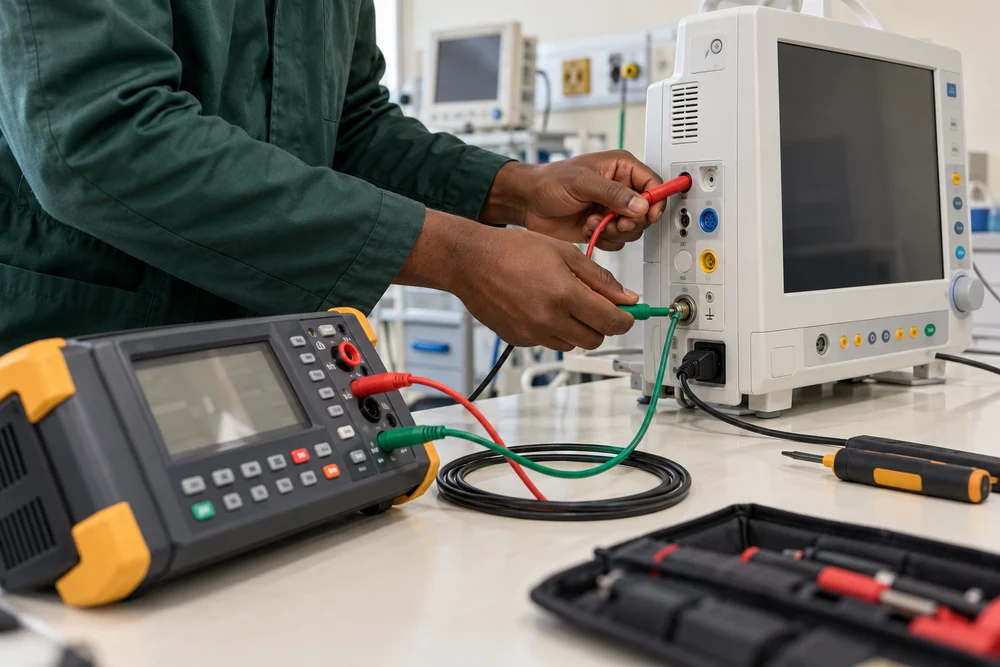
A practical guide to patient-monitor, pump and ventilator verification enquiries in Nigeria
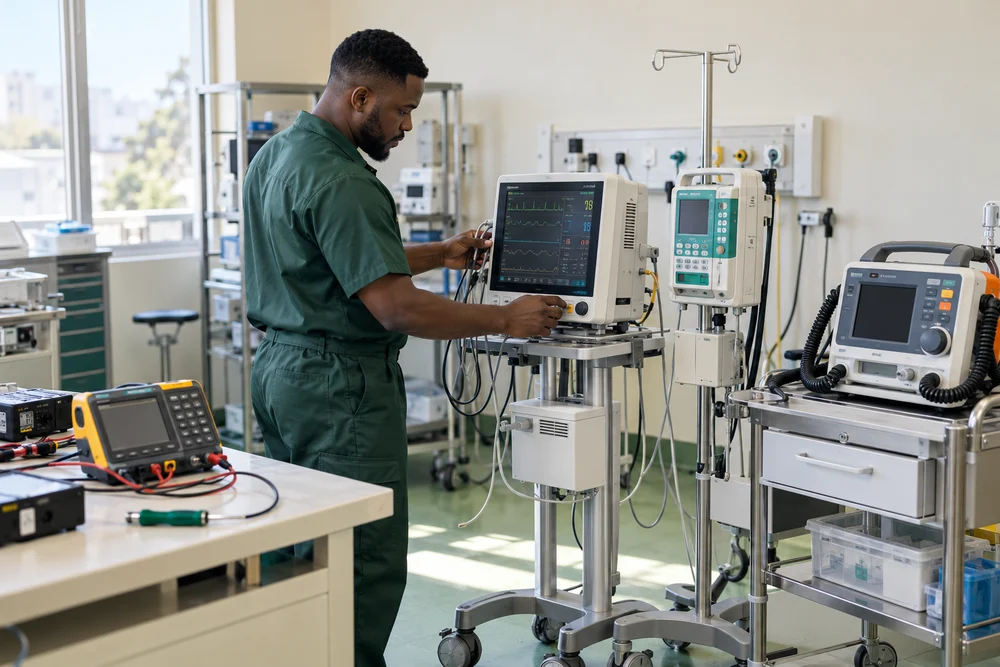
Where can a facility in Nigeria request patient-monitor or infusion-pump performance verification?
Send Franance the exact device, functions, configuration, facility location and evidence your team needs. Franance can review the request and confirm whether a suitable scope, reference equipment, location and report can be agreed; an enquiry does not confirm delivery capability or a booking.
A useful request names the question to be answered. A patient monitor may need checks of selected ECG, non-invasive blood pressure, temperature, oxygen saturation or invasive pressure channels. A pulse oximeter request concerns the model, sensor type and operating range. An infusion or syringe pump request may concern a programmed delivery rate, volume, pressure limit or alarm response. A ventilator request can involve several measured functions. These are different test tasks and should not be bundled under a vague request for calibration.
Include manufacturer, exact model, serial or asset number, software or module details where visible, accessories, facility city and department. Say whether the unit is recently repaired, due for a planned check or showing a concern. Franance can review the information and discuss an assessment or quotation. The proposed scope must identify functions and conditions covered, method and reference equipment, exclusions, logistics, deliverable and commercial terms before work is authorised.
Use the on-page enquiry form to request a review or callback. A callback request is a request to discuss the asset and scope; it does not establish that a particular test can be performed, that an engineer is available at a given time or that an on-site visit is included. Confirm those points in the written offer for your facility and device.
Is performance verification the same as calibration?
No. Calibration relates readings to reference values under defined conditions. Verification evaluates specified functions against agreed acceptance criteria. Neither term by itself means the device was adjusted, repaired, passed, or assessed across every channel.
The word calibration is often used loosely for a functional check. A calibration task should identify the quantity, range, test points, conditions, method, reference and measurement result. Performance verification asks whether defined functions meet a stated requirement. Adjustment changes a device setting; repair addresses a fault. These activities are related, but each requires its own scope and record.
This distinction matters for patient monitors and pulse oximeters because one device can combine multiple channels, modules, probes and accessories. A check of SpO2 does not automatically verify ECG, NIBP or temperature. For pumps, a check of flow at one programmed rate does not establish performance at other rates, syringes, sets, pressure or alarm conditions. For ventilators, a selected pressure or volume check does not certify all modes or clinical performance.
Before approving a request, ask whether the deliverable will be a calibration record, performance-verification report, maintenance record or combination. Agree whether results will be recorded before and after any adjustment, if adjustment is separately included, and how the decision will be made. A document should describe only the work actually completed.
Which patient-monitor functions should be listed in the request?
List each channel and accessory separately: for example ECG/heart rate, NIBP, temperature, SpO2 or invasive pressure, plus modules and sensor types. Share required ranges and acceptance criteria so the proposed check can match the configuration.
Start with the channels used by the department, not just the monitor family name. Identify whether the device is bedside, transport or modular, and record installed modules, parameter options and software version if available. For ECG, identify lead configuration and relevant heart-rate ranges. For NIBP, note cuff sizes or simulator conditions expected. For SpO2, identify sensor type and facility requirement. For temperature and invasive pressure, include the relevant probe or transducer interface.
A reference simulator or analyser must suit the function and configuration being checked. The written scope should identify the proposed reference and test conditions; Franance has not represented that it holds a particular simulator, reference standard, or traceable calibration for any measurement. If a channel depends on a module or accessory that is unavailable, document that as an exclusion rather than treating the entire monitor as checked.
Tell the reviewer whether this is an acceptance check, periodic verification, or follow-up after repair. Provide the facility procedure or manufacturer specification used for the acceptance decision. If no tolerance or method has been selected, the enquiry can ask what information is needed to define one; it should not invent a pass limit after seeing results.
What information helps scope a pulse oximeter verification?
Provide the model, sensor and connector type, intended configuration, displayed parameters and requested range or procedure. Confirm whether this is a standalone oximeter or an SpO2 channel within a patient monitor.
Pulse oximeters may differ in sensor compatibility, connector, alarm configuration and operating range. Include exact device and sensor identification, whether the sensor is reusable or disposable, and any extension cable or module in the setup. State the clinical department and why the check is needed, such as scheduled verification or review after service. Do not send patient-identifiable data in an equipment enquiry.
The proposed method should identify the reference simulator or other method used and points tested. A simulator check does not reproduce every element of measurement on a patient, and its result should be interpreted within the agreed method and manufacturer instructions. Confirm whether alarm settings, display, signal indicators or only measured values are in scope. Do not assume that checking one sensor type establishes performance with every compatible sensor.
Ask the report to identify device, sensor arrangement, method, reference, tested points, measured results and acceptance basis. If the test is limited by the available sensor or reference configuration, the report should state that limit. Calibration or traceability details should be supplied only where they apply to the specific reference; a generic certificate label is not proof of accredited scope.
How should an infusion-pump verification request be scoped?
Identify pump type, delivery mode, syringe or administration set, programmed rate, test duration, pressure/alarm requirements and acceptance criteria. These details shape a meaningful flow or volume check and its limitations.
A pump result depends on configuration and measurement setup. State whether it is volumetric or syringe, make/model, channel, mode, syringe or set type, and rate or rates the facility needs considered. Include manufacturer instructions or local procedure and acceptance limits. If the concern is an occlusion alarm or another alarm, name it and its conditions rather than treating it as part of every flow check.
A suitable infusion-device analyser or measurement method and controlled setup may be required. The quotation should identify the reference, fluid path and accessories used, test duration and recorded quantity, and whether pressure or alarm functions are excluded. A result at a single rate does not establish delivery accuracy across the full range or other consumable types. This page does not state that Franance holds a particular analyser or that every pump family can be assessed.
The facility should advise whether a test requires a defined consumable, post-repair check, or comparison against the manufacturer procedure. Agree how residual fluid, disposal and infection-control arrangements are handled before physical work. The report should record configuration and conditions so another reader can understand what was measured and what remained outside scope.
What should be specified for ventilator performance verification?
Name the ventilator model, modes and functions requested, accessories, test conditions, manufacturer criteria and location. Pressure, volume, flow, oxygen concentration and alarm checks may require different methods and references.
A ventilator enquiry should distinguish device type and configuration, including ICU, neonatal or non-invasive use, installed options, circuit and accessories. List operating modes and specific parameters that matter to the facility. A request might concern selected pressure, delivered volume or alarm functions under a defined setup. Oxygen concentration measurement may require a separate suitable reference. These examples do not mean every listed test is included in one verification.
Provide model-specific service or operator instructions, facility procedure and acceptance criteria when available. The scope should state test lung or simulator configuration, measurement reference, test points, operating conditions and any function not assessed. Results from a test setup should not be described as clinical performance on a patient. A post-repair request should identify the repaired area and whether the facility expects only a focused check or wider review.
Before authorisation, confirm whether the requested mode and configuration can be supported, where work would take place, the effect on equipment availability and report format. The quotation should not promise a particular range, calibration status, or comprehensive coverage unless those elements have been established for the exact model and test.
What reference and traceability evidence should be agreed?
Ask the proposed provider to identify reference equipment, its suitability for the device and range, and available calibration or traceability records. Do not infer accreditation from traceability or from a report title.
A result is meaningful only when its method and reference suit the property and range being checked. A patient-monitor simulator, pulse-oximeter simulator, infusion analyser and ventilator analyser serve different functions. The request should name the measurand and range; the provider should state what reference and setup are proposed and what limitations apply. A generic claim that standards are used is not enough to evaluate a particular result.
Where traceability is relevant, ask which reference instrument was used, its identification, calibration status or supporting record, and how the chain relates to reported measurement. Ask whether uncertainty or a decision rule is relevant to acceptance. Traceability of a result does not automatically show that an organisation is accredited, that work lies within an accredited scope, or that a device is fit for every clinical use.
Franance's scope and available references must be confirmed for each enquiry; this page makes no claim that a particular reference instrument is held or that accredited calibration is available. If an external laboratory or technical partner is proposed, the written offer should identify its role and report source before approval.
What happens when a result is outside the agreed criteria?
The report should record the finding against the agreed basis and identify limitations. Adjustment, repair, replacement and clinical-use decisions are separate matters that require their own authority and facility process.
Agree before testing how an out-of-tolerance or unexpected result will be reported and who at the facility will receive it. The record should show tested configuration, method, result, criterion and exception. A measurement by itself does not establish when a device began to drift, whether it affected prior care, or what retrospective clinical review is needed. Those questions remain with the facility's governance and clinical teams.
If adjustment or repair is requested, obtain a separate written scope describing work, parts if relevant, price, warranty implications and post-work checks. Do not assume a verification quotation includes adjustment, repair, consumables or return logistics. After a change, the facility may request a repeat check against agreed criteria; the report should clearly distinguish initial and subsequent readings where included.
Use Franance's enquiry form to submit equipment details and request assessment or a callback. Share city, department, contact person, preferred timing and whether the asset can be removed from service. Franance can review the request and respond with next steps that can be confirmed; visit timing, test capacity and deliverables require written confirmation.
Common questions about monitoring and infusion verification enquiry in Nigeria
Does performance verification mean the equipment is calibrated?
Not necessarily. Calibration and verification describe different activities. The quotation and report should name the method, measured function, reference, criteria and result.
Can one patient-monitor check cover every channel?
No assumption should be made. List each channel, module and accessory required; the report should state exactly which were tested.
Does a pump check at one rate verify its full range?
No. State pump type, rate or rates, administration set or syringe, test duration and criteria. A result applies to the agreed setup.
Can Franance provide accredited calibration?
This page makes no such claim. Ask for the exact provider, measurement scope and evidence relevant to your requirement before approving work.
How do I request a callback?
Use the enquiry form with device list, facility location, required functions and preferred contact. Timing and scope are confirmed after review.
Tell us what your facility needs.
Send the equipment details, your requirement and the facility location. We’ll discuss the information needed to review the scope and prepare the next step.
Contact Franance