

Buy Dräger Medical Vacuum System in Nigeria
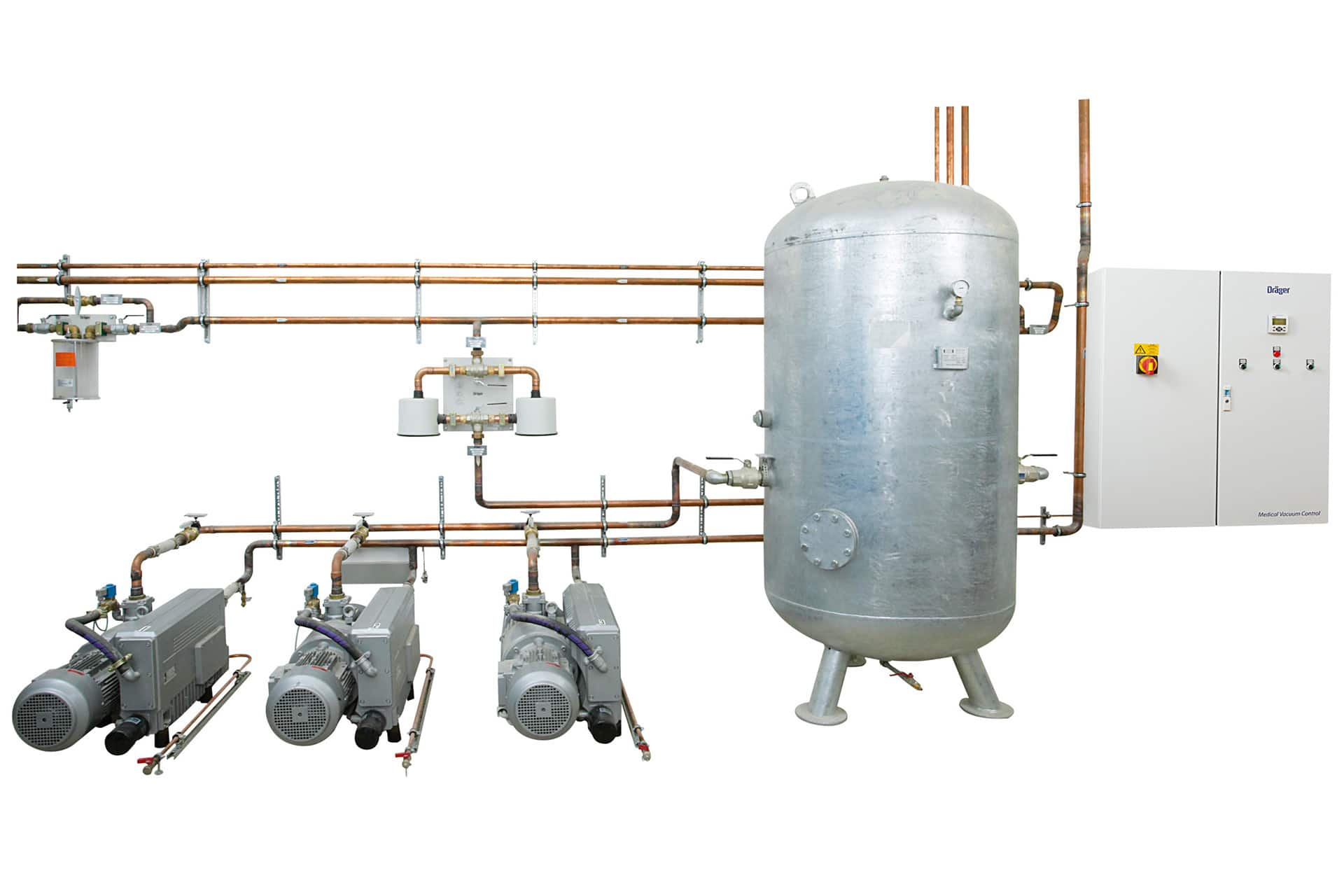
To buy a Dräger medical vacuum system in Nigeria, request a project quotation through Franance with the hospital’s demand schedule, vacuum performance requirements, plant-room survey, pipeline boundary and commissioning scope. Dräger’s “Medical Vacuum Systems” is a configurable plant solution, not one fixed pump SKU. The manufacturer describes modular pump, tank, filtration, secretion-trap and control arrangements, with the Medical Vacuum Control SE monitoring and alarm functions configured for the project. The quote must define the actual pumps, capacity, redundancy, interfaces, installation and testing. The catalogue page is a quote enquiry, not an online sale, and does not confirm Nigerian price, stock, delivery, approval or service coverage.
Where can I request a Dräger medical vacuum quote in Nigeria?
Review the Dräger medical vacuum system listing filtered to its category and the medical vacuum pump system category. To begin a project enquiry, use the Franance quotation request for Dräger Medical Vacuum System. Include the hospital name, project site and state/city, delivery and construction status, engineering contact, planned departments and a short description of the required plant.
Franance follows up by phone or email after an enquiry. The listing is not a fixed ready-to-install package and there is no checkout or online payment. Ask for a site-specific proposal that separates design and survey, plant equipment, controls, installation, pipeline integration, testing, commissioning, handover, training and maintenance scope. The facility should involve qualified medical-gas engineering professionals and its clinical engineering, facilities and clinical stakeholders before finalizing performance criteria.
What is a Dräger medical vacuum system?
Dräger describes its Medical Vacuum Systems as configurable hospital plant systems with pumps, a vacuum tank, filtration and secretion traps, a medical vacuum control unit and associated distribution interfaces. The official product page identifies Medical Vacuum Control SE as a monitoring and control component and describes an integrated display for system parameters, alarms and history. The product information document describes a modular project design that may consider a central plant room or supply sources at separate locations.
This catalogue entry represents that system family rather than a unique pump model. Dräger’s product information discusses oil-lubricated rotary-vane pumps and gives different options and technical ranges; the exact choice is project-dependent. Do not assume a particular pump type, count, motor power, tank volume, filter grade or controller will be part of a proposed Nigerian system unless the quote says so. Request a component schedule and drawings for the precise configuration.
The facility should define the expected service and distribution scope. Clarify whether the offer includes only source plant, source controls and alarms, pipework to an agreed interface, the complete pipeline network, terminal units, electrical works, builder’s work or commissioning. A catalogue product name does not automatically include all of these project elements.
How should a hospital calculate vacuum demand?
Begin with a point-of-use schedule. For each clinical area, list the number and type of vacuum outlets, intended application, required flow and pressure at the point of use, expected concurrent use and relevant equipment connections. Include wards, intensive care, operating theatres, emergency, recovery, procedure rooms and other planned spaces. Identify whether any requirement is special or outside the ordinary medical vacuum service and have the designer determine the appropriate system boundary.
For an existing site, send current as-built drawings, outlet counts, source and pipeline information, available load data, operational issues and planned expansion. Distinguish measured demand from assumed or future demand. Explain which areas can operate simultaneously, whether the hospital has temporary or phased operations and which services cannot tolerate a planned interruption. If demand data are incomplete, ask the engineering team to identify a survey or measurement phase rather than sizing from bed count alone.
Request a transparent calculation basis in the proposal. It should state peak and coincident flow, required vacuum level at relevant interfaces, distribution pressure-loss assumptions, reserve capacity, expected expansion and operating sequence. The project designer must select and approve the calculations under applicable requirements. This guide provides no generic pump size or numeric demand formula because a safe design depends on facility-specific loads and standards.
What pump arrangement and redundancy should I review?
Dräger’s product information describes pump options and states that key system components, including control elements, pumps and filters, may be backed up with identical reserve units in a redundant design. It also describes central or separated source-room concepts. The actual arrangement is tailored to the hospital’s requirements and risk assessment; a product-family description does not prove that a particular number of pumps or a specific reserve configuration is included.
Ask the designer to explain the normal duty sequence, pump rotation, standby activation, response to one pump or controller failure, and what happens during maintenance. Clarify how system availability is assessed if power, the room, a filter, the controller or a downstream pipeline component is unavailable. Define the expected alarm locations and the facility’s emergency response. If separated plant rooms are considered, ask for a site layout, cross-connection design and description of how failure scenarios are addressed.
Compare redundancy across the whole source system, not only at the pump. Request details for control components, filters, receivers, secretion traps, electrical supplies and alarms. Ask for the proposal’s risk and design basis, plus any exceptions. A redundant pump arrangement is not itself proof of compliance with the project’s standard or of uninterrupted service under every fault. The hospital’s responsible engineer should review and accept the stated design basis.
How should I specify filtration and contamination protection?
Medical vacuum plant requires configuration appropriate to its intended collection and downstream handling. Dräger’s product information identifies bacteria double filters and secretion traps in its system overview, describing the filters as protecting plant components and the exhaust stream and the traps as protecting the distribution system from inadvertently entering liquids or secretions. These are manufacturer-described components, but the configuration, grades, quantities, replacement interval and disposal process must be confirmed for the quoted unit and the facility’s workflow.
Specify the clinical areas and applications that will connect to the system and ask the designer to identify the required separation, filters, traps, collection vessels, exhaust routing and maintenance access. Clarify how hazardous or infectious materials are managed under hospital policy and applicable local requirements. Ask who supplies replacement elements, how they are isolated and changed, how used components are handled and where the service records are retained. Do not assume that a generic bacteria filter or one brochure specification covers every clinical use.
If filtration or alarm monitoring is included, request exact manufacturer references and specifications in the offer. Have the supplier explain the pressure drop and performance assumptions used for sizing and check them against the system demand model. Avoid transferring a filter grade from another Dräger model or a regional brochure to the proposed installation without confirmation.
What plant-room and site survey details are needed in Nigeria?
Share a site plan and scaled plant-room drawings that show intended equipment locations, door and delivery access, floor loading, structural details, clearances, ventilation, ambient temperatures, drainage, maintenance routes and proximity to occupied or noise-sensitive areas. Dräger describes both conventional central-room systems and designs that account for infrastructure conditions, but the brochure does not establish which arrangement fits a specific hospital or its real estate constraints.
Have the site survey record the electrical service, available phases, voltage and frequency, motor starting requirements, earthing, protective devices, standby generator, power quality, cable routes and any planned electrical works. Dräger’s older system data spans different pump and power configurations; calculate the actual load from the component schedule for the selected design rather than applying a published maximum to a Nigerian site. Ask for heat rejection, ventilation, acoustic information, service clearance and lifting details tied to the equipment that will actually be offered.
For a Nigerian project, include the state and city, access hours, building stage, flood or water ingress concerns, dust, temperature and humidity conditions, security, route from receiving bay to plant room and availability of local contractors. Identify current operating constraints where construction is phased or the hospital must remain open. Request a written site-survey report distinguishing measured facts, drawings supplied by the client and assumptions that still require validation.
How does medical vacuum connect to the pipeline and alarm system?
ISO 7396-1 covers the supply system and distribution pipeline, monitoring and alarm system, testing, commissioning and documentation for medical vacuum. It also addresses system-specific components and the separation of systems. The facility should identify the current applicable standard, amendments, national requirements and approving authorities with the project’s qualified design team. The ISO reference is not an automatic certification of the Dräger package or the completed hospital installation.
Define the interface boundary between the vacuum plant, pipeline contractor and facility. Request drawings that identify the plant outlet, isolation valves, pipeline materials and routing, gas-specific connections, terminal units, alarm points and test locations. Ask which party provides and tests each segment, who validates the existing pipeline for a plant replacement or extension, and who signs the commissioning records. Where the hospital has an existing medical gas alarm or building management system, provide its interface documentation before design completion.
Dräger’s product information describes potential transfer of control and alarm signals through potential-free contacts or an optional Alarm Management System, and possible integration into an existing BMS through that system. The actual interface is configuration-dependent. Obtain the signal list, output contact details, alarm priorities, cable and panel scope, interface drawings and test plan in writing. Do not assume a network protocol, direct connection or compatibility with a named BMS from a general statement about integration.
What commissioning and acceptance should the quote cover?
Request a commissioning plan that covers the plant and its interface with the medical vacuum pipeline. ISO 7396-1’s scope includes design, installation, function, performance, testing, commissioning and documentation. The facility’s design authority should identify the applicable clauses, method, acceptance criteria, test instruments, witnessing and responsibilities. The quote should define whether the supplier’s commissioning includes the source equipment only, or the entire gas pipeline, alarms, terminal units and facility handover.
Ask for component and serial-number records, installation drawings, test reports, operating and maintenance manuals, alarm-response instructions, controller settings, filter and trap replacement guidance, preventive-maintenance schedule, recommended spare parts and training documentation. If the project includes remote monitoring or BMS, include end-to-end signal testing with the correct receiving point and responsible staff. Agree who will correct deficiencies and how retesting is documented.
Before handover, the facility’s engineering and clinical stakeholders should review the as-built drawings, system labels, alarm descriptions and contingency procedures. Clarify which personnel receive training and whether it is delivered onsite, remotely or through another arrangement. Obtain warranty duration, territory, exclusions, service response and escalation details that apply to the specific Nigerian project. None of these obligations should be inferred from manufacturer statements about services generally available in other markets.
How should I evaluate the Dräger MVC SE and alarm integration?
Dräger describes Medical Vacuum Control SE as a PLC-based unit that controls the configured system and monitors vacuum supply. The product information says an integrated multilingual display can show system parameters, alarm state and history, operating hours and service intervals. It also describes signals sent by potential-free contacts or through the optional Dräger Alarm Management System. These documented capabilities are useful for writing a requirement, but they do not define the exact controller supplied, enabled functions or interface package for a project.
Ask the proposal to identify the control unit version and software, sensors, local display, alarms, external outputs, optional alarm-management components, event history and any requested remote or BMS connection. State where alarms must be visible, which staff respond and how alarm escalation works during normal and after-hours operation. Review the arrangement with the facilities or controls team, including power supply, cabling, alarm test procedure and maintenance ownership.
If the hospital’s BMS or centralized alarm network is being integrated, require the system integrator to confirm interface support and commissioning requirements. The brochure does not make any named BMS automatically compatible. Avoid including critical functions in procurement scoring until the supplier supplies written confirmation for the exact configuration and the project team accepts the interface design.
How should I compare central and distributed vacuum plant proposals?
Dräger describes conventional centralized arrangements and system concepts with sources at separate locations. Central plant may simplify some elements of site management, while distributed or separated sources may address specific infrastructure and risk constraints. These choices require a facility design assessment; this guide does not recommend a layout without demand data, drawings and site information.
Ask alternatives to respond to the same demand schedule, pipeline assumptions, required vacuum performance, redundancy criteria, room constraints and alarm requirements. Compare pump type and count, capacity, tank sizing, filter/trap configuration, controller, maintenance access, power loads, heat and noise, delivery dimensions, civil/electrical needs, expansion options, installation staging, commissioning and service dependencies. Require lifecycle consumables and replacement schedules to be identified. Have the project engineer explain how routine maintenance and major fault scenarios are handled for each layout.
If the proposal cites ISO 7396-1, request the specific design and verification evidence for the offered configuration and completed system. Dräger states its systems meet ISO requirements in its product information, but a facility must still review the current applicable standard, project scope and local obligations. No local Nigerian certification or conformity statement is assumed by this guide.
What should a Nigerian Dräger vacuum quotation include?
Provide the facility name, state and city, delivery address, project stage, contact details, planned departments, outlet schedule, demand calculation, required vacuum criteria, future expansion assumptions, existing system drawings, plant-room information, utilities and pipeline boundary. Include room access, construction sequencing and whether the facility must remain operational during work. Identify expectations for design and site survey, supply, installation, pipeline interfaces, controls, alarms, commissioning, training and maintenance.
Ask Franance to obtain a written itemized project proposal with the exact plant configuration, pump types and count, capacity, motors and power loads, receiver/tank and filter/trap specifications, controller and alarm interfaces, drawings, installation materials, delivery, site works, testing, commissioning and handover. Require the offer to state design assumptions and exclusions, documents provided, delivery terms, warranty and service arrangements that apply to Nigeria. Ask the supplier to state which features depend on site survey, additional components or another contractor.
Use the Dräger medical vacuum exact brand/category/model filter and submit the Franance Dräger vacuum project enquiry. The project remains subject to engineering review and written quotation. No price, stock, lead time, Nigerian installation, regulatory approval or local service coverage is implied.
What is verified about this Dräger system and what remains open?
Dräger’s Medical Vacuum Systems product page describes configurable medical vacuum plant, Medical Vacuum Control SE, system monitoring and alarm status. Its official product information document describes modular plant options, pump and power ranges, tanks, filters, secretion traps, and control/alarm options; it states that not all products, features or services are available in every country. These sources establish the product family, not the equipment configuration or Nigerian commercial offer.
The ISO 7396-1 overview describes requirements for medical-gas and vacuum supply systems, distribution, monitoring, testing, commissioning and documentation. It excludes dental vacuum systems. ISO lists the 2016 edition with an amendment and shows it is under revision; the project’s design authority should verify the current edition, applicable amendments, national requirements and local approvals. A mention of ISO by a manufacturer does not certify a particular installation or show that the project meets Nigerian regulatory conditions.
Franance’s catalogue assigns Dräger Medical Vacuum System to the medical vacuum pump system category as a project-configured system. It does not state the site demand, number or model of pumps, control package, interface drawings, civil scope, installation schedule, commissioning tests, local approval, price, stock, warranty or service terms. Confirm every project-specific item in the quotation and design documentation.