

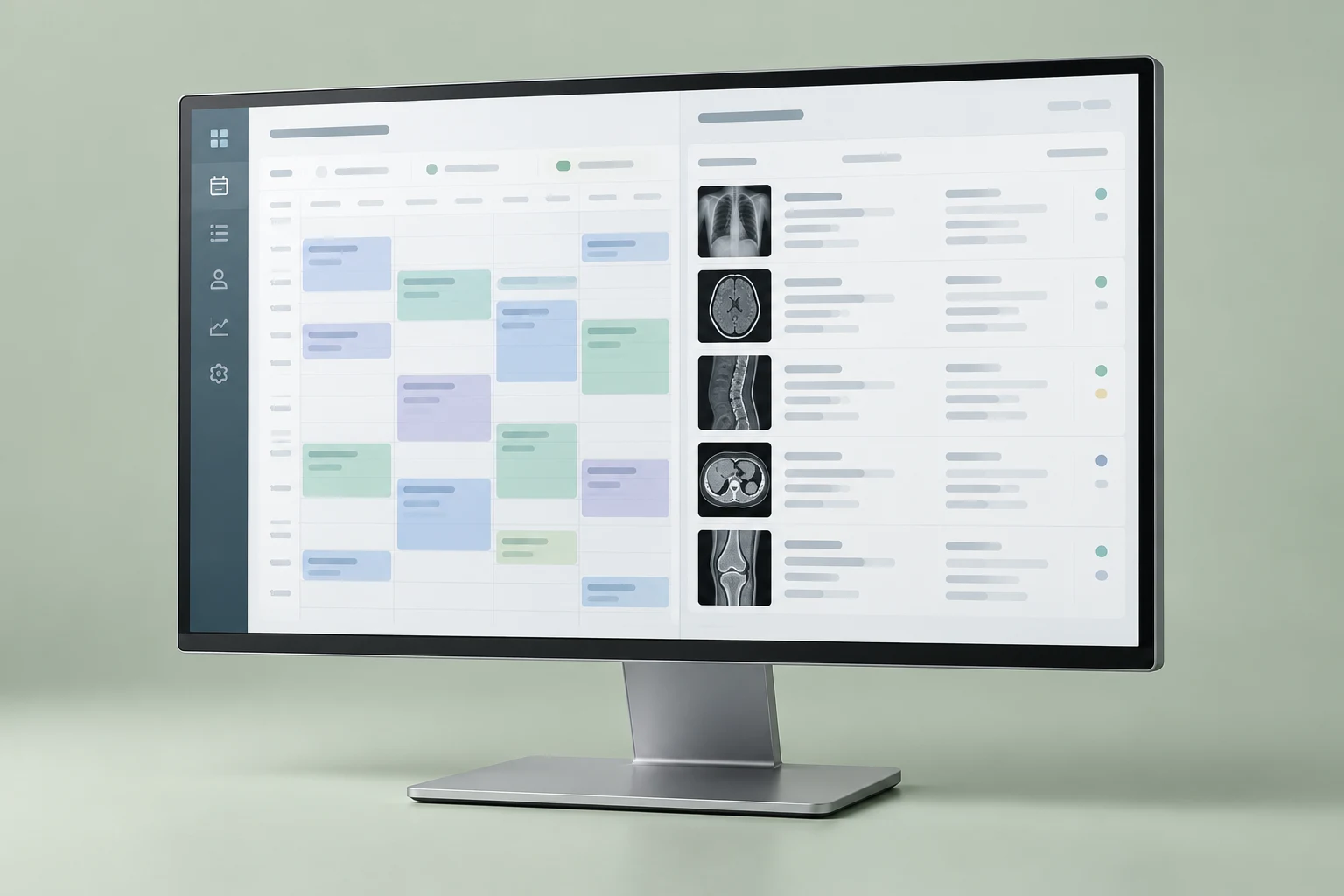
Buy AGFA HealthCare Enterprise Imaging RIS in Nigeria
To buy AGFA HealthCare Enterprise Imaging RIS and Scheduling in Nigeria, request a project quotation from Franance and describe the facilities, imaging departments, existing RIS/PACS/EHR, radiology workflows, integrations, deployment preference and implementation scope. AGFA describes a radiology information system and scheduling components that can coordinate work from orders and registration through appointment booking, tracking, reporting and follow-up. The exact modules, software release, interfaces, licensing, hosting and delivery responsibilities depend on the proposed project and must be specified in the quotation. This is radiology workflow software, not a scanner, PACS archive or automatically complete hospital IT implementation. An AGFA case announcement describes a five-site NHS Trust choosing Enterprise Imaging RIS and Scheduling to replace its RIS while retaining a third-party PACS, with business intelligence also included in that project. That case demonstrates one deployment approach; it does not establish that every interface, module, workflow or contract term is included in a Nigerian offer.
Where can I buy AGFA HealthCare Enterprise Imaging RIS in Nigeria?
Start with the exact filtered AGFA HealthCare RIS listing, browse the RIS server and radiology information systems category, and request a Franance quotation for AGFA HealthCare Enterprise Imaging RIS and Scheduling.
In your enquiry, give the number of hospitals and imaging sites, modality and department scope, approximate workflow and user groups, existing RIS/PACS/EHR, desired deployment approach, required interfaces, data migration needs, target timeline and procurement requirements. Franance will follow up by phone or email to clarify the request and confirm commercial terms. This is a quote-order process, with no online payment or checkout. The public listing does not confirm Nigerian availability, price, implementation capacity, delivery timing, distributor status or local support.
What is Enterprise Imaging RIS and Scheduling?
A radiology information system supports administrative and clinical workflows around imaging orders, patient registration, appointment scheduling, exam status, reporting and results distribution. AGFA’s Enterprise Imaging RIS announcement describes a next-generation RIS and Scheduling solution intended to support a complete imaging pathway, including order placement and receipt, procedure scheduling, patient registration and arrival, image acquisition workflows, protocolling or vetting, structured reporting, multidisciplinary team workflows, result distribution, audit and business intelligence.
The exact list above came from AGFA’s announcement about one customer’s contract. It is a useful scope checklist, not a default bill of materials. For a Nigerian project, have AGFA and the implementation parties confirm which of these workflows are available in the proposed release, which components are licensed, which are configured, and which require other systems or services.
AGFA’s current Enterprise Imaging Scheduling materials describe coordinating central booking, imaging departments, referrers and nursing units, with appointment and resource visibility. The current product information also references multi-step appointments, exam-linked questionnaires, whiteboards, order tracking, and EHR connectivity. Verify these functions, their release status, user permissions and configuration in a formal proposal rather than assuming every feature is part of the specific RIS product listing.
What should a Nigerian hospital define before selecting RIS software?
Begin with a written workflow map, not a feature list. Document how a request becomes an accepted order, how patient identity and demographics are checked, how an appointment is chosen, how preparation instructions are communicated, how a patient arrives, how an exam is marked in progress or complete, how the report is created and approved, and how results return to the requester. Include exceptions such as cancellations, rescheduling, urgent requests, incomplete information, multiple procedures and referrals from outside the hospital.
List the sites, modalities and departments in scope. Specify whether booking is centralized across locations, managed by each imaging department, or divided between local and central teams. Identify who can create, approve, change or view appointments and orders. Ask the vendor to demonstrate the proposed workflows using representative scenarios from the facility’s actual radiology operations.
For Nigerian deployments, include connectivity between sites, available network capacity, local power and server-room constraints if any components will be hosted on premises, the organisation’s recovery objectives, IT staffing and remote-support constraints. If a hosted or cloud model is proposed, request written details about hosting location, data access, backup, recovery, availability commitments and responsibilities. These are project questions, not claims that any particular hosting or service package is available through Franance.
How does RIS scheduling support imaging departments?
Scheduling software can coordinate appointments across equipment, rooms, staff, referrers and departments. AGFA describes a unified scheduling workflow and direct booking options for referring physicians, nursing units and central booking staff. It also describes rules-based matching of exams to rooms, equipment and time slots, alongside visibility into readiness and appointment status. The practical value depends on accurate department rules, up-to-date resource calendars, agreed roles, integration and consistent staff adoption.
When evaluating scheduling, identify the resources each exam requires, the appointment duration and sequencing rules, site-specific availability, patient preparation needs and who is permitted to override a schedule. For multi-step or multi-day exam sequences, ask the vendor to show how dependencies, changes, cancellations and conflicts are represented. Confirm whether questionnaires, reminders, referral documents and preparation information are included, licensed, configured or provided by connected systems.
A live whiteboard or operational view can help staff see appointment progress, but it depends on timely status updates and a defined workflow for maintaining them. Ask how the system handles arrival, readiness, room assignment, delays, completion and communication with other teams. The software does not by itself ensure that schedules are accurate or that every stakeholder receives a message; those outcomes depend on implementation, integrations and operational procedures.
Can AGFA Enterprise Imaging RIS work with an existing PACS?
AGFA’s announcement for Doncaster and Bassetlaw Teaching Hospitals says that the selected Enterprise Imaging RIS and Scheduling solution was intended to work with the Trust’s existing third-party PACS. This is evidence that AGFA described such a configuration in that project. It is not a guarantee of compatibility with every PACS, its version, or the particular interface and workflow a Nigerian organisation requires.
For a project that keeps its current PACS, provide the PACS manufacturer, product and version, available interface documentation, patient and order identifiers, modality worklist requirements, reporting workflow, image and report access needs, and any existing interface engine. Ask both vendors to confirm the proposed information flows in writing. Define what happens when an order changes, an exam is cancelled or a patient identity is merged, and how the systems reconcile order status and results.
AGFA’s interoperability pages describe RIS integrations across ordering, registration, scheduling, tracking, reporting and follow-up, and refer to standards-based connections. Standards support does not mean a connection is plug-and-play. Confirm exact versions, profiles, messages, APIs, ownership, testing, error handling, monitoring and any interface fees in the solution design. Do not assume that maintaining an existing PACS eliminates all migration, integration or workflow work.
How should Enterprise Imaging RIS relate to PACS, EHR and other modules?
RIS and PACS have related but distinct roles. A RIS coordinates administrative and workflow information for radiology; PACS manages imaging data and viewing workflows. An EHR or hospital information system can manage broader clinical records and orders. A project may connect these systems, replace some functions, or retain several vendors. Agree which system owns each identifier, order, appointment, report, result and audit record before implementation begins.
The “Enterprise Imaging” name covers a broader platform and a range of components. AGFA lists products and capabilities such as Scheduling, universal viewing, vendor-neutral archiving, workflow orchestration, business intelligence, artificial intelligence and other specialty workflows. Those capabilities should not be treated as automatically included with the RIS and Scheduling software named in this listing. Request a module-by-module scope and licensing table, identify dependencies, and distinguish current deliverables from future options.
Ask whether the project requires business intelligence, data migration, reporting templates, external referral access, patient portals, image exchange, AI integrations or a vendor-neutral archive. For each, determine whether it is in scope, who supplies it, what systems it depends on and how it is priced. The Doncaster project included business intelligence for reporting, regulatory and audit requirements; that customer-specific choice is not evidence that BI is bundled with every RIS order.
What deployment, data and security questions should IT ask?
AGFA’s Enterprise Imaging material describes flexible delivery options, including on-premises, hybrid and cloud arrangements at the platform level. The actual hosting choices for this RIS product, in the target region and proposed release, must be confirmed. Ask where data will be stored and processed, which parties can access it, how backups and restoration are handled, what happens during a network or service outage, and which party manages updates and incident response.
Request security architecture and product documentation for the exact solution. Confirm identity and access management, role design, authentication options, audit logging, encryption, vulnerability and patch processes, remote support access, data export, retention, backup, disaster recovery, and responsibilities between the hospital, AGFA and any hosting or integration vendors. A broad platform claim or certification does not establish the security posture, compliance or availability of a particular deployment.
The solution will handle sensitive patient and imaging information. Have the organisation’s data-protection, legal, clinical safety and cybersecurity leads review the proposed data flows and hosting terms against the requirements applicable to the organisation. This guide does not make a legal or regulatory determination for Nigeria. Ask the vendor to provide the documents needed for that review and specify any data-location, retention, breach-notification or audit requirements in the project brief.
What should be included in the implementation plan?
A software quotation should separate licences or subscriptions, implementation, interface work, data migration, configuration, infrastructure, training, testing, go-live support and ongoing maintenance. For each workstream, name the owner, deliverable, assumptions, dependencies, acceptance criteria and charges. Clarify whether the vendor or a local partner will perform each activity and which support channels and hours apply to the Nigerian organisation.
Plan discovery and workflow design with radiologists, radiographers, booking and registration staff, referrers, nursing teams, IT, biomedical engineering and records or compliance stakeholders. Define the test environment, test data, interface validation, user acceptance, cutover approach, downtime process, parallel running if required, rollback criteria and post-go-live monitoring. Make the migration inventory explicit: patient identities, historical appointments, reports, orders, templates, audit history and attached documents may have different migration paths and rules.
Training and adoption should match job roles. Ask who creates role-specific training materials, how new staff are onboarded, how configuration changes are governed, and how operating procedures will be maintained. Establish how the project measures completion and resolves issues without promising a specific efficiency or clinical outcome.
What should I include in an AGFA RIS quotation request in Nigeria?
Provide the number of sites and departments, modalities, estimated user groups, existing RIS/PACS/EHR and versions, current order and scheduling workflows, required modules, interface needs, deployment preference, migration scope, infrastructure constraints and preferred project timeframe. Include any required documentation, hosting location expectations, security review, data-retention rules, training, support and acceptance requirements.
Ask the quotation to identify the exact product modules and versions, licensing basis, hosting and infrastructure, implementation and integration scope, data migration assumptions, third-party dependencies, training, support, warranty or subscription terms, availability, delivery and project milestones. Request a responsibility matrix and list of exclusions. If a workflow or integration is proposed as standard, ask for the exact evidence and acceptance test that will demonstrate it in the delivered environment.
Frequently asked questions about AGFA HealthCare Enterprise Imaging RIS
### Is this a complete radiology system including PACS?
Not necessarily. The listing is for Enterprise Imaging RIS and Scheduling. AGFA has described a customer deployment integrated with a third-party PACS, while its broader platform includes separate imaging components. Confirm the exact modules, PACS scope and interfaces in the project quotation.
### Does the RIS include scheduling?
AGFA describes Enterprise Imaging RIS and Scheduling components, and its current product materials describe Enterprise Imaging Scheduling. Confirm which scheduling functions, release, licences and workflows are included in the proposed Nigerian configuration.
### Does it support HL7 or FHIR integration?
AGFA’s current scheduling and interoperability materials refer to standards-based connectivity, including HL7 and FHIR. Exact supported versions, profiles, messages, APIs and interface scope must be validated with the vendor for each connected system.
### Is it available as cloud software in Nigeria?
The broader Enterprise Imaging platform describes cloud and other delivery options. Confirm whether the specific RIS product, selected release, hosting location and service terms are available for the organisation’s region and project.
### Can Franance sell it online?
No. Submit a quotation request through Franance. The team follows up by phone or email to clarify the project and commercial terms; the site does not provide online payment or checkout for this software.
Sources and product limitations
This guide was reviewed on 20 October 2026 against AGFA HealthCare’s Doncaster and Bassetlaw Enterprise Imaging RIS announcement, its current Enterprise Imaging Scheduling overview, Interoperability overview, and Enterprise Imaging platform overview. The Doncaster deployment facts describe that customer project; current Scheduling and platform materials describe the wider product family. They do not establish a Nigerian configuration or contract.
The record does not specify a software release, modules, hosting model, licence, interface versions or implementation scope. Confirm those details and applicable documentation for the project. No Nigerian registration or legal compliance, stock, pricing, delivery, local implementation capacity, warranty or support entitlement is asserted. Performance and workflow outcomes depend on solution design, configuration, integrations, local infrastructure and operational practice.