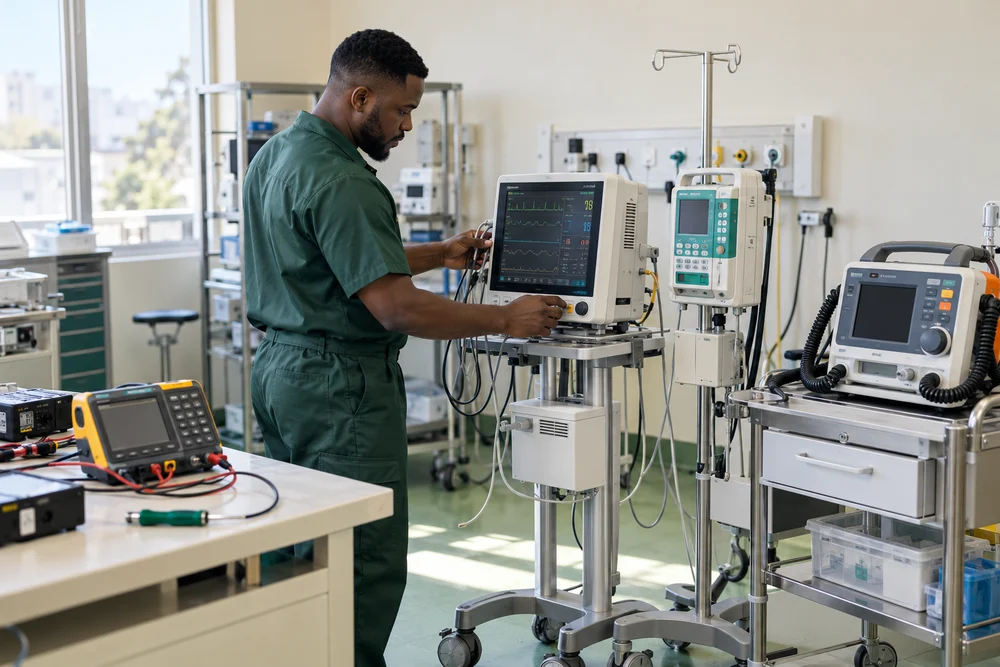
A buyer’s guide to medical equipment refurbishment and upgrades in Nigeria
How can I request medical equipment refurbishment in Nigeria?
Send Franance the exact model and serial number, photos of the equipment condition, fault and service history, requested outcome and facility location. We will review whether a defined assessment or work scope can be quoted.
Start by identifying the equipment and the decision you need to make. Is the device not working, operating with a known limitation, missing parts, due for a supported upgrade, or being evaluated before a replacement budget? Include manufacturer, model, serial number, configuration, software version and the department where the unit is used. Describe alarms and symptoms without opening the enclosure or attempting repair. Attach external photographs or a nameplate image only after removing patient, staff or account information. Share the maintenance record and prior reports if available.
An enquiry does not mean refurbishment is already approved or that the device can be restored. Franance reviews the information to decide whether more evidence or a physical assessment is needed and whether the request can be quoted. The written offer should describe what the assessment covers, where it would take place, what access is required, any fee and what the resulting report can establish. It should also say what is not included, such as repair, parts, software licensing, calibration, safety testing or recommissioning, unless those activities are explicitly specified.
What does medical equipment refurbishment include?
There is no single universal scope. A refurbishment offer should list the equipment inspected, work performed, parts replaced, tests completed, documents supplied, exclusions and condition remaining after handover.
The word can describe different levels of intervention, from condition assessment and targeted repair to a broader renewal programme. A buyer should not infer that all wear parts, boards, probes, batteries, software or accessories have been replaced. Ask for a task-by-task schedule stating the starting condition, proposed work, parts and labour, responsible party, test method, results and handover documents. If cosmetic work is included, separate it from technical work. The quotation should use a clear condition description rather than rely on “like new,” “factory refurbished” or “fully restored” without supporting criteria.
Refurbishment, repair, upgrade and preventive maintenance answer different needs. Repair addresses a fault; an upgrade changes a function or capability; preventive maintenance is planned work intended to inspect or maintain an asset. An acceptance or performance test provides evidence against agreed criteria and is not automatically included in any of the other activities. WHO guidance describes refurbishment as a possible route to extending useful life, but notes that not every device is suitable and that careful assessment and selection are needed. The facility should decide whether the documented scope is sufficient for its intended use.
How do you assess whether hospital equipment can be refurbished?
Review identity, age and condition, fault history, support documentation, parts access, software rights, safety concerns, intended use and applicable rules. The assessment should state evidence gaps and whether further work is technically and commercially reasonable.
A feasibility review begins with the device’s lifecycle and service history. Consider whether the model is still supported, whether essential documentation and diagnostic access exist, whether components can be obtained and whether software or licences can legally be transferred. Identify corrosion, liquid ingress, impact, heat damage, repeated faults, missing safety guards, undocumented modifications and expired consumables where known. A device that powers on can still have degraded performance or an unresolved safety concern. For imaging and laboratory systems, unavailable components or software may affect critical functions even when the visible exterior appears acceptable.
The assessment should distinguish observed facts from assumptions and recommendations. It can compare the expected refurbishment scope with repair, replacement or retirement, but should not promise a particular lifespan without evidence. If the manufacturer’s maintenance instructions, parts, firmware or service tools are necessary, identify how the project will obtain them and whether access is permitted. Local rules for refurbished devices and import or resale may apply, so the responsible buyer should confirm regulatory requirements before commitment. Franance can review the information and document a quotation pathway; feasibility remains specific to the asset and evidence available.
What parts and upgrades should be checked before refurbishment?
List every proposed replacement part and upgrade by reference, source, condition and compatibility. Confirm whether parts are new, repaired, reused or third-party, and whether software licences, calibration, configuration or manufacturer approval are required.
Parts provenance affects traceability, compatibility, warranty and future maintenance. Ask for a parts schedule that identifies original manufacturer references where known, supplier or source category, new or used condition, repair history and any equivalent-part claim. “Genuine” should be used only when the source can substantiate it. For patient-contacting components, probes, applied parts, sensors or sterile accessories, the facility may have additional requirements. A quotation should disclose if parts are unavailable, substituted, reconditioned or awaiting confirmation instead of implying that every item has already been secured.
An upgrade can involve hardware, software, operating systems, network interfaces, detectors, modules or application features. Check compatibility with the exact device and installed configuration, cybersecurity requirements, licence ownership, support term and any effect on regulatory status or original warranty. Ask which party authorises, performs and validates the change. New functionality may require training, configuration records, acceptance testing or updated manuals. A repair that restores a function is not necessarily an upgrade, and an upgrade label does not prove that the device meets current standards. Keep these activities as separate lines in the scope and cost comparison.
What tests should be included after medical equipment refurbishment?
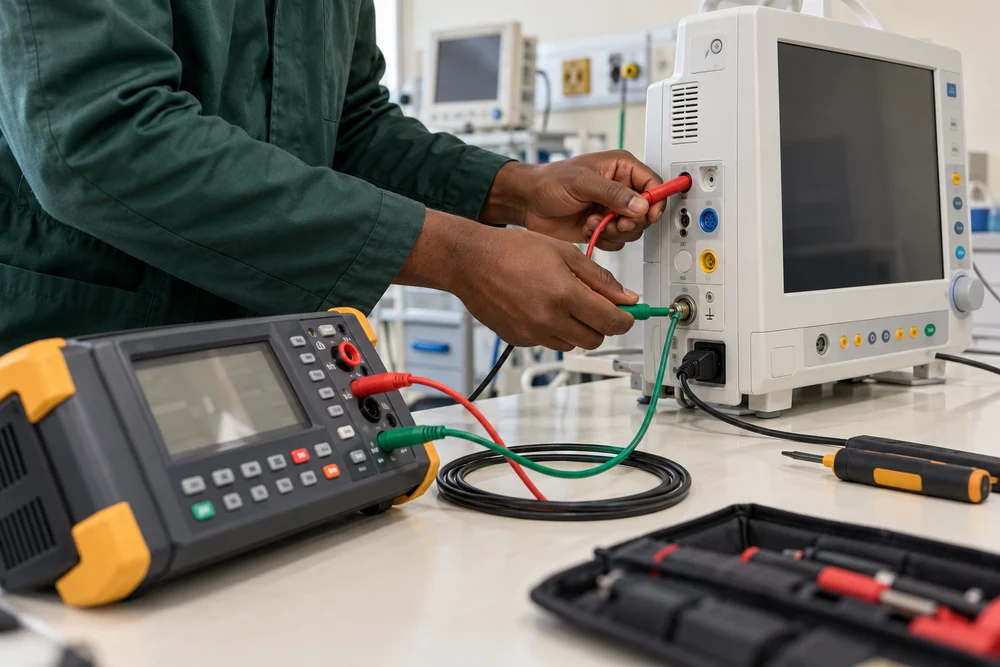
Agree tests against the intervention and intended use. Specify functional checks, performance verification, calibration or electrical safety tests separately, with methods, acceptance criteria, configuration, records and responsible reviewer identified.
There is no universal “refurbishment test” that demonstrates every kind of safety, performance and regulatory requirement. A test plan should follow the equipment design, manufacturer instructions, work performed and facility acceptance criteria. If a circuit, power supply, enclosure, patient connection or protective feature was affected, the relevant safety assessment may need to be discussed. If a measurement channel, sensor, image chain or therapeutic output was adjusted, define the verification needed for that function. Identify accessories and operating modes included; testing one main unit does not necessarily cover every option or assembled system.
Request a report that identifies the equipment, serial number, configuration, work and parts, test procedure, instruments or references where relevant, conditions, results, acceptance limits and exclusions. Ask for unresolved defects or out-of-limit results to be listed clearly. A result is evidence only for the test performed and its scope; it is not a promise of future fault-free operation or blanket regulatory compliance. The facility’s authorised technical and clinical personnel decide whether the asset can return to use. Franance can include specific tests only when their method and delivery scope are confirmed in the written offer.
Should a facility refurbish or replace medical equipment?
Compare refurbishment cost and downtime with a replacement offer using equivalent function, configuration and lifecycle assumptions. Include parts and software support, consumables, training, installation, warranty, maintenance and residual risks.
Compare like with like. A refurbishment quote for one fault cannot be compared fairly with a new system that includes accessories, warranty, installation and training. Build a decision table with current condition, proposed work, excluded faults, replacement configuration, delivery assumptions, downtime, facility changes, expected support and consumable costs. Consider whether the older unit can meet current workload, interface and user requirements. Include the costs of future obsolescence, hard-to-source components, software security and repeated call-outs where those are relevant and evidenced by the service history.
The lowest immediate spend may not be the lowest risk or lifecycle cost, while a new unit may add configuration or infrastructure requirements the facility does not need. Ask for options that show assumptions instead of a guaranteed savings claim. A refurbishment decision also depends on local regulations, donor or tender conditions, facility policy and the technical evidence required for continued use. Franance can help frame the equipment and quotation scope for review; the facility’s procurement, biomedical and clinical leads make the final decision against their approved requirements and risk controls.
What warranty and handover records should refurbished equipment include?
Ask for the written warranty term and covered parts, labour, location, exclusions and claim process. Handover should document the asset, condition, repairs, parts, tests, software, limitations and outstanding actions.
Warranty terms are specific commercial commitments, not an automatic feature of refurbishment. Confirm when coverage starts, what is covered, where service occurs, who pays transport, how a claim is assessed and whether replacement parts or labour are included. Ask whether the warranty differs for reused or third-party components and whether a later modification affects it. If the quotation offers no warranty or only limited coverage, make that visible in the decision record. Avoid treating “tested” or “refurbished” as a warranty statement.
The handover pack should connect the work to the asset: received condition, work order, parts record, software or configuration changes, tests and results, manuals, service contacts, warranty terms and limitations. Record items not replaced or tested so future users do not assume a complete renewal. Confirm whether the facility needs updated asset-register fields, maintenance schedule or user familiarisation. If the equipment is moving between sites, separate transport and installation records. A complete record helps the facility plan future maintenance without implying that Franance provides an ongoing contract unless one is separately agreed.
How should Nigerian facilities plan refurbishment logistics?
Identify whether assessment or work is on site or off site, and agree isolation, custody, packing, transport, access, power, downtime and return arrangements. State city and state so logistics can be reviewed for the specific quotation.
For on-site work, plan equipment access, power, department availability, infection-control or decontamination requirements set by the facility, tools, security and a responsible contact. For off-site work, document the handover condition, packing requirements, serial and accessory inventory, custody and transport responsibility. Ask who bears risk during movement and how damage or missing components are recorded. If the unit supports essential services, the facility should plan downtime and an alternative through its own operational procedures; a page or enquiry does not provide emergency cover or guarantee a temporary replacement.
In Nigeria, the destination, transport route, import status and access constraints should be confirmed for the particular device and job. Large imaging equipment may require specialist handling, while bench equipment may be moved under a different arrangement; neither method should be assumed. Clarify any shipping, customs, insurance, tax, handling or third-party charges and the party responsible for them. Set the return endpoint and whether reinstallation, commissioning or acceptance checks are quoted separately. Franance will document the arrangements that can be confirmed; no national coverage or turnaround time should be inferred from the country-level page.
Common questions about equipment refurbishment in Nigeria
Can all medical equipment be refurbished?
No. Suitability depends on condition, support, parts, documentation, safety, intended use and applicable rules. Request an assessment before deciding.
Is refurbished equipment the same as new equipment?
No. The condition and work performed must be described for the specific unit. Ask for a parts, testing, warranty and limitations record.
Does refurbishment include calibration and electrical safety testing?
Not automatically. Request each test separately and agree the method, acceptance criteria, configuration and report in the quotation.
What should a refurbishment warranty in Nigeria cover?
Ask the offer to state the covered work and parts, warranty period, exclusions, service location and claim process. Franance will confirm the terms available for the assessed scope; compare them with the documented condition and test records.
What should I send for a refurbishment quotation?
Send make, model, serial and asset numbers, condition, fault and maintenance history, requested upgrade, location, available documents and required handover evidence.
Tell us what your facility needs.
Send the equipment details, your requirement and the facility location. We’ll discuss the information needed to review the scope and prepare the next step.
Contact Franance