

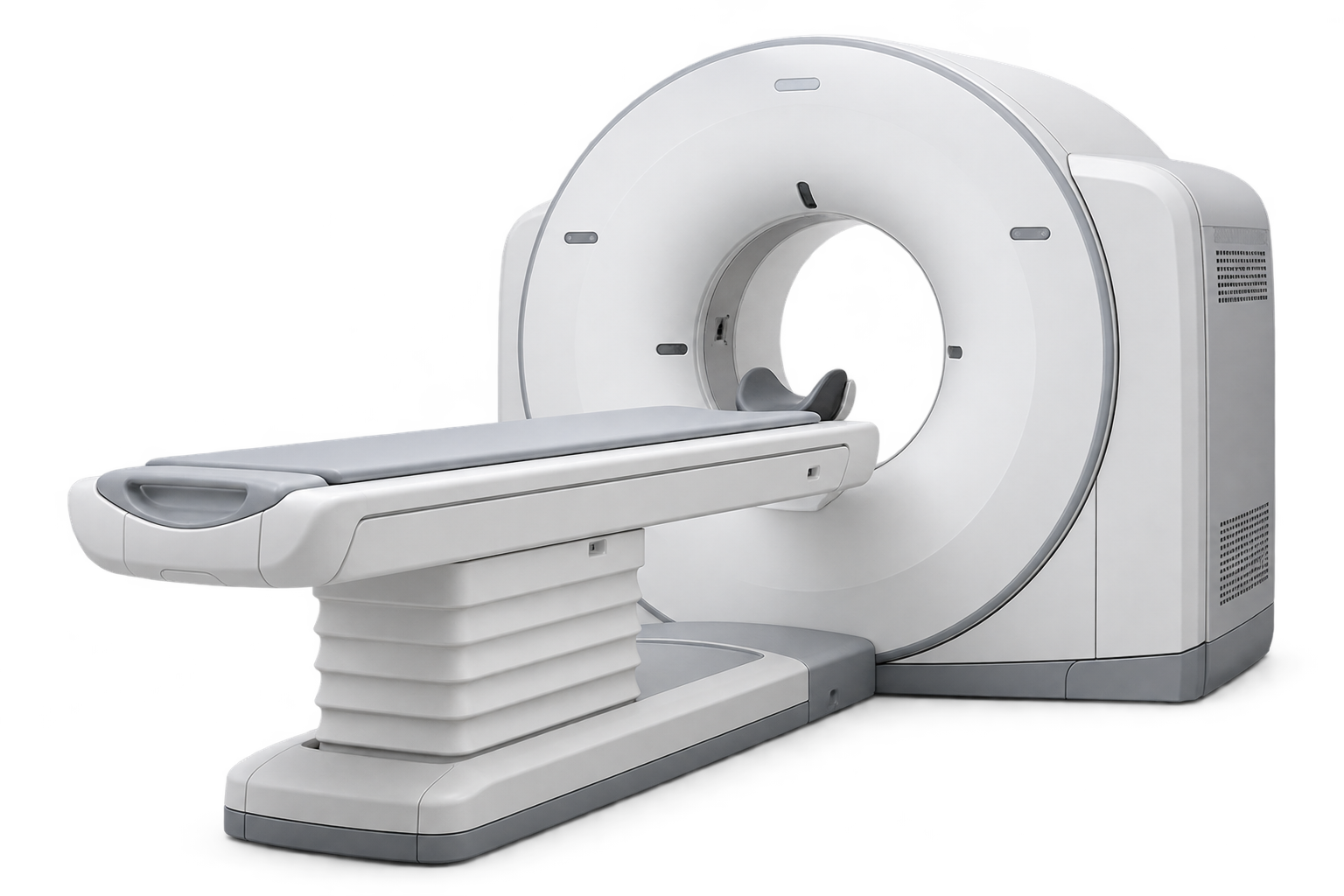
Buy the GE HealthCare Revolution EVO 64-Slice CT Scanner in Nigeria
Buy a GE HealthCare Revolution EVO 64-slice CT scanner in Nigeria by specifying the exact channel and slice configuration, generator, rotation speed, table, reconstruction tools, site requirements and service scope you need. GE HealthCare's product data sheet covers several Revolution EVO configurations and selectable options, so the model-family name alone does not tell you what a particular system includes. Franance lists this model for quotation: submit a quote order and Franance will follow up by phone or email to check the enquiry and prepare a written offer. The page does not confirm stock, final price, NAFDAC registration, delivery, warranty or service coverage.
Where can I buy a GE HealthCare Revolution EVO 64-slice CT scanner in Nigeria?
Start with the GE HealthCare Revolution EVO 64-slice CT scanner listing, the 64-slice CT scanner category in Nigeria and the GE HealthCare 64-slice CT range. Franance organises the model under diagnostic imaging and CT systems so procurement teams can compare it with other equipment in the same class. The catalogue is a starting point for a quote order, not evidence that a specific unit is physically available in Nigeria or ready for installation.
Include your facility, procurement contact, destination state and city, quantity, target delivery window, intended examinations and procurement stage. If you have a tender specification, room plan, power details, existing scanner information or approved scope of work, provide it with the enquiry. Identify whether the request is for a new, refurbished or replacement system and require the quotation to say which condition applies. Franance can then follow up to clarify the request and prepare a configuration-specific proposal.
Before comparing offers, ask each supplier to identify the model and configuration by manufacturer documentation and, for a specific installed unit, by serial number and available service history. Request an itemised offer that names standard equipment, selected options, software, table, accessories, delivery assumptions, installation and commissioning boundaries, training, warranty and exclusions. This makes it easier for the hospital's radiology, medical physics, biomedical engineering, facilities, ICT and procurement teams to review the same scope.
What does the Revolution EVO 64-slice CT configuration include?
Revolution EVO is GE HealthCare's computed tomography product family. Its product data sheet describes an imaging chain that includes the Clarity detector and lists technologies such as iterative reconstruction, dose-management features and clinical application options. The manufacturer document is the right reference for discussing the family, but it spans more than one configuration. Do not infer that a particular used or new unit has every feature named in the product-family literature.
For a Revolution EVO 64-slice enquiry, have the offer state the channel count, slices per rotation, detector collimation, generator rating, supported rotation speeds, reconstruction software, table model, included workstations and licensed applications. The GE data sheet lists a 64-channel based system with 40 mm collimation at 64 × 0.625 mm, while separately describing selectable systems such as 32-channel/64-slice and 64-channel/128-slice. Those labels are not interchangeable. Request current technical documentation that matches the serialised unit or exact factory configuration being offered.
Franance's catalogue model record identifies the 64-slice configuration. It does not independently establish whether a specific unit has been upgraded, what software is installed, what tube is fitted, which options are licensed or whether the unit is new or refurbished. Ask the seller to document all of those points in the proposal and list any mismatch between the catalogue category and the actual system. This protects a purchase decision from relying on broad family language alone.
Which facilities should evaluate this CT scanner?
Hospitals and diagnostic imaging providers evaluating a multi-slice CT system may consider the Revolution EVO if its verified configuration, service plan and site requirements match the facility's approved imaging workload. Suitability depends on the examinations the qualified clinical team plans to perform, expected throughput, patient population, operating model, available staff, image-review workflow, maintenance capability and lifecycle budget. A 64-slice label by itself does not establish clinical suitability or prove performance for a particular protocol.
Write down the service scope before asking for a final offer. Specify routine head and body CT, contrast-enhanced studies, angiography, cardiac work or other intended applications only when those are part of the facility's clinical plan. Have radiologists, radiographers, medical physicists and biomedical engineers review required protocols, dose-management workflow, image quality criteria, patient handling, injector and ancillary equipment, and user training. Ask the supplier to map each requirement to a listed hardware component, software option, licence or documented workflow. Mark requirements as mandatory, preferred or out of scope.
WHO and the International Atomic Energy Agency have published a CT technical-specification document as a procurement reference, including system functions, dose information, connectivity, table and gantry considerations. The publication was prepared for a defined imaging context and is not an endorsement of this model or a universal substitute for local clinical and technical review. Use it as one structured checklist alongside your own requirements, applicable standards, local regulatory advice and current manufacturer documentation.
How do the Revolution EVO channel, slice and detector terms differ?
CT descriptions can use “channels,” “detector rows,” “slices,” “collimation,” “images per rotation” and “reconstructed slices.” These values describe related but different parts of acquisition and reconstruction. A 64-slice configuration should not be assumed to mean that every rotation, protocol or reconstruction produces a particular number of clinically usable images. Manufacturer specifications set out the selected acquisition configuration and reconstruction modes; your technical team should interpret them for the applications it intends to run.
GE HealthCare's data sheet lists multiple selectable arrangements, including 32-channel/32-slice, 32-channel/64-slice, 64-channel/64-slice and 64-channel/128-slice. It gives the 64-channel system's 40 mm collimation as 64 × 0.625 mm. Elsewhere, the document explains that generated images per rotation depend on rotation and z-coverage, and differentiates an overlapped reconstruction from the base acquisition. Therefore, the broad phrases “64-slice” or “128-slice” should not replace a written description of the physical detector setup and enabled reconstruction capability.
Ask the supplier to include the exact configuration in the quotation and attach the matching data sheet or configuration printout. Have your medical physicist or qualified technical reviewer confirm what the figures mean for your protocols, image thickness choices, scan coverage and dose-management assessment. If two proposals use different terminology, ask both suppliers to answer the same questions in the same units. Do not compare reconstructed image counts as though they alone establish image quality, speed or clinical utility.
Which generator, rotation and reconstruction options should I specify?
GE HealthCare's product data sheet lists selectable generator ratings of 48 kW and 72 kW and rotation-speed options including 0.7, 0.5, 0.4 and 0.35 seconds, with some speed and cardiac options specifically marked as selectable or market-dependent. The same document identifies table variants VT1700V, VT2000 and VT2000x, and describes differences in load capacity and scannable range. These are product-family options; this catalogue entry does not verify which are installed on an offered system.
Set out your requirements as a configuration schedule. Ask the quotation to state generator rating, tube identification and condition, rotation speeds enabled, table model and capacity, software release, reconstruction packages, cardiac or intervention options, dose-management tools, workstations and every required licence. For each item, ask whether it is included, optional, unavailable or subject to technical confirmation. Request part numbers or GE configuration codes when available, and ask which software features incur recurring charges or depend on workstation hardware.
Do not choose a generator, rotation speed or reconstruction option solely by selecting the largest number. Clinical users and medical physicists should evaluate those choices against intended exams, image-quality goals, patient workload, dose protocols and the facility's technical constraints. Request a demonstration, protocol review or acceptance criterion for important workflows. Have the quotation identify any accessory, injector, workstation, application software, network feature or support item that is outside the system price.
How should I assess dose, workflow and imaging requirements?
Evaluate the scanner with written, clinically relevant requirements. Identify protocol groups, patient sizes, examination mix, required scan coverage, reconstruction and post-processing workflows, image transfer, reporting and expected workload. Ask how the offered configuration records and displays dose metrics, which dose-management options are enabled, how protocols are customised and who validates them after installation. A manufacturer's claim about a dose tool is not a promise of a particular patient dose reduction; GE's data sheet states that results depend on the clinical task, patient size, anatomy, practice and reconstruction, and recommends radiologist and physicist consultation for appropriate image quality.
Use structured evaluation criteria rather than judging a system from one demonstration image. Have the radiology team review representative applications, controls, patient positioning, protocol selection, image reconstruction, workstation operation, reporting and transfer to the hospital archive. Ask your IT team to test the intended DICOM workflow and any required worklist or PACS connection. Confirm the product data, image reconstruction, protocol licences and any advanced tools on the exact unit. Record tests and unresolved dependencies in the procurement file.
The Revolution EVO product sheet describes a number of technologies and options, but not all options are available in all markets. Ask GE HealthCare documentation to confirm which are offered for the proposed system and region. Require any promised upgrade, software licence, workstation or application training to appear in writing. Make clear which functionality is essential to your service so a supplier can identify a configuration gap before purchase rather than after delivery.
What room, power, cooling and connectivity details should be checked?
Before ordering, request a site-planning document for the exact system and table. A CT installation is a room and infrastructure project as well as an equipment purchase. Confirm room dimensions, door and lift access, gantry and table placement, patient and staff circulation, equipment delivery route, floor and structural requirements, shielding design, HVAC and cooling requirements, electrical service, grounding, UPS or power-conditioning requirements and any equipment-room or chiller arrangements. A qualified local radiation-protection professional should determine shielding requirements for the room and workload; the catalogue does not provide a site design.
Ask the supplier to state required electrical supply, peak load, heat rejection, environmental limits and the responsibility for each site prerequisite. Compare these with a facilities survey, electrical drawings and local utility conditions. Clarify whether the supplier includes a site inspection, room preparation review, delivery, rigging, installation, commissioning, acceptance testing, applications training and handover. List customer-provided building works, shielding, chiller, injector, network cabling, furniture and permits separately. Do not treat “installation included” as a complete description of scope.
Define connectivity requirements with the hospital's ICT team. Identify DICOM services, modality worklist, storage and query/retrieve, PACS/RIS interfaces, network segmentation, cybersecurity controls, time synchronisation, user accounts, backup, remote support and integration validation. The manufacturer should state what interfaces are supported and what licences or third-party work are required. Ask who configures each connection, what test proves it works, and how updates and remote access are governed. The installed configuration and local systems determine the actual integration work.
Which regulatory, technical and service documents should I request in Nigeria?
NAFDAC's medical-device registration guidance effective 4 November 2024 states that medical devices must be registered in accordance with applicable Nigerian law before manufacture, import, export, advertising, sale, distribution or use in Nigeria. Confirm the regulatory status and obligations for the exact model, configuration, supplier and transaction with NAFDAC or qualified Nigerian regulatory counsel. This page does not represent or verify the Revolution EVO's registration status. Ask for the relevant registration evidence and confirm that it identifies the device and responsible parties applicable to the proposed supply.
For technical evaluation, request the current manufacturer product data sheet, configuration list, serial and model identity, instructions for use, service and maintenance history where applicable, tube details, software and licence schedule, table specification, site-planning document, conformity documents and warranty terms. If the system is refurbished or pre-owned, ask for its year, prior use, operating history, refurbishment scope, replacement parts, calibration and service records, available upgrades and known exclusions. Require documentation to correspond to the actual offered unit rather than a different system in the same product family.
Clarify service coverage before comparing price. Ask who is authorised and qualified to install and maintain the system, where support is provided, expected response process, availability of parts, remote diagnostic conditions, preventive-maintenance schedule, software support and warranty exclusions. Confirm whether the offer includes applications training, technical training, acceptance checks and post-installation visits. Request service obligations in the signed quotation or contract. Availability of local support, warranty and parts is not confirmed by this catalogue listing.
What determines the price of a Revolution EVO CT scanner in Nigeria?
There is no single price that applies to every Revolution EVO. A written quotation may depend on the exact channel and slice configuration, condition, tube, generator, table, software, licences, workstation, options, accessories, delivery destination, import arrangements, site preparation, installation, commissioning, training, warranty and continuing service. New and refurbished units are not directly comparable unless condition, documentation, scope and support are described in the same way.
Request a line-item offer in the currency and price basis used for your procurement. Ask it to identify validity period, exchange-rate assumptions if relevant, payment milestones, taxes or duties included or excluded, delivery point, lead time, installation responsibilities and all dependencies. Ask the supplier to separate the scanner from software, workstations, selected options, accessories, freight, rigging, site works, commissioning, training, warranty and service. Require a list of exclusions and state which work will be performed by the facility or a third party.
For a meaningful comparison, send each supplier the same clinical workload, technical requirements, site information, connectivity needs, requested options and service expectations. Use a compliance matrix to record whether each item is included, optional, unavailable or awaiting confirmation. Franance can review your quote order and follow up by phone or email; a final price and scope should be confirmed in a written, configuration-specific offer. Do not treat an indicative figure or catalogue label as an approved purchase price.
How do I request a GE HealthCare Revolution EVO quotation from Franance?
Submit a quote order from the GE HealthCare Revolution EVO 64-slice CT product page. Include the facility and contact person, phone or email, destination city and state, quantity, expected procurement timeline and the CT services the facility plans to support. Attach or summarise the technical specification, site plan, electrical and cooling information, room readiness, PACS/RIS requirements, shielding plan and requested installation or support scope. Identify any non-negotiable requirements and acceptable alternatives.
Ask the quotation to state the exact system generation and configuration, channel and slice arrangement, detector collimation, generator, rotation options, table, tube, software, licenses, workstation, condition and serial identity where available. Request documentation for applicable Nigeria regulatory status, site requirements, delivery, installation, acceptance, training, warranty, maintenance, price, payment and exclusions. Have clinical, biomedical engineering, medical physics, facilities, ICT, radiation-safety and procurement stakeholders review the offer relevant to their remit.
Franance can follow up by phone or email to clarify the requirements and prepare a quotation for your facility. The quote order starts that discussion; it does not constitute online payment, an accepted purchase, clinical advice or confirmation of inventory. To begin, request a GE HealthCare Revolution EVO 64-slice CT quotation from Franance. Ask the written response to distinguish verified system details from pending confirmation and to identify every included and excluded item before a procurement decision.
Common questions
Does every Revolution EVO have the same 64-slice configuration?
No. GE HealthCare's product data sheet lists several channel and slice combinations. The offer must identify the exact installed configuration; the name of the Revolution EVO family alone is not enough.
Does this page confirm that a Revolution EVO is in stock in Nigeria?
No. This catalogue entry does not establish present stock, condition, NAFDAC registration, warranty, delivery time or local service entitlement. Submit a quote order so Franance can verify and respond to the specific enquiry.
Can I buy the GE HealthCare Revolution EVO online from Franance?
No. Franance accepts quote orders and follows up by phone or email with availability and a written quotation; this is not an online checkout or payment.
Are ASiR-V, cardiac tools and all table options included?
Do not assume so. GE HealthCare marks selectable configurations and options in its product data sheet and notes that options may not be available in every market. Ask for the offered system's itemised configuration schedule.
Request your Revolution EVO 64-Slice quotation from Franance.
Send Franance your facility name, destination city and state, required CT workload, target configuration, room and site details, connectivity and installation requirements, quantity and timeline. Franance can review your quote order and follow up by phone or email. Ask for a written, configuration-specific quotation that identifies the system, condition, included options, applicable registration documents, delivery assumptions, price and service scope.
Choose quantity