

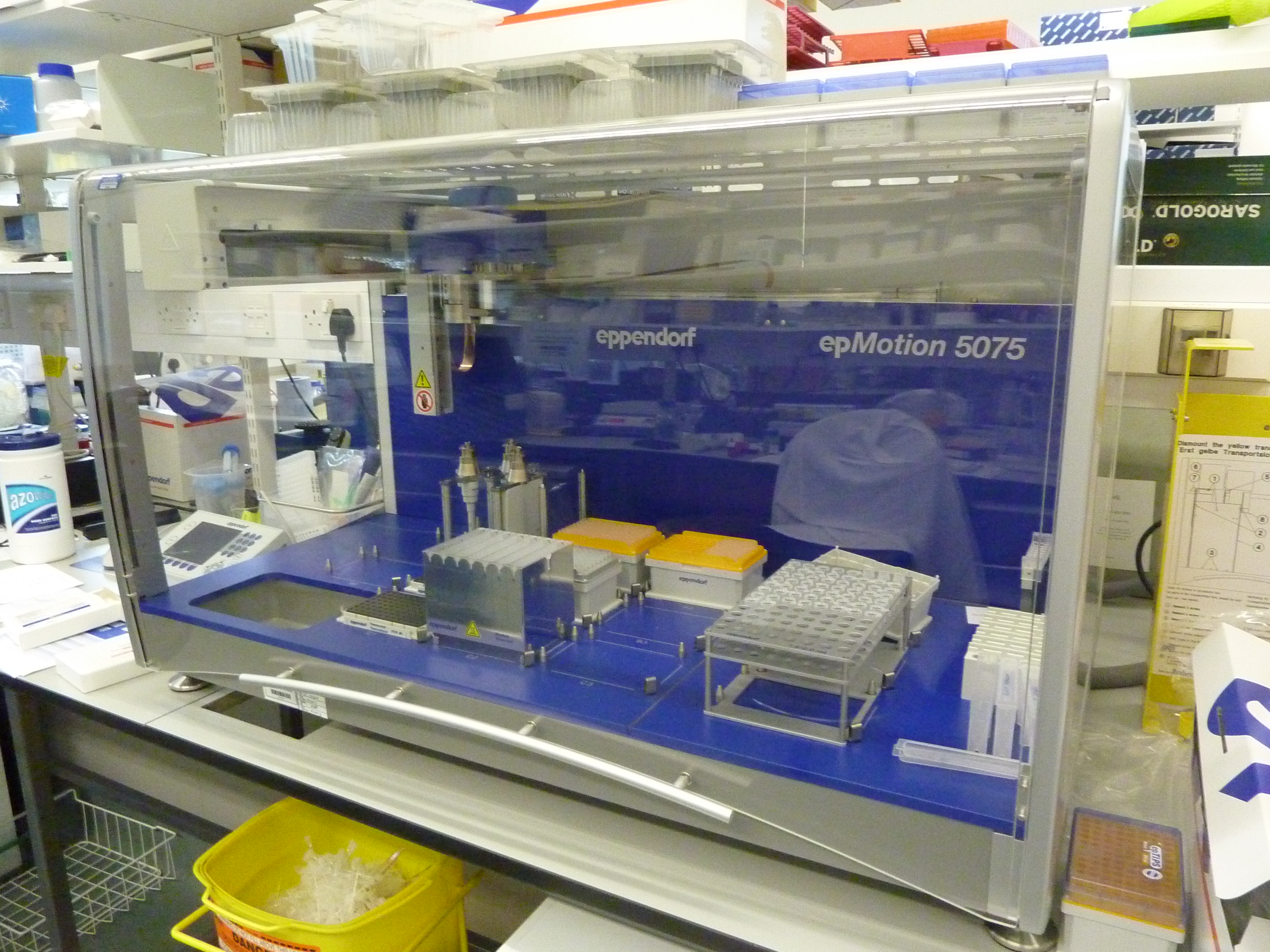
Buy Eppendorf epMotion 5075 Automated Liquid Handling System in Nigeria
Buy an Eppendorf epMotion 5075 automated liquid-handling system in Nigeria by specifying the exact 5075 variant, order reference, workflow, liquid volumes, consumables, worktable arrangement and implementation scope before requesting a quotation. Eppendorf lists a configurable family rather than one identical package: 5075l, 5075t, 5075t NGS Solution, 5075v and 5075vt differ in integrated modules, worktable positions and included accessories. Franance lists the system for quotation. Submit your requirements and Franance will follow up by phone or email; this page does not take online payment or confirm stock, final price, registration, delivery, installation or service. Use the Eppendorf epMotion 5075 product listing, pipettes and liquid handling category in Nigeria and Eppendorf liquid handling range to keep the model within its category and brand context. The product family page is not a substitute for a configuration-specific written offer. Ask the supplier to identify the exact catalogue number, system variant, accessories, software, consumables and any implementation services included.
Where can I buy an Eppendorf epMotion 5075 in Nigeria?
Request a quotation from Franance for the Eppendorf epMotion 5075 in Nigeria. In the enquiry, identify your organisation, contact person, delivery city and state, number of systems, expected procurement timeline and whether the application is research, routine testing or another laboratory workflow. State the configuration you want assessed, or describe the method and ask for a configuration review before selecting a variant.
For a useful quotation, include sample and reagent volumes, liquid types, vessels or plate formats, pipetting and mixing steps, number of runs, target batch size, required temperature or vacuum operations, tip requirements and existing protocols. Attach the method or a step-by-step description if available. If the method is still being developed, say so; method development and implementation are different activities from supplying an instrument and should be priced and scoped separately.
Franance uses a quote-order process. There is no online checkout or payment on the product page. A submitted enquiry is a request for follow-up, not an accepted purchase order, confirmed stock position or final price. Ask for a written proposal that names the exact Eppendorf order reference, supplied hardware and software, consumables, delivery assumptions, warranty, documentation, installation and training scope, and all exclusions. The quotation should make it possible to compare like-for-like configurations rather than simply comparing the family name.
What is the Eppendorf epMotion 5075 liquid handler?
The epMotion 5075 is an automated liquid-handling workstation family used to run defined pipetting and sample-preparation sequences. Eppendorf lists applications such as PCR or qPCR setup, DNA and RNA purification, NGS library preparation, solid-phase extraction, cell-based assays, immunoassays, tube-to-plate transfer, plate reformatting, serial dilution, cherry-picking, normalization and sample or reagent transfer. These are manufacturer-described application areas, not a guarantee that every method or assay is validated on every configuration.
The workstation automates programmed operations using selected dispensing tools, a defined worktable layout, compatible vessels and labware, and the modules needed for the method. The user must identify the protocol and the physical items that will occupy the deck. Where a procedure uses temperature control, mixing, vacuum filtration or automated plate movement, the configuration needs the corresponding compatible module and accessories. Software and method files also need to match the offered instrument and intended workflow.
Automation can standardize repetitive liquid transfers and reduce manual pipetting steps, but it does not independently establish assay validity, analytical performance or a laboratory’s quality system. A protocol must be reviewed by the laboratory’s responsible users, verified with the intended reagents and samples, and documented under the facility’s procedures. Ask Eppendorf or its authorised channel to confirm the exact configuration and method requirements before treating a product-family application example as a ready-to-run procedure.
Which epMotion 5075 variant should a laboratory specify?
The suffix is important because the five listed variants do not have the same built-in modules or worktable capacity. Eppendorf’s current family page identifies the 5075l, 5075t, 5075t NGS Solution, 5075v and 5075vt. Its technical table lists 15 SLAS/ANSI positions for the 5075l, 14.5 for the 5075t and 5075t NGS Solution, and 12 for the 5075v and 5075vt. Treat these as variant-specific worktable figures, not as a count of samples per run or an output-rate claim.
The 5075l is presented for plate preparation and workflows such as PCR/qPCR setup, normalization, cherry-picking, dilution series, reformatting and immunoassays. The 5075t adds an Eppendorf ThermoMixer. The 5075t NGS Solution is a named package that Eppendorf lists with a ThermoMixer, thermal module, four dispensing tools, gripper, NGS-specific accessories and consumables, and epBlue software with Enhanced Feature Set 1. Confirm current package contents and kit compatibility rather than assuming the package includes every consumable for a planned project.
The 5075v includes a vacuum system and gripper in the listed configuration. The 5075vt combines vacuum capability with a ThermoMixer and gripper. These variants are intended to support workflows where their modules are needed, but the correct choice depends on the protocol, compatible labware, required sequence and available deck space. The manufacturer's listed example order numbers are 5075000041 for 5075l, 5075000042 for 5075t, 5075000045 for 5075t NGS Solution, 5075000043 for 5075v and 5075000044 for 5075vt. Ask the quote to confirm that the reference is current and valid for the regional supply.
What does the 0.2 to 1,000 microlitre range mean?
Eppendorf lists a family volume range of 0.2 µL to 1,000 µL, with the actual range depending on the dispensing tool used. Do not interpret this as one installed tool covering every volume from 0.2 to 1,000 µL, or as a blanket accuracy and precision claim for every liquid. The tool, tip, liquid properties, selected volume, aspiration and dispense settings, vessel geometry, method and environmental conditions all affect whether the proposed setup is appropriate.
For each protocol step, document the target volume and tolerance, whether the liquid is aqueous, viscous, volatile, foaming or otherwise challenging, and the vessel or source geometry. Request the exact dispensing tool and compatible epT.I.P.S. Motion tip reference for the range. Ask for manufacturer performance data and any relevant limitations at the volumes and conditions that matter to the method. If low-volume transfers are critical, seek an application review or evaluation based on the actual liquid and vessels rather than relying on the smallest headline volume alone.
List the number of distinct volume ranges and whether the sequence needs automatic exchange among tools. Eppendorf describes automatic exchange for up to four tools, but the installed tools and method depend on the selected configuration. Confirm how the tools, racks, tip loading, waste handling, carriers and deck positions will be arranged. The quotation should identify included tools and consumables by reference and quantity; “supports 0.2–1,000 µL” is not a full consumables schedule.
Which laboratory workflows can the epMotion 5075 automate?
The product family is described for a range of laboratory preparation tasks. Eppendorf names PCR/qPCR setup, DNA/RNA purification, NGS library preparation, solid-phase extraction, cell-based assays, immunoassays, plate reformatting, serial dilution and sample transfer among application examples. Start by selecting the one or two workflows that matter most, then give the supplier enough detail to assess the sequence and the exact instrument configuration.
For PCR or qPCR preparation, state the plate format, number of samples and controls, reagent list, transfer volumes, required mixing, number of runs and any cold-storage or temperature steps. For nucleic-acid purification or magnetic-bead procedures, identify the kit manufacturer and exact kit reference, plate or tube format, bead handling, wash sequence, vacuum or thermal steps and required consumables. For NGS, include the library-preparation kit, target throughput, protocol version, sample count and whether the named NGS Solution package is being considered. A general statement such as “for genomics” is not sufficient to confirm method compatibility.
For immunoassays or cell-based work, list the plate type, volumes, reagent additions, mixing or incubation sequence, required environmental controls and contamination-control procedures. If the method uses a specific kit, assay or regulated workflow, ask for written confirmation that the current software, instrument variant, modules and labware are compatible. The manufacturer’s application list is a starting point for a technical review, not evidence that a particular third-party method has already been validated on the offered system.
How should a laboratory assess throughput and method compatibility?
There is no single samples-per-hour figure that can responsibly describe every epMotion 5075 setup. Throughput depends on sample and plate formats, number and order of liquid transfers, volume changes, mixing, heating, vacuum steps, tool changes, tip loading, waste handling, instrument pauses and operator intervention. A short transfer sequence and a multi-stage extraction or library-preparation protocol place different demands on the deck and take different amounts of time. Do not compare workflows using an unqualified “high-throughput” label.
Ask the supplier to map the method step by step to the proposed variant and deck layout. Request the expected cycle time for a defined batch, the assumptions used, the steps that require staff action, the consumable quantities, and any capacity limits imposed by the selected modules or carriers. Confirm whether the estimate includes setup, loading, run time, unloading, cleaning and changeover. If a target daily capacity matters, calculate it from the complete workflow and operating schedule rather than extrapolating a single cycle time.
Method compatibility should be demonstrated through current manufacturer documentation, a supported method file or an agreed technical assessment. Where a method has not been verified, make that explicit and agree who is responsible for programming, verification, training and acceptance. Define the success criteria in advance: transfer performance at required volumes, acceptable run completion, sample traceability, error handling, carryover or contamination controls, data export and reproducibility according to the laboratory’s own protocol. Do not treat a software simulation or demonstration as a substitute for local method verification.
What site, consumable and implementation requirements should I check?
The manufacturer’s technical data lists family dimensions of 108 × 62 × 81 cm, maximum power consumption of 700 W and a 100–240 V, 50–60 Hz supply. It lists variant-dependent product weights of approximately 122–128 kg. Confirm the current dimensions and mass for the exact order reference and allow for door access, bench capacity, surrounding clearance, ventilation, loading and service access. Verify the available electrical outlet, grounding, local plug and protection requirements with the manufacturer’s installation instructions and facility engineering team. These figures are procurement planning inputs, not a site acceptance specification.
Create a complete bill of materials for the method: dispensing tools, pipette tips, tip racks or reloads, reservoirs, plates, tubes, carriers, adapters, gripper, thermal modules, mixer blocks, vacuum frames, filters, waste containers and any other protocol-specific accessories. Specify each item’s manufacturer reference, quantity and whether it is included, required at commissioning or replenished as a recurring consumable. Check that the exact plate, tube and rack formats fit the proposed deck layout and that the method has enough available positions.
Agree how software and method files will be supplied, licensed, updated and backed up. Identify workstation, network, user access, data export and information-security requirements. Define the expected delivery, installation, training, commissioning, method setup, acceptance checks and after-sales response in writing. If these services are needed, request them as explicit quotation lines with responsibilities, prerequisites, travel or site assumptions and exclusions. The listing does not promise that installation, training, programming or ongoing service is included.
What documents and regulatory checks apply in Nigeria?
Before procurement, request the current manufacturer brochure, technical specification, instructions for use, software documentation, compatible consumables list and the full configuration schedule for the offered order reference. For a method-specific system, also request written compatibility or method support information for the intended kit or protocol, and document any deviations or local verification that remain. Check whether the instrument and its intended use are classified as a medical device or in vitro diagnostic device in the relevant context; laboratory automation equipment can serve different applications, so do not assume a regulatory status from the product family name alone.
NAFDAC’s medical-device registration guideline effective 4 November 2024 states that devices within its scope must be registered for regulated activities such as importation, advertising, sale, distribution or use in Nigeria. Ask the supplier for the registration or other regulatory documents applicable to the exact device and intended use, and have the facility’s regulatory lead verify them with NAFDAC where required. This guide does not establish that a particular epMotion 5075 unit is registered, exempt, available for import or suitable for a regulated diagnostic method.
WHO procurement guidance for in vitro diagnostics and related laboratory equipment emphasizes matching equipment and related items to the intended setting and use. Apply that approach by documenting user needs, staffing, space, power, consumables, workflow, quality requirements and maintenance before choosing a configuration. Keep the evaluation within the laboratory’s quality system and have qualified procurement, laboratory, engineering and regulatory personnel approve the requirements. Product information here supports an enquiry; it is not engineering, clinical, legal or regulatory advice.
What affects the price and how do I request a Franance quotation?
The product page does not list a fixed price. A configuration-specific quotation may change with the 5075 variant, order reference, tools, worktable accessories, gripper, ThermoMixer, thermal module, vacuum system, software feature set, NGS package, starter consumables, additional tips and labware, delivery destination and requested services. Installation, training, method development, commissioning, warranty extensions and ongoing support should be identified separately rather than presumed to be included in the base system.
Send Franance the exact variant or the workflow you need assessed; order number if known; target volumes and liquid types; required tools; plate, tube and tip references; mixing, heating or vacuum steps; expected sample and batch volume; current protocol; destination city and state; quantity; timeline; power and bench constraints; and requested documentation or service. You can use the Eppendorf-filtered equipment listing or request an epMotion 5075 quotation directly.
Ask the written quotation to show the manufacturer model and order reference, every included and optional item, quantities, consumables, software and licences, delivery assumptions, price validity, regulatory documents where applicable, installation and training scope, warranty terms, availability and exclusions. Franance will follow up by phone or email to clarify the request. Submission does not charge a payment method, place an accepted online order or confirm stock. This structured enquiry helps Franance recommend and quote a configuration that can be reviewed against your laboratory’s actual method.
Common questions
Is the Eppendorf epMotion 5075 one fixed configuration?
No. It is a product family with 5075l, 5075t, 5075t NGS Solution, 5075v and 5075vt variants. Request the exact order reference and complete supplied-items list.
Can the epMotion 5075 dispense from 0.2 µL to 1,000 µL?
Eppendorf lists that family range depending on the installed dispensing tool. It does not mean one tool covers the entire range or that every liquid and method meets a particular accuracy or precision. Confirm the tool, tips and method-specific performance.
How many samples per hour can an epMotion 5075 process?
There is no single reliable samples-per-hour figure for the family. Throughput depends on the complete protocol, plate layout, operations, mixing or heating steps, vacuum steps, consumable changes and operator intervention. Ask for a timed workflow review using the exact configuration.
Does the 5075t NGS Solution include everything for my NGS kit?
Eppendorf lists NGS-specific accessories and consumables in the package, but kit and method compatibility must be checked against current documentation and the exact order reference. Confirm the kit, protocol, software feature set and included quantities in the quotation.
Can I buy this product online from Franance?
No. Franance takes quote orders and follows up by phone or email. A submitted enquiry is not online payment, an order confirmation or proof of current stock.
Request your epMotion 5075 quotation from Franance.
Send Franance the exact variant and catalogue reference, facility and delivery destination in Nigeria, intended method and target plate or tube formats, volume and liquid requirements, compatible tips and labware, module and software needs, quantity, timeline and site details. Ask the written quotation to identify the supplied equipment and accessories, regulatory documents where applicable, availability, itemised price, delivery assumptions, installation or training scope, warranty terms and exclusions. Franance will follow up by phone or email; no online payment or stock confirmation is implied.
Choose quantity