

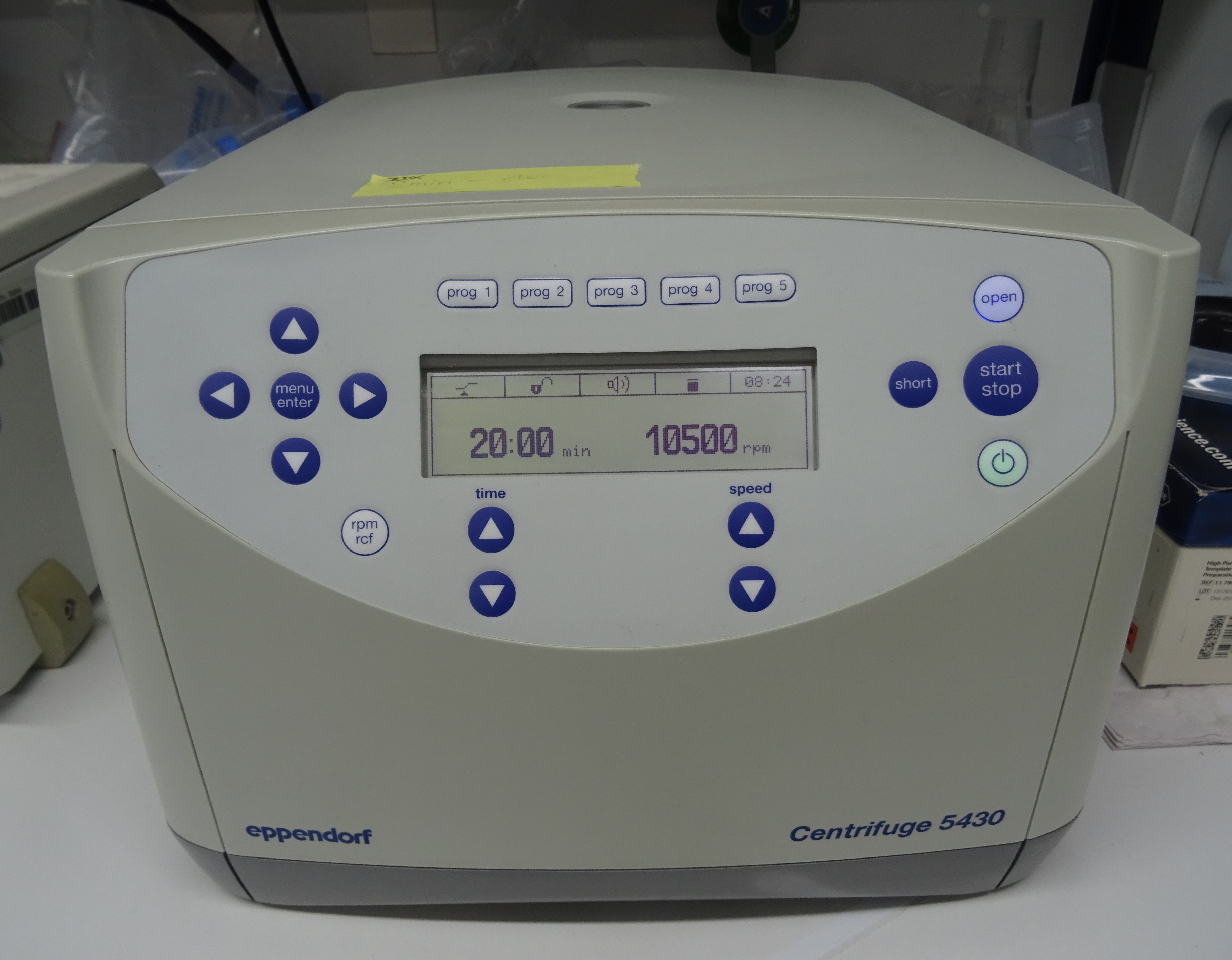
Buy the Eppendorf Centrifuge 5430 in Nigeria
Buy the non-refrigerated Eppendorf Centrifuge 5430 in Nigeria by requesting a configuration-specific quotation from Franance. Identify the sample vessels, required rotor and adapters, throughput, environmental conditions, electrical version, and installation destination. Eppendorf describes the 5430 family as a compact, versatile benchtop centrifuge with rotor options for microtubes, conical tubes and plates. The separate Centrifuge 5430 R is refrigerated; it is not the model represented by this Franance listing. Maximum speed, force and capacity depend on the rotor and supported assembly, so the quote should state the exact rotor, lid, adapters and included accessories. See the exact Eppendorf 5430 brand and research-grade centrifuge listing, the research-grade centrifuges category, and the separate laboratory centrifuge category for other equipment roles. Franance handles product enquiries as quote orders, not online purchases. A listing does not confirm stock, price, delivery timing, warranty, local service or that an accessory shown or described by a manufacturer is included. Confirm every commercial and technical item in the written offer.
Where can I buy an Eppendorf Centrifuge 5430 in Nigeria?
Open Franance’s exact 5430 filtered product listing and send a Centrifuge 5430 quotation enquiry. State the laboratory’s location, number of instruments, intended work, sample count per batch, vessel type and volume, any rotor already owned, and the electrical details available at the site. If the equipment will replace an existing centrifuge, include its model and rotor references; compatibility must still be checked for the proposed parts.
Franance follows up by phone or email. Request a written quote that identifies the actual 5430 model, electrical version, rotor and adapter configuration, lid or aerosol-tight components if required, starter accessories, shipping, installation or handover, training, warranty and service arrangements. Ask which items are included and which are optional. The product name does not state a local stock position, confirmed lead time, purchase price or support entitlement.
What is the Eppendorf Centrifuge 5430?
The Centrifuge 5430 is a non-refrigerated, high-speed benchtop centrifuge. Eppendorf presents the 5430 and 5430 R as a family with a range of rotors, but the listing here is specifically the non-refrigerated Centrifuge 5430. The 5430 R adds refrigeration and has different size, power and environmental requirements. Keep the model suffix visible in all procurement documents so the offered instrument matches the requested one.
Eppendorf lists the family’s maximum figures up to 30,130 × g and 17,500 rpm, and rotor capacity options that can include 48 microtubes, six 50 mL conical tubes or two microplates. These are not simultaneous capacities or promises for every rotor. The relevant RCF, rpm, tube compatibility and load depend on the selected rotor and adapters. Ask the supplier to put the exact rotor catalogue reference and the vessel table into the quote.
The 5430 is suitable for laboratories needing a compact instrument that can be configured for certain small-volume, conical-tube or plate workflows. That category-level description does not determine whether it fits a particular protocol. The laboratory must confirm the rotor’s permitted vessels, sample density, materials, loading limits, method parameters and any containment requirements using the current manufacturer documentation.
Which samples and rotor formats should I specify?
Start with the vessels your approved procedure actually uses. Record tube or plate manufacturer, catalogue reference, material, nominal volume, dimensions, cap style, quantity per run and whether vessels are reusable or single-use. Do not send only a broad request such as “PCR centrifuge” or “blood tube centrifuge”: the required rotor and adapter can vary with plate skirt, tube diameter, vessel shape and closure.
The 5430 family’s rotor options include fixed-angle and swing-bucket types, microtube arrangements, conical-tube arrangements and plate configurations. Each has its own capacity and maximum permitted operating conditions. Some vessels require dedicated adapters, and a rotor’s listed capacity does not mean every tube at that nominal volume fits without one. Ask the quote to identify all required rotor components, including buckets, lids, caps, adapters and carriers, with manufacturer part numbers.
For multi-format laboratories, separate each workflow in the request. For example, list microtubes, 15/50 mL conical tubes, PCR plates or deepwell plates as distinct requirements and ask whether the selected 5430 can support each with an identified rotor/adapter assembly. If a proposed package is meant to replace different instruments, compare the documented configurations and workflow limits rather than assuming one universal rotor will do every job.
How should I compare a non-refrigerated 5430 with 5430 R?
The catalogue listing is the non-refrigerated 5430. Eppendorf identifies the 5430 R as a separate refrigerated model. Cooling can matter for a validated procedure or sample-handling plan, but the decision belongs to the laboratory’s technical owner. If active temperature control is required, ask Franance to quote the correct 5430 R product separately and check its footprint, power, ambient conditions and accessories. Do not accept an offer that uses “5430” generically if the model version is material to the request.
Eppendorf’s product-family page may show data for both versions. The values must not be copied across models. In the manufacturer’s manual, the 5430 and 5430 R have separate power consumption, dimensions and ambient-temperature ranges. A non-refrigerated centrifuge also does not actively control sample temperature. The actual sample temperature can depend on rotor, speed, run time and ambient conditions; ask the method owner whether this configuration is appropriate.
When reviewing quotations, compare the model plate, full product code, electrical version and rotor package. If “refrigerated” appears on an offer for this listing, request clarification before acceptance so the product delivered matches the intended specification.
What does the rotor change about speed and capacity?
The rotor is a defining part of centrifuge performance. Eppendorf’s published rotor table assigns each rotor its own vessel capacity, maximum g-force, speed and load. A headline maximum for the centrifuge family should not be treated as the maximum for every rotor, adapter or sample vessel. Adapters can affect allowable force and load, while the vessel manufacturer also sets limits for the tube or plate itself.
Request a comparison table for the proposed instrument and rotor: rotor reference, number and type of vessels, required adapters and lids, maximum permitted RCF and rpm for that assembly, compatible vessel part numbers and any rotor service-life requirements. Have the laboratory verify this against its approved protocol and the current user manual. This guide does not provide operational centrifugation settings or recommend a procedure.
If your procedure specifies relative centrifugal force rather than rpm, preserve that unit in the purchasing brief. Do not convert a protocol between rotors based on rpm alone. Ask the qualified method owner to confirm the correct operating parameter for the selected rotor radius and vessel assembly. Any calculation or protocol change should be documented under the laboratory’s procedures.
Does the 5430 include rotors, adapters or aerosol-tight containment?
The catalogue record does not enumerate a particular rotor or accessory set. Eppendorf lists multiple packages and rotor choices across the product family, so the delivered configuration must be confirmed in the written offer. Ask whether the price includes the instrument only or a specified rotor, lid, adapters, buckets, rotor wrench and other items. List optional rotor packages separately so the lab can compare the true cost of each required workflow.
If biological risk assessment or containment procedures require aerosol-tight equipment, specify that requirement explicitly. Eppendorf’s rotor documentation distinguishes aerosol-tight rotors and lids from other options and describes compatibility for particular components. Do not infer containment from a sealed-looking lid, product photo or rotor family name. Ask for the exact rotor/lid combination, supporting manufacturer documentation and maintenance or replacement requirements. The laboratory’s biosafety lead must decide what containment is required for the intended samples and process.
Also ask for the current instructions for cleaning, inspection, rotor service life and accessory replacement. These are model- and part-specific. Do not continue using a damaged or expired rotor based on a general product description. Have trained staff follow the current manual and local safety procedures.
What should a Nigerian laboratory check about power and site conditions?
Before delivery, request the current installation instructions for the exact Centrifuge 5430 and electrical version. Eppendorf’s cited manual lists 230 V, 50–60 Hz and 475 W maximum for the non-refrigerated 5430, but the nameplate on the actual regional unit governs. The same manual lists other voltage variants, so do not assume the correct one is supplied without seeing the product code and nameplate details. The manufacturer instructs users to connect the unit only to a supply matching its plate and to a grounded outlet with protective earth.
The manual gives an indoor, non-moist environment and ambient temperature range for the non-refrigerated 5430; confirm the current range and site conditions for the offered model. Measure or verify supply voltage, frequency, grounding, outlet type, circuit capacity, room temperature, bench stability and access. Nigeria’s local power conditions differ by facility. Share observed voltage variation, generator transitions and UPS arrangements with the supplier and ask what protections are compatible with the instrument. Do not assume a generic UPS or stabilizer is approved.
Check the bench footprint, loading, height clearance for opening the lid, ventilation around the instrument and safe movement route to the laboratory. The unit’s weight and dimensions vary from the refrigerated R model, and rotor mass adds to handling. Have the facilities team and qualified electrician review the room and power before scheduling installation. Request the manufacturer’s clearance recommendations and confirm delivery access through doors, lifts and corridors.
What consumables, maintenance and training should I quote?
List recurring accessories that match the planned vessels: tubes, plates, caps, rotor lids, adapters and any aerosol-tight seals. Ask the supplier for manufacturer references, expected replacement or inspection requirements, compatible materials and local replenishment route. A centrifuge purchase may also need a rotor, buckets and adapters at first delivery; confirm whether these are included rather than assuming the instrument is ready for the intended workflow.
Request the current care and maintenance schedule, spare-part references, warranty terms and service path for the actual delivery location. Eppendorf’s manuals specify care and service-life information for individual rotors and accessories. A general product page does not prove that replacement parts are stocked in Nigeria or that a service engineer can attend onsite. Ask for any local support arrangements, response terms, travel scope and parts logistics in writing.
Training should cover the exact instrument version and its accessories: routine operation, rotor installation and removal, balancing requirements from the current manual, inspection, cleaning, alarms and shutdown. This is equipment familiarisation, not protocol validation or permission to use a rotor with any sample. Ask who provides training, the number of users, duration, format, supplied materials and whether competency records are available. The lab should retain responsibility for training, procedure approval and biosafety decisions.
How can I assess fit for a method or regulated laboratory?
The instrument’s category does not establish its suitability for clinical diagnostics or another regulated purpose. Review the laboratory’s approved method, sample type, vessel and rotor requirements, necessary force or temperature controls, containment, throughput, recordkeeping and quality-system obligations. Ask the manufacturer or supplier to confirm the proposed model and accessory compatibility in writing, then have the laboratory’s technical owner assess whether the configuration meets the method.
If the centrifuge will support diagnostic testing, accreditation, research or production, identify the responsible authority and current requirements before purchasing. Request applicable declarations, manuals, installation records and service documents for the exact regional product. A research-grade catalogue label is only a taxonomy description; it is not a certification or intended-use statement. Do not treat an application example or family brochure as evidence that the equipment and laboratory meet a specific standard.
For acceptance, agree what the supplier will demonstrate and document, such as model and rotor identity, power-up, controls, condition of supplied parts and completion of installation tasks. Define whether any qualification service is included and what it covers. Commissioning checks do not replace the lab’s responsibility for method validation or competency assessment.
What should I include in a Centrifuge 5430 quotation request?
Send Franance the exact product name, confirmation that the non-refrigerated 5430 is intended, quantity, sample-vessel schedule, rotor and adapter references, required lid or aerosol-tight configuration, electrical version, site power details, room location, destination city and state, and any requested delivery, installation, training, documents or service. Include the method’s approved parameters only to help verify compatibility; do not ask the supplier to substitute operational parameters without the laboratory’s approval.
Ask for an itemised response covering the centrifuge, selected rotor(s), buckets, lids, adapters, startup supplies, installation, commissioning, training, freight, taxes, warranty and technical support. Request exact product codes, current manuals, exclusions, quote validity and any model or voltage substitutions. Compare packages with the same rotor and vessel combination rather than comparing instrument-only totals.
Start with the Eppendorf 5430 listing or send a quote request to Franance. Franance will follow up by phone or email. Availability, pricing, lead time and support must be confirmed for the specific order.
Frequently asked questions about the Eppendorf Centrifuge 5430 in Nigeria
### Is this listing for the refrigerated Centrifuge 5430 R?
No. The listing is for non-refrigerated Centrifuge 5430. Eppendorf 5430 R is a separate model. Confirm the full model designation on any quotation.
### What is the maximum speed of the 5430?
Eppendorf lists up to 17,500 rpm and 30,130 × g at the family level. The maximum permitted value depends on the specific rotor, adapter, vessel and load. Verify the exact assembly in the current manual.
### Does the instrument come with the rotor?
The catalogue record does not specify a rotor package. Ask the quote to list the instrument, rotor, buckets, lids and adapters by exact reference.
### Can it hold 50 mL tubes or microplates?
The family has rotor options for these formats, but the required rotor and adapters differ. Confirm the exact tube or plate model and part references before ordering.
### Does the 5430 guarantee sample cooling?
No. This is the non-refrigerated model. If temperature control is required, review the separate refrigerated 5430 R and confirm method suitability with the laboratory owner.
### Is it available with installation or local warranty in Nigeria?
Those terms are not established by the product listing. Include the facility destination and requested scope, then obtain written confirmation in Franance’s quotation.
Sources and limitations
Model and rotor information were checked against Eppendorf’s Centrifuge 5430 / 5430 R product information, the Centrifuge 5430 / 5430 R operating manual, and rotor tables in the manual. Sources reviewed 20 October 2026.
The product-family materials cover 5430 and 5430 R; only facts that distinguish or clearly apply to the non-refrigerated 5430 are used here. Rotor-specific values do not define a universal operating configuration. Confirm current regional model code, electrical version, manuals, accessories, price, stock, delivery, warranty, installation and service in the written offer. This guide is procurement information and does not prescribe centrifugation settings, certify a method or establish local regulatory suitability.