

Buy Amico M4 NEMA 4 NFPA Digital Manifold in Nigeria
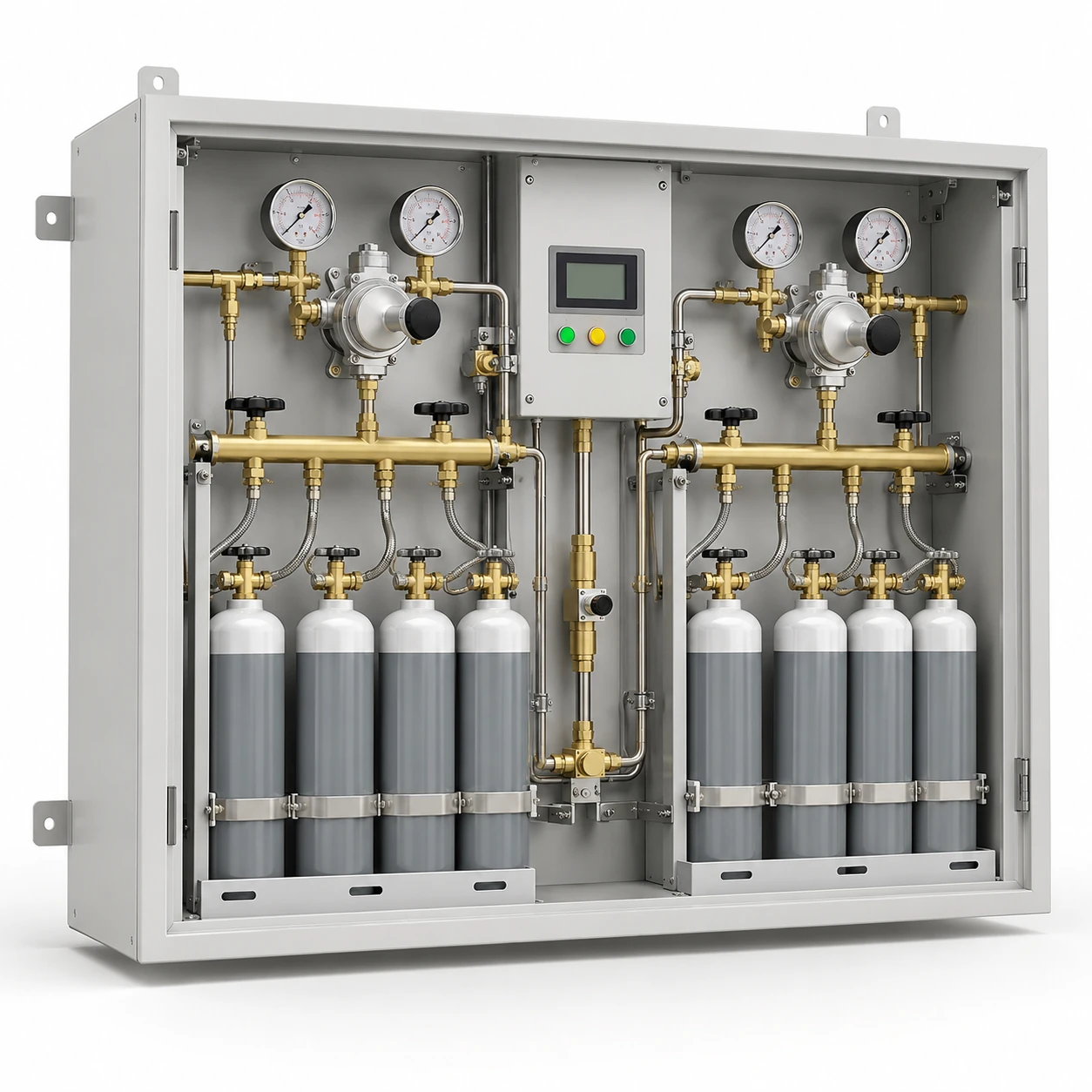
To buy the Amico Dome Loaded NEMA 4 NFPA Digital Manifold in Nigeria, request a project-specific quotation from Franance. This is an automatic medical-gas cylinder manifold with an outdoor-rated NEMA 4 cabinet variant, automatic bank changeover, digital status indicators and alarm contacts. The correct gas service, cylinder-bank size, header-bar arrangement, pigtails, final delivery pressure, required flow, electrical supply and alarm interface must be defined for the facility before a configuration can be confirmed. Franance handles quote enquiries by phone or email; the catalogue does not offer online payment. The live catalogue places the item in the Amico oxygen manifold listing filtered to the M4 NEMA 4 NFPA Digital model. The manufacturer’s gas selections include services beyond oxygen, so do not infer the required gas from the category label. Review the oxygen manifold system category and send the gas service, demand information, cylinder arrangement and site details with the Franance Amico M4 quote enquiry.
What is the Amico M4 NEMA 4 NFPA digital manifold?
Amico describes the Dome Loaded NEMA 4 NFPA Digital Manifold as an automatic cylinder manifold. It has a primary bank and a reserve bank. As the active bank depletes, the manifold changes over to the reserve bank. Amico’s product page says its dome-loading design switches banks without a fluctuation in flow pressure. The operating manual explains the regulator and control arrangement in more detail; facility engineers should use that manual and the project design documents when reviewing a proposed installation.
The current Amico specification identifies a cabinet model format beginning M4D4-DL-HH(H)-U-XXX and a header-bar assembly format beginning M2-HBXC-04U-XXX. In that specification, D means digital, DL identifies dome-loaded/NFPA, U identifies English, and XXX identifies the gas service. Exact code interpretation and the complete order code should be confirmed by Amico for the quoted configuration. The listing’s short name is not enough to define every orderable option.
This unit is one component of a medical-gas source and pipeline project. It does not by itself provide cylinders, cylinder storage, a pipeline distribution system, outlets, alarms throughout a facility or engineering design. Confirm what equipment is supplied with the cabinet and what is separate. Do not assume an image or a broad “manifold system” description is a packing list.
Which gas service and model code should I specify?
Amico’s current NEMA 4 specification provides gas codes for oxygen (OXY), nitrogen (NIT), medical air (AIR), carbon dioxide (CO2), nitrous oxide (N2O), argon (ARG), helium (HEL), heliox (HELIOX) and instrument air (IAR). These are manufacturer-listed options, not a recommendation that one manifold serve multiple gases. The model code and gas-specific components must match the intended source and system design.
State the gas service explicitly in the enquiry and quote. If your project includes more than one gas, list each as its own system requirement and ask Amico to confirm the appropriate equipment and separation. Include the expected inlet-cylinder specification and required downstream pressure from the signed design basis. Do not use the product category name, an existing pipe label or a photo to infer what gas the proposed model is configured for.
The NEMA 4 spec sheet gives example order-code structures; the manual and final manufacturer submittal should govern the actual selections. Have the quote state the full cabinet and header-bar references, language, gas code, pressure option, heater option if relevant, cylinder count, header layout, and pigtail material. Resolve any difference between the quoted model code and approved project drawings before procurement.
How should I size cylinder banks and capacity?
Amico publishes maximum flow figures on its NEMA 4 specification: 4,500 SCFH (2,123 L/min) for oxygen, medical air, nitrous oxide and carbon dioxide, and 6,000 SCFH (2,831 L/min) for nitrogen and instrument air. These are manufacturer-published figures for the specified product family. They are not an engineering calculation for a specific hospital, a guaranteed site flow under every condition, or proof that the system will meet a project’s demand.
Amico specifically notes that nitrous oxide and carbon dioxide flow capacity depends on installation-site environmental conditions and the number of cylinders in service. Its spec also cautions against installing those gas manifolds where ambient temperatures may fall below 0 °C. Request the manufacturer’s review of the actual gas, environmental range, bank size and expected operating demand. Do not apply the oxygen figure to another gas or select a system solely from its headline maximum flow number.
Provide the facility’s calculated peak and diversity demand, required delivery pressure, cylinder type and capacity, expected supply duration, replenishment interval and planned expansion. Identify whether the project needs 2 × 2 or 4 × 4 cylinder banks, and whether future cylinder additions are planned. Amico’s product documents show cylinder/header configurations, but the project engineer must determine an appropriate arrangement using the applicable design and operating assumptions. Ask the supplier to document the design inputs used to confirm capacity.
What does the NEMA 4 enclosure mean for installation?
Amico describes the NEMA 4 cabinet as intended for outdoor use and designed to protect against dust, dirt, oil and water; its technical sheet describes protection against dust, oil and water. This manufacturer statement describes the enclosure rating and intended use. It does not confirm suitability for every outdoor location, weather exposure, corrosive atmosphere, temperature range, mounting surface or maintenance condition in Nigeria.
Give the project team the actual installation location, whether it is indoors or outdoors, expected temperatures, direct rain or sun exposure, dust, flooding risk, corrosive exposure, ventilation, access and maintenance clearance. Ask Amico to verify environmental suitability and any cabinet-heater requirement for the selected gas. The spec lists optional heaters for nitrous oxide and carbon dioxide; the exact option and site need must be confirmed by the design engineer and manufacturer. Outdoor deployment of those gases needs particular attention to the stated environmental limits.
The spec sheet gives cabinet dimensions for its NEMA 4 version. Confirm the dimensions and clearances on the latest approved submittal rather than sizing a plant enclosure from a catalogue thumbnail. Review how the cabinet, cylinder headers, cylinder handling route, protective barriers and service access fit into the gas-source area. Confirm the supporting wall or structure and header-bar brackets for the specific cylinder count. The manufacturer specification notes bracket supply thresholds tied to particular bar layouts and cylinder counts, so ask for the complete mounting scope in the quote.
Which header bars and pigtails are required?
Amico identifies straight and staggered header-bar assemblies and copper or stainless-steel pigtail options. The current specification explicitly says to use only copper pigtails for oxygen service. It also states that gas-specific header bars and cylinder pigtail assemblies are ordered separately. Do not assume these parts are included with the digital manifold cabinet.
Specify cylinder count per bank, header-bar shape, pigtail material, gas service, cylinder-valve connection and any required check valves. Ask Amico to confirm all gas-specific connectors and the complete header assembly reference. Where the supply includes multiple cylinder sizes or connection standards, identify each cylinder type for review. Do not assume a connector fits because another site uses the same gas name; cylinder-valve connection details are part of the equipment selection.
The quote should itemise the cabinet, header bars, pigtails, check valves, isolation valves, mounting brackets and any separate interconnecting pipework. Ask the supplier to distinguish equipment included in the manifold assembly from site-fabricated connections, cylinders and building piping. Confirm the responsibility for final installation and leak testing under the approved project scope.
How does the digital changeover and alarm interface work?
Amico’s manual describes pressure transducers that read bank and line pressure and a digital board that controls bank changeover. The front-panel indicators report the banks’ “In Use,” “Ready” and “Empty” status. The product specification describes six LEDs and a fail-safe relay that provides a remote signal to a master alarm or buzzer. The manual describes normally closed dry contacts for the reserve-in-use alarm and says one or both contact sets may be wired to an external alarm, remote buzzer or building-management system.
That interface description does not establish compatibility with a particular hospital alarm panel or building-management system. Provide the project’s alarm design, preferred signal convention, wiring diagrams, contact supervision requirements and receiving equipment details. Ask Amico and the alarm-system integrator to confirm the interface and required components. State whether the scope includes the manifold contact connection only or also remote annunciation, cabling, conduit, programming, testing and integration.
The manual notes that a power fluctuation or failure activates a switchover alarm at connected master alarm panels; it also describes bank switching behavior during power loss. Have the engineer review the current manual and project alarm philosophy. Do not infer that a standalone manifold includes remote alarm panels, network connectivity, telemetry, or a BMS gateway. Identify any desired monitoring in the specification and have the vendor confirm a supported solution.
What electrical supply and utility details should I confirm?
Amico lists input power of 110–240 VAC, 50–60 Hz for the manifold. Its manual describes the power supply mounted on the cabinet and a 1-amp fuse. Confirm the delivered unit’s nameplate, supplied cord and connection method against the latest manual and final quote. A facility electrician should check supply protection, earthing, isolation and installation details against the manufacturer’s instructions and local electrical requirements.
The manifold also needs the correct gas cylinders, header assembly, cylinder connections and downstream medical-gas pipeline connection. Give the supplier the facility drawings and the relevant line pressure, outlet size and source shutoff requirements. The Amico spec references a 3/4-inch supply-line shutoff valve and a 1/8-inch port for an optional pressure switch on that configuration; confirm the exact model’s connections in its submittal before coordinating pipework. Relief-valve vent routing, room ventilation and cylinder storage provisions should be resolved by the qualified project team using the manufacturer instructions and applicable codes.
State whether the room has dedicated electrical service, protective equipment, gas detection or other project utilities, but do not assume a requirement from this guide. The design team should determine requirements from the selected gas, equipment documents, facility risk review and governing codes. Record who supplies and connects each utility so that factory equipment and site works are not omitted or double-counted.
What standards and local approvals should the project review?
The product is labelled an NFPA configuration. Amico’s technical sheet states that installation should follow NFPA 99, CGA and applicable local codes, and it makes an NFPA 99 compliance claim for the manifold specification. Those manufacturer statements identify the product’s stated standard context; they do not establish that a proposed installation complies with every project specification or Nigerian requirement.
Before ordering, have the project’s responsible medical-gas designer, facility engineer and authorities having jurisdiction identify the standards and approvals that govern this specific site and project. Confirm which editions and clauses are contractually applicable, what evidence or submittals are required, and who is responsible for design review, installation, testing, commissioning and handover. Do not treat an NFPA-labelled product as an automatic substitute for project-specific design or local acceptance.
Ask Amico for the current product-specific manual, specification, drawings, electrical diagrams, gas-specific ordering code and any declarations or test records required by the project. The purchasing file should record the reviewed model and revisions. Franance’s catalogue and this guide do not establish Nigeria-specific certification, regulatory approval or code acceptance for a particular installation.
What maintenance and commissioning scope should I quote?
Amico provides an operating and maintenance manual with installation, initial power-up, gas-flow, changeover, performance-verification, cylinder-change and parts-ordering sections. The manual says the manifold must be checked periodically, and parts that are broken, missing, worn, distorted or contaminated must be replaced. It also warns against repair or alteration without prior Amico approval. Use the current manual for the supplied version and ensure installation and maintenance are performed by qualified personnel within the approved project scope.
Ask the quotation to state whether delivery, mounting, header assembly, cylinder-bank connection, pipeline connection, electrical connection, initial testing, alarm-interface checks, commissioning records and operator orientation are included. These are separate activities and may involve different contractors. Identify who provides the gas cylinders, piping, isolating valves, alarm system, vent line and integration wiring. Request a responsibility matrix for equipment supply and site works.
Confirm the planned maintenance schedule, recommended spare parts, inspection criteria, documentation, training and service route. Request warranty terms applicable to the specific equipment and delivery route, including territory, duration, exclusions and claim process. Manufacturer documentation alone does not establish local service availability, response time, spare-parts stock or warranty support in Nigeria.
What should a Franance quotation include for Nigeria?
Provide the gas service, full project name, destination state and city, required quantity, demand calculation, required line pressure, cylinder type and count, bank configuration, header layout and site environment. Include the alarm/BMS interface specification, electrical supply, any environmental-heater question and the project’s standards or submittal requirements. Attach the relevant drawings and identify the engineer or contractor who will approve the proposed configuration.
Request an itemised offer showing the complete cabinet model code, header-bar reference, cylinder-bank arrangement, pigtail material and connections, check valves, isolation valve, mounting brackets, power accessories, alarm contacts and any heater. Ask the supplier to distinguish included parts from optional accessories, cylinders, site piping, alarm equipment and installation work. The returned documentation should confirm the exact gas service, capacity assumptions, working pressure, flow basis, environmental suitability and electrical details for review by the project engineer.
Ask for price and currency, quote validity, confirmed availability, lead time, delivery and insurance, customs/import responsibility, taxes, payment instructions and delivery terms for the stated Nigerian destination. Request warranty territory, service and spare-part arrangements in writing. Franance will follow up to clarify the quote request and provide commercial terms; no online checkout or local availability is implied by the catalogue listing.
How do I request an Amico M4 digital manifold quote?
Use the Amico M4 exact filtered listing and submit the Franance Amico manifold enquiry. Include gas service, destination, required pressure and peak demand, cylinder bank arrangement, installation conditions, alarm interface and requested project scope. Ask the supplier to resolve model-code and accessory questions against Amico’s current documentation before you approve the order.
For technical review, see Amico’s Dome Loaded NEMA 4 NFPA Digital product page, current NEMA 4 specification and operating and maintenance manual. The product page and documents describe the manufacturer's model; your engineer and project authority must confirm that a specific configuration fits the facility design and applicable Nigerian requirements.