
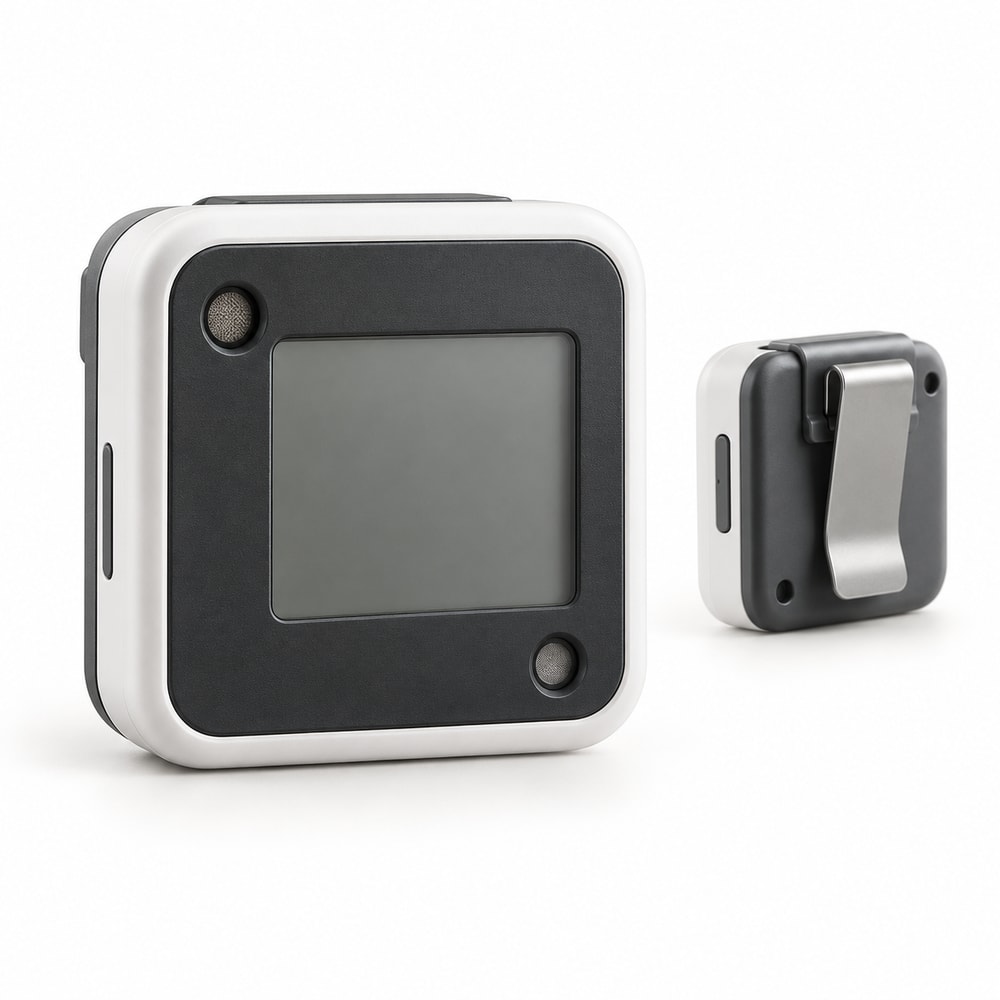
Instadose 2 Wireless Dual-Detector Dosimeter
Wireless electronic personal radiation dosimeter
Price on request

Medical equipment and biomedical engineering.
Abuja, Nigeria.
 Mirion Medical
Browse Mirion radiation dosimeters listed by Franance and request a quotation. Specify the badge type, monitoring programme, reporting needs and local service requirements.
Wireless electronic personal radiation dosimeter
Buy Mirion Diagnostic imaging in Nigeria through Franance. The current catalogue lists Mirion Instadose 2 Wireless Dual-Detector Dosimeter. For a quotation order, specify the Instadose 2 reference, number of wearers, monitoring workflow and whether any separate dosimetry service is requested. Include quantities and delivery destination; Franance will follow up by phone or email.
Wireless electronic personal radiation dosimeter
Buy Mirion Radiation Protection Equipment in Nigeria through Franance. The current catalogue lists Mirion Instadose 2 Wireless Dual-Detector Dosimeter. For a quotation order, specify the Instadose 2 reference, number of wearers, monitoring workflow and whether any separate dosimetry service is requested. Include quantities and delivery destination; Franance will follow up by phone or email.
Send exact model references, quantities by location and the intended facility requirements. Ask Franance to confirm the offered configuration, accessories, delivery and any separately requested technical services in the written quotation.
Wireless electronic personal radiation dosimeter
Buy Mirion Radiation Dosimeter (TLD/Badge) in Nigeria through Franance. The current catalogue lists Mirion Instadose 2 Wireless Dual-Detector Dosimeter. For a quotation order, specify the Instadose 2 reference, number of wearers, monitoring workflow and whether any separate dosimetry service is requested. Include quantities and delivery destination; Franance will follow up by phone or email.
Send exact model references, quantities by location and the intended facility requirements. Ask Franance to confirm the offered configuration, accessories, delivery and any separately requested technical services in the written quotation.
Send exact model references, quantities by location and the intended facility requirements. Ask Franance to confirm the offered configuration, accessories, delivery and any separately requested technical services in the written quotation.
Start with the Mirion dosimeter listing. Franance currently assigns Instadose 2 to its radiation dosimeter and TLD badge category. The category name groups radiation-monitoring products for discovery; it does not mean Instadose 2 is a passive thermoluminescent dosimeter. Review the model description and ask for the exact electronic badge type and programme components on the quote.
Read moreMirion describes Instadose 2 as a wireless dual-detector dosimeter that can capture, transmit, measure, analyse and report radiation dose on demand. The manufacturer identifies Direct Ion Storage technology and Bluetooth communication. The two detector measurements are deep dose Hp(10) and shallow dose Hp(0.07), for photon and beta radiation sources. Mirion describes automatic calendar-set readings and configurable email notifications for dose thresholds or overdue communication.
Read moreMirion identifies two independent detector channels: deep Hp(10) and shallow Hp(0.07). The product page describes these measurements for photon and beta radiation sources. Those quantities support defined monitoring tasks, but they do not by themselves determine whether the badge is suitable for a particular worker, practice or regulatory programme. A radiation protection officer or qualified medical physicist should select monitoring requirements based on the facility's radiation sources, procedures, local rules and risk assessment.
Read moreFranance currently lists the Mirion Instadose 2 wireless dual-detector dosimeter under radiation dosimeters and TLD badges. Instadose 2 is an electronic dosimeter that measures deep Hp(10) and shallow Hp(0.07) dose quantities for photon and beta sources. It wirelessly transmits dose information for on-demand reading and reporting through Mirion's associated platform and a compatible transmission source. It is not a passive TLD badge, protective shield or standalone substitute for a radiation protection programme. Browse the Mirion radiation dosimeter listing to see the product currently assigned to this Franance category. The product depends on more than the badge itself: wearer assignments, access to a Mirion account, an enabled transmission path, reporting arrangements, calibration and local programme oversight must be clarified. Mirion's US accreditation statement does not establish Nigerian regulatory acceptance or a local dosimetry service. Franance accepts quote orders and follows up by email or phone; it does not process online payment. Request written confirmation of badge supply, account and service access, report availability, price, delivery, calibration documentation and local requirements before ordering.
Start with the Mirion dosimeter listing. Franance currently assigns Instadose 2 to its radiation dosimeter and TLD badge category. The category name groups radiation-monitoring products for discovery; it does not mean Instadose 2 is a passive thermoluminescent dosimeter. Review the model description and ask for the exact electronic badge type and programme components on the quote.
Submit a quote order with the number of wearers or area-monitoring positions, required badge type, dose quantities, reporting cadence, alert thresholds and intended use. Explain how staff will access dose results and whether the facility has or needs a compatible enabled transmission source. Include the destination city and state and identify who will manage the radiation protection programme. Do not include personal health or identifiable dose histories in a general sales enquiry.
Ask Franance to confirm in writing the precise product reference, current availability, account or service access, included software or platform scope, compatible communication infrastructure, calibration and registration documentation, price and currency, validity, delivery and applicable warranty or support terms. A request is not an online purchase or a reservation. Manufacturer information does not establish Nigerian stock, regulatory status, service entitlement or programme availability for the particular quote.
Mirion describes Instadose 2 as a wireless dual-detector dosimeter that can capture, transmit, measure, analyse and report radiation dose on demand. The manufacturer identifies Direct Ion Storage technology and Bluetooth communication. The two detector measurements are deep dose Hp(10) and shallow dose Hp(0.07), for photon and beta radiation sources. Mirion describes automatic calendar-set readings and configurable email notifications for dose thresholds or overdue communication.
The product is an electronic personal dosimeter, not a passive TLD badge. It also is not a radiation shield, survey meter or complete occupational monitoring programme. The badge works as part of a service and data workflow: wearer assignment, compatible communication, account access, reporting and administration must be available. Mirion's product page states that dose data can be seen on a smart device or PC when close to an enabled transmission source. Confirm what hardware and service access are offered for Nigeria.
Franance's current catalogue lists one Instadose 2 product. The brand/category listing links to that current Franance assignment; it does not show every Mirion dosimeter or occupational dosimetry service. If your programme uses another detector, dosimeter type or reporting service, specify it directly and ask the seller to confirm whether it is in scope rather than assuming the listed product covers every monitoring need.
Mirion identifies two independent detector channels: deep Hp(10) and shallow Hp(0.07). The product page describes these measurements for photon and beta radiation sources. Those quantities support defined monitoring tasks, but they do not by themselves determine whether the badge is suitable for a particular worker, practice or regulatory programme. A radiation protection officer or qualified medical physicist should select monitoring requirements based on the facility's radiation sources, procedures, local rules and risk assessment.
The manufacturer lists a useful dose range from 10 mrem to 500 rem, also stated as 0.1 mSv to 5 Sv. It gives a badge type 38, size of 2 × 2 inches and weight of 0.8 ounces. The page reports a temperature range and US NVLAP accreditation code, while noting various other country accreditations. These are manufacturer statements; they do not establish Nigerian acceptance or the exact accreditation scope applicable to the proposed service.
Before purchase, ask Mirion or the authorised service provider to explain calibration, energy response, measurement uncertainty, reportable dose, quality controls, lost-badge procedures and record retention. Confirm that the service's calibration documents and accreditation meet the facility's current national regulator and institutional policy. Do not interpret a specification table as a substitute for the radiation protection programme or legal advice.
Mirion describes Bluetooth wireless communication and on-demand dose reads. The product page says dose readings and history can be viewed on a smart device or PC when the badge is near an enabled transmission source. It also describes calendar-based automatic reading intervals and email notifications for user-defined thresholds or overdue communication. The required platform, gateway or transmission hardware and internet or network arrangement need confirmation for the exact service offered.
Map the user's workflow before placing an order. Identify how badges are assigned and reassigned, who owns the administrator account, where dose records are viewed, how badges communicate, how often reads occur and who receives alarms. Ask whether any gateway, reader, license, subscription, account setup, connectivity or recurring fee is needed. Confirm offline behaviour, missed transmission handling and how dose reports can be exported and retained by the institution.
Consider privacy and access controls. Mirion states that personal information is not contained on or transmitted by the dosimeter, while account records and dose reports still require secure handling by the programme administrator. Define who can access identifiable worker data and how information is retained, exported and deleted in accordance with applicable law and policy. Do not assume the product's feature description alone establishes the hospital's compliance or data protection obligations.
Suitability depends on the facility's monitoring policy, radiation sources, exposure pathways, worker assignments, reporting needs and applicable regulation. Confirm that the deep and shallow dose quantities match the dosimetry requirement. Determine whether staff need whole-body or area monitoring and whether the badge's wear method and detector placement fit the procedure. Ask the radiation protection officer to approve the badge type and programme before procurement.
Check the operating environment, communication availability, account management and user training. Mirion recommends use and storage in indoor room-temperature conditions within its stated range. Facilities should consider whether badges remain within communication range at required reading times and how alerts are handled when a badge cannot transmit. Ensure records are reviewed by responsible personnel and that overdue badges or threshold notifications trigger an approved action.
The manufacturer page lists US accreditation and mentions accreditations in other countries, but it does not establish Nigerian regulatory acceptance. Have the competent authority or qualified local radiation protection adviser verify whether the service, calibration, report, model and provider meet current requirements. Do not represent the Instadose device as approved locally unless that status has been independently confirmed for the exact product and service.
State that you are requesting Mirion Instadose 2 and give the estimated badge quantity, user groups, intended monitoring task, badge type and required dose quantities. Describe whether the badges will be used for occupational whole-body monitoring, area monitoring or another defined programme. Identify the number of administrators, reporting interval, alarm thresholds, badge assignment method, account access expectations and data retention requirements.
Explain the transmission environment: expected usage locations, access to enabled transmission sources, mobile or PC platforms and any IT security restrictions. Ask whether the quotation includes required communication hardware, software, account provisioning, training, licensing and any recurring service. Confirm how results will be reported, how badges are reissued or replaced and who handles a failed or lost badge. Have IT and radiation protection staff review connectivity and data access.
Include destination city and state, delivery preferences and the documents needed for procurement. Ask the offer to show price and currency, quote validity, current availability, delivery, calibration certificates, service access and any applicable warranty. Request confirmation of local regulatory acceptability through the appropriate supplier and institutional process. Do not send names, individual dose records or other sensitive personal information in the initial enquiry.
Cost may depend on badge quantity, service model, account or platform access, transmission equipment, reporting, accessories, training, calibration documentation, delivery and any recurring programme charges. Confirm whether the quote covers badges alone or a service package. If subscription, account, portal, transmission source or per-badge monitoring fees apply, ask the seller to list initial and ongoing charges separately.
Mirion's product page provides features and specifications, not a current price for a Nigerian customer. Franance accepts quote orders and follows up by email or phone. Request an itemised offer in the required currency with validity, payment terms, quantity breaks if applicable, delivery destination, availability, included platform access, service duration, calibration and report scope. Ask whether the proposal includes registration or any required programme onboarding.
Compare quotes only when they cover the same badge type, detector channels, service interval, account access, enabled communication arrangement, reports, calibration and support. A unit price that excludes platform or service charges may not represent the total programme cost. Ask the relevant service provider to confirm that the proposed subscription and data access remain available for the full intended monitoring period.
The Franance listing does not confirm stock, geographic coverage, delivery timing or service reach for a specific Nigerian location. Include the final facility address, city and state in your quote request. If badges are needed at several hospitals or clinics, list each destination and quantities separately. Ask whether delivery is consolidated or split, how packages are tracked and who receives and assigns the badges.
For a dosimetry programme, delivery is only one part of the service. Confirm whether account setup, badge assignment, transmission hardware, administrator training, dose reporting, calibration and ongoing support can be provided for each location. Request written confirmation of the exact delivery schedule, costs, coverage, service contact and any limitations. The manufacturer's global website does not prove that every part of its programme operates in Nigeria.
Franance can review a quote order for your destination and return proposed terms. Do not assume a product page means local stock, regulatory acceptance, a Nigerian service arrangement or countrywide coverage. Confirm the order-specific supply and service plan before assigning badges to workers.
Assign responsibility to the radiation protection officer or other approved programme administrator. Establish an inventory that links each badge identifier to the right wearer or monitoring location under the facility's privacy rules. Define assignment start and end dates, wearing position, return or reassignment process, lost or damaged badge procedure, communication frequency and response to a notification. Train users on correct wear, storage, care and how to report a missing badge.
Set a process to review dose data and investigate unusual, missing or overdue readings. Keep authorised access limited to staff with a programme need. Decide how reports are retained, exported to institutional records and handled when a worker changes roles or leaves. The supplier should explain account access and retention controls; the hospital remains responsible for its policies and legal duties.
The operational procedure should reference current Mirion instructions and locally applicable radiation protection requirements. Confirm the calibration and service documentation available for each badge cohort. When badges are reassigned, follow the official account workflow so that historical exposures remain correctly attributed. Do not treat a dose alert as a clinical diagnosis; route it to the radiation protection professional for assessment and follow the facility's approved response protocol.
Check the exact product name, model or badge type, detector channels, quantity, service interval and accessories. Confirm whether the offer includes platform access, enabled transmission source, account setup, software or recurring service. Verify how dose reports are delivered, how a badge is assigned, what happens if communication is missed, and whether administrator access works from your facility's devices and network.
Have radiation protection and regulatory staff confirm the model, calibration, accreditation documentation and service provider meet the applicable Nigerian and institutional requirements. A US accreditation listed on the product page is not proof of local acceptance. Have IT and privacy staff review connectivity, access control and handling of personnel dose data. Confirm the calibration and quality documents that will accompany the order and how they are maintained.
Review commercial terms separately: availability, price, currency, quote validity, delivery, local service access, warranty, subscription period, renewal, training and exclusions. Request written confirmation before approving a purchase. The Franance catalogue supports a quote enquiry but does not guarantee local availability or service. Keep the final configuration, service terms, instructions and calibration records with the radiation monitoring programme documents.
Open the Mirion radiation dosimeter listing and submit a quote order for Instadose 2. State the number of wearers, monitoring purpose, required dose channels, transmission arrangement, reporting interval, administrator access, calibration documentation, quantity and destination. Ask Franance to confirm whether the offer includes only badges or a complete platform and monitoring service arrangement.
Franance follows up by email or telephone; there is no online checkout for this item. An enquiry does not reserve stock or confirm availability. Request a written quote with exact badge type, service components, platform and hardware scope, price and currency, validity, delivery, ongoing fees, calibration and regulatory documents, warranty and support terms. Have the radiation protection officer, biomedical or procurement team, IT and privacy reviewer assess the proposal as needed.
Do not submit identifiable worker dose histories with the initial enquiry. If more technical detail is needed, provide non-identifying programme requirements and follow the institution's approved secure process for sensitive records. Before badges are assigned, confirm the service, account, communication and local compliance arrangements are operational and documented.
No. Mirion describes Instadose 2 as a wireless electronic dosimeter with deep Hp(10) and shallow Hp(0.07) detectors. The Franance category also groups dosimeter and TLD badge products.
Mirion states that dose data can be viewed when near an enabled transmission source. Confirm the exact hardware, account and service arrangement in the quotation.
No. Confirm the service, calibration documentation and regulatory acceptability for Nigeria with the relevant supplier and institutional authority.
Provide the badge quantity, monitoring purpose, dose channels, transmission arrangement, reporting, account access, calibration documents and Nigerian destination. Franance can review the quote order and follow up with proposed availability and terms.
Request a Mirion quotationAdd the models you need to a quote order, or send us your equipment list.