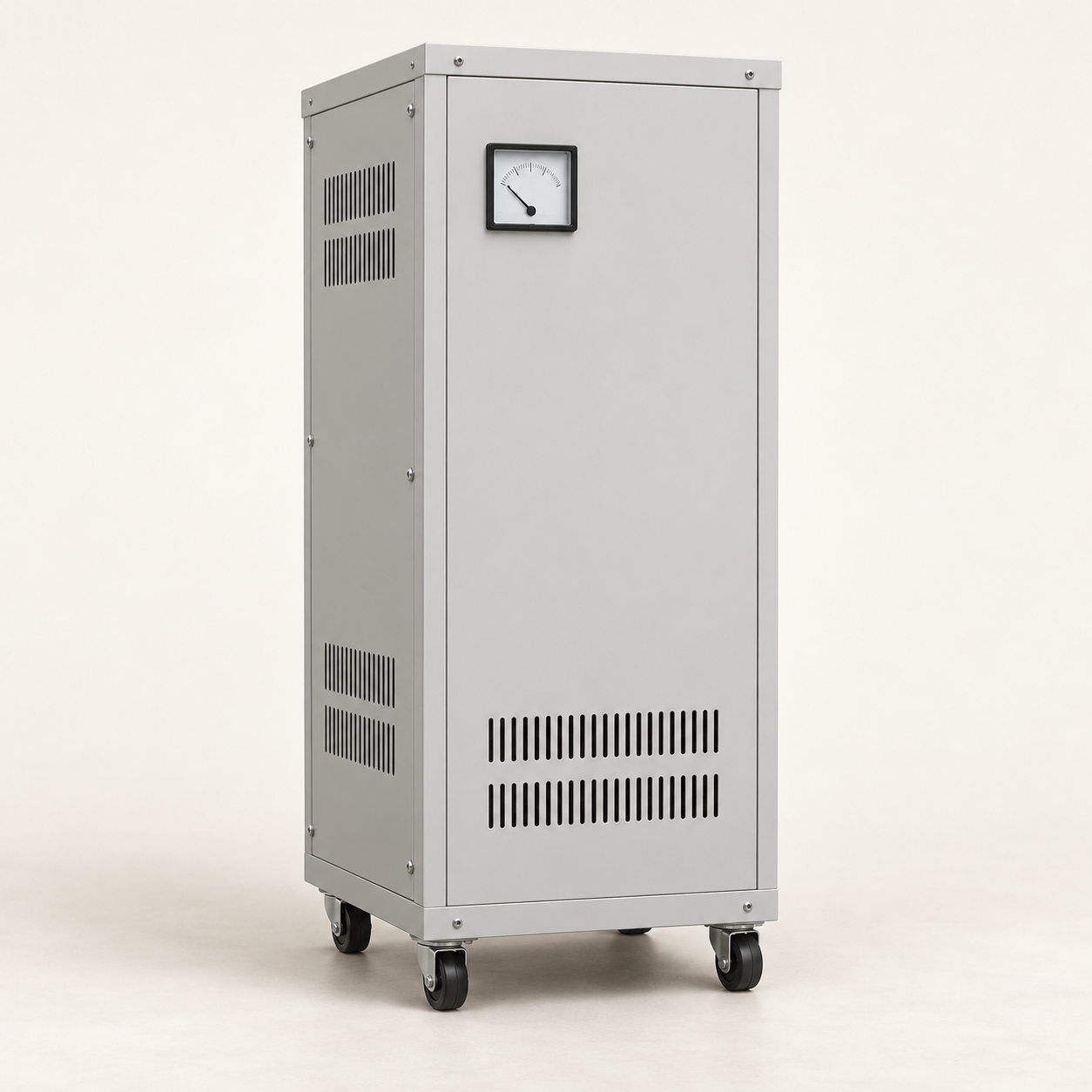
Buy Hindustan Power Control System voltage stabilizers and electrical power conditioning equipment in Nigeria.
Compare HPCS single-phase servo voltage stabilizers listed by Franance: 10SSA8-90 at 8 kVA and 10SSA10-140 at 10 kVA. Share the connected equipment, supply conditions, required capacity and destination to request a quotation and have the model selection reviewed against your project needs.
Franance lists HPCS single-phase servo voltage stabilizers for power-protection applications: 10SSA8-90 (8 kVA) and 10SSA10-140 (10 kVA). Choose a model for quotation based on the connected load and electrical requirements, and provide the site details needed to review the request.
The HPCS power-quality listings from Franance include 8 kVA model 10SSA8-90 and 10 kVA model 10SSA10-140 servo voltage stabilizers. Include the equipment load and supply characteristics in your request so the quotation can identify the model and project assumptions clearly.
For a quotation, specify the selected stabilizer model, load profile, input voltage range and phase, output requirement, quantity and installation location. Include the equipment documentation or project schedule if available and request written configuration details.
Franance lists HPCS servo voltage stabilizers 10SSA8-90 (single-phase, 8 kVA) and 10SSA10-140 (single-phase, 10 kVA). Compare rated capacity against your actual connected equipment and supply conditions, then submit the required model and site information for a quotation.
Name 10SSA8-90 or 10SSA10-140 and provide the connected load, input and output requirements, phase, installation environment, quantity and delivery site. Confirm sizing and electrical compatibility with the responsible project engineer.
State the HPCS model, connected equipment, measured or specified input conditions, required output, quantity and facility location. Ask your electrical designer to confirm capacity and suitability before the configuration is finalised.
Start with the HPCS 8 kVA 10SSA8-90 listing or the HPCS 10 kVA 10SSA10-140 listing. These brand- and category-filtered listings identify the corresponding current catalogue records. Tell Franance which exact model you need, the number of units, facility city and state, connected equipment, measured supply conditions and target delivery timeline.
Franance lists two Hindustan Power Control System (HPCS) servo voltage stabilizers for Nigerian facilities to review through a quotation order: the 8 kVA 10SSA8-90 and the 10 kVA 10SSA10-140. Both are single-phase air-cooled units, but the manufacturer's published input ranges and capacities differ. Review the 8 kVA HPCS stabilizer listing and the 10 kVA HPCS stabilizer listing before deciding which model to request.
HPCS describes these products as servo voltage stabilizers with a stated 230 VAC output and voltage regulation, along with protection and bypass features. A stabilizer does not automatically provide battery backup, guarantee uninterrupted power or make an electrical supply suitable for every medical device. The equipment's manufacturer, a qualified electrical engineer and the facility's biomedical engineering team must specify whether a stabilizer is appropriate, size it for the actual load and validate the installation.
The manufacturer notes that it continuously upgrades products and specifications may change. Treat the values in this guide as descriptions of HPCS's reviewed product pages, not a substitute for the current datasheet and quote. No Nigerian stock, price, authorised distribution, regulatory status, warranty, delivery, installation or local service is promised. Send Franance your location, load and electrical requirements; Franance will follow up by phone or email with a quotation order proposal. Confirm all model and local terms in writing.
Where can I buy an HPCS servo voltage stabilizer in Nigeria?
Start with the HPCS 8 kVA 10SSA8-90 listing or the HPCS 10 kVA 10SSA10-140 listing. These brand- and category-filtered listings identify the corresponding current catalogue records. Tell Franance which exact model you need, the number of units, facility city and state, connected equipment, measured supply conditions and target delivery timeline.
Provide the equipment nameplate data, load type, rated voltage and current, number of phases, frequency, power factor, startup or inrush requirements, duty cycle, earthing arrangement and expected voltage variation. Ask the medical-device manufacturer or its qualified technical representative to confirm whether an external stabilizer is permitted and what input-output requirements apply. Do not select a model solely because its kVA appears close to a device's nominal power rating.
Franance handles orders by quotation rather than direct online checkout. After receiving requirements, Franance will follow up by phone or email to clarify the request and discuss a quotation. A catalogue listing is not a live stock statement, fixed price, delivery estimate, installation commitment or confirmation of HPCS representation in Nigeria. Ask the written offer to confirm model, technical configuration, price validity, freight, taxes, delivery, warranty and service responsibility.
What do the HPCS 10SSA8-90 and 10SSA10-140 designations mean?
HPCS identifies the listed models as 10SSA8-90, rated at 8 kVA with a published input range of 90–270 VAC, and 10SSA10-140, rated at 10 kVA with a published input range of 140–275 VAC. Both product pages list 230 VAC output, single-phase operation and air cooling. The 8 kVA model's wider stated input range does not make it a higher-capacity stabilizer; the 10 kVA model has a larger stated apparent-power capacity. The correct selection must be based on the system's load and supply conditions, not on only one specification.
The 10 kVA page lists model number 10SSA10-140, 34 A maximum current and dimensions of approximately 54 × 50 × 55 cm, while the 8 kVA page lists 10SSA8-90, 26 A maximum current and dimensions of approximately 335 × 400 × 350 mm. These manufacturer pages use different dimension formats and may change. Confirm the exact current drawing, maximum current, weight, clearances, enclosure and terminal arrangement for the model you request.
For either unit, have an electrical professional check the supply voltage range and phase, connected load, transformer or motor loads, harmonics, short-circuit level, protective devices, earthing, bypass operation and installation environment. Ask HPCS or the supplier to confirm suitability from the device data rather than treating the published product application list as a project design approval.
Is an HPCS stabilizer the same as a UPS or backup generator?
No. A servo voltage stabilizer is intended to regulate voltage within its design range; it is not described as an energy-storage UPS and does not itself provide battery runtime or independent generation. HPCS lists a bypass facility and generator compatibility on its product pages, but these features do not create backup power or guarantee continuous operation during an outage. Confirm the exact behavior, transfer path and electrical ratings from current documentation.
If the connected medical equipment requires uninterrupted supply, ask its original equipment manufacturer for the required power architecture. That may involve a UPS, generator, power-conditioning equipment or a specific combination, but the solution must be designed for the equipment and facility. A stabilizer alone should not be represented as ride-through or backup unless the manufacturer expressly documents that function for the exact model.
Have the facility's electrical engineer draw the intended system path, including mains, generator, transfer switch, stabilizer, UPS and medical equipment where applicable. Verify startup currents, overload behavior, bypass interlocks, earthing, protective coordination and maintenance isolation. Do not introduce a stabilizer, bypass or other component into an installed system without review by the device and electrical-system authorities.
What are the published HPCS technical specifications?
HPCS's product page for 10SSA8-90 lists an input range of 90–270 VAC, 50 Hz ±3 Hz, 8 kVA capacity, 230 VAC output, maximum current of 26 A, line and load regulation of ±1%, efficiency above 99%, correction speed of 20 V/s, response time below 10 ms and continuous duty. It also lists over- and under-voltage, overload and short-circuit protection, digital input and output voltage display, bypass, time delay and generator compatibility. Verify all values against the current model-specific datasheet.
The 10SSA10-140 page lists input from 140–275 VAC, 50 Hz ±3 Hz, 10 kVA capacity, 230 VAC output, maximum current of 34 A, line and load regulation of ±1%, efficiency above 99%, correction speed of 20 V/s, response below 10 ms, continuous duty and similar protection and display features. HPCS identifies both products as single-phase and air-cooled. The output waveform and frequency are described as the same as the input, so this is not a frequency converter.
HPCS notes that it continuously upgrades products and specifications may change. Some page content includes warranty, standards and construction details for products sold from India; those terms are not evidence that the same terms apply to a Nigerian sale. Ask for the current technical sheet, wiring diagram, input and output terminal layout, bypass description, acoustic and thermal data, enclosure rating, transport weight, installation clearance and applicable certificates for the quoted unit.
How should I size a stabilizer for medical equipment?
Do not size from the medical device's kW figure alone. Apparent power in kVA, active power in kW, power factor, startup current, simultaneous load, duty cycle and the device manufacturer's requirements all matter. Some medical systems have compressors, pumps, gradients, X-ray generators, motors or switch-mode power supplies with transient or nonlinear loads. The stabilizer page's stated kVA rating does not prove compatibility with such loads.
Ask the original equipment manufacturer or its authorized technical representative to specify the permissible input range, phase, frequency, voltage regulation, maximum demand, inrush or transient needs, power factor, harmonics, required protective devices, grounding and whether a stabilizer may be used. Provide that requirement to a qualified electrical engineer and to HPCS or the quote supplier. Obtain a written sizing rationale for the intended load and its operating modes.
If multiple devices will share a stabilizer, list each nameplate and expected simultaneous operation. Confirm whether the total current, apparent power, inrush and phase balance remain within the rated continuous capacity and correction limits. Include auxiliary cooling, computers, monitors and room equipment only when the engineering design says they belong on the same supply. Do not combine unrelated loads based on an estimate.
What input range and output should I request?
Record voltage at the installation point over representative operating conditions, including generator or mains operation if both are expected. Compare those measurements with the current model's stated input range, then ask HPCS to confirm the acceptable operating limits, cutoff behavior, restart or time-delay settings and output regulation. The 8 kVA model is published at 90–270 VAC input, and the 10 kVA model at 140–275 VAC; these figures must be confirmed for the production unit being quoted.
Both pages list 230 VAC output. Confirm that the connected medical device is designed for that output voltage, phase, frequency and waveform, and ask for the output under full rated load and the expected site conditions. HPCS lists 50 Hz ±3 Hz input and says output frequency and waveform are the same as input. A stabilizer therefore should not be assumed to correct frequency instability or convert a 50 Hz supply to 60 Hz.
Ask about bypass functionality: whether it is manual, automatic or another arrangement; what happens during a fault or maintenance; whether the output is disconnected or passed through; and which indicators or alarms are provided. A bypass can affect the connected device's supply and must be understood within the approved electrical design. Require a wiring diagram and written explanation for the exact model.
What protections and installation conditions should I check?
HPCS lists over-voltage, under-voltage, overload and short-circuit protection, together with indicators for mains, output and cutoff status. Ask for protection thresholds, trip curves, reset behavior, available alarm contacts and required upstream and downstream protective devices. Verify that the proposed stabilizer coordinates with the facility distribution board, generator, UPS and medical equipment. Do not assume that built-in protection replaces circuit breakers, surge protection or a facility electrical-safety review.
Ask for the unit's rated ambient-temperature range, ventilation clearance, cooling method, enclosure and ingress-protection details, noise, heat rejection, mounting position and cable-entry requirements. The product pages list an operating temperature range, but the exact current value and conditions should be verified. Ensure the installation has adequate ventilation and can support the unit's dimensions and weight.
For a medical environment, have the facility's electrical and biomedical engineering teams review applicable safety standards and the equipment manufacturer's installation requirements. Confirm earthing point and conductor sizing, polarity, neutral arrangement, isolation and test method. Obtain installation, commissioning and maintenance instructions for the actual unit, and identify who is qualified to perform them.
What does an HPCS stabilizer cost in Nigeria?
Franance does not publish a fixed online price for these listings. Request a quote for the exact 8 kVA or 10 kVA model, quantity, required input range, options and destination. Ask whether a custom voltage range, enclosure, bypass arrangement or other change is proposed; custom options must be identified as a different configuration and assessed technically. The quotation should state currency, validity period, taxes, freight, insurance and any import or installation charges.
Do not treat an Indian manufacturer price, an old quote or an online marketplace listing as a Nigerian delivered price. Ask whether delivery to your city and state, wiring, installation, commissioning, testing, documentation, warranty and after-sales service are included or excluded. If your facility has a tender format, budget code or compliance-document requirement, provide it when requesting the quotation.
Franance will follow up by phone or email after receiving the specification. That follow-up does not confirm stock, an HPCS sales relationship, price or delivery until the formal proposal states the terms. Review the technical schedule and commercial offer together, especially the model, capacity, input range and protection details.
What warranty, documents and local service should I confirm?
Request the current datasheet, installation and operating manuals, wiring diagram, model label, test records and applicable conformity documents for the exact stabilizer. HPCS's pages state warranty terms and manufacturing standards for its listed products, but a warranty statement published by an Indian manufacturer does not establish eligibility, provider or service coverage for a Nigerian purchase. Ask the supplier to identify the warranty provider, covered model, term, start date, exclusions, claim process and transport responsibility in writing.
Confirm whether a qualified technician can install and commission the unit in your city, whether that work is included, and who handles repairs and replacement parts. Ask for service location, response process, remote technical assistance, travel costs and any loan unit arrangement. No Nigerian service coverage is established by the catalogue or this guide. If local installation or support is a purchase requirement, do not leave it as an assumed condition.
Ask what testing and handover records are supplied, including input-output test results, protection checks, bypass verification, earthing inspection and maintenance schedule. The facility's engineer should establish acceptance criteria before delivery. Keep the model serial number, wiring documents and maintenance history with the connected medical equipment records.
Can Franance deliver HPCS stabilizers across Nigeria?
The catalogue does not guarantee nationwide delivery or local inventory. Give Franance the city and state, complete address, receiving hours, site contact, access constraints and target date. Ask for written confirmation that the exact model can be supplied to the destination, what lead time is proposed, who handles freight and insurance, and whether unloading, installation, wiring or commissioning is included.
For multiple sites, list each stabilizer's model, quantity, load specification and facility address separately. Confirm whether the voltage range or electrical configuration differs by site and whether the supplier proposes distinct models. Share site access and mounting requirements so logistics and installation are planned before dispatch. Do not apply one delivery estimate to all states or assume that delivery to the entrance includes electrical work.
Before the equipment arrives, have a qualified electrical professional confirm site readiness, supply measurement, protective devices, earthing and installation location. Arrange isolation and commissioning windows with the facility. Inspect the model and packaging on receipt and record serial numbers and any damage. The site should not energize equipment until the approved installation and acceptance checks are complete.
Franance will follow up by phone or email to clarify requirements and discuss a quotation order. Have the equipment manufacturer or qualified technical representative confirm stabilizer requirements and ask the electrical engineer to review the sizing. In the written quote, verify the exact model, capacity, input range, output, protection, bypass, installation scope, current technical documents, price validity, delivery, warranty and service.
Do not approve a quote based only on the phrase “medical equipment stabilizer” or a kVA figure. Confirm that the device manufacturer permits the arrangement and that the facility electrical design supports it. That review keeps the order aligned with the actual equipment, power quality and site requirements.
Common questions
Which HPCS models are listed by Franance?
The current catalogue assigns HPCS 10SSA8-90 and 10SSA10-140 to the servo voltage stabilizer category. Open the filtered listings or include the exact model in a Franance quote request.
Does a stabilizer replace a UPS or generator?
No. A voltage stabilizer regulates supply within its design limits; it does not by itself provide stored energy during an outage. Confirm separate backup and protection requirements with the equipment and facility engineers.
Does Franance show a fixed HPCS price?
The listed catalogue records do not establish a fixed current Nigerian price. Request a quotation for the exact model, quantity, destination and any installation scope.
Can Franance confirm delivery or local service in my state?
Franance can receive the destination and scope in a quote request, then confirm applicable supply and service terms for that enquiry. The manufacturer specifications alone do not verify local availability or coverage.
Request an HPCS stabilizer quotation.
Send Franance the exact model, load and electrical requirements, quantity, facility location and any requested installation scope for a Nigeria quote review.

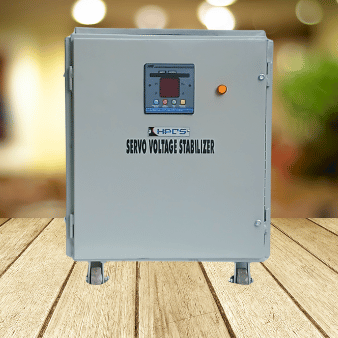

 Hindustan Power Control System