

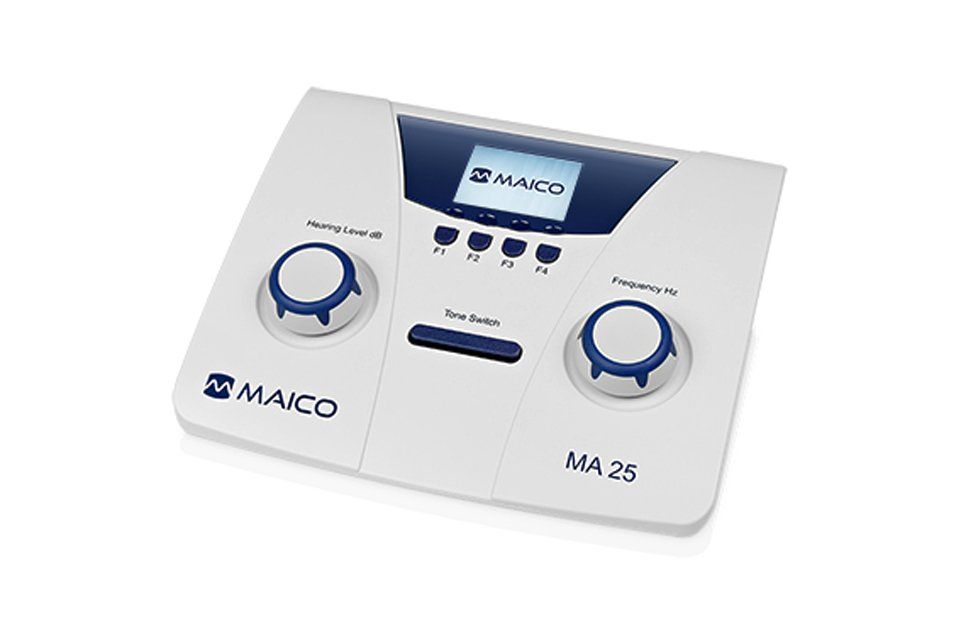
Buy MAICO MA 25 Audiometer in Nigeria
To buy a MAICO MA 25 audiometer in Nigeria, request a written quotation from Franance for the exact MA 25 configuration, including its transducer, power arrangement, accessories, delivery destination and requested handover support. The MA 25 is a portable air-conduction screening audiometer. MAICO lists 11 frequencies from 125 Hz to 8,000 Hz, signal levels from -10 to 100 dB HL, and pure-tone or warble-tone stimuli that can be pulsed or continuous. It is a quotation enquiry: the catalogue page does not take payment or confirm price, stock, delivery timing, local calibration or service coverage.
Where can I request a MAICO MA 25 quote in Nigeria?
Open the MAICO MA 25 listing filtered to the audiometer category to check the catalogue record, then use the Franance MAICO MA 25 quotation enquiry. Include the facility, contact person, destination state and city, quantity, intended screening setting and any written technical requirement. Franance follows up by phone or email after receiving an enquiry; there is no checkout or online purchase on the listing.
Ask for a written response that identifies the model as MA 25, the offered unit’s region or configuration, included transducer and accessories, power supply, delivery scope, documentation and any requested training or calibration arrangement. Ask the seller to state exclusions as well as included items. This matters because manufacturer specifications and packages may vary by country, and the manufacturer lists MA 25e separately from MA 25. Do not accept a quotation that describes only “MA 25 series” if the facility requires a specific model or function.
What is the MAICO MA 25 audiometer used for?
MAICO describes the MA 25 as a portable audiometer for basic air-conduction screening. Its manufacturer page lists a frequency set spanning 125 Hz through 8,000 Hz, with 11 test frequencies. The available signals are pure tone and warble tone, and the operator can choose pulsed or continuous presentation. The published hearing-level range is -10 dB HL to 100 dB HL, with level adjustments in 1 or 5 dB steps described on the product page.
These facts identify the instrument’s documented scope; they do not establish that the MA 25 replaces a complete diagnostic audiometry system or meets every screening programme’s protocol. Confirm the intended test method, frequency set, transducer and output levels with the responsible audiologist or clinical lead. If the facility needs bone conduction, masking, speech testing, automated thresholds, data management or a specific test workflow, state that explicitly and confirm whether the base MA 25 supports it. Do not infer those capabilities from the word “audiometer” or from features associated with another model.
How should a buyer distinguish MA 25 from MA 25e?
The MA 25e is a separate model variant. MAICO says that the MA 25e adds an automated Hughson-Westlake test, talk-forward function and optional MAICO Sessions PC software for transferring results to a computer. Those functions must not be assumed for the base MA 25. If the request requires an automated test sequence, talk-forward communication, PC transfer or related software, write “MA 25e” into the specification and ask the quotation to identify that exact model and its software/accessory configuration.
The Franance catalogue record is for “MAICO MA 25 Audiometer,” with model code MA 25; it does not identify an MA 25e. Keep the listing and quote request aligned with that record unless a separate, confirmed model is offered. Ask the supplier to provide a manufacturer datasheet matching the model name and hardware revision on the quote. Confirm any regional variant and the included transducer using a current manufacturer document. Similar model names do not establish interchangeable functions, accessories or software compatibility.
Which test frequencies, levels and stimuli should I confirm?
The MAICO product page lists 125, 250, 500, 750, 1,000, 1,500, 2,000, 3,000, 4,000, 6,000 and 8,000 Hz. It lists the test-signal range as -10 to 100 dB HL, with 1 or 5 dB increments. It also lists pure and warble tones with pulsed or continuous presentation. Use this specification as a starting point, then compare it with the screening protocol and acceptance requirements set by the facility.
Ask for confirmation of the offered transducer and the applicable output table for the exact version. The usable output may depend on frequency, transducer and local configuration; a single headline range should not be treated as identical output at every frequency. If test documentation must include a particular earphone type, patient response switch, test environment or recording form, list that requirement. The US regional datasheet gives examples of standard and optional components for that market, but it is not evidence that the same package will be supplied in Nigeria. Request the regional datasheet for the actual quoted unit.
What transducer and accessories should the facility specify?
The manufacturer’s international page identifies the MA 25 as an air-conduction audiometer, but the exact transducer and package should be confirmed against the quote and regional documentation. Ask the supplier to name the earphone or headphone by manufacturer part number, and to list the patient response switch, power adapter, batteries, USB cable, carrying case, test forms and any other accessory as included, optional or excluded. If the facility will use a sound-treated room or booth, identify it separately and request confirmation of compatibility and the intended test configuration.
Do not assume an accessory shown in a photograph or described in a regional brochure is bundled with the unit. Ask how consumable or replaceable components are ordered and whether the quoted accessories are suitable for the intended patient population and local workflow. If several screening locations are planned, clarify whether each location needs its own transducer or accessory set. Confirm cleaning instructions and compatible cleaning materials from the current operator documentation rather than applying generic disinfectant assumptions to earphones, cables or controls.
What room and operating conditions should I plan for in Nigeria?
Portable equipment can support a mobile screening workflow, but the test environment remains part of the facility’s planning. Identify the rooms or outreach locations, likely ambient noise, available seating and table space, privacy needs, and whether the site has an appropriate quiet area or sound-treated booth. A product’s portability does not itself establish that a given room meets the facility’s audiometric test requirements. Have the clinical lead define acceptable conditions and the biomedical or facilities team assess the proposed sites.
MAICO lists three AA batteries, a power supply or USB connection to a PC as power-use options on its product page. Confirm which power arrangement is included in the Nigerian offer, the adapter’s input rating and plug arrangement, and the approved operating procedure for battery or external-power use. If a laptop or PC is intended, distinguish the base MA 25’s USB power/cable description from the MA 25e’s stated PC result-transfer feature. The page does not make those two models’ software workflows interchangeable.
Before deployment, plan secure storage, transport protection, inventory control and a location-specific check process. For mobile outreach, clarify who carries the instrument, how it is protected between sites and how the team records which serial number was used. These are operational choices for the facility; they are not claims that the instrument is supplied with a case, achieves a particular field-test result or is automatically calibrated for every environment.
What calibration, documentation and service questions belong in the quote?
Ask for the calibration status and supporting documentation for the exact unit, including serial number, calibration date, traceability information if required by the facility, and the applicable schedule for future checks. Confirm the local owner of routine verification, calibration, repairs and record keeping. The MAICO product page describes the device but does not establish Nigerian calibration availability, service response time, warranty territory or the terms of any particular sale.
Request the current operator manual, regional specification sheet, service contact route and recommended maintenance instructions. Ask whether operator orientation or biomedical-engineering handover is included, who delivers it, and whether it is remote or onsite. If the facility needs periodic calibration through an external laboratory, identify the desired method and documentation before ordering. Do not treat an international datasheet or the existence of a manufacturer support page as proof of local service coverage.
For an auditable handover, the buyer can request the quoted model and serial number, included transducer and power components, manuals, calibration record, warranty terms applicable to the Nigerian transaction and a written service escalation route. Have biomedical staff record acceptance and asset details according to the facility’s own process. These steps make the offer reviewable without implying that a specific certification, calibration provider or service commitment is already available.
How should I compare the MA 25 with other audiometers?
Compare instruments against the test workflow rather than headline portability alone. Make a requirements list covering air-conduction frequencies and levels, stimulus types, transducer, patient response method, test modes, result recording, software or transfer needs, transport, power and support. The MA 25’s documented role is basic air-conduction screening. A facility requiring a broader diagnostic workflow should ask an audiology lead to specify the additional functions and verify each one in the exact manufacturer datasheet.
Compare the MA 25 and MA 25e as separate choices if automation, talk-forward or PC result transfer matters. Compare total quoted configuration, including accessories, case, power option, documentation, calibration evidence, delivery and any training. Ask the supplier to mark each requested feature as confirmed for the quoted model, an optional item, not supported or awaiting manufacturer confirmation. This avoids assuming that a family-level brochure or a different regional kit describes the proposed Nigerian unit.
The MAICO audiometer listing in the audiometer taxonomy shows the relevant catalogue category. Use the MAICO-filtered audiometer listing for the exact current product record. A category may contain other instruments with different test functions, so compare individual model documentation rather than selecting by category label alone.
What should I include in a Nigerian MA 25 quotation request?
Send the exact product name and model code, facility and delivery address, state and city, contact person, quantity, intended locations, and the requested delivery window. Specify the required transducer, power arrangement, included accessories, case, patient response method, documentation, calibration evidence, training and service terms. State whether the facility has a sound-treated booth or expects to use an existing room, and provide any relevant test protocol requirements from the clinical lead.
Ask Franance for an itemized written quotation that states the equipment model and regional configuration, each included or optional accessory, delivery terms, warranty scope, calibration documentation, and any installation, training or service commitments. Ask the supplier to mark unknowns clearly and resolve them before the facility accepts the offer. If data transfer or automated testing is necessary, ensure the quote says MA 25e where appropriate and identifies the software and accessories rather than assuming the base MA 25 provides them.
Start at the MAICO MA 25 category-and-model filtered listing, then submit the MA 25 quote request to Franance. Franance handles product enquiries by follow-up; the page is not an online checkout. No current price, stock, delivery date, local registration, warranty, calibration or service arrangement is promised here.
What is verified about the MAICO MA 25, and what must be confirmed?
MAICO’s official MA 25 product page supports the model identity, portable air-conduction screening role, frequency range and count, hearing-level range, pure and warble tone options, pulsed or continuous presentation, weight, and stated power options. It expressly distinguishes MA 25e functions and warns that international datasheet specifications may vary by country. The manufacturer’s regional download centre should be used to obtain documentation for the offered region. The older manufacturer-hosted datasheet URL included in the catalogue record is not currently resolving reliably; the live product page is the reference for the facts above.
The Franance catalogue assigns this exact record to the ENT audiometer category and lists model code MA 25. It does not specify an offered serial number, regional package, transducer, included accessories, calibration status, price, delivery, warranty territory or Nigerian service arrangement. Confirm those details in writing with the quote. This guide is procurement information and does not provide a clinical testing protocol or claim a patient outcome.