

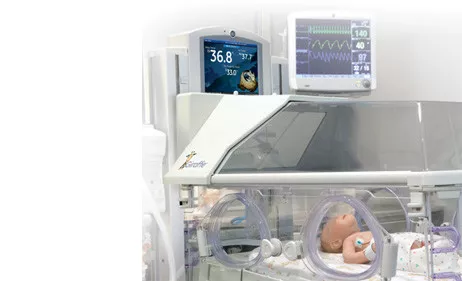
Buy GE HealthCare Giraffe OmniBed Carestation in Nigeria
To buy the GE HealthCare Giraffe OmniBed Carestation in Nigeria, request a written quotation from Franance that identifies the exact Carestation configuration, included accessories, delivery destination and installation or training scope. The OmniBed combines an incubator enclosure with radiant-warmer operation: GE describes a one-touch canopy lift that converts between the two modes. The Franance catalogue places this model in both neonatal-incubator and radiant-warmer categories. It is a quotation request, not an online purchase, and the listing does not establish current stock, price, delivery time or local service coverage.
Where can I request a Giraffe OmniBed Carestation quote in Nigeria?
Start with the GE HealthCare Giraffe OmniBed Carestation listing filtered to neonatal incubators. The same record also belongs to the radiant-warmer category, because the manufacturer describes an open-bed radiant-warmer mode. Use the Franance quote enquiry for the Giraffe OmniBed Carestation to send the model, quantity and facility destination. Franance follows up by phone or email after receiving an enquiry; payment is not taken on the product page.
For a useful first quotation, specify whether the request is for a new or previously owned unit if applicable to the offer, the intended NICU or newborn-care area, and whether the facility expects commissioning, operator orientation or biomedical-engineering handover. Ask the written offer to identify the exact model and revision, the included probes and accessories, the electrical configuration, delivery terms, and the documents that accompany the unit. A product-family page is not a bill of materials: confirm every component and service item rather than assuming it is bundled.
What is the Giraffe OmniBed Carestation designed to do?
GE HealthCare describes the Giraffe OmniBed Carestation as a neonatal-care system that provides a controlled microenvironment. Its defining product distinction is the combination of an enclosed incubator configuration and radiant-warmer configuration in one bed. GE says its one-touch canopy lift changes the bed into radiant-warmer operation, and its India product page also describes a foot pedal for the lift. This makes the product different from a conventional standalone incubator or a standalone open radiant warmer.
The combination can be relevant to facilities planning one care station for workflows that require both closed and open access. It does not mean every requested use, accessory or clinical workflow is supported by the same purchased configuration. Confirm the offered system against the current manufacturer instructions and the facility’s approved clinical and biomedical-engineering requirements. This guide is procurement information, not a clinical protocol, patient-selection guide or substitute for operator training.
GE’s product page describes features including a 10.4-inch colour touchscreen, a canopy lift, Air Boost, servo humidity, an X-ray tray and radiolucent mattress, and connectivity capabilities. Several statements are product-family descriptions, and some elements may depend on option, software revision, market or included accessories. Ask the quotation to mark each required feature as included, optional, unavailable or needing a separate line item. Do not infer that the listed catalogue record includes a Giraffe Shuttle, particular probes, an in-bed scale, oxygen control or a specific connectivity integration.
How does the incubator and radiant-warmer configuration affect planning?
The OmniBed’s canopy-down and canopy-up configurations occupy different vertical clearances. GE’s India specifications list an approximate footprint of 114 by 66 centimetres, a unit weight of 149 kilograms, and maximum height of 178 centimetres with the canopy down or 239 centimetres with it raised. GE lists a minimum-height range of 152 centimetres with the canopy down and 209 centimetres with it up. These are useful planning references from the manufacturer’s product page; the final facility layout must use the installation documentation and the exact quoted revision.
Before placing an order, measure the room route as well as the final bedside space. Confirm doorway width, lift car and threshold limits, corridor turns, ramps, flooring, staging area and the route from receiving to the NICU. The published footprint alone does not establish the manoeuvring clearance required for delivery, servicing, raising the canopy, opening panels or moving staff around the bed. Ask the supplier to confirm shipping dimensions and unpacking requirements for the actual unit.
For room planning, identify nearby clinical equipment, wall outlets, emergency power arrangements, medical-gas connections if required by the selected option, access to cleaning and maintenance areas, and the location of any network or data outlet requested by the hospital. Do not assume the unit can be connected to a particular Nigerian hospital information system simply because GE states it has connectivity capabilities. Ask the facility’s IT and biomedical teams to review the exact interface, software and supported workflow with the manufacturer before making a compatibility decision.
Which mattress, scale and accessories should I specify?
GE describes an X-ray tray and radiolucent mattress, and its product page describes a Baby Susan mattress with 360-degree rotation. The page marks Baby Susan with an asterisk in places, so confirm whether it is part of the offered configuration or a selectable option. If imaging access, mattress rotation, pressure-diffusing properties or mattress directionality matter to the facility, state those requirements explicitly and request the offered part numbers and configuration documentation.
The published India page includes an in-bed-scale performance table and resolution notes for different regional scale revisions. That does not prove a particular scale is included in the Franance listing, which identifies only the base product name. If a scale is required, ask whether the quote includes the scale, which revision it is, its display resolution, operating range, calibration instructions and documentation relevant to the facility’s local measurement policy. Avoid assuming that resolution, legal-metrology status or calibration requirements are identical across regions.
Request a line-item list for mattress, mattress rotation option, scale, temperature probes, skin probes, oxygen-control components, humidity components, X-ray tray, shelves, storage accessories, cable or network interfaces, batteries, power cord and any mounting hardware. This is a question list, not a claim that every item is offered or applicable. The final accessory schedule should map each item to an official manufacturer reference and state quantities. Check the supplied cleaning and disinfection instructions for the exact accessory materials and compatible agents.
What do GE’s published specifications say, and what still needs confirmation?
GE’s India product page lists a 10.4-inch LCD touchscreen, eight tubing-access ports, RS-232 data collection, a mattress size of approximately 64.8 by 48.8 centimetres, and mattress height adjustment from approximately 84 to 109 centimetres. It also lists product operating ranges, including air-temperature control from 20 to 39 degrees Celsius and servo-humidity control from 30 to 95 percent relative humidity. These are manufacturer-published product specifications, not a recommended clinical setting or a guarantee about the exact unit offered in Nigeria.
The same page lists oxygen-control performance and humidifier specifications, but those should be treated as configuration-specific until the quotation identifies the installed options and the applicable revision. If oxygen control, humidification or scale functionality is needed, ask the seller to confirm the exact parts, supported gas and utility requirements, accessories, alarms, included sensors and the current instructions for use. Never choose clinical settings from procurement copy; trained clinicians must follow manufacturer instructions and institutional protocols.
The page lists an operating environment of 20–30 degrees Celsius and 5–85 percent relative humidity, non-condensing, alongside maximum airflow and water-ingress information. Include the NICU’s ambient conditions in the site review and request the formal installation requirements for the quoted version. The brochure may use international specifications, and GE explicitly labels some items as not available in the United States; regional differences make the current configuration sheet essential. Do not assume the cited Indian-market warranty or service arrangement applies in Nigeria.
What electrical, utility and room requirements should a Nigerian facility check?
Request the manufacturer’s current site-preparation and installation documentation for the precise model, power supply and options in the offer. Have the facility biomedical engineer and electrical lead check supply voltage and frequency, protective earthing, outlet type, circuit capacity, emergency-power connection policy and any restrictions on extension leads or other connected equipment. The brochure contains multiple international electrical variants; none should be treated as proof that the offered unit’s plug, voltage or cord matches the facility without confirmation.
If the proposed configuration includes oxygen control or other gas-related options, ask for the exact source, connection standard, pressure range, connector and site conditions required by GE’s current instructions. Do not adapt a gas connector or assume a local pipeline pressure is suitable based on this guide. Ask the supplier and hospital engineering team to resolve the interface before delivery. Similarly, if data connectivity is requested, list the intended system and ask the facility IT group to confirm the interface, cabling, network and cybersecurity review separately.
For a Nigerian site, clarify import and delivery scope, unloading equipment, stairs or lifts, temporary storage conditions, commissioning responsibilities and who will inspect the unit after arrival. Ask whether any voltage protection, isolation transformer or power-conditioning equipment is required by the manufacturer for the quoted unit and local supply. This guide does not establish a specific Nigerian regulatory approval, electrical certification, customs status, or suitability of the facility’s utilities.
How should I compare the OmniBed with other neonatal beds?
Compare equipment according to the workflow and the actual configuration, not only by product-family name. A standalone incubator, a radiant warmer and an OmniBed do not represent the same system arrangement. The OmniBed’s dual configuration may be relevant where both enclosed incubator operation and open radiant-warmer access are part of the facility’s design. A standalone device might be more suitable for a unit with a narrower function, different space plan or different budget; the clinical and biomedical teams should set the requirement.
Compare the proposed configuration, height and footprint, ease of access, mattress arrangement, service access, cleaning workflow, accessories, data requirements, utilities, training scope and lifecycle support documentation. If transport between departments is a requirement, GE describes thermal support during transport when the bed is paired with the Giraffe Shuttle. The Shuttle is a separate product reference and must not be presumed included. Ask for a distinct line item and verify the complete transport system’s compatibility and intended operating conditions with GE.
Ask the supplier to provide an itemized offer and a response against a facility-defined specification. A comparison table should state the proposed model and revision; included versus optional components; service and warranty conditions; delivery scope; installation and training; required infrastructure; and exclusions. Where a specification is unavailable or unclear, mark it for written confirmation instead of treating a brochure feature as a binding offer.
What installation, training and maintenance should the quote address?
Ask whether delivery includes installation, inspection, commissioning, operator orientation, biomedical-engineering orientation and any post-installation acceptance documents. Name the responsible parties and the expected handover documents in the request. Do not assume that a product page’s training-programme reference guarantees that a trainer, course or local visit is part of a Nigerian sale. Obtain the commitment in the written quote.
Request the current operator and service manuals, accessory instructions, cleaning and disinfectant compatibility information, preventive-maintenance schedule, calibration requirements and recommended spare-parts list for the exact revision. GE’s India product page lists an annual recommended calibration/preventive-maintenance period and a one-year limited parts-and-service warranty, but the page is regional and does not establish what applies to a Nigerian transaction. Ask the seller to state the warranty territory, duration, exclusions, response process and whether service is local, remote, partner-provided or otherwise arranged.
Biomedical engineering should document the asset identity, serial number, installed options, software, acceptance checks, training attendance and maintenance plan at handover. Clinical staff should receive manufacturer-approved operating instructions and follow local policy. The procurement request should distinguish technical acceptance and maintenance commitments from clinical use or patient outcomes, which cannot be guaranteed by a product guide.
What should I include in a Nigerian quotation request?
Provide the facility name and delivery address, contact person, required quantity, preferred delivery window, intended department, exact model, requested configuration, and a list of must-have accessories. Add room measurements, route constraints, power and utility information, data-interface requirements, and whether installation, commissioning, operator training or biomedical-engineering orientation is requested. Share the facility’s written specification if available.
Ask Franance to return a written quotation that identifies the equipment and each accessory by manufacturer reference, states what is excluded, and confirms the commercial terms and delivery scope. Ask for manufacturer documentation relevant to the exact configuration, installation requirements, warranty terms applicable to Nigeria and service arrangements available for the proposed transaction. If the quote includes the Shuttle, scale, oxygen control, probes or connectivity, request each as a separately described line item and ask the manufacturer to confirm compatibility.
Use the exact GE HealthCare product listing to confirm the catalogue identity and the Franance Giraffe OmniBed quotation form to submit the request. The sale remains subject to quotation and follow-up. No online payment, live stock level, price, delivery date, warranty coverage or Nigerian service commitment is implied by this guide.
What is verified about this model and what remains open?
GE HealthCare’s India product page for the Giraffe OmniBed Carestation is the source for the product identity, combined incubator and radiant-warmer role, one-touch canopy lift, dimensions, display, options and published technical ranges cited here. GE’s official Carestation brochure provides additional manufacturer context. Specifications can vary by region, revision and options, so the quotation and current instructions for use must control.
The current Franance record identifies GE HealthCare Giraffe OmniBed Carestation and assigns it to neonatal incubator and radiant warmer taxonomies. It does not identify a specific serial number, configuration code, included accessory set or Nigerian commercial offer. No claim is made here about current availability, clinical outcome, local registration, regulatory approval, warranty territory, installation entitlement or local service. Resolve those questions in writing with Franance, GE HealthCare and the facility teams before order acceptance.