
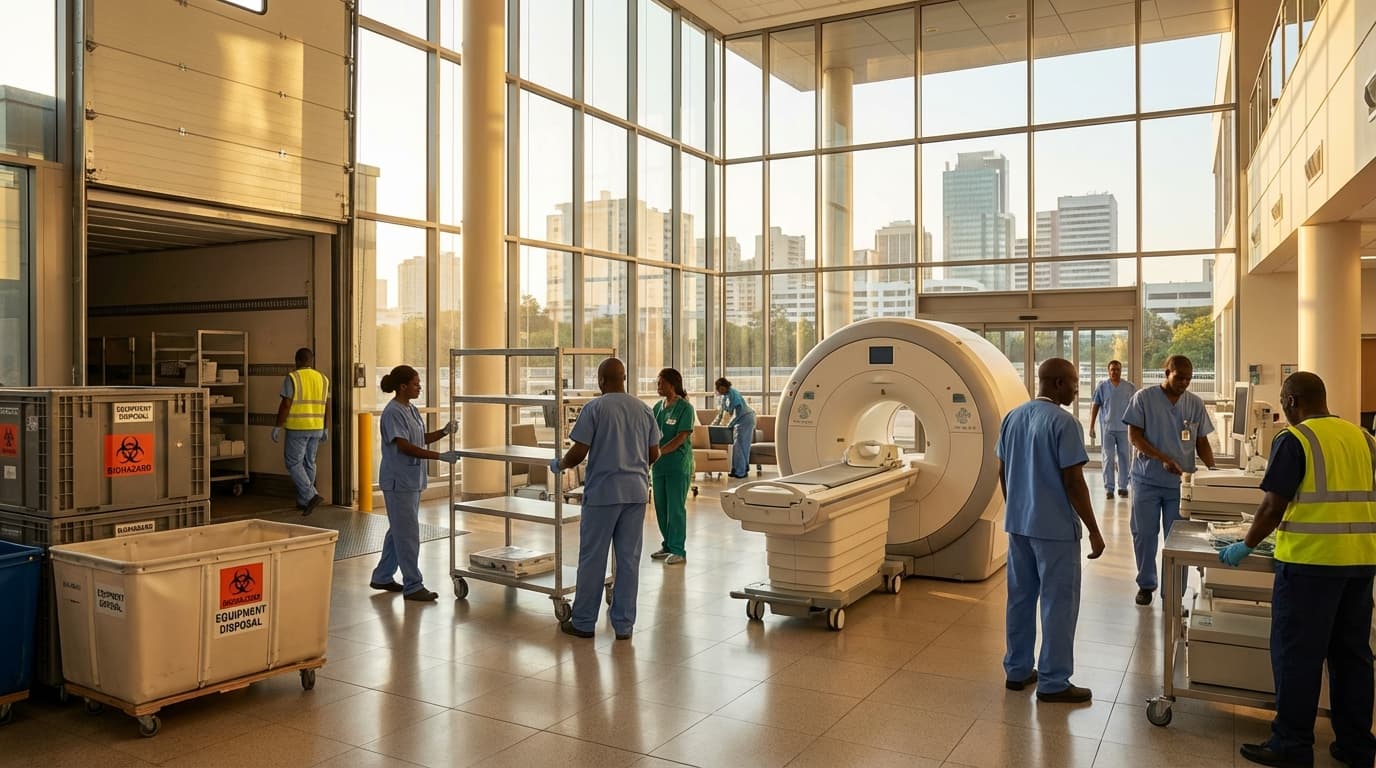
Patient Data Wiping Service (Medical Equipment Storage) in South Africa
Engineering Excellence & Technical Support
Patient Data Wiping Service (Medical Equipment Storage) High-standard technical execution following OEM protocols and local regulatory frameworks.
Secure Data Sanitization
Our advanced wiping service employs multi-pass overwriting and cryptographic erasure techniques, ensuring all patient data on medical equipment is rendered irretrievable and compliant with South African POPIA regulations, safeguarding sensitive health information.
Certified Data Destruction
We provide legally binding certificates of data destruction for every piece of equipment processed. This documentation offers irrefutable proof of compliant and secure patient data removal, vital for regulatory audits and risk management within South African healthcare facilities.
On-Site & Off-Site Logistics
We offer flexible collection and secure transport options across South Africa, with on-site wiping capabilities for maximum security and convenience. Our specialized logistics ensure the integrity of equipment and data throughout the entire wiping process.
What Is Patient Data Wiping Service (Medical Equipment Storage) In South Africa?
Patient Data Wiping Service (Medical Equipment Storage) in South Africa refers to the secure and compliant process of erasing all Protected Health Information (PHI) and Personally Identifiable Information (PII) from medical devices prior to their storage, redeployment, or disposal. This service is critical for healthcare providers and medical equipment vendors operating within South Africa's stringent data privacy regulations, primarily the Protection of Personal Information Act (POPIA). The service ensures that sensitive patient data is rendered irretrievable, mitigating the risk of data breaches, identity theft, and regulatory non-compliance.
| Who Needs It? | Typical Use Cases |
|---|---|
| Hospitals and Clinics (Public & Private) | Storage of Medical Equipment: When devices are temporarily taken out of service, awaiting repair, upgrade, or relocation, and patient data may still reside on them. |
| Medical Equipment Manufacturers & Suppliers | Refurbishment and Resale: Preparing devices for resale or redeployment after they have been used, ensuring no residual patient data is transferred to the new owner. |
| Third-Party Medical Equipment Service Providers | Equipment Returns and End-of-Life Disposal: Handling devices returned by healthcare facilities for servicing, repair, or decommissioning, to prevent unauthorized access to stored data. |
| Healthcare IT Departments | Device Redeployment or Transfer: Ensuring that data is securely removed before a device is moved to a different department or facility within the same organization. |
| Medical Device Storage and Logistics Companies | Secure Storage and Asset Management: Providing a compliant service for storing medical equipment, which includes the secure wiping of any data prior to storage or retrieval. |
What the Service Involves:
- Secure Data Erasure: Employing industry-standard data sanitization methods (e.g., DoD 5220.22-M, NIST 800-88) to overwrite storage media on medical devices, rendering existing data unrecoverable.
- Device Inventory and Audit: Maintaining a detailed record of each medical device processed, including serial numbers, data storage types, and the erasure methods applied.
- Certificate of Destruction/Erasure: Providing a formal attestation confirming that data has been securely wiped from the device, serving as proof of compliance.
- Compliance with POPIA: Adhering to the South African POPIA legislation, which mandates the protection of personal information, including health data.
- Chain of Custody: Establishing and maintaining a documented chain of custody for devices throughout the wiping and storage process.
- Verification and Testing: Implementing procedures to verify that the data erasure process has been successful.
Who Needs Patient Data Wiping Service (Medical Equipment Storage) In South Africa?
In South Africa, the secure and compliant disposal of medical equipment containing sensitive patient data is a critical concern. As healthcare providers increasingly rely on digital systems and data-intensive devices, the need for professional patient data wiping services for medical equipment storage becomes paramount. This service ensures that patient information is irrevocably erased from devices before they are stored, repurposed, or disposed of, mitigating the risk of data breaches and upholding patient privacy regulations.
| Target Customer Type | Specific Departments / Roles | Primary Concerns & Needs | Examples of Medical Equipment | ||||
|---|---|---|---|---|---|---|---|
| Hospitals & Large Healthcare Networks | IT Departments, Biomedical Engineering, Records Management, Procurement, Facilities Management | HIPAA/POPIA compliance, data security, risk of data breaches, cost-effective equipment lifecycle management, reputation management, preventing unauthorized access to patient records, secure data destruction for archived devices. | MRI machines, CT scanners, X-ray machines, patient monitors, EMR/EHR systems, PACS workstations, ultrasound devices, laboratory analysers, sterilization equipment with data storage. | ||||
| Clinics & Smaller Healthcare Practices | Practice Managers, IT Support (if outsourced), Doctors, Nurses | POPIA compliance, patient confidentiality, secure storage of outdated or serviced equipment, preventing accidental data exposure, budget constraints, ease of compliance. | Digital X-ray machines, dental imaging equipment, diagnostic devices, electronic health record systems, appointment scheduling software stored on devices, small laboratory equipment. | ||||
| Medical Equipment Manufacturers & Resellers | Service & Repair Departments, Returns & Refurbishment Departments, Sales & Technical Support | Ensuring data sanitization before resale or refurbishment, maintaining client trust, compliance with data protection laws, preventing data leakage from returned or serviced devices, offering a complete service package. | Imaging devices, diagnostic equipment, patient care systems undergoing maintenance or upgrades, devices being prepared for resale. | Third-Party Medical Equipment Service Providers | Biomedical Engineers, Field Technicians, IT Support, Operations Managers | Providing certified data wiping as part of their service offering, ensuring compliance for their clients, efficient handling of equipment returns and repairs, liability reduction, maintaining service standards. | Any medical device requiring maintenance, repair, or relocation that has onboard data storage capabilities. |
| Research Institutions & Universities | Research IT, Biomedical Research Labs, Data Management Departments, Ethics Committees | Protecting sensitive research data, ensuring anonymity of study participants, secure disposal of research equipment, compliance with research ethics and data protection regulations. | Specialized research scanners, data loggers, analytical instruments, gene sequencers, data acquisition systems. | Government Health Departments | IT Divisions, Public Health Facilities Management, Procurement & Tender Divisions | Ensuring public sector compliance, standardizing data destruction protocols across facilities, safeguarding citizen health data, managing large fleets of medical equipment, cost-efficiency and bulk services. | Mass imaging equipment, public hospital EMR systems, public health data servers, diagnostic equipment in public clinics. |
| Insurance Companies & Medical Aid Providers | Claims Processing Departments, IT Security, Data Management | Securing patient health information accessed for claims, ensuring compliant data destruction from devices used for data analysis or record keeping, protecting sensitive financial and medical data. | Devices used for claims processing, data analysis workstations, archival storage devices with medical data. | ||||
| Private Practice Owners | Practice Manager, Owners (Doctors, Dentists, Specialists) | Maintaining patient privacy, compliance with POPIA, secure disposal of outdated practice equipment, preventing accidental data leaks, peace of mind regarding data security. | Digital X-ray units, dental chairs with integrated systems, patient management software on local devices, ultrasound machines. |
Who Needs Patient Data Wiping Service (Medical Equipment Storage) in South Africa?
- Healthcare Facilities (Hospitals, Clinics, Surgeries)
- Medical Equipment Manufacturers & Resellers
- Third-Party Medical Equipment Service Providers
- Research Institutions & Universities
- Government Health Departments
- Insurance Companies & Medical Aid Providers
- Private Practice Owners (Doctors, Dentists, Specialists)
Patient Data Wiping Service (Medical Equipment Storage) Process In South Africa
This document outlines the standard workflow for a Patient Data Wiping Service, specifically for medical equipment storage, within South Africa. The process ensures secure and compliant deletion of sensitive patient information from medical devices before they are stored, repurposed, or disposed of. This workflow prioritizes data privacy regulations like POPIA (Protection of Personal Information Act).
| Phase | Step | Description | Key Considerations/Deliverables | Responsible Parties |
|---|---|---|---|---|
| Phase 1: Inquiry and Consultation | Initial Contact | Client (e.g., hospital, clinic, medical equipment vendor) contacts the service provider to inquire about patient data wiping services for medical equipment destined for storage. | Understanding client's needs, types of equipment, volume, and urgency. Preliminary discussion on data privacy compliance (POPIA). | Client, Service Provider |
| Phase 1: Inquiry and Consultation | Needs Assessment Call/Meeting | A detailed discussion to gather specific requirements, including the types of medical devices, the storage duration or intended use post-wiping, and any specific data security protocols or compliance needs. | Inventory of equipment, identification of data storage components (hard drives, memory cards, etc.), confirmation of service scope. | Client, Service Provider |
| Phase 2: Assessment and Quotation | Equipment Inventory and Data Mapping | Service provider may request a detailed inventory of the equipment to be wiped, along with information on where patient data is stored on each device. | Accurate assessment of data locations and complexity for wiping. | Client, Service Provider |
| Phase 2: Assessment and Quotation | Methodology Proposal and Quotation | Based on the assessment, the service provider proposes the most suitable data wiping methodology (e.g., secure erasure software, physical destruction where applicable) and provides a formal quotation. | Clear pricing, breakdown of services, proposed wiping standards (e.g., DoD 5220.22-M, NIST 800-88), estimated timeline. | Service Provider |
| Phase 2: Assessment and Quotation | Contract/Agreement | Client reviews and accepts the quotation, leading to the signing of a service agreement or contract outlining terms, responsibilities, and confidentiality clauses. | Mutual agreement on scope, cost, payment terms, liability, and data handling protocols. | Client, Service Provider |
| Phase 3: Scheduling and Logistics | Service Scheduling | The client and service provider agree on a date and time for the on-site data wiping to take place, considering the client's operational schedule. | Minimizing disruption to hospital/clinic operations. | Client, Service Provider |
| Phase 3: Scheduling and Logistics | Logistics Planning | Coordination of personnel, equipment, and any necessary travel arrangements for the service provider's technical team. | Ensuring all necessary tools and certified wiping software are available. | Service Provider |
| Phase 4: On-Site Data Wiping Execution | Site Access and Security Protocols | Service provider's technicians gain authorized access to the designated area where the medical equipment is stored, adhering to client's security protocols. | Confidentiality agreements for technicians, secure access procedures. | Service Provider, Client (Facility Security) |
| Phase 4: On-Site Data Wiping Execution | Data Wiping Procedure | Technicians connect to each medical device identified for data wiping and execute the agreed-upon secure erasure method. This involves overwriting data multiple times or using specialized software. | Strict adherence to chosen wiping standards. Real-time monitoring and logging of the wiping process. | Service Provider |
| Phase 4: On-Site Data Wiping Execution | Verification of Wiping | After each device is wiped, technicians verify the success of the erasure process through built-in software checks or audit trails. | Ensuring data is irrecoverable. | Service Provider |
| Phase 5: Verification and Certification | Data Verification and Auditing | A final review of the wiping logs and any sample checks to confirm that all targeted data has been successfully and securely erased according to the agreed standards. | Independent verification of the wiping process (if required by client). | Service Provider, Client (Optional) |
| Phase 5: Verification and Certification | Issuance of Certificate of Data Destruction | The service provider issues a formal Certificate of Data Destruction for each device or for the batch of devices wiped, confirming the secure erasure of patient data. | Certified documentation for compliance and audit purposes. Includes device serial numbers, date of service, method used, and technician details. | Service Provider |
| Phase 6: Handover and Documentation | Final Reporting | A comprehensive report is provided to the client detailing the services performed, including the number of devices wiped, the methods used, and any exceptions or issues encountered. | Transparency and accountability. | Service Provider |
| Phase 6: Handover and Documentation | Secure Documentation Storage | Both the service provider and the client retain copies of the Certificates of Data Destruction and service reports for their respective record-keeping and compliance requirements. | Adherence to POPIA's data retention policies. | Service Provider, Client |
Patient Data Wiping Service Workflow (Medical Equipment Storage) - South Africa
- Phase 1: Inquiry and Consultation
- Phase 2: Assessment and Quotation
- Phase 3: Scheduling and Logistics
- Phase 4: On-Site Data Wiping Execution
- Phase 5: Verification and Certification
- Phase 6: Handover and Documentation
Patient Data Wiping Service (Medical Equipment Storage) Cost In South Africa
The cost of patient data wiping services for medical equipment storage in South Africa can vary significantly based on several key factors. These services are crucial for ensuring compliance with data privacy regulations like POPIA (Protection of Personal Information Act) and protecting sensitive patient information before equipment is decommissioned, resold, or reused. The price is typically influenced by the volume and type of equipment, the complexity of the data stored, the chosen wiping method, and the vendor's service level agreements.
| Service Type/Volume | Estimated Cost Range (ZAR) | Notes |
|---|---|---|
| Single Device (e.g., patient monitor, small diagnostic machine) | R 500 - R 1,500 | Software-based wipe, basic reporting. |
| Small Batch (5-10 devices, mixed types) | R 3,000 - R 7,500 | May include on-site service, standard reporting. |
| Medium Batch (10-25 devices, standard medical equipment) | R 7,500 - R 15,000 | Standard certified software wipe, detailed reports. |
| Large Batch (25+ devices, including complex equipment) | R 15,000+ | Negotiable, often with bulk discounts. May include advanced wiping techniques or physical destruction options. Custom quotes are standard. |
| Complex Medical Imaging Equipment (e.g., MRI, CT) | R 2,000 - R 5,000+ per device | High data volume, specialized software. Costs can escalate significantly based on the specific model and storage. |
| Physical Destruction (per device) | R 300 - R 1,000 | Includes secure transport and documentation. Cost varies by device size and material. |
| Certified Data Sanitization (advanced) | R 1,000 - R 3,000+ per device | Often involves multiple passes and rigorous verification. Higher assurance for highly sensitive data. |
Key Pricing Factors for Patient Data Wiping Services in South Africa:
- {"title":"Volume of Equipment:","description":"The more devices that require data wiping, the lower the per-unit cost may become due to economies of scale. Bulk discounts are common."}
- {"title":"Type and Complexity of Equipment:","description":"Wiping data from complex medical imaging devices (MRI, CT scanners) with large storage capacities and specialized software can be more expensive than wiping simpler devices like patient monitors or older diagnostic machines."}
- {"title":"Data Volume and Sensitivity:","description":"The sheer amount of data to be erased and the sensitivity of the patient information contained within will influence the time and resources required for secure wiping."}
- {"title":"Wiping Method:","description":"Different wiping methods exist, ranging from software-based overwriting (e.g., DoD 5220.22-M standard) to physical destruction. More robust and secure methods, especially those involving physical destruction or certified software wiping, will generally be more costly."}
- {"title":"On-site vs. Off-site Service:","description":"Services performed on-site at the healthcare facility might incur travel and logistics costs. Off-site services may require secure transportation of equipment, which adds to the overall price."}
- {"title":"Certification and Reporting:","description":"Vendors offering certified data wiping with detailed reports, audit trails, and certificates of destruction provide a higher level of assurance and often come at a premium."}
- {"title":"Urgency of Service:","description":"Rush services or expedited data wiping can lead to higher costs."}
- {"title":"Vendor Reputation and Expertise:","description":"Established vendors with a proven track record, specialized knowledge of medical equipment, and strong security protocols may charge more but offer greater reliability."}
- {"title":"Geographic Location within South Africa:","description":"Costs can vary slightly between major metropolitan areas (e.g., Johannesburg, Cape Town, Durban) and more remote regions due to logistical considerations."}
Affordable Patient Data Wiping Service (Medical Equipment Storage) Options
Businesses and institutions that handle medical equipment are faced with the critical need for secure and compliant patient data wiping services. When medical devices are retired, sold, or repurposed, any residual patient information must be irrevocably erased to prevent data breaches and maintain HIPAA compliance. This service ensures that sensitive health information (PHI) is destroyed according to industry standards, offering peace of mind and avoiding potentially crippling fines. For those managing medical equipment storage, prioritizing data wiping is not just a regulatory requirement, but a fundamental aspect of responsible data stewardship and risk management. We offer affordable solutions designed to meet these needs, focusing on value and cost-effectiveness.
| Cost-Saving Strategy | Description | Benefit |
|---|---|---|
| Volume Discounts | As the number of devices requiring wiping increases, per-device costs decrease significantly. Our bundle options inherently incorporate volume pricing. | Lower overall expense for organizations with larger inventories of medical equipment. |
| Annual/Multi-Year Contracts | Committing to a service contract for a longer duration provides predictable budgeting and often unlocks preferential pricing compared to one-off services. | Ensures consistent compliance and cost predictability, while locking in current rates. |
| Bundled Services | Combining data wiping with other asset management services (e.g., secure disposal, refurbishment assessment) can lead to package deals and reduced administrative overhead. | Streamlined processes and potential discounts for a comprehensive solution. |
| Tiered Service Levels | Choosing the appropriate service level based on the sensitivity and volume of data reduces unnecessary expenditure on features not required. | Pay only for the level of security and reporting that your specific needs demand. |
| Remote vs. On-Site Wiping | For suitable devices, remote wiping can reduce logistical costs associated with on-site visits. We assess feasibility for each client. | Reduced travel expenses and minimal disruption to facility operations. |
| Data Verification Options | While all our services include verification, offering different levels of reporting detail allows clients to select the most cost-effective option that meets their compliance needs. | Avoids overspending on reporting features that may not be strictly necessary. |
Affordable Patient Data Wiping Service Value Bundles
- {"title":"Basic Data Wipe Bundle","description":"Includes standard data sanitization for up to 5 devices, verification report, and basic chain of custody documentation. Ideal for small organizations or infrequent needs."}
- {"title":"Standard Data Wipe Bundle","description":"Covers data sanitization for up to 15 devices, enhanced verification reports, detailed chain of custody, and a certificate of destruction. Recommended for mid-sized operations."}
- {"title":"Premium Data Wipe Bundle","description":"Designed for larger facilities or high-volume needs. Includes sanitization for an unlimited number of devices within a contract period, advanced reporting with forensic analysis insights, secure transport options, and priority service. Includes a full data security audit of the wiping process."}
- {"title":"Custom Data Wipe Solutions","description":"Tailored packages to meet unique requirements, including on-site wiping services, specialized device compatibility, and integration with existing IT asset management workflows."}
Verified Providers In South Africa
Finding reliable healthcare in South Africa can be challenging. 'Verified Providers' signifies a commitment to quality, adherence to standards, and patient-centered care. Franance Health stands out as a leader in this regard, offering a robust network of credentialed healthcare professionals and facilities. Their rigorous vetting process ensures that every provider associated with Franance Health meets stringent criteria for expertise, ethical practice, and patient satisfaction. This dedication to verification translates into peace of mind for patients seeking accessible and high-quality medical services.
| Credentialing Aspect | Franance Health Approach | Benefit for Patients |
|---|---|---|
| Professional Qualifications | Mandatory verification of degrees, licenses, and certifications. | Ensures providers are academically and legally qualified. |
| Clinical Experience | Thorough review of past practice history and patient feedback. | Guarantees experienced and competent healthcare professionals. |
| Specialization Expertise | Verification of specialized training and ongoing professional development. | Connects patients with the most suitable experts for their needs. |
| Ethical Conduct | Background checks and adherence to a strict code of conduct. | Promotes trust and ensures patient safety and privacy. |
| Patient Satisfaction | Regular collection and analysis of patient feedback. | Drives continuous improvement and prioritizes patient experience. |
Why Franance Health is the Best Choice for Verified Providers:
- Rigorous Credentialing Process: Franance Health employs a multi-stage verification system for all its providers.
- Focus on Patient Outcomes: Their network prioritizes providers with a proven track record of positive patient results.
- Commitment to Ethical Practices: All Franance Health partners adhere to the highest ethical and professional standards.
- Comprehensive Network: Access to a wide range of specialists and facilities across South Africa.
- Continuous Quality Improvement: Ongoing monitoring and evaluation to maintain provider excellence.
Scope Of Work For Patient Data Wiping Service (Medical Equipment Storage)
This Scope of Work (SOW) outlines the requirements for a comprehensive patient data wiping service for medical equipment intended for storage. The objective is to ensure that all Protected Health Information (PHI) and personally identifiable information (PII) stored on the medical equipment's internal storage media is securely and irreversibly erased, meeting all relevant regulatory compliance standards (e.g., HIPAA, GDPR). This SOW details the technical deliverables and standard specifications required to achieve this objective.
| Section | Description | Standard Specifications / Requirements |
|---|---|---|
| 1.0 Service Overview | This section defines the overall scope and purpose of the patient data wiping service for medical equipment being prepared for storage. | The service provider will be responsible for the secure sanitization of all internal storage devices within designated medical equipment. This includes, but is not limited to, hard disk drives (HDDs), solid-state drives (SSDs), flash memory, and any other persistent storage media. The service must be performed prior to the equipment being moved to a designated storage facility. |
| 2.0 Data Wiping Methodology | Details the approved methods for data erasure. | The provider must utilize data wiping methods that meet or exceed the National Institute of Standards and Technology (NIST) Special Publication 800-88 Revision 1 guidelines for media sanitization. Approved methods include:
|
| 3.0 Equipment Identification and Inventory | Process for identifying and cataloging equipment to be wiped. | The service provider must work with the client to identify all equipment requiring data wiping. A detailed inventory of each piece of equipment, including serial numbers, model numbers, and storage device types, will be created and agreed upon prior to service commencement. The provider shall ensure all identified equipment is processed. |
| 4.0 On-Site vs. Off-Site Services | Defines whether the wiping will occur at the client's facility or at the provider's facility. | Services may be performed on-site at the client's location or off-site at the provider's secure facility. On-site: Service provider personnel and equipment will visit the client's premises. All operations must comply with the client's site security policies. Off-site: Equipment will be securely transported to the provider's facility. The provider must demonstrate robust chain-of-custody procedures and secure transport protocols. The provider's facility must be secure with access controls, surveillance, and background-checked personnel. |
| 5.0 Data Wiping Process Execution | Step-by-step procedure for data wiping. | The provider shall execute the following steps for each piece of equipment:
|
| 6.0 Verification and Validation | Methods for confirming successful data erasure. | The provider must provide a documented verification process for each wiped storage device. This may include:
|
| 7.0 Documentation and Reporting | Deliverables related to proof of service. | The service provider shall deliver the following:
|
| 8.0 Security and Compliance | Ensuring data privacy and regulatory adherence. | The service provider must adhere to all applicable data privacy regulations, including HIPAA, GDPR, and any other relevant local or national laws.
|
| 9.0 Equipment Compatibility | Ensuring the service can be applied to all relevant medical equipment. | The service provider must demonstrate experience and capability in wiping storage devices within a wide range of medical equipment types and manufacturers. They must be able to identify and address any specific challenges associated with different storage technologies used in medical devices (e.g., proprietary interfaces, encrypted drives). |
| 10.0 Disposal of Wiped Media (Optional) | Services related to the final disposition of storage media. | Upon request, the service provider can offer secure disposal or recycling services for storage media that have been physically destroyed. This service must comply with environmental regulations and provide appropriate certificates of disposal. |
Key Objectives
- Securely and irreversibly erase all patient data (PHI/PII) from medical equipment storage.
- Comply with relevant data privacy regulations (e.g., HIPAA, GDPR).
- Provide verifiable proof of data erasure.
- Minimize downtime and disruption to storage operations.
Service Level Agreement For Patient Data Wiping Service (Medical Equipment Storage)
This Service Level Agreement (SLA) outlines the terms and conditions for the Patient Data Wiping Service provided for medical equipment slated for storage. It defines the responsibilities of both parties, response times for critical issues, and uptime guarantees for the service infrastructure. This SLA is incorporated by reference into the Master Service Agreement between [Provider Name] ('Provider') and [Client Name] ('Client').
| Service Component | Priority Level | Response Time Target | Resolution Time Target (Max) | Uptime Guarantee |
|---|---|---|---|---|
| Service Availability (Initiation of Wipe Requests) | Critical (Service Outage) | 1 hour | 4 business hours | 99.5% |
| Service Availability (Status Updates & Reporting) | High (Service Degradation) | 2 business hours | 8 business hours | 99.5% |
| Support & Inquiry Response | Medium (General Inquiries) | 4 business hours | 1 business day | N/A |
| Scheduled Maintenance | Low | Advance Notification Required (48 hours) | N/A | N/A |
Key Definitions
- Patient Data: Any personally identifiable health information (PHI) or protected health information (PHI) stored on medical equipment, as defined by HIPAA and other relevant regulations.
- Wiping Service: The process of securely deleting or rendering unrecoverable all patient data from medical equipment.
- Equipment Downtime: The period during which the Client is unable to initiate or complete a data wiping request due to a failure in the Provider's service infrastructure.
- Response Time: The maximum time allowed for the Provider to acknowledge and begin addressing a reported incident.
- Resolution Time: The maximum time allowed for the Provider to resolve a reported incident and restore service functionality.
Frequently Asked Questions

Ready when you are
Let's scope your Patient Data Wiping Service (Medical Equipment Storage) in South Africa project in South Africa.

Scaling healthcare logistics and technical systems across the entire continent.