
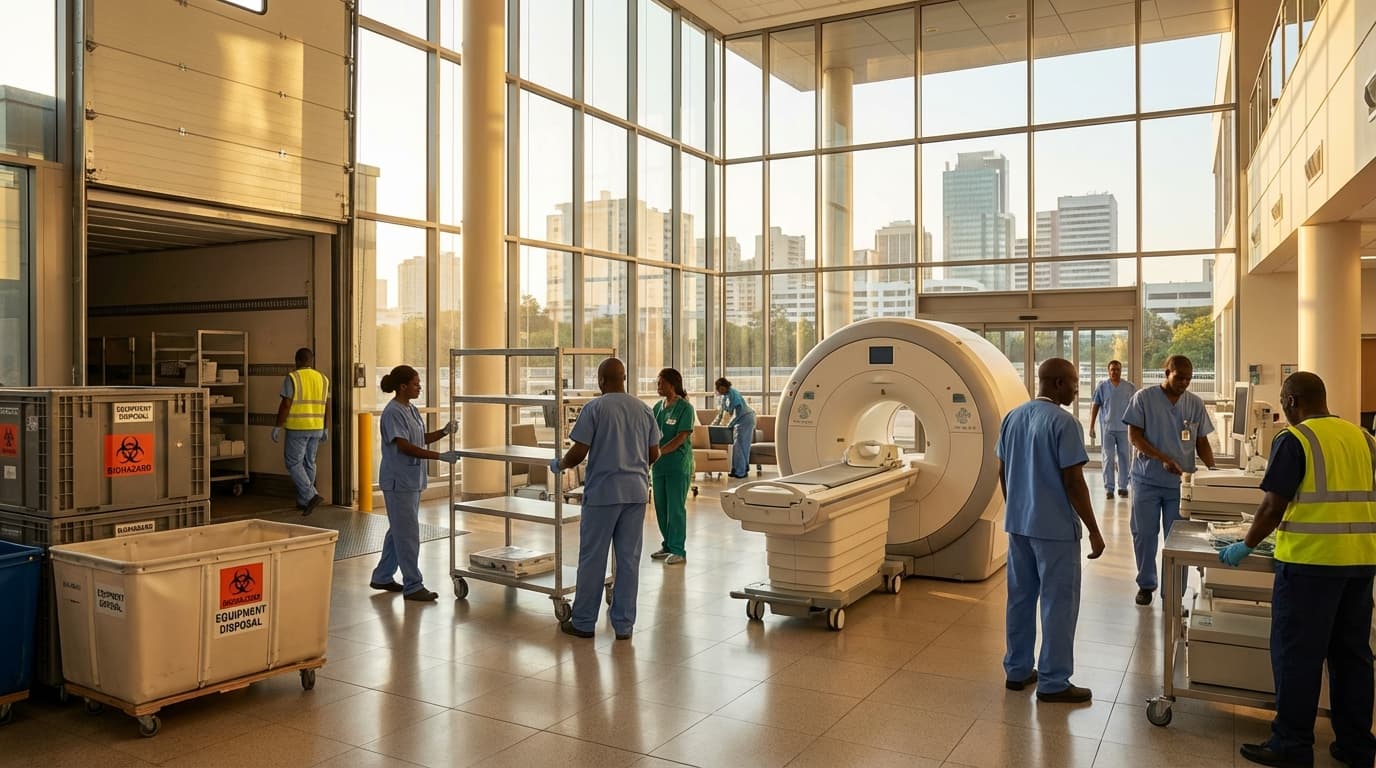
Decommissioning Service for Medical Devices in South Africa
Engineering Excellence & Technical Support
Decommissioning Service for Medical Devices High-standard technical execution following OEM protocols and local regulatory frameworks.
Regulatory Compliance & Certified Disposal
Ensuring full adherence to South African healthcare regulations and environmental standards, with certified disposal processes that protect data privacy and prevent hazardous material release.
Environmentally Responsible & Secure Asset Management
Implementing a secure, traceable, and environmentally conscious decommissioning workflow, including data sanitization, component recycling, and responsible waste management to minimize ecological impact.
Data Security & Confidentiality Assurance
Providing robust data destruction and sanitization services for all medical devices, safeguarding patient confidentiality and meeting stringent data privacy laws in South Africa.
What Is Decommissioning Service For Medical Devices In South Africa?
Decommissioning service for medical devices in South Africa refers to the formal process of retiring a medical device from clinical service. This encompasses a series of controlled procedures designed to ensure the safe, secure, and compliant removal of the device from its operational environment. The service is critical for managing the lifecycle of medical equipment, mitigating risks associated with outdated or malfunctioning devices, and adhering to regulatory mandates. It involves a comprehensive approach that extends beyond simple disposal, incorporating technical, administrative, and environmental considerations.
| Who Needs Decommissioning Services? | Typical Use Cases | ||||||
|---|---|---|---|---|---|---|---|
| Healthcare Facilities: Hospitals, clinics, diagnostic laboratories, and specialized medical centers that utilize a wide range of medical devices. | End-of-Life (EOL) Devices: Medical equipment that has reached the end of its intended operational lifespan and is no longer cost-effective to maintain or repair. | Technological Obsolescence: Devices that have been superseded by newer, more advanced technologies and no longer meet current clinical needs or performance standards. | Malfunctioning or Unrepairable Devices: Equipment that has sustained significant damage or degradation and cannot be economically or safely repaired to operational standards. | Regulatory Compliance Requirements: Facilities needing to comply with SAHPRA or other regulatory body mandates regarding the lifecycle management of medical devices. | Facility Relocations or Renovations: When existing medical equipment needs to be removed to facilitate the move or refurbishment of a healthcare facility. | Consolidation of Services: When multiple facilities merge or services are consolidated, leading to redundant or obsolete equipment. | Mergers and Acquisitions: During the integration of healthcare entities, there is often a need to standardize and decommission redundant medical assets. |
| Outdated Imaging Equipment: Decommissioning of older X-ray machines, CT scanners, or MRI units due to technological advancements or failing components. | Aging Anesthesia Machines and Ventilators: Removing and safely disposing of critical care equipment that has exceeded its service life. | Discontinued Diagnostic Instruments: Decommissioning of laboratory equipment for which spare parts are no longer available or that cannot meet current diagnostic accuracy standards. | Obsolete Surgical Tools and Systems: Retirement of specialized surgical equipment that has been replaced by more ergonomic or technologically advanced alternatives. | End-of-Service Life Infusion Pumps and Patient Monitoring Systems: Safely deactivating and disposing of devices crucial for patient care that have reached their operational limits. | Data-Bearing Devices for Security: Decommissioning devices like older ultrasound machines or ECG machines that may store sensitive patient information, requiring secure data sanitization. | Replacement of Medical IT Infrastructure: Decommissioning of legacy medical devices connected to outdated IT networks or requiring specialized software no longer supported. |
Key Components of Medical Device Decommissioning Services
- Asset Retirement Planning: Developing a strategic plan that outlines the scope, timeline, and resources required for decommissioning, considering the device's criticality, age, and potential for reuse or recycling.
- Data Security and Sanitization: Implementing rigorous procedures to securely erase or destroy all patient data, proprietary information, and software configurations stored on the device, complying with data protection regulations (e.g., POPIA in South Africa).
- Functional Assessment and Deactivation: Conducting a final technical evaluation to confirm the device's operational status and then safely deactivating its power and any network connectivity to prevent unauthorized use or data leakage.
- Physical Removal and Transportation: Safely disconnecting, disassembling (if necessary), and transporting the device from its clinical location to a designated holding or disposal facility, employing appropriate handling procedures to prevent damage or injury.
- Environmental Compliance and Disposal: Ensuring that the device is disposed of in an environmentally responsible manner, adhering to South African environmental regulations for the disposal of electronic waste (e-waste) and potentially hazardous materials. This may involve specialized recycling or incineration.
- Documentation and Record Keeping: Maintaining comprehensive records of the entire decommissioning process, including the device's identification, the dates of key activities, data sanitization reports, disposal certificates, and any relevant service logs, for audit and compliance purposes.
- Regulatory Adherence: Ensuring all decommissioning activities comply with relevant South African healthcare regulations (e.g., those governed by the South African Health Products Regulatory Authority - SAHPRA) and any manufacturer-specific guidelines.
Who Needs Decommissioning Service For Medical Devices In South Africa?
Decommissioning services for medical devices in South Africa are crucial for ensuring compliance with regulations, protecting patient data, and managing the lifecycle of medical equipment responsibly. These services are essential for a range of organizations and departments that handle, use, or dispose of medical devices. Proper decommissioning involves not just physical removal but also data sanitization, functional disabling, and certification of disposal.
| Department/Entity | Key Reasons for Decommissioning | Specific Device Types |
|---|---|---|
| Radiology Department (Hospitals) | Equipment obsolescence, upgrade to digital imaging, end-of-lease agreements | X-ray machines, CT scanners, MRI machines, Ultrasound devices |
| Operating Theatre (Hospitals) | Technological advancements, safety updates, lease termination | Surgical robots, anaesthesia machines, patient monitoring systems, electrosurgical units |
| Intensive Care Unit (ICU) (Hospitals) | End-of-life, replacement with advanced monitoring, data security requirements | Ventilators, defibrillators, advanced patient monitors, infusion pumps |
| Pathology/Laboratory Services | New diagnostic technologies, regulatory compliance, data integrity | Automated analyzers, microscopes, centrifuges, PCR machines |
| Information Technology (IT) Departments (Healthcare) | Data sanitization of connected medical devices, secure disposal of storage media | PACS workstations, network-connected medical devices, data storage units |
| Procurement/Asset Management Departments (Healthcare) | Budgetary constraints, fleet rationalization, compliance with disposal policies | All types of medical devices |
| Biomedical Engineering Departments (Hospitals) | End-of-service life, safety recalls, end-of-support from manufacturers | All types of medical devices |
| Research & Development Departments (Pharma/Biotech) | Project conclusion, technology refresh, IP protection | Specialized laboratory equipment, clinical trial devices |
Target Customers and Departments for Medical Device Decommissioning Services in South Africa
- {"title":"Hospitals and Healthcare Facilities","description":"The primary users of medical devices, including public and private hospitals, clinics, and specialized treatment centers. They require decommissioning for devices that are: \n* Reaching end-of-life or irreparable.\n* Being replaced with newer technology.\n* Moving to a different department or facility.\n* Being retired due to lease agreements ending.\n* Upgrading software or firmware that renders old hardware obsolete."}
- {"title":"Medical Research Institutions and Laboratories","description":"Organizations involved in scientific research and diagnostic testing often use specialized medical equipment. Decommissioning is needed when:\n* Research projects conclude.\n* Equipment is no longer supported by manufacturers.\n* Devices are upgraded to more advanced models.\n* Data privacy regulations necessitate secure data erasure."}
- {"title":"Medical Device Manufacturers and Distributors","description":"These entities need decommissioning services for:\n* Recalled or obsolete models.\n* Devices returned from customers due to issues or trade-ins.\n* Demonstration units no longer in use.\n* Ensuring responsible disposal of their own product lines."}
- {"title":"Government Health Departments and Agencies","description":"Responsible for the overall healthcare infrastructure, including public hospitals and clinics. They require decommissioning for:\n* Large-scale equipment replacement programs.\n* Ensuring compliance with national and provincial health regulations.\n* Managing the disposal of assets across the public health sector."}
- {"title":"Medical Training and Educational Institutions","description":"Universities, colleges, and training centers that use medical equipment for educational purposes. Decommissioning is necessary when:\n* Simulators or training devices are upgraded.\n* Practical training equipment is retired.\n* Ensuring safe and compliant disposal of outdated training tools."}
- {"title":"Third-Party Medical Device Service Providers","description":"Companies that offer maintenance, repair, and asset management for medical devices on behalf of healthcare facilities. They may require decommissioning services as part of their service contracts for:\n* Devices they have serviced that are now to be retired.\n* Managing the end-of-life process for their clients."}
Decommissioning Service For Medical Devices Process In South Africa
This document outlines the comprehensive decommissioning service process for medical devices within South Africa. It details the workflow from the initial client inquiry to the successful execution and closure of the decommissioning project. The process emphasizes adherence to regulatory requirements, safety protocols, and environmental responsibility.
| Phase | Key Activities | Responsible Parties | Deliverables | Regulatory Considerations |
|---|---|---|---|---|
| Phase 1: Inquiry & Initial Consultation | Client contacts service provider with request for decommissioning. Initial discussion of device types, quantities, location, and desired timeline. Understanding client's specific needs and concerns. | Client, Service Provider (Sales/Consulting Team) | Acknowledgement of inquiry, preliminary understanding of scope. | None directly, but sets the stage for compliance. |
| Phase 2: Site Assessment & Planning | On-site visit to assess devices, location, power sources, access, and potential hazards. Inventory of devices to be decommissioned. Development of a detailed decommissioning plan, including safety protocols and waste management strategy. Risk assessment and mitigation planning. | Service Provider (Technical Team, Safety Officer), Client (Facility Manager, Biomedical Engineering) | Site assessment report, detailed decommissioning plan, risk assessment report. | Occupational Health and Safety Act (OHSA), National Environmental Management Act (NEMA). |
| Phase 3: Quotation & Agreement | Submission of a comprehensive quotation based on the site assessment and decommissioning plan. Negotiation of terms and conditions. Formal agreement and contract signing. | Service Provider (Sales/Management), Client (Procurement/Management) | Formal quotation, signed service agreement/contract. | Contractual obligations, payment terms. |
| Phase 4: Pre-Decommissioning Preparations | Scheduling of the decommissioning activities. Securing necessary permits or authorizations (if applicable). Ensuring availability of specialized tools, equipment, and personal protective equipment (PPE). Communication with relevant stakeholders (e.g., facility management, IT). If applicable, data sanitization/destruction plans confirmed. | Service Provider (Project Manager, Technical Team), Client (Facility Management) | Project schedule, confirmed permits, prepared equipment and materials. | Data Protection Act (POPIA) if data-bearing devices are involved. |
| Phase 5: On-Site Decommissioning Execution | Safe disconnection of devices from power and other utilities. Physical dismantling or removal of devices according to the plan. Implementation of safety procedures and use of PPE. Ensuring minimal disruption to facility operations. | Service Provider (Technical Team, Site Supervisor) | Physically decommissioned devices, adherence to safety protocols. | OHSA, specific device handling guidelines. |
| Phase 6: Waste Management & Disposal | Segregation of decommissioned devices and components based on material type. Safe packaging and transportation of waste. Disposal or recycling through accredited and licensed waste management facilities. Compliance with hazardous waste regulations. | Service Provider (Waste Management Team, Logistics), Licensed Waste Contractors | Properly managed waste streams, waste manifests/certificates of disposal. | NEMA, Hazardous Substances Act, provincial environmental regulations. |
| Phase 7: Documentation & Certification | Compilation of a comprehensive decommissioning report. Issuance of certificates of decommissioning for each device (if required). Provision of waste disposal certificates. Documentation of all steps taken, including photographs where relevant. | Service Provider (Project Manager, Administration) | Decommissioning report, certificates of decommissioning, waste disposal certificates. | Regulatory requirements for record-keeping. |
| Phase 8: Project Closure & Reporting | Final review of documentation with the client. Confirmation of client satisfaction. Invoicing and final payment processing. Archiving of project records. | Service Provider (Project Manager, Finance), Client (Management) | Final project report, closed project file, satisfied client. | Financial regulations. |
Decommissioning Service Workflow for Medical Devices in South Africa
- Phase 1: Inquiry & Initial Consultation
- Phase 2: Site Assessment & Planning
- Phase 3: Quotation & Agreement
- Phase 4: Pre-Decommissioning Preparations
- Phase 5: On-Site Decommissioning Execution
- Phase 6: Waste Management & Disposal
- Phase 7: Documentation & Certification
- Phase 8: Project Closure & Reporting
Decommissioning Service For Medical Devices Cost In South Africa
Decommissioning medical devices in South Africa involves the safe and compliant removal of equipment from service. This process is crucial for maintaining patient safety, data privacy, and environmental regulations. The cost of this service is influenced by several key factors, leading to a range of pricing in South African Rand (ZAR).
| Device Category | Estimated Cost Range (ZAR) | Notes |
|---|---|---|
| Basic/Low Complexity (e.g., Hospital Beds, Standard Monitors, Basic Diagnostic Tools) | ZAR 1,500 - ZAR 5,000 per unit | Primarily labor for disassembly and standard disposal. |
| Medium Complexity (e.g., X-ray Machines, Ultrasound Units, Laboratory Equipment) | ZAR 5,000 - ZAR 25,000 per unit | May involve specialized dismantling, moderate data sanitization, and specific disposal protocols. |
| High Complexity/Specialized (e.g., MRI, CT Scanners, Linear Accelerators, Surgical Robots) | ZAR 25,000 - ZAR 100,000+ per unit | Significant specialized labor, complex dismantling, advanced data destruction, hazardous material handling, and potentially intricate transportation/disposal. |
| Data Sanitization/Destruction (Standalone Service) | ZAR 500 - ZAR 5,000 per device (depending on method and certification) | Cost is highly dependent on the chosen method (e.g., software erasure vs. physical shredding) and required verification. |
| Bulk Decommissioning (e.g., Entire Clinic/Ward) | Custom Quote Required (significant discount per unit for high volume) | Factors include total number, device mix, and project scope. |
Key Pricing Factors for Medical Device Decommissioning in South Africa
- Device Type and Complexity: Simple devices like standard hospital beds or basic diagnostic equipment are generally less expensive to decommission than complex imaging machines (MRI, CT scanners), surgical robots, or life-support systems. The complexity of their components, internal systems, and required disassembly procedures significantly impacts labor and specialized disposal costs.
- Number of Devices: Larger quantities of devices often benefit from economies of scale, potentially leading to a lower per-unit cost. However, the overall project cost will increase with volume.
- Location of Decommissioning: The geographical location of the healthcare facility plays a role. Decommissioning services in major metropolitan areas like Johannesburg or Cape Town might have different pricing structures compared to more remote or rural areas due to travel costs, accessibility, and the availability of specialized technicians.
- Data Sanitization Requirements: For devices storing patient data (e.g., PACS systems, electronic health record servers, imaging equipment), rigorous data sanitization or destruction is paramount to comply with POPIA (Protection of Personal Information Act). The method employed (e.g., physical destruction, secure overwriting) and the level of certification required will influence the cost.
- Environmental Disposal and Recycling: Proper disposal of medical waste, including hazardous materials found in some devices, is subject to strict environmental regulations. Costs will vary depending on the nature of the waste and the licensed disposal or recycling facilities used. Recycling of valuable components can sometimes offset disposal costs.
- Dismantling and Transportation: The need for specialized tools, trained personnel for intricate dismantling, and the logistics of transporting equipment (especially large or heavy items) contribute to the overall cost.
- Certifications and Documentation: Providing certificates of decommissioning, data destruction, and environmental compliance are often required by regulatory bodies and for auditing purposes. These add to the administrative and verification costs.
- Urgency of Service: Rush or emergency decommissioning services will typically incur higher charges.
- Service Provider's Reputation and Expertise: Established and reputable decommissioning service providers with proven track records, certifications, and insurance may command higher prices due to their reliability and adherence to best practices.
Affordable Decommissioning Service For Medical Devices Options
Decommissioning medical devices is a critical, yet often overlooked, aspect of healthcare operations. It involves the safe and compliant removal of equipment from service, including data sanitization, physical disposal, and proper documentation. Finding affordable options without compromising on compliance and environmental responsibility is a significant challenge for many healthcare providers. This guide explores value bundles and cost-saving strategies for medical device decommissioning services.
| Strategy | Description | Cost-Saving Mechanism |
|---|---|---|
| Negotiate Bulk Discounts | When decommissioning a large number of devices, negotiate a lower per-unit price with the service provider. | Leveraging volume to secure reduced rates. |
| Long-Term Contracts | Commit to a service provider for an extended period (e.g., 1-3 years) for potentially lower rates and guaranteed service. | Provider incentives for customer loyalty and predictable revenue. |
| Off-Peak Scheduling | If possible, schedule decommissioning during less busy periods for the service provider, which may come with reduced pricing. | Provider flexibility in resource allocation leads to potential discounts. |
| Standardized Decommissioning Processes | Develop and implement a standardized checklist for device preparation and data sanitization before the service provider arrives. | Reduces the provider's labor time and potential for errors. |
| Proper Device Inventory and Classification | Accurate categorization of devices (e.g., by data sensitivity, material type) allows for optimized disposal and recycling routes. | Efficient sorting and processing by the provider, avoiding unnecessary costs for special handling. |
| Phased Decommissioning | Instead of decommissioning all devices at once, plan for phased removals to manage budget and logistics more effectively. | Spreads costs over time, potentially allowing for better negotiation on smaller batches or aligning with budget cycles. |
| Explore Local Service Providers | Local providers may offer more competitive pricing due to reduced travel and logistics costs. | Lower overhead for local businesses translates to potentially lower service fees. |
| Partner with Multiple Facilities (for larger organizations) | If a healthcare system has multiple locations, consolidating decommissioning services across sites can lead to volume discounts. | Increased negotiation power due to larger overall service scope. |
| Prioritize Data Sanitization Methods | Understand the required data sanitization standards (e.g., NIST 800-88) and choose methods that are effective yet cost-efficient. | Avoiding over-specification on data erasure techniques if simpler methods suffice for lower-risk devices. |
| Inquire About Recycling Credits | Some service providers offer credits or rebates for devices with valuable recyclable materials. | Offsetting decommissioning costs through material recovery. |
Understanding Value Bundles and Cost-Saving Strategies
- {"title":"What are Value Bundles in Decommissioning?","description":"Value bundles are service packages that combine multiple decommissioning tasks into a single, often discounted, offering. Instead of paying for each service individually (e.g., data wiping, transportation, recycling), providers can opt for a bundled solution that covers the entire process. This simplifies procurement, potentially reduces overall costs, and ensures a comprehensive approach to decommissioning."}
- {"title":"Benefits of Value Bundles","description":"Bundles can streamline the decommissioning process, reduce administrative overhead, and provide predictable costs. They often include a higher level of service or additional features compared to à la carte options, ensuring all compliance and environmental requirements are met efficiently."}
- {"title":"Key Cost-Saving Strategies","description":"Several strategies can be employed to reduce the cost of medical device decommissioning while maintaining high standards."}
Verified Providers In South Africa
In South Africa's evolving healthcare landscape, discerning the credibility of healthcare providers is paramount. Verified providers assure patients of adherence to stringent quality standards, ethical practices, and regulatory compliance. Franance Health stands out as a leader in this regard, offering a comprehensive network of vetted professionals and facilities. Their rigorous credentialing process ensures that all associated providers meet the highest benchmarks for patient care, safety, and clinical excellence. Choosing Franance Health translates to accessing reliable, high-quality healthcare services backed by an unwavering commitment to patient well-being and trust.
| Credentialing Aspect | Franance Health's Standard | Patient Benefit |
|---|---|---|
| Medical Licenses & Registrations | Up-to-date and verified with relevant South African health authorities. | Assurance of legal and professional practice. |
| Professional Qualifications | Verification of degrees, diplomas, and specialized training from accredited institutions. | Confidence in provider's expertise and knowledge. |
| Clinical Experience | Assessment of practical experience and track record in their respective fields. | Access to seasoned and competent medical professionals. |
| Continuing Professional Development (CPD) | Mandatory participation in ongoing training and skill enhancement. | Providers stay abreast of the latest medical advancements and treatments. |
| Reputation & Peer Review | Consideration of professional standing and feedback. | Trust in providers with a positive and respected professional history. |
| Adherence to Protocols & Ethics | Commitment to established medical protocols and ethical guidelines. | Safe and trustworthy healthcare delivery. |
Why Franance Health Represents the Best Choice:
- Rigorous Vetting Process: Franance Health employs a multi-faceted verification system for all its providers, including checks on qualifications, licenses, and professional history.
- Commitment to Quality Care: All Franance Health providers adhere to evidence-based practices and maintain high standards of clinical competence.
- Patient-Centric Approach: The network prioritizes patient satisfaction, safety, and accessibility, ensuring a positive healthcare experience.
- Ethical Standards: Franance Health is dedicated to upholding the highest ethical principles in healthcare delivery, fostering trust and transparency.
- Regulatory Compliance: Providers within the Franance Health network are fully compliant with all relevant South African healthcare regulations and guidelines.
- Comprehensive Network: Access to a wide range of specialists, general practitioners, and healthcare facilities across South Africa.
Scope Of Work For Decommissioning Service For Medical Devices
This Scope of Work (SOW) outlines the requirements and deliverables for the decommissioning of medical devices. This service ensures that medical equipment is retired from service in a safe, compliant, and environmentally responsible manner. The SOW covers technical aspects, documentation, and adherence to relevant standards.
| Deliverable | Description | Standard Specification / Compliance Requirement | Format / Documentation |
|---|---|---|---|
| Decommissioning Plan | Detailed plan outlining the scope, methodology, timeline, and resource allocation for the decommissioning of each identified medical device. Includes risk assessment and mitigation strategies. | Compliance with internal policies, regulatory requirements (e.g., HIPAA for data privacy), and manufacturer recommendations. | Written document (PDF) |
| Asset Inventory Update | Verification and update of the existing asset inventory database to reflect the decommissioned status of devices. Includes final disposition of each asset. | Accuracy and completeness of records. | Digital database update, printable report (Excel/CSV) |
| Data Sanitization Report | Proof of secure erasure or destruction of all sensitive data (patient information, settings, etc.) from device memory and storage media, adhering to recognized standards. | NIST SP 800-88 Rev. 1 (Guidelines for Media Sanitization), HIPAA Security Rule. | Certificate of Data Destruction (PDF) |
| Device Dismantling & Removal Report | Confirmation of safe and proper disassembly of devices, removal from site, and transport. Includes photographic evidence of the final state of the device and its location post-removal if required. | Adherence to safety protocols, minimal disruption to facility operations, proper handling of hazardous materials (if applicable). | Written report with photographic evidence (PDF) |
| Environmental Disposal Certificate | Certification confirming that all disposed components, including hazardous materials (e.g., batteries, mercury-containing parts), have been handled and disposed of in accordance with local, state, and federal environmental regulations. | EPA regulations, R2 (Responsible Recycling) or e-Stewards certifications for recyclers. | Certificate of Disposal/Recycling (PDF) |
| Final Decommissioning Summary Report | Comprehensive report summarizing all decommissioning activities, including dates, personnel involved, issues encountered, and final disposition of all devices and their components. May include cost reconciliation. | Completeness and accuracy of information, clarity of reporting. | Written document (PDF) |
| Compliance Documentation Package | Collection of all relevant certificates, reports, and logs generated during the decommissioning process to demonstrate compliance with all applicable regulations and internal policies. | Audit readiness, clear traceability of actions. | Digital archive (ZIP/PDF collection) |
Key Stages of Medical Device Decommissioning
- Decommissioning Planning & Assessment
- Data Sanitization & Security
- Disassembly & Removal
- Environmental Disposal & Recycling
- Documentation & Reporting
Service Level Agreement For Decommissioning Service For Medical Devices
This Service Level Agreement (SLA) outlines the response times and uptime guarantees for the Decommissioning Service provided by [Your Company Name] for medical devices. This SLA is an addendum to the Master Service Agreement (MSA) between [Your Company Name] and [Client Company Name].
| Service Component | Priority Level | Response Time Target | Uptime Guarantee | Notes/Exclusions |
|---|---|---|---|---|
| Initial Service Request Acknowledgment (for scheduling and planning) | Standard | Within 4 business hours | N/A | Applies to requests for scheduling new decommissioning projects. |
| Technical Support for Decommissioning Process Issues | Critical Incident | Within 1 business hour | 99.5% Monthly | Applies to issues preventing progress on an active decommissioning project. Excludes scheduled maintenance. |
| Technical Support for Decommissioning Process Issues | High Priority | Within 2 business hours | 99.5% Monthly | Applies to significant but not fully blocking issues. Excludes scheduled maintenance. |
| Technical Support for Decommissioning Process Issues | Medium Priority | Within 4 business hours | 99.5% Monthly | Applies to non-critical issues or inquiries. Excludes scheduled maintenance. |
| Data Sanitization Completion (per device, subject to device type and complexity) | Service Delivery Metric | As per agreed project plan | N/A | Specific timelines are defined in individual Statement of Work (SOW) documents for each decommissioning project. |
| Physical Disposal & Certification Issuance (per device, subject to agreed process) | Service Delivery Metric | As per agreed project plan | N/A | Specific timelines are defined in individual Statement of Work (SOW) documents for each decommissioning project. |
Key Definitions
- Decommissioning Service: The end-to-end process of safely and compliantly removing medical devices from service, including data sanitization, physical disposal, and documentation.
- Downtime: Any period during which the Decommissioning Service is unavailable or significantly degraded, preventing the initiation or completion of decommissioning tasks as per agreed-upon schedules.
- Response Time: The maximum time allowed for [Your Company Name] to acknowledge and begin addressing a reported issue related to the Decommissioning Service.
- Uptime Guarantee: The percentage of time the Decommissioning Service is expected to be available and fully functional.
- Service Request: A formal request submitted by [Client Company Name] for a specific decommissioning task or issue resolution.
- Critical Incident: An event that renders the Decommissioning Service completely unavailable or causes significant disruption to critical decommissioning workflows, as defined by mutual agreement.
- Scheduled Maintenance: Planned periods of unavailability for system updates, upgrades, or preventative maintenance, communicated to the Client in advance.
Frequently Asked Questions

Ready when you are
Let's scope your Decommissioning Service for Medical Devices in South Africa project in South Africa.

Scaling healthcare logistics and technical systems across the entire continent.