
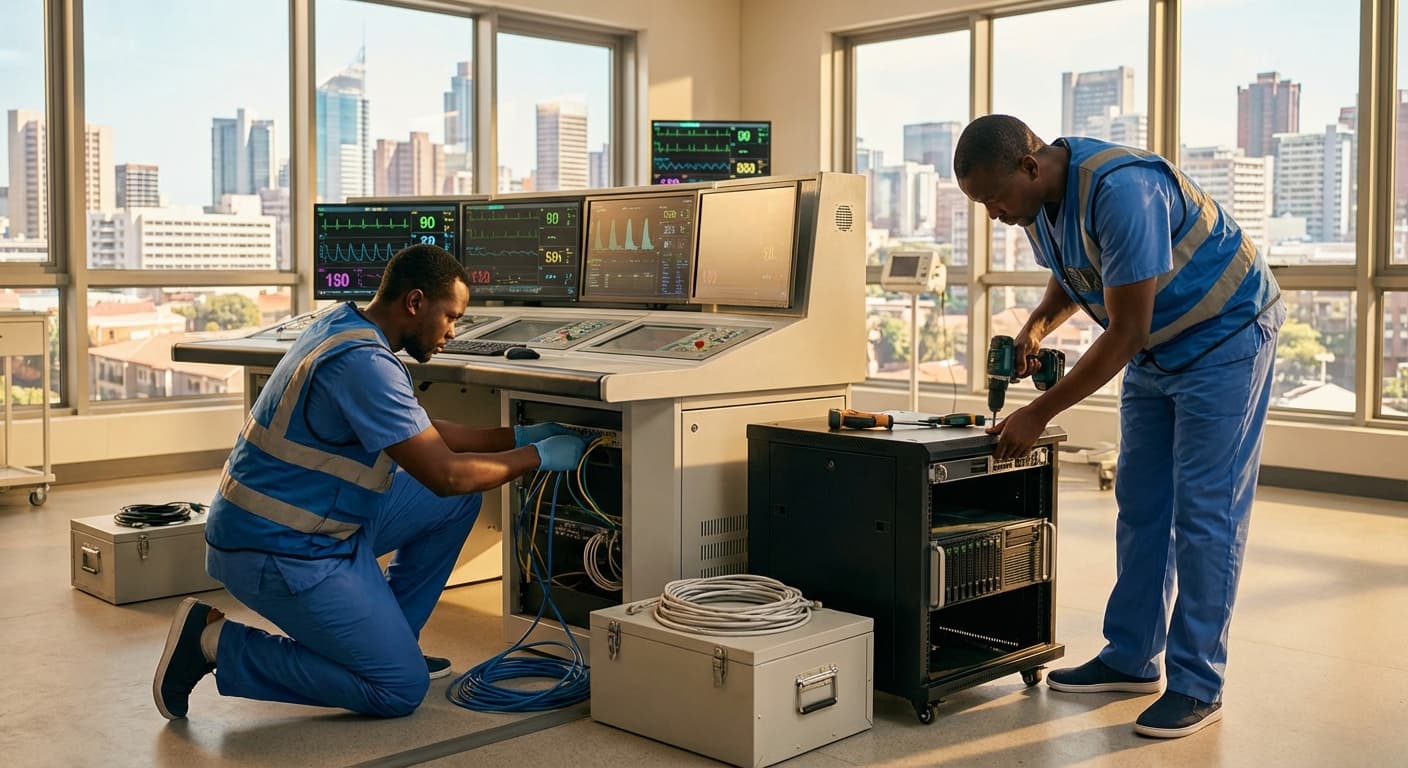
ICU Central Monitoring Station Installation Service in Mauritius
Engineering Excellence & Technical Support
ICU Central Monitoring Station Installation Service High-standard technical execution following OEM protocols and local regulatory frameworks.
High-Performance Central Monitoring Servers
We deploy robust, scalable server infrastructure designed for real-time data acquisition and processing from multiple ICU devices. Our solutions ensure minimal latency and maximum uptime for critical patient data.
Secure & Reliable Network Integration
Our expert technicians ensure seamless, secure integration of all bedside monitors and central stations with the hospital's existing network infrastructure, adhering to strict data privacy and cybersecurity protocols mandated in Mauritius.
Intuitive User Interface & Workflow Optimization
We configure and customize user-friendly dashboards and alarm management systems, designed to enhance clinical workflow efficiency and provide ICU staff with immediate, actionable insights, tailored for the Mauritian healthcare context.
What Is Icu Central Monitoring Station Installation Service In Mauritius?
ICU Central Monitoring Station Installation Service in Mauritius refers to the comprehensive process of designing, procuring, installing, configuring, and commissioning a centralized monitoring system for Intensive Care Units (ICUs) within healthcare facilities in Mauritius. This service ensures the continuous and integrated surveillance of vital patient physiological data from multiple ICU beds at a single, dedicated monitoring station. The core objective is to enhance patient safety, facilitate timely clinical interventions, and optimize resource utilization within the critical care environment.
| Who Needs This Service? | Typical Use Cases |
|---|---|
| Hospitals and healthcare institutions in Mauritius with existing or newly established Intensive Care Units (ICUs). | Continuous, real-time monitoring of multiple critically ill patients from a central location. Facilitating rapid response to deteriorating patient conditions through centralized alarm management. Improving workflow efficiency for nursing staff by consolidating patient data visualization. Enabling remote monitoring and consultation by physicians. Supporting research and quality improvement initiatives through data analysis. Enhancing patient safety by reducing the risk of missed alarms or delayed interventions. Optimizing the use of limited critical care resources. |
| Facilities undergoing ICU expansion or renovation requiring upgraded monitoring infrastructure. | Standardization of patient monitoring across different ICU bays. Integration with Electronic Health Records (EHR) systems for seamless data flow. Deployment in specialized ICUs (e.g., Cardiac, Neurological, Surgical) with specific monitoring needs. |
Key Components and Activities of ICU Central Monitoring Station Installation Service:
- Needs Assessment & System Design: Evaluating existing ICU infrastructure, patient bed capacity, network capabilities, and specific clinical requirements to design a scalable and interoperable central monitoring system architecture.
- Hardware & Software Procurement: Sourcing and acquiring high-quality patient monitors, central workstations, servers, networking equipment (switches, routers, cabling), power backup solutions, and specialized monitoring software.
- Network Infrastructure Setup: Designing and implementing a robust and secure network (wired or wireless) capable of handling real-time data transmission from multiple patient monitors to the central station with minimal latency and high reliability.
- Device Integration & Configuration: Connecting individual patient monitors (bedside units) to the central system, configuring data acquisition parameters, alarm thresholds, and ensuring seamless communication protocols (e.g., HL7, DICOM).
- Central Workstation & Server Installation: Setting up and configuring central monitoring workstations, servers for data storage, and visualization software that displays patient data streams, trends, and alarms.
- Alarm Management System Implementation: Configuring sophisticated alarm management features, including customizable alarm priorities, audible and visual alerts, and integration with nurse call systems or pagers.
- Data Archiving & Retrieval: Establishing secure and compliant mechanisms for long-term storage of patient monitoring data, facilitating audits, research, and retrospective analysis.
- System Testing & Validation: Conducting rigorous testing of all system components, network connectivity, data integrity, alarm functionality, and user interface under simulated clinical scenarios.
- User Training & Documentation: Providing comprehensive training to clinical staff (physicians, nurses, technicians) on the operation, maintenance, and troubleshooting of the central monitoring system, along with detailed user manuals and technical documentation.
- Commissioning & Handover: Finalizing the installation, conducting a formal handover to the healthcare facility, and providing ongoing support and maintenance contracts.
- Compliance & Standards Adherence: Ensuring the installation adheres to relevant international and local healthcare technology standards, cybersecurity protocols, and data privacy regulations.
Who Needs Icu Central Monitoring Station Installation Service In Mauritius?
The installation of an ICU Central Monitoring Station (CMS) is a critical infrastructure upgrade for any healthcare facility aiming to provide advanced patient care in Mauritius. This service caters to hospitals and specialized medical centers that require centralized, real-time monitoring of critically ill patients. A CMS allows a dedicated team of nurses and physicians to observe vital signs, waveforms, and alarms from multiple ICU beds simultaneously, enabling faster intervention and improved patient outcomes. This technology is essential for managing high-acuity patients, optimizing resource allocation, and ensuring a high standard of critical care delivery.
| Target Customer Group | Key Departments/Users | Primary Needs Addressed | Why CMS is Crucial |
|---|---|---|---|
| Public Hospitals | Intensive Care Units (ICUs), Anesthesiology, Cardiology, Neurology, Emergency Departments | Centralized patient monitoring, improved staff efficiency, early detection of critical events, enhanced patient safety. | To manage large patient volumes, standardize critical care protocols, and optimize limited specialized staff resources. |
| Private Hospitals | ICUs, Cardiac Catheterization Labs, Operating Rooms, Post-Anesthesia Care Units (PACUs) | Real-time patient data access, seamless data integration with EMRs, advanced alarm management, high-level patient care for competitive advantage. | To offer cutting-edge critical care services, attract top medical talent, and provide premium patient experiences. |
| Specialized Medical Centers (e.g., Cardiac, Neuro) | Dedicated ICUs for specific specialties, Interventional Cardiology/Radiology Teams, Neurosurgery Units | Specialized monitoring parameters, tailored alarm configurations, seamless integration with advanced diagnostic equipment, continuous expert oversight. | To manage complex patient populations with unique physiological needs and ensure specialized interventions are supported by robust monitoring. |
| Tertiary Care Facilities | All critical care units, including medical ICUs, surgical ICUs, trauma ICUs, neonatal ICUs (with appropriate modules) | Comprehensive patient oversight across multiple units, data-driven decision-making, research capabilities, advanced telemedicine integration. | To serve as referral centers for complex cases, requiring sophisticated and integrated monitoring capabilities for optimal outcomes. |
| Government Health Institutions | National hospitals, regional hospitals with critical care capabilities | Standardization of critical care across the public sector, resource optimization, training and education for healthcare professionals, equitable access to advanced monitoring. | To improve the overall quality and consistency of critical care services delivered to the nation, particularly in resource-constrained environments. |
Target Customers for ICU Central Monitoring Station Installation Service in Mauritius:
- Public Hospitals
- Private Hospitals
- Specialized Medical Centers (e.g., Cardiac Centers, Neuro-ICUs)
- Tertiary Care Facilities
- Government Health Institutions
Icu Central Monitoring Station Installation Service Process In Mauritius
This document outlines the comprehensive workflow for the Installation Service of ICU Central Monitoring Stations in Mauritius. It details each stage from the initial customer inquiry to the final system handover, ensuring a streamlined and efficient process for all stakeholders.
| Stage | Description | Key Activities | Responsible Party | Deliverables |
|---|---|---|---|---|
| Inquiry and Initial Consultation | The process begins with a potential client expressing interest in an ICU Central Monitoring Station installation. | Initial discussion of client needs, project scope, and potential solutions. | Client, Service Provider Sales Team | Understanding of client requirements, preliminary project scope. |
| Site Assessment and Requirements Gathering | A thorough evaluation of the target installation site is conducted to understand the existing infrastructure and specific needs. | On-site visit, network assessment, power availability check, room layout analysis, security considerations. | Service Provider Technical Team, Client IT/Biomedical Engineering | Detailed site survey report, confirmed system requirements, Bill of Materials (BOM) estimation. |
| Proposal and Quotation | Based on the gathered information, a detailed proposal and quotation are prepared. | Development of a comprehensive proposal including system specifications, installation plan, timeline, and cost breakdown. | Service Provider Sales & Technical Teams | Formal proposal document, detailed quotation, project timeline. |
| Contract Finalization and Deposit | Upon acceptance of the proposal, a formal contract is signed, and an initial deposit is usually required to commence work. | Review and signing of the installation service agreement, processing of the initial payment. | Client, Service Provider Management | Signed contract, confirmed commencement date, initial payment. |
| System Design and Procurement | The detailed technical design of the monitoring system is finalized, and all necessary equipment is procured. | Finalization of network architecture, server configuration, workstation layout, and purchase of hardware/software. | Service Provider Technical & Procurement Teams | Approved system design document, procured equipment. |
| Pre-installation Planning and Scheduling | Detailed logistical planning for the installation process is undertaken. | Creation of a detailed installation schedule, coordination with hospital departments, logistics for equipment transport. | Service Provider Project Manager, Client Facilities Management | Detailed installation schedule, confirmed access arrangements. |
| Site Preparation and Infrastructure Setup | The installation site is prepared to receive the new equipment, including necessary infrastructure modifications. | Installation of network cabling, power outlets, server racks, and any required environmental controls. | Service Provider Installation Team, Client IT/Facilities | Ready installation environment, completed infrastructure work. |
| Equipment Delivery and Unpacking | All procured equipment is delivered to the site and carefully unpacked. | Safe transportation of equipment, inspection for damage, organized unpacking. | Service Provider Logistics Team, Client Representative | Delivered and inventoried equipment, damage report (if any). |
| Installation and Cabling | The physical installation of the central monitoring station hardware and the connection of bedside monitors. | Mounting of servers and workstations, installation of network switches, running of data and power cables, connecting bedside devices. | Service Provider Installation Team | Physically installed hardware, completed cabling infrastructure. |
| System Configuration and Integration | The software and hardware are configured to work together and integrate with existing hospital systems. | Installation and configuration of monitoring software, setting up user accounts, integrating with EMR (Electronic Medical Records) if applicable. | Service Provider Technical Team | Configured monitoring system, integrated modules. |
| Testing and Commissioning | Rigorous testing is performed to ensure the system functions as intended and meets all specifications. | Functional testing of all components, network connectivity testing, alarm testing, data validation, performance checks. | Service Provider Technical Team, Client Biomedical Engineering | Successful test results, system performance validation report. |
| User Training | End-users are trained on how to operate and manage the new central monitoring station. | On-site training sessions for nurses, physicians, and IT staff on system features, functionalities, and troubleshooting. | Service Provider Trainer, Client End-Users | Trained personnel, training materials, attendance records. |
| Final Inspection and Handover | A final inspection is conducted with the client to ensure satisfaction before formally handing over the system. | Joint review of the installed system, addressing any final queries, official handover documentation. | Service Provider Project Manager, Client Representative | Client sign-off, completed handover documentation, operational system. |
| Post-Installation Support and Maintenance | Ongoing support and maintenance services are provided as per the service agreement. | Troubleshooting, software updates, hardware maintenance, remote support, on-site visits as needed. | Service Provider Support Team | Ongoing system reliability, performance, and adherence to SLA (Service Level Agreement). |
ICU Central Monitoring Station Installation Service Process
- Inquiry and Initial Consultation
- Site Assessment and Requirements Gathering
- Proposal and Quotation
- Contract Finalization and Deposit
- System Design and Procurement
- Pre-installation Planning and Scheduling
- Site Preparation and Infrastructure Setup
- Equipment Delivery and Unpacking
- Installation and Cabling
- System Configuration and Integration
- Testing and Commissioning
- User Training
- Final Inspection and Handover
- Post-Installation Support and Maintenance
Icu Central Monitoring Station Installation Service Cost In Mauritius
The installation of an ICU Central Monitoring Station (CMS) in Mauritius involves a range of costs influenced by several key factors. These factors dictate the overall price, making it crucial for healthcare facilities to understand them when budgeting for such an essential upgrade. The complexity of the system, the number of beds to be monitored, the specific features and functionalities required, the brand and quality of the equipment, and the expertise of the installation team all play significant roles. Additionally, the need for integration with existing hospital infrastructure, such as the Electronic Health Record (EHR) system, can introduce further costs. The market in Mauritius for these sophisticated medical systems is growing, and while there isn't a single fixed price, understanding the contributing elements helps in estimating a realistic budget.
| Cost Component | Estimated Price Range (MUR) | Notes |
|---|---|---|
| Basic ICU CMS (for ~4-6 beds) | MUR 800,000 - MUR 1,500,000 | Includes central station, basic monitoring units, and essential cabling. Focus on core vital signs. |
| Intermediate ICU CMS (for ~8-12 beds) | MUR 1,500,000 - MUR 3,000,000 | Adds more advanced parameters, greater scalability, and potentially basic EHR integration. Higher quality components. |
| Advanced ICU CMS (for ~12+ beds) | MUR 3,000,000+ | Comprehensive suite of monitoring, advanced analytics, robust EHR integration, remote access capabilities, and premium brand equipment. |
| Installation & Commissioning (per system) | MUR 150,000 - MUR 400,000 | Varies based on the complexity of the installation, site readiness, and the number of integration points. |
| Software & Integration Services | MUR 100,000 - MUR 500,000+ | Dependent on the level of integration required with existing hospital IT and EHR systems. |
| Training & Support (Annual) | MUR 50,000 - MUR 200,000+ | Covers technical support, software updates, and potential on-site training refresher courses. |
Key Pricing Factors for ICU Central Monitoring Station Installation in Mauritius:
- System Complexity and Scope: The more advanced the features (e.g., advanced waveform analysis, predictive algorithms, remote access), the higher the cost.
- Number of ICU Beds: The primary driver of cost is the number of monitoring points or beds that need to be connected to the central station.
- Equipment Brand and Quality: Reputable international brands known for reliability and advanced technology typically come with a higher price tag than lesser-known alternatives.
- Features and Functionality: Basic vital sign monitoring will be less expensive than systems offering specialized parameters like invasive pressure monitoring, capnography, or advanced hemodynamic monitoring.
- Integration with Existing Systems: Connecting the CMS to the hospital's IT infrastructure, EHR, or other medical devices requires specialized integration services and software, adding to the cost.
- Installation and Commissioning Services: This includes the physical installation of the CMS hardware, network setup, software configuration, and thorough testing and calibration by certified technicians.
- Training: Comprehensive training for ICU staff on operating and maintaining the new CMS is often included or offered as an additional service.
- Post-Installation Support and Maintenance: Service level agreements (SLAs) for ongoing technical support, software updates, and equipment maintenance contribute to the long-term cost.
- Local vs. Imported Equipment: While many components might be imported, the local installation and support services are crucial for pricing.
Affordable Icu Central Monitoring Station Installation Service Options
Securing affordable and reliable ICU central monitoring station (CMS) installation is crucial for patient care and operational efficiency. This service ensures that all vital signs from various patient monitors are consolidated and displayed in a central nursing station, enabling real-time observation and rapid response to critical changes. We offer a range of options designed to meet diverse budgetary needs, focusing on value bundles and strategic cost-saving measures.
| Service Component | Standard Pricing (Estimate) | Value Bundle Option | Cost-Saving Strategy |
|---|---|---|---|
| CMS Software License | $5,000 - $25,000+ | Included in Silver/Gold Bundle | Explore Open-Source Alternatives |
| Central Monitoring Unit Hardware | $10,000 - $50,000+ | Included in Gold Bundle | Opt for Certified Refurbished Units |
| Installation Labor (On-site) | $2,000 - $10,000+ | Reduced Rate in Bundles | Phased Implementation for Cost Spread |
| Network Cabling & Configuration | $1,000 - $5,000+ | Included in Platinum Bundle | Utilize Existing Network Infrastructure where possible |
| Initial User Training | $1,000 - $4,000+ | Basic Training in Silver Bundle, Comprehensive in Gold | Focused, Role-Specific Training Sessions |
| Annual Maintenance Contract | $2,000 - $10,000+ (15-20% of hardware cost) | Discounted Rate in Bundles | Negotiate Longer-Term Contracts for Better Rates |
| Integration with EMR/EHR | $3,000 - $15,000+ | Advanced Integration in Platinum Bundle | Prioritize Essential Data Points for Initial Integration |
| Extended Warranty | $1,000 - $5,000+ | Included in Platinum Bundle | Assess Necessity Based on Hardware Reliability |
Understanding Value Bundles and Cost-Saving Strategies
- Value Bundles: These are pre-packaged service offerings that combine essential CMS installation components with additional benefits at a discounted price compared to purchasing them individually. Bundles often include hardware, software licensing, installation labor, initial training, and basic maintenance contracts.
- Cost-Saving Strategies: These are proactive approaches to reduce the overall expense of CMS installation and long-term ownership.
- Phased Implementation: Breaking down the installation into manageable phases can spread costs over time and allow for adaptation to evolving needs.
- Refurbished Equipment: Utilizing high-quality, certified refurbished central monitoring units and network components can significantly reduce upfront hardware costs.
- Open-Source Software Options: Exploring open-source clinical data management systems can eliminate or reduce expensive proprietary software licensing fees.
- Negotiated Service Agreements: Engaging in transparent negotiations for installation labor rates and long-term maintenance contracts can secure more favorable terms.
- Bulk Purchasing Discounts: If multiple ICUs or departments require CMS installation, consolidating purchases can lead to volume discounts.
- Training Optimization: Focusing on essential training modules for core functionalities reduces training time and associated costs.
- Remote Support Integration: Leveraging remote diagnostic and support capabilities can minimize the need for on-site technician visits for minor issues, saving on travel and labor costs.
- Energy-Efficient Hardware Selection: Choosing energy-efficient monitors and network devices can lead to long-term operational cost savings on electricity bills.
Verified Providers In Mauritius
When seeking healthcare services in Mauritius, the designation of 'Verified Providers' holds significant weight. This verification process ensures that healthcare facilities and professionals meet stringent standards of quality, safety, and ethical practice. Franance Health stands out as a leader in this regard, meticulously vetting its network of providers. Their rigorous credentialing process is not just a formality; it's a commitment to patient well-being and trust. By partnering with Franance Health, patients gain access to a curated selection of the best healthcare options available, offering peace of mind and confidence in the care they receive.
| Provider Type | Franance Health Verification Key Focus Areas | Benefits for Patients |
|---|---|---|
| Hospitals | Accreditation, Staff Qualifications, Patient Outcomes, Safety Records | Access to comprehensive services, expert medical teams, and high standards of patient care. |
| Specialist Clinics | Physician Credentials, Specialization Expertise, Equipment Standards, Patient Feedback | Targeted treatment from highly qualified specialists with access to advanced diagnostic tools. |
| Diagnostic Centers | Technological Advancement, Staff Competency, Report Accuracy, Turnaround Time | Reliable and precise diagnostic results delivered efficiently. |
| Medical Practitioners (GPs & Specialists) | Licensing, Board Certifications, Continuing Medical Education, Professional Reputation | Confidence in the expertise and ethical practice of individual healthcare professionals. |
Why Franance Health Verified Providers are the Best Choice:
- Uncompromised Quality of Care: Franance Health's verification process scrutinizes clinical expertise, adherence to international best practices, and the overall patient experience.
- Patient Safety Paramount: Rigorous checks on safety protocols, infection control measures, and equipment maintenance ensure a secure environment for all treatments.
- Ethical Practices Guaranteed: Providers are assessed for their commitment to ethical conduct, patient rights, and transparent communication.
- Access to Advanced Facilities: Franance Health partners with institutions equipped with state-of-the-art technology and modern medical infrastructure.
- Streamlined Access and Support: Their network facilitates easier appointment booking and provides dedicated support throughout your healthcare journey.
Scope Of Work For Icu Central Monitoring Station Installation Service
This Scope of Work (SOW) outlines the services required for the installation of an ICU Central Monitoring Station (CMS). The objective is to establish a robust and reliable system for continuous patient monitoring, enabling efficient clinical decision-making and improved patient care within the Intensive Care Unit. The scope includes all necessary hardware and software installation, configuration, testing, and commissioning of the ICU CMS, ensuring seamless integration with existing and future medical devices.
| Technical Deliverable | Description | Standard Specification/Reference |
|---|---|---|
| Central Monitoring Station Server(s) | Installation and configuration of dedicated server(s) to host the CMS software, database, and data storage. | Server hardware meeting minimum performance requirements (CPU, RAM, storage) as per manufacturer's recommendations and project needs. Redundant configuration for high availability is preferred. Operating system licensed and installed. |
| CMS Software Platform | Installation, licensing, and configuration of the central monitoring software application. | Software version compatibility with existing hospital IT infrastructure. Adherence to data privacy regulations (e.g., HIPAA, GDPR). Multi-language support if required. |
| Workstation(s) and Display(s) | Installation and setup of clinician workstations and high-resolution displays within the CMS room and potentially at bedside nursing stations. | Workstation hardware specifications for optimal performance. Display resolution (e.g., 1920x1080 or higher), size, and viewing angles suitable for critical care monitoring. Ergonomic setup. |
| Network Infrastructure and Cabling | Installation of all necessary network cabling (e.g., Ethernet), patch panels, and network switches to connect monitoring devices to the CMS. | Structured cabling according to TIA/EIA-568 standards. Use of high-quality, hospital-grade cabling. Network segmentation for security and performance. PoE (Power over Ethernet) support for applicable devices. |
| Medical Device Connectivity Modules/Adapters | Installation and configuration of hardware or software modules required to interface various bedside monitoring devices (e.g., ventilators, EKG machines, SpO2 monitors, NIBP monitors) with the CMS. | Compatibility with specific medical device manufacturers and models. Use of industry-standard communication protocols (e.g., HL7, FHIR, proprietary vendor protocols). Secure data transmission. |
| Data Storage Solution | Configuration of storage for patient waveform, vital signs, and alarm data. Includes short-term and long-term archival. | Sufficient storage capacity based on anticipated patient volume and data retention policies. RAID configuration for data redundancy and performance. Back-up and disaster recovery plan integration. |
| Alarm Management System | Configuration of alarm rules, priorities, and notification methods for critical events. | Customizable alarm parameters. Integration with audible and visual alarm systems. Compliance with relevant medical device standards for alarm management. |
| System Integration with EMR/HIS | Configuration and testing of data flow between the CMS and the Electronic Medical Record (EMR) or Hospital Information System (HIS). | HL7 or FHIR compliant integration. Bi-directional data transfer for patient demographics, admission/discharge, and physiological data. Secure authentication and authorization. |
| System Backup and Disaster Recovery | Implementation of automated backup procedures for CMS data and configuration. Development and testing of a disaster recovery plan. | Regular, scheduled backups. Offsite backup storage. Documented recovery procedures with defined RTO/RPO (Recovery Time Objective/Recovery Point Objective). |
| System Security Measures | Implementation of access controls, user authentication, data encryption, and audit trails to protect patient data. | Role-based access control. Strong password policies. Data encryption in transit and at rest. Regular security vulnerability assessments. |
| Testing and Validation Documentation | Comprehensive documentation of all testing procedures, results, and sign-off for each installed component and the integrated system. | Unit testing, integration testing, system testing, and user acceptance testing (UAT) protocols. Traceability matrix linking requirements to test cases. |
| User Training Materials | Development of comprehensive training manuals and guides for CMS operators and administrators. | Clear, concise language with step-by-step instructions. Illustrated guides. Covering all CMS functionalities and troubleshooting. |
| As-Built Drawings and Documentation | Provision of final system diagrams, network layouts, cabling schematics, and configuration details post-installation. | Accurate representation of the final installed system. Including all hardware, software, and network connections. |
Key Project Phases
- Project Planning and Design
- Site Preparation and Infrastructure
- Hardware Installation and Cabling
- Software Installation and Configuration
- Device Integration and Connectivity
- System Testing and Commissioning
- User Training and Documentation
- Post-Installation Support and Handover
Service Level Agreement For Icu Central Monitoring Station Installation Service
This Service Level Agreement (SLA) outlines the response times and uptime guarantees for the installation of the ICU Central Monitoring Station service. This SLA is between [Your Company Name] (hereinafter referred to as "Provider") and [Client Name] (hereinafter referred to as "Client") for the installation of the ICU Central Monitoring Station.
| Service Component | Response Time (Business Hours) | Resolution Time (Business Hours) | Uptime Guarantee |
|---|---|---|---|
| Critical System Failures (Complete Loss of Monitoring) | 1 Hour | 4 Hours | 99.9% (excluding scheduled maintenance) |
| Major System Malfunctions (Partial Loss of Monitoring or Key Functionality) | 2 Hours | 8 Hours | 99.5% (excluding scheduled maintenance) |
| Minor System Issues (Non-critical Functionality Affecting User Experience) | 4 Business Hours | 24 Business Hours | N/A (Service may be degraded but operational) |
| Scheduled Maintenance Notification | N/A | N/A | Scheduled maintenance windows will be communicated with at least 72 hours' notice. Downtime during scheduled maintenance does not count towards uptime guarantees. |
Scope of Service
- Installation of ICU Central Monitoring Station hardware and software.
- Configuration of monitoring parameters and alarms.
- Integration with existing hospital network infrastructure.
- Initial system testing and validation.
- Basic user training for system administrators.
Frequently Asked Questions

Ready when you are
Let's scope your ICU Central Monitoring Station Installation Service in Mauritius project in Mauritius.

Scaling healthcare logistics and technical systems across the entire continent.