
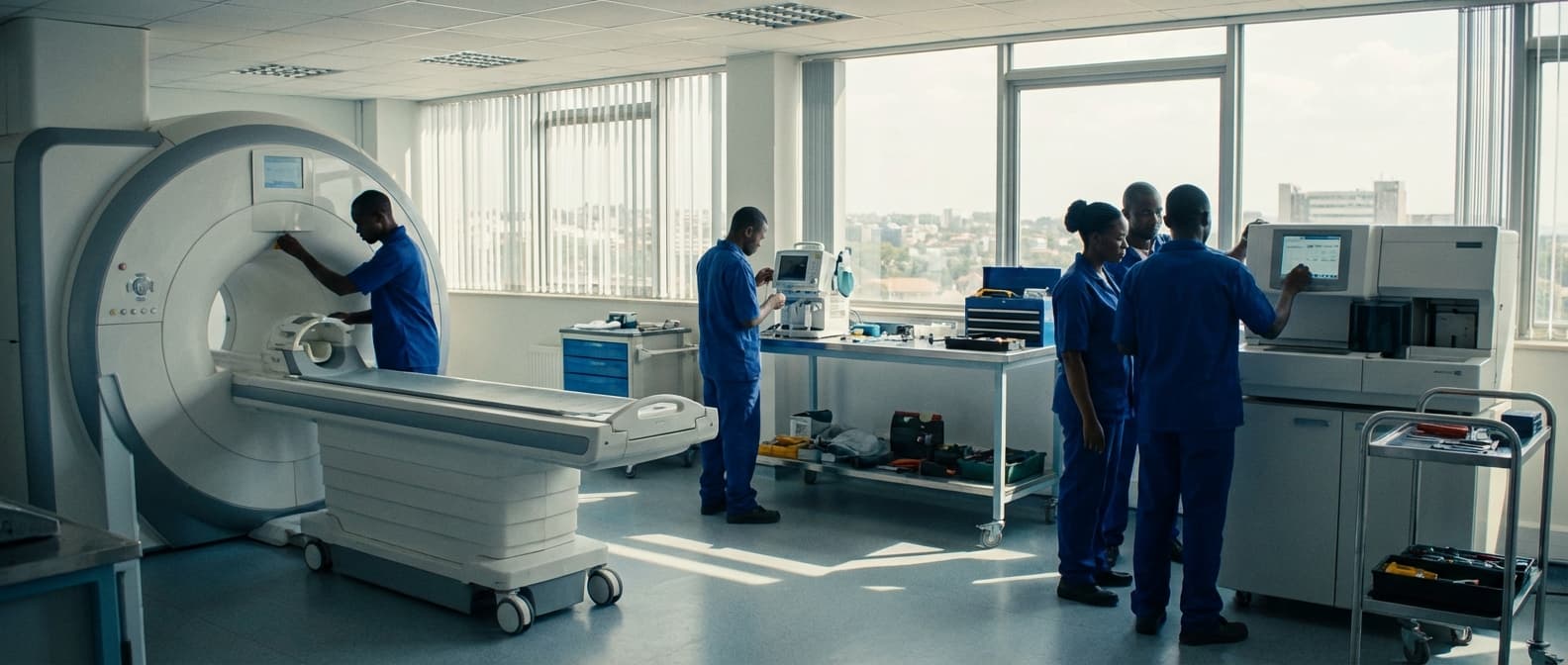
Uptime, Downtime & Root-Cause Analysis Reporting Service in Burkina Faso
Engineering Excellence & Technical Support
Uptime, Downtime & Root-Cause Analysis Reporting Service High-standard technical execution following OEM protocols and local regulatory frameworks.
Real-time Uptime & Downtime Monitoring
Leverage our state-of-the-art infrastructure to provide continuous, granular visibility into your IT systems' availability across Burkina Faso. Our service offers real-time alerts and dashboards, ensuring you're always aware of your system's status, minimizing the impact of outages.
Automated Root-Cause Analysis (RCA)
Go beyond simple outage detection. Our advanced analytics engine automatically pinpoints the root cause of downtime events, identifying the contributing factors from infrastructure issues to application failures. This accelerates your Mean Time To Resolution (MTTR) and prevents recurring problems.
Comprehensive Reporting & Compliance
Receive detailed, actionable reports on uptime, downtime, and RCA findings tailored to your operational needs. Our service supports regulatory compliance requirements and provides historical data for trend analysis, capacity planning, and performance optimization within Burkina Faso's unique business environment.
What Is Uptime, Downtime & Root-cause Analysis Reporting Service In Burkina Faso?
Uptime, Downtime & Root-Cause Analysis Reporting Service in Burkina Faso refers to a specialized offering focused on monitoring the operational availability of critical IT systems and infrastructure, identifying periods of unresponsiveness (downtime), and conducting in-depth investigations to determine the underlying causes of these disruptions. This service aims to provide organizations in Burkina Faso with actionable insights to enhance system reliability, minimize service interruptions, and optimize their IT operational efficiency. It encompasses proactive monitoring, incident detection, detailed reporting, and prescriptive recommendations for remediation and prevention.
| Who Needs This Service? | Typical Use Cases | |||||
|---|---|---|---|---|---|---|
| Businesses with Critical IT Infrastructure: Companies heavily reliant on IT systems for core operations, including financial institutions, telecommunications providers, e-commerce platforms, and manufacturing firms. | Service Providers: Internet Service Providers (ISPs), cloud hosting companies, and Software-as-a-Service (SaaS) vendors that guarantee availability to their customers. | Government Agencies & Public Services: Organizations managing critical public infrastructure, such as power grids, transportation networks, and emergency services. | Enterprises with Remote Operations or Distributed Systems: Businesses operating across multiple locations or managing complex, interconnected IT environments. | Organizations Subject to Regulatory Compliance: Industries with strict uptime requirements mandated by regulatory bodies. | IT Departments Seeking to Improve Operational Efficiency: Internal IT teams aiming to reduce firefighting, enhance system stability, and optimize resource allocation. | |
| Ensuring Business Continuity: Minimizing financial losses and reputational damage by preventing or quickly resolving system outages. | Meeting Service Level Agreements (SLAs): Demonstrating adherence to contractual obligations regarding system availability for clients and partners. | Optimizing IT Resource Allocation: Identifying recurring issues to address them proactively, thereby reducing the need for reactive troubleshooting and resource strain. | Improving System Performance & Reliability: Gaining insights into system bottlenecks and vulnerabilities to implement targeted improvements. | Forensic Analysis of Incidents: Providing detailed evidence for post-incident reviews and for understanding the impact of specific events. | Proactive Risk Management: Identifying potential points of failure before they lead to downtime through trend analysis. | Capacity Planning & Infrastructure Upgrade Justification: Using performance data to inform decisions about scaling or upgrading IT resources. |
Key Components of the Service:
- Uptime Monitoring: Continuous surveillance of network devices, servers, applications, and critical services to verify their operational status and performance against predefined Service Level Agreements (SLAs).
- Downtime Detection & Alerting: Real-time notification mechanisms triggered by deviations from expected availability, including system failures, network outages, or performance degradation exceeding thresholds.
- Incident Logging & Tracking: Comprehensive documentation of all detected incidents, including timestamps, affected components, severity levels, and associated error messages.
- Root-Cause Analysis (RCA): A systematic process involving data collection, analysis of logs, configuration reviews, and correlation of events to identify the fundamental reason(s) for an outage.
- Reporting & Documentation: Generation of detailed reports encompassing uptime statistics, downtime durations, incident summaries, RCA findings, and recommendations for corrective and preventive actions.
- Performance Benchmarking: Establishing baseline performance metrics for systems and services to facilitate the identification of anomalies and trends.
- Trend Analysis: Analyzing historical data to identify recurring issues, potential vulnerabilities, and areas for proactive improvement.
- Post-Incident Review (PIR): Facilitating structured discussions to learn from incidents, refine operational procedures, and update documentation.
Who Needs Uptime, Downtime & Root-cause Analysis Reporting Service In Burkina Faso?
Organizations in Burkina Faso that rely on the continuous operation of their IT infrastructure, digital services, and critical business processes require robust Uptime, Downtime, and Root-Cause Analysis (RCA) Reporting Services. These services are crucial for maintaining operational efficiency, minimizing financial losses due to outages, ensuring customer satisfaction, and proactively improving system reliability. Without effective monitoring and RCA, businesses are left vulnerable to unpredictable disruptions, leading to reputational damage and lost revenue.
| Target Customer Segment | Key Departments Requiring Service |
|---|---|
| Large Enterprises | IT Operations, Network Operations Center (NOC), System Administration, DevOps, Business Continuity Planning, Executive Management |
| SMEs | IT Management, Operations Management, Business Owners, Technical Support |
| Government Agencies | IT Departments, E-Government Initiatives, Public Service Delivery Units, Security Operations Centers (SOC) |
| Telecommunications Companies | Network Operations, Service Assurance, Engineering, Customer Support, Infrastructure Management |
| Financial Institutions | IT Operations, Risk Management, Compliance, Security, Core Banking Operations, Digital Banking Services |
| Healthcare Providers | IT Infrastructure, Medical Records Management, Patient Care Systems, Clinical Operations, Facility Management |
| Educational Institutions | IT Services, Academic Administration, Learning Management Systems (LMS), Student Support Services |
| E-commerce Platforms | E-commerce Operations, IT Infrastructure, Customer Service, Marketing Technology |
| Logistics and Transportation Companies | Supply Chain Management Systems, Fleet Management, IT Operations, Customer Tracking Systems |
| Mining and Natural Resource Companies | Operational Technology (OT) Management, IT Infrastructure, Production Monitoring, Safety Systems |
Target Customers & Departments
- Large Enterprises
- Small and Medium-sized Enterprises (SMEs)
- Government Agencies
- Telecommunications Companies
- Financial Institutions
- Healthcare Providers
- Educational Institutions
- E-commerce Platforms
- Logistics and Transportation Companies
- Mining and Natural Resource Companies
Uptime, Downtime & Root-cause Analysis Reporting Service Process In Burkina Faso
This document outlines the workflow for the Uptime, Downtime & Root-Cause Analysis Reporting Service offered in Burkina Faso. This service aims to provide clients with comprehensive reports on their system's availability, identify the causes of any disruptions, and propose corrective actions. The process begins with an initial client inquiry and concludes with the delivery of a detailed report and subsequent follow-up.
| Stage | Description | Key Activities | Deliverables | Responsible Party | Timeline (Indicative) |
|---|---|---|---|---|---|
| Client expresses interest in the Uptime, Downtime & Root-Cause Analysis Reporting Service. | Client contacts service provider via phone, email, or website. Initial discussion of client's needs, existing infrastructure, and desired reporting frequency. | Understanding of client requirements. Initial qualification of service applicability. | Client, Service Provider Representative | 1-3 Business Days |
| Detailed understanding of the client's systems and specific reporting needs. | On-site or remote assessment of client infrastructure. Defining the scope of systems to be monitored (servers, networks, applications). Determining Key Performance Indicators (KPIs) for uptime and downtime. Specifying reporting formats and frequency. | Detailed Service Proposal outlining scope, methodology, deliverables, pricing, and terms. Service Level Agreement (SLA) draft. | Service Provider Technical Team, Account Manager, Client | 3-7 Business Days |
| Formalizing the service agreement between the client and the service provider. | Review and negotiation of the Service Proposal and SLA. Signing of the service contract. | Signed Service Contract. Formal agreement to proceed. | Client Legal/Procurement, Service Provider Management | 5-10 Business Days |
| Implementing the necessary tools and configurations to collect uptime and downtime data. | Installation and configuration of monitoring agents/software. Setting up network probes and log collectors. Establishing secure data transmission channels. User access and credential management. | Operational monitoring systems. Baseline uptime/downtime data. | Service Provider Technical Team | 7-14 Business Days |
| Real-time identification and immediate notification of system interruptions. | Continuous monitoring of defined systems and KPIs. Automated alerts triggered by deviations from normal operation. Initial incident classification and severity assessment. | Incident alerts (email, SMS, dashboard). Initial incident log entry. | Automated Monitoring System, Service Provider Operations Team | Continuous (24/7) |
| Investigating detected incidents to determine the underlying causes of downtime. | Reviewing system logs, performance metrics, and network traffic. Correlating events across different system components. Interviewing client IT personnel (if necessary). Applying troubleshooting methodologies. | Identified root cause(s) of downtime. Detailed incident timeline. | Service Provider Technical Analysts, Senior Engineers | Hours to Days (depending on incident complexity) |
| Compiling all collected and analyzed data into a comprehensive report. | Gathering uptime statistics for the reporting period. Documenting all detected downtime incidents. Detailing the root cause analysis for each incident. Including performance trends and system health overview. | Comprehensive Uptime, Downtime & Root-Cause Analysis Report. | Service Provider Reporting Team | 2-5 Business Days (post-analysis) |
| Communicating the findings of the report to the client and clarifying any queries. | Scheduled meeting (remote or in-person) with the client. Presentation of the report's key findings and insights. Answering client questions and providing explanations. | Client understanding of system performance and incident causes. Confirmation of report accuracy. | Service Provider Account Manager, Technical Lead, Client Stakeholders | 1-2 Business Days (post-report generation) |
| Providing actionable recommendations to prevent future occurrences and assisting with implementation. | Proposing specific technical solutions, process improvements, or configuration changes. Offering assistance with the implementation of recommended solutions. Defining follow-up actions and responsibilities. | Actionable recommendations document. Optional: Assistance with implementation. | Service Provider Technical Team, Account Manager, Client IT Team | Variable (based on recommendations) |
| Ensuring client satisfaction and evaluating the effectiveness of the service. | Post-implementation review of corrective actions. Gathering client feedback on the service. Periodic review of service performance and potential adjustments to scope or methodology. | Client satisfaction. Service improvement feedback. Potential for contract renewal or expansion. | Service Provider Account Manager, Client | Ongoing (monthly/quarterly) |
Uptime, Downtime & Root-Cause Analysis Reporting Service Workflow in Burkina Faso
- Inquiry & Initial Consultation
- Service Scope Definition & Proposal
- Agreement & Contract Finalization
- Data Collection & Monitoring Setup
- Downtime Incident Detection & Notification
- Data Analysis & Root-Cause Identification
- Report Generation
- Report Presentation & Discussion
- Corrective Action Recommendations & Implementation Support
- Follow-up & Service Review
Uptime, Downtime & Root-cause Analysis Reporting Service Cost In Burkina Faso
This report outlines the typical cost structure for Uptime, Downtime & Root-Cause Analysis (RCA) reporting services in Burkina Faso, detailing key pricing factors and providing estimated cost ranges in the local currency, the West African CFA franc (XOF). The complexity, frequency, and scope of the analysis are the primary drivers of these costs. Smaller businesses with simpler infrastructure might find more affordable, standardized packages, while larger enterprises with complex IT environments and critical uptime requirements will necessitate more bespoke and therefore expensive solutions.
Key Pricing Factors:
- Scope of Service: This includes whether the service covers all IT infrastructure, specific critical systems (e.g., servers, networks, cloud services), or a subset of applications. A broader scope naturally increases cost.
- Frequency of Reporting: Daily, weekly, monthly, or quarterly reports will have different price points. More frequent reporting, especially for real-time monitoring and immediate incident analysis, is generally more expensive.
- Depth of Analysis: Basic uptime/downtime reporting is less complex than in-depth root-cause analysis that involves deep investigation into system logs, network traffic, and application behavior. Advanced RCA requires specialized tools and expertise.
- Automation vs. Manual Analysis: Services heavily reliant on automated tools for initial data gathering and reporting will be more cost-effective than those requiring significant manual investigation and human expertise for RCA.
- Complexity of Infrastructure: The more complex the IT environment (e.g., multiple data centers, hybrid cloud, diverse operating systems, intricate network topology), the more challenging and costly the monitoring and RCA will be.
- Service Level Agreements (SLAs): The stringency of SLAs for response times, resolution times, and report delivery will influence pricing. Higher uptime guarantees often come with higher service costs.
- Provider Expertise and Reputation: Established providers with a proven track record and specialized expertise in cybersecurity and IT infrastructure will likely command higher fees.
- Technology Stack Used: The specific monitoring and analysis tools employed by the service provider can impact costs, especially if they are proprietary or require significant licensing.
- Customization Requirements: Bespoke reporting formats, specific metrics to track, or integration with existing internal systems will add to the overall cost.
- Support Level: The level of technical support provided during incidents and for report clarification also plays a role. 24/7 support will be priced higher than business hours support.
Estimated Cost Ranges in XOF:
It is important to note that these are estimated ranges and actual quotes can vary significantly based on the specific needs and negotiations with the service provider. Prices are typically quoted on a monthly or annual basis.
- Basic Uptime/Downtime Monitoring & Reporting (Monthly):
* **Small Businesses (Limited Scope):** 50,000 XOF - 150,000 XOF
* **Medium Businesses (Broader Scope):** 150,000 XOF - 400,000 XOF
- Advanced Uptime/Downtime & Root-Cause Analysis Reporting (Monthly):
* **Medium Businesses (Standardized RCA):** 200,000 XOF - 600,000 XOF
* **Large Enterprises (Complex Infrastructure & In-depth RCA):** 600,000 XOF - 2,000,000+ XOF
- Project-Based RCA (One-off Incident Investigation):
* This can range from 100,000 XOF for a simple issue to 1,000,000 XOF or more for highly complex, multi-day investigations requiring extensive forensic analysis.
These figures are indicative and it is highly recommended for businesses in Burkina Faso to obtain multiple quotes from reputable IT service providers to accurately assess their specific needs and budget.
| Service Type | Business Size/Complexity | Estimated Monthly Cost (XOF) |
|---|---|---|
| Basic Uptime/Downtime Monitoring & Reporting | Small Businesses (Limited Scope) | 50,000 - 150,000 |
| Basic Uptime/Downtime Monitoring & Reporting | Medium Businesses (Broader Scope) | 150,000 - 400,000 |
| Advanced Uptime/Downtime & Root-Cause Analysis Reporting | Medium Businesses (Standardized RCA) | 200,000 - 600,000 |
| Advanced Uptime/Downtime & Root-Cause Analysis Reporting | Large Enterprises (Complex Infrastructure & In-depth RCA) | 600,000 - 2,000,000+ |
| Project-Based RCA (One-off Incident Investigation) | Simple Issue | 100,000+ |
| Project-Based RCA (One-off Incident Investigation) | Complex, Multi-day Investigation | 1,000,000+ |
Key Factors Influencing Uptime, Downtime & Root-Cause Analysis Reporting Service Costs in Burkina Faso
- Scope of Service (IT infrastructure covered)
- Frequency of Reporting (e.g., daily, weekly, monthly)
- Depth of Analysis (basic vs. in-depth root-cause)
- Level of Automation vs. Manual Investigation
- Complexity of the Client's IT Infrastructure
- Stringency of Service Level Agreements (SLAs)
- Provider's Expertise, Reputation, and Tooling
- Specific Technology Stack Utilized
- Customization Needs (reporting formats, metrics)
- Required Level of Technical Support (e.g., 24/7)
Affordable Uptime, Downtime & Root-cause Analysis Reporting Service Options
Ensuring your systems are operational and quickly diagnosing issues are critical for business continuity and customer satisfaction. Our Uptime, Downtime, and Root-Cause Analysis (RCA) Reporting Service offers a tiered approach to provide you with the insights you need without breaking the bank. We understand that different businesses have varying needs and budgets, which is why we've designed flexible value bundles and cost-saving strategies.
| Cost-Saving Strategy | Description | Benefit | Applicable Bundles |
|---|---|---|---|
| Tiered Service Levels | Choose the bundle that precisely matches your current monitoring and analysis needs. Avoid overpaying for features you don't utilize. | Reduces unnecessary expenditure, allowing budget allocation to core business functions. | All Bundles |
| Annual Commitments | Opt for an annual subscription instead of monthly payments for a significant discount. | Lower per-month cost, predictable budgeting. | Standard, Premium, Enterprise |
| Bundled Feature Discounts | Certain features, like historical data access or advanced alerting, may be offered at a reduced price when bundled with higher-tier RCA services. | Increased value for money, access to more powerful tools at a lower integrated cost. | Premium, Enterprise |
| Volume-Based Pricing | For large deployments or multiple services, we offer customized pricing based on the volume of monitored endpoints or analysis requests. | Significant cost reduction for larger-scale operations. | Enterprise |
| Self-Service Reporting Options | Basic reporting features can be accessed and customized through our client portal, reducing the need for dedicated analyst time for routine reports. | Empowers clients with immediate data access and reduces service costs for standard reporting. | Basic, Standard |
| Focus on Proactive RCA | Investing in our Premium or Enterprise bundles with proactive RCA can prevent costly future downtime and reduce the need for reactive, expensive incident response. | Long-term cost savings through prevention, improved operational efficiency. | Premium, Enterprise |
Value Bundles Explained
- {"title":"Basic Uptime Monitoring","description":"Ideal for startups and small businesses needing fundamental visibility. Focuses on critical uptime alerts and basic incident logging. No in-depth RCA included."}
- {"title":"Standard Incident & Downtime Reporting","description":"A balanced option for growing businesses. Includes uptime monitoring, automated downtime alerts, and a foundational incident report. Basic RCA for recurring issues."}
- {"title":"Premium Uptime & Comprehensive RCA","description":"For businesses where performance and rapid resolution are paramount. Offers advanced uptime monitoring, detailed downtime reports, and thorough, actionable root-cause analysis for all significant incidents."}
- {"title":"Enterprise-Grade Visibility & Proactive RCA","description":"Our top-tier solution for large organizations with complex infrastructures. Features sophisticated monitoring, predictive analytics for potential issues, and proactive, in-depth root-cause analysis with strategic recommendations."}
Verified Providers In Burkina Faso
In Burkina Faso, ensuring access to reliable and qualified healthcare is paramount. Franance Health has established itself as a leading provider, distinguished by its rigorous credentialing process. This commitment to verification means that all healthcare professionals and facilities associated with Franance Health meet stringent standards, offering patients a higher degree of trust and confidence in the care they receive. Their dedication to quality and safety makes them the optimal choice for healthcare needs in the region.
| Credentialing Aspect | Franance Health's Standard | Benefit to Patients |
|---|---|---|
| Professional Licenses & Certifications | Thorough verification of all relevant medical licenses and board certifications. | Guarantees that providers meet the minimum legal and professional requirements for practice. |
| Educational Background | Confirmation of medical education from accredited institutions. | Ensures a solid foundation of medical knowledge and training. |
| Clinical Experience | Assessment of relevant practical experience and specialization. | Provides access to experienced professionals who can effectively manage diverse medical conditions. |
| Professional Reputation & Ethics | Background checks and reference verification for ethical conduct. | Upholds high standards of patient care and trust. |
| Continuing Medical Education (CME) | Ensures providers actively participate in ongoing professional development. | Guarantees that patients receive care informed by the latest medical advancements and practices. |
Why Choose Franance Health in Burkina Faso?
- Rigorous Credentialing: Franance Health meticulously verifies the qualifications, licenses, and experience of all their healthcare providers.
- Commitment to Quality Care: Their credentialing process ensures that only competent and ethical professionals are part of their network.
- Enhanced Patient Safety: By partnering with verified providers, Franance Health prioritizes the safety and well-being of its patients.
- Access to Trusted Professionals: Patients can be assured that they are receiving care from reputable and experienced healthcare experts.
- Streamlined Healthcare Experience: Franance Health simplifies the process of finding and accessing high-quality healthcare services.
Scope Of Work For Uptime, Downtime & Root-cause Analysis Reporting Service
This Scope of Work (SOW) outlines the requirements and deliverables for a comprehensive Uptime, Downtime, and Root-Cause Analysis (RCA) Reporting Service. The service aims to provide actionable insights into system availability, identify the underlying causes of service disruptions, and facilitate continuous improvement in system reliability and performance. This document details the technical deliverables and standard specifications expected from the service provider.
| Deliverable Category | Specific Deliverable | Description | Standard Specifications / Requirements | Frequency / Cadence | Format |
|---|---|---|---|---|---|
| Uptime/Downtime Monitoring & Reporting | System Uptime Report | Detailed report on the percentage of time critical systems were available and operational. | Includes per-system uptime percentage, overall platform uptime, and comparison against Service Level Agreements (SLAs). Data must be collected from designated monitoring tools. | Weekly, Monthly, Quarterly, Annually | PDF, CSV, Interactive Dashboard |
| Uptime/Downtime Monitoring & Reporting | Downtime Incident Log | A comprehensive log of all unplanned downtime events, including start/end times, duration, affected services, and impact. | Must capture accurate timestamps, service criticality, and estimated business impact. Data integrated from incident management systems. | Real-time updates, aggregated Weekly | CSV, JSON, Integration with Incident Management Tool |
| Uptime/Downtime Monitoring & Reporting | Availability SLA Compliance Report | Analysis of system availability against defined Service Level Agreements (SLAs), highlighting any breaches. | Includes SLA targets, actual achieved availability, and calculation of SLA credit or penalty implications if applicable. | Monthly, Quarterly | PDF, Executive Summary |
| Root-Cause Analysis (RCA) | Downtime RCA Report | In-depth analysis of the underlying causes for each significant downtime incident. | Must include: incident timeline, contributing factors, direct root cause, impact analysis, corrective actions taken, preventative measures proposed, and responsible parties. Based on the '5 Whys' or similar structured methodology. | Within 24-48 hours of incident resolution (for critical incidents), within 5 business days (for non-critical) | PDF, Word Document, Presentation Slides |
| Root-Cause Analysis (RCA) | RCA Trend Analysis | Identification of recurring root causes or patterns of downtime across multiple incidents. | Analysis of historical RCA reports to identify common themes, system weaknesses, or process deficiencies. Provides recommendations for systemic improvements. | Quarterly, Annually | PDF, Presentation Slides |
| Performance & Optimization | System Performance Metrics Report | Overview of key performance indicators (KPIs) related to system responsiveness, resource utilization, and error rates. | Includes metrics like latency, throughput, CPU/memory usage, disk I/O, and application error rates. Data sourced from performance monitoring tools. | Weekly, Monthly | PDF, CSV, Interactive Dashboard |
| Performance & Optimization | Proactive Improvement Recommendations | Actionable suggestions for improving system reliability, performance, and reducing future downtime. | Based on RCA findings, trend analysis, and performance metrics. Recommendations should be prioritized and include estimated effort and potential benefits. | As identified, included in RCA reports and Quarterly reviews | Included in RCA Reports, Dedicated Recommendation Document |
| Reporting & Communication | Executive Summary Report | High-level overview of system availability, critical incidents, and key improvement areas for management. | Concise summary of uptime/downtime trends, major incidents and their RCA, and strategic recommendations. Focus on business impact. | Monthly, Quarterly | PDF, Presentation Slides |
| Reporting & Communication | Technical Deep Dive Presentation | Detailed presentation of RCA findings, technical challenges, and proposed solutions for technical teams. | Includes technical details of incident resolution, in-depth root cause analysis, and collaborative discussion on future strategies. | As needed, following significant incidents or quarterly reviews | Presentation Slides (e.g., PowerPoint, Google Slides) |
Key Objectives of the Reporting Service
- To accurately monitor and report on system uptime and downtime across all defined critical services.
- To perform thorough and timely Root-Cause Analysis (RCA) for all identified downtime events.
- To provide clear, concise, and actionable reports that facilitate understanding and decision-making.
- To identify trends and patterns in downtime to proactively address potential issues.
- To support continuous improvement initiatives by providing data-driven insights.
Service Level Agreement For Uptime, Downtime & Root-cause Analysis Reporting Service
This Service Level Agreement (SLA) outlines the guaranteed uptime, acceptable downtime, and the procedures for root-cause analysis reporting for the Uptime, Downtime & Root-Cause Analysis Reporting Service. It defines the responsibilities of both the Service Provider and the Customer regarding the availability and performance of the service.
| Service Level | Guaranteed Uptime | Maximum Allowable Downtime per Month | Response Time for Critical Incidents | RCA Report Delivery Time |
|---|---|---|---|---|
| Uptime, Downtime & Root-Cause Analysis Reporting Service | 99.9% | Approximately 43.8 minutes | 15 minutes (acknowledgement), 1 hour (resolution target for critical issues) | Within 48 business hours of incident resolution |
Key Definitions
- Service: Refers to the Uptime, Downtime & Root-Cause Analysis Reporting Service provided by the Service Provider.
- Downtime: Any period during which the Service is unavailable to the Customer. Scheduled maintenance is excluded from Downtime, provided proper notification is given.
- Uptime: The percentage of time the Service is available to the Customer. Calculated as ((Total Minutes in Month - Downtime Minutes in Month) / Total Minutes in Month) * 100.
- Root-Cause Analysis (RCA): A systematic process to identify the underlying causes of a problem or incident to prevent recurrence.
- Service Credits: A measure of compensation provided to the Customer for failure to meet agreed-upon Service Levels.
Frequently Asked Questions

Ready when you are
Let's scope your Uptime, Downtime & Root-Cause Analysis Reporting Service in Burkina Faso project in Burkina Faso.

Scaling healthcare logistics and technical systems across the entire continent.