
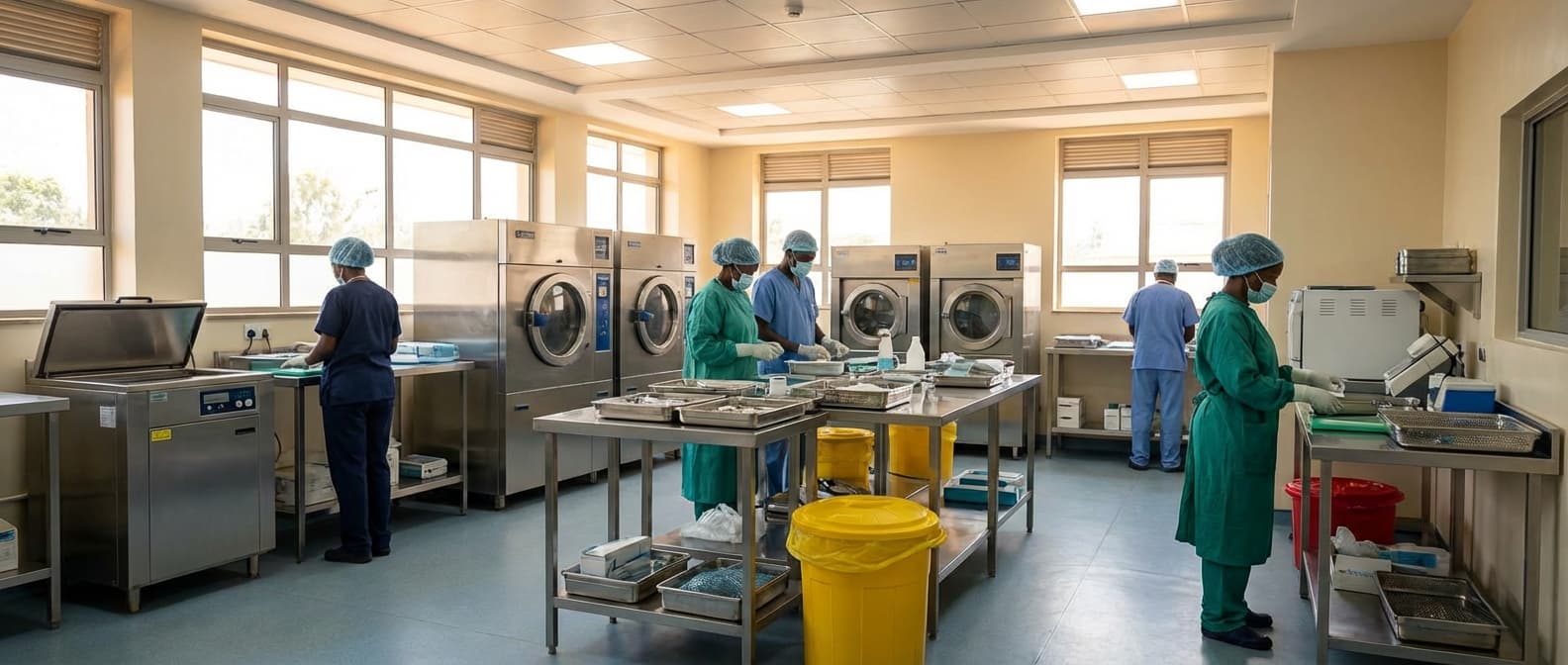
Endoscope Reprocessing Equipment Support Service in Zimbabwe
Engineering Excellence & Technical Support
Endoscope Reprocessing Equipment Support Service High-standard technical execution following OEM protocols and local regulatory frameworks.
Rapid On-Site Repair & Maintenance
Expert technicians provide prompt, on-site repair and preventative maintenance for all major endoscope reprocessing equipment brands, minimizing downtime and ensuring operational readiness in Zimbabwean healthcare facilities.
Certified Calibration & Validation
Ensuring the accuracy and performance of your endoscope washers, disinfectors, and drying cabinets through certified calibration and validation services, meeting international standards for patient safety and equipment longevity.
Customized Support & Training Solutions
Offering tailored service agreements, spare parts management, and specialized operator training programs designed to optimize efficiency and compliance for endoscope reprocessing departments across Zimbabwe.
What Is Endoscope Reprocessing Equipment Support Service In Zimbabwe?
Endoscope reprocessing equipment support service in Zimbabwe refers to the comprehensive range of technical assistance, maintenance, and operational support provided for automated and semi-automated systems utilized in the cleaning, disinfection, and sterilization of flexible and rigid endoscopes. This service is critical for ensuring the safety and efficacy of endoscopic procedures by preventing the transmission of healthcare-associated infections (HAIs) through inadequately reprocessed instruments. It encompasses routine preventative maintenance, calibration, troubleshooting, repair of mechanical and electrical components, software updates, validation and verification of reprocessing cycles, and user training.
| Who Needs the Service? | Typical Use Cases | ||||
|---|---|---|---|---|---|
| Hospitals (Public and Private): Operating departments, gastroenterology units, pulmonology departments, surgical suites, and endoscopy clinics. | Automated Endoscope Reprocessors (AERs): For the high-level disinfection (HLD) of flexible endoscopes (e.g., gastroscopes, colonoscopes, bronchoscopes). | Instrument Washers/Disinfectors: For the pre-cleaning and disinfection of both flexible and rigid endoscopes and associated accessories. | Sterilization Equipment (e.g., Low-Temperature Sterilizers): For rigid endoscopes and heat-sensitive accessories requiring terminal sterilization. | Central Sterile Services Department (CSSD): Facilities responsible for the reprocessing of all reusable medical devices within a healthcare institution. | Specialized Endoscopy Clinics: Standalone clinics focusing on diagnostic and therapeutic endoscopic procedures. |
Key Components of Endoscope Reprocessing Equipment Support Service
- Preventative Maintenance (PM): Scheduled inspections, lubrication, cleaning of internal components, and replacement of wear-and-tear parts to ensure optimal performance and longevity of the equipment.
- Calibration and Performance Verification: Regular calibration of critical parameters such as temperature, flow rates, and disinfectant concentration to meet manufacturer specifications and regulatory requirements.
- Troubleshooting and Repair: Diagnosis and resolution of operational issues, including mechanical failures, electrical malfunctions, and software errors, utilizing specialized tools and expertise.
- Validation and Documentation: Performing and documenting validation studies (IQ, OQ, PQ) to confirm that the reprocessing equipment consistently performs as intended, achieving the required level of microbial inactivation.
- Consumables and Spare Parts Management: Ensuring the availability of genuine spare parts and appropriate reprocessing consumables (detergents, disinfectants, enzymatic cleaners) to maintain uninterrupted operation.
- Technical Training and Education: Providing comprehensive training to healthcare facility staff on the correct operation, troubleshooting, and routine maintenance of the reprocessing equipment.
- Emergency Breakdown Support: Offering prompt response to critical equipment failures to minimize downtime and potential disruption to patient care.
- Compliance and Regulatory Adherence: Assisting facilities in meeting national and international guidelines and standards for endoscope reprocessing.
Who Needs Endoscope Reprocessing Equipment Support Service In Zimbabwe?
Endoscope reprocessing equipment is critical for infection control and patient safety in healthcare settings. In Zimbabwe, where the demand for quality healthcare services continues to grow, the need for reliable support services for this specialized equipment is paramount. These services ensure that expensive and vital endoscopes are properly cleaned, disinfected, and maintained, preventing the spread of infections and maximizing the lifespan of the equipment. This includes scheduled maintenance, emergency repairs, calibration, and the provision of spare parts and consumables.
| Customer Type | Primary Departments Requiring Support | Key Needs |
|---|---|---|
| Public Hospitals | Gastroenterology, Pulmonology, Urology, Gynecology, Surgery, Central Sterile Supply Department (CSSD) | Cost-effective maintenance, rapid response to breakdowns, reliable spare parts, training for in-house technicians. |
| Private Hospitals | Gastroenterology, Pulmonology, Urology, Gynecology, Surgery, Endoscopy Suites, CSSD | Proactive maintenance plans, quick turnaround times for repairs, access to the latest technology updates, comprehensive service agreements. |
| Specialist Clinics | Gastroenterology Clinics, Pulmonology Clinics, Urological Clinics | Regular servicing to ensure optimal performance, troubleshooting for specific equipment issues, calibration services. |
| Diagnostic Centers | Endoscopy Units | Ensuring equipment is always operational for diagnostic procedures, compliance with infection control standards, preventative maintenance. |
| Surgical Centers | General Surgery, Laparoscopic Surgery, Endoscopic Surgery Units | Minimizing downtime during surgical procedures, ensuring equipment readiness, validation of cleaning and disinfection processes. |
| Polyclinics (with specialized services) | Outpatient Endoscopy Units, Minor Procedure Rooms | Basic maintenance, troubleshooting of common issues, guidance on consumables and cleaning agents. |
Target Customers and Departments Requiring Endoscope Reprocessing Equipment Support Service in Zimbabwe
- Hospitals (Public and Private)
- Specialist Clinics
- Diagnostic Centers
- Surgical Centers
- Polyclinics
Endoscope Reprocessing Equipment Support Service Process In Zimbabwe
This document outlines the Endoscope Reprocessing Equipment Support Service Process in Zimbabwe. It details the workflow from the initial customer inquiry to the successful execution of the service, ensuring efficient and reliable support for endoscope reprocessing equipment.
| Stage | Description | Key Activities | Responsibility (Service Provider) | Responsibility (Customer) |
|---|---|---|---|---|
| Inquiry & Initial Assessment | The customer contacts the service provider with a need for support for their endoscope reprocessing equipment. | Customer outlines the issue (e.g., malfunction, routine maintenance). Service provider gathers preliminary information about the equipment type, model, and nature of the problem. | Receiving inquiries, acknowledging receipt, performing initial triage. | Initiating contact, providing accurate equipment details and problem description. |
| Service Request & Quotation | Formalizing the service request and providing a cost estimate to the customer. | Service provider creates a detailed service request form. Based on the assessment, a quotation outlining scope of work, parts required (if any), labor charges, and estimated timeline is generated. | Generating service request, developing accurate quotations, communicating terms and conditions. | Reviewing and approving the quotation, providing necessary purchase orders if applicable. |
| Scheduling & Preparation | Arranging for the service visit and ensuring all necessary resources are in place. | Service provider schedules the visit based on customer availability and technician workload. Technicians prepare necessary tools, spare parts (if identified in quotation), and safety equipment. | Coordinating service schedule, assigning qualified technicians, preparing equipment and parts. | Confirming availability of the equipment for service, ensuring safe access to the service area. |
| On-site Service Execution | The service technician performs the required maintenance, repair, or installation on the customer's premises. | Technician conducts a thorough diagnosis, performs repairs or maintenance as per service request and quotation. This may include cleaning, calibration, part replacement, or software updates. | Performing technical diagnostics, executing repairs/maintenance, adhering to safety protocols. | Providing access to the equipment and service area, answering technician's queries, observing service process (optional). |
| Testing & Validation | Ensuring the equipment is functioning correctly and meets performance standards after the service. | Technician performs functional tests and validation procedures to confirm successful repair or maintenance. This may involve running cycles, checking parameters, and verifying operational efficiency. | Conducting comprehensive testing, performing validation procedures, ensuring performance standards are met. | Witnessing testing and validation, confirming satisfactory operational status of the equipment. |
| Documentation & Handover | Completing all necessary paperwork and formally handing over the equipment and service report to the customer. | Technician completes a detailed service report documenting all work performed, parts used, and test results. A final invoice is generated. The report and equipment are handed over to the designated customer representative. | Completing service reports, generating invoices, facilitating formal handover. | Reviewing and signing the service report, accepting the equipment, processing final payment. |
| Follow-up & Feedback | Ensuring customer satisfaction and gathering feedback for continuous improvement. | Service provider may follow up with the customer to confirm ongoing satisfaction with the service and equipment performance. Customer feedback is collected to identify areas for improvement in the service process. | Conducting customer follow-up calls/emails, analyzing feedback for service enhancement. | Providing feedback on the service received, reporting any post-service issues. |
Service Workflow Stages
- Inquiry & Initial Assessment
- Service Request & Quotation
- Scheduling & Preparation
- On-site Service Execution
- Testing & Validation
- Documentation & Handover
- Follow-up & Feedback
Endoscope Reprocessing Equipment Support Service Cost In Zimbabwe
The cost of endoscope reprocessing equipment support services in Zimbabwe is a critical consideration for healthcare facilities. These services are vital for ensuring the proper cleaning, disinfection, and sterilization of endoscopes, which is paramount for patient safety and preventing healthcare-associated infections. Several factors influence the pricing of these services, leading to a range of costs that can vary significantly.
| Service Type | Estimated Price Range (ZWL) | Notes |
|---|---|---|
| Routine Preventative Maintenance (per unit, annual) | 80,000 - 250,000 | Covers basic checks, cleaning, calibration. May include one or two scheduled visits. |
| On-Demand Repair Service (per incident) | 50,000 - 200,000+ | Varies greatly based on the complexity of the repair and parts required. Excludes cost of spare parts. |
| Comprehensive Annual Service Contract (per unit) | 200,000 - 600,000+ | Often includes scheduled maintenance, priority breakdown support, and potentially some spare parts. Negotiable. |
| Emergency/Expedited Service | Additional 30% - 70% on top of standard repair cost | For urgent call-outs outside of normal working hours or when immediate attention is required. |
| Software Updates/Upgrades | 30,000 - 100,000 | Depending on the software complexity and the number of units. |
| Spare Parts (estimation, highly variable) | 20,000 - 500,000+ | Costs for specific components like light sources, camera heads, or valves can be substantial. Import costs are a factor. |
Key Pricing Factors for Endoscope Reprocessing Equipment Support Service in Zimbabwe
- Type of Endoscope: Different endoscope models and types (e.g., flexible, rigid, video endoscopes) require specific reprocessing protocols and compatible equipment. More complex or specialized endoscopes may necessitate specialized support and thus higher costs.
- Type of Service: The scope of the support service significantly impacts pricing. This can range from routine preventative maintenance and calibration to emergency repairs, software updates, or comprehensive service contracts.
- Frequency of Service: Facilities that opt for regular, scheduled maintenance and service contracts often benefit from more predictable costs and potentially bundled pricing, which can be more cost-effective than ad-hoc repairs.
- Equipment Age and Condition: Older or heavily used equipment may require more frequent servicing and replacement parts, leading to higher support costs. The overall condition of the equipment also plays a role in the diagnostic and repair effort required.
- Service Provider Reputation and Expertise: Established and reputable service providers with highly trained technicians and specialized diagnostic tools may command higher prices. Their expertise can translate to faster, more effective repairs, minimizing downtime.
- Geographic Location: While Zimbabwe's market might be less geographically diverse in terms of major service hubs compared to larger countries, travel costs for technicians, especially to remote areas, can influence pricing.
- Spare Parts Availability and Cost: The cost and availability of original equipment manufacturer (OEM) or compatible spare parts are significant drivers of service costs. Import duties and logistical challenges within Zimbabwe can affect these prices.
- Service Level Agreements (SLAs): The specific terms of an SLA, including response times, guaranteed uptime, and included services, will directly impact the overall cost. More comprehensive SLAs typically come with higher price tags.
- Brand of Equipment: Support services for endoscopes from well-known international brands may have different pricing structures compared to less common brands, often influenced by the availability of local representation and parts.
Affordable Endoscope Reprocessing Equipment Support Service Options
Maintaining the integrity and functionality of endoscope reprocessing equipment is crucial for patient safety and operational efficiency. This service focuses on providing cost-effective support for a range of reprocessing equipment, ensuring compliance with regulatory standards and minimizing downtime. We offer flexible solutions tailored to the budgetary needs of healthcare facilities, emphasizing value through proactive maintenance, strategic repairs, and resource optimization.
| Value Bundle | Description | Cost-Saving Strategy | Benefits |
|---|---|---|---|
| Proactive Maintenance Package | Includes scheduled preventive maintenance visits, performance checks, and lubrication for key equipment components. | Reduces unexpected breakdowns and associated emergency repair costs. Extends equipment lifespan, delaying capital expenditure. | Minimized downtime, improved equipment reliability, extended asset life, predictable budgeting. |
| Comprehensive Support Plan | Combines preventive maintenance with a set number of on-demand repair calls and priority response for urgent issues. | Bundled service rates offer a discount compared to individual service calls. Reduced emergency repair costs due to faster response. | Guaranteed response times, lower overall repair expenditure, enhanced operational continuity. |
| Parts & Service Integration | Offers discounted pricing on common spare parts when purchased alongside a service contract. Includes optimized inventory recommendations. | Bulk purchasing discounts on parts. Reduced shipping costs by consolidating orders. Minimizes overstocking and obsolescence of parts. | Lower parts acquisition cost, faster repair times due to readily available parts, optimized inventory investment. |
| Training & Support Bundle | Includes on-site or remote training for biomedical technicians on common maintenance and troubleshooting procedures, coupled with a basic support contract. | Empowers in-house staff to resolve minor issues, reducing billable service calls. Proactive problem-solving prevents escalation. | Increased in-house technical capability, reduced reliance on external technicians, faster resolution of minor issues. |
Key Service Offerings for Affordable Endoscope Reprocessing Equipment Support
- Preventive Maintenance Programs: Scheduled inspections and servicing to identify and address potential issues before they lead to costly breakdowns.
- On-Demand Repair Services: Prompt and efficient repair of malfunctioning equipment by certified technicians.
- Spare Parts Management: Strategic sourcing and inventory management of essential spare parts to reduce lead times and procurement costs.
- Equipment Upgrades and Retrofits: Cost-effective options for modernizing existing equipment to improve performance and extend lifespan.
- Training and Education: Empowering in-house staff with the knowledge to perform basic troubleshooting and maintenance, reducing reliance on external support.
- Remote Monitoring and Diagnostics: Leveraging technology to identify and diagnose issues remotely, potentially reducing the need for on-site visits.
Verified Providers In Zimbabwe
In Zimbabwe's evolving healthcare landscape, identifying truly 'verified' providers is crucial for ensuring quality and trustworthy medical services. "Verified Providers" signifies a commitment to excellence, adherence to stringent standards, and a proven track record of patient care. This verification process often involves rigorous assessments of medical professionals' qualifications, facilities, ethical practices, and patient satisfaction. For patients seeking the best in healthcare, understanding what constitutes a verified provider is paramount.
| Credential Category | Franance Health Verification Standard | Benefit to Patients |
|---|---|---|
| Medical Licensure & Board Certification | Up-to-date and valid licenses and certifications confirmed with relevant medical councils. | Ensures providers are legally authorized and possess specialized expertise. |
| Facility Accreditation | Verification of accreditation from recognized health bodies (e.g., Ministry of Health, international standards if applicable). | Guarantees safe infrastructure, equipment, and operational standards. |
| Professional Experience | Demonstrated history of successful patient outcomes and continuous professional development. | Indicates proven competence and up-to-date medical knowledge. |
| Patient Feedback Mechanisms | Regular collection and analysis of patient satisfaction surveys and feedback. | Promotes accountability and continuous improvement in patient care quality. |
| Adherence to Protocols | Confirmation of compliance with established medical treatment protocols and ethical guidelines. | Ensures standardized, evidence-based, and ethical medical practice. |
Franance Health Credentials and Why They Represent the Best Choice
- {"title":"Rigorous Qualification Verification","description":"Franance Health meticulously vets all its affiliated healthcare professionals. This includes verifying medical licenses, specialist certifications, and continuing education records. This ensures that all practitioners are not only qualified but also up-to-date with the latest medical advancements."}
- {"title":"Accreditation and Compliance","description":"We partner with healthcare facilities that meet and exceed national and international accreditation standards. This encompasses adherence to safety protocols, infection control measures, and regulatory compliance, providing a secure and reliable environment for patients."}
- {"title":"Patient-Centric Approach","description":"Franance Health places a strong emphasis on patient experience. Our verified providers are committed to compassionate care, clear communication, and respecting patient autonomy. This focus on the patient journey is a cornerstone of our selection criteria."}
- {"title":"Technological Advancement","description":"We prioritize providers who utilize modern medical technology and equipment to enhance diagnostic accuracy and treatment effectiveness. This commitment to innovation ensures patients receive the most advanced care available."}
- {"title":"Ethical Practice and Transparency","description":"Integrity and transparency are non-negotiable. Franance Health ensures all its verified providers operate with the highest ethical standards, providing clear information about treatments, costs, and potential outcomes."}
- {"title":"Comprehensive Range of Services","description":"Our network comprises a diverse array of specialists and facilities, offering comprehensive healthcare solutions. This means patients can find trusted, verified care for a wide spectrum of medical needs, from routine check-ups to complex surgical procedures."}
Scope Of Work For Endoscope Reprocessing Equipment Support Service
This Scope of Work (SOW) outlines the requirements for Endoscope Reprocessing Equipment Support Services. This service is crucial for maintaining the operational readiness, safety, and compliance of endoscope reprocessing equipment within healthcare facilities. The scope encompasses scheduled preventive maintenance, unscheduled corrective maintenance, validation/revalidation services, technical training, and spare parts management for a specified list of endoscope reprocessing equipment.
The primary objective is to ensure that all equipment operates according to manufacturer specifications, regulatory requirements (e.g., FDA, AAMI, ISO 13485), and facility policies, thereby minimizing downtime and ensuring patient safety. The service provider will be responsible for delivering high-quality technical support, detailed documentation, and timely resolution of any equipment-related issues.
| Technical Deliverable | Description | Standard Specification/Reference | Frequency/Trigger | Documentation Requirement |
|---|---|---|---|---|
| Scheduled Preventive Maintenance (PM) | Performing routine checks, cleaning, lubrication, calibration, and replacement of wear parts as per manufacturer recommendations. | Manufacturer's recommended PM schedule and procedures. Refer to specific equipment manuals and AAMI ST91 for guidelines. | As per manufacturer's recommendations (e.g., quarterly, semi-annually, annually). | Detailed PM report including performed tasks, parts replaced, measurements taken, and technician's sign-off. Updated equipment logs. |
| Unscheduled Corrective Maintenance (CM) | Troubleshooting, diagnosis, and repair of equipment failures or malfunctions. Includes on-site visit and necessary parts replacement. | Manufacturer's service manuals, diagnostic guides. Response time SLA (e.g., within 24-48 hours). | Upon equipment failure or reported malfunction. | Detailed CM report including issue description, diagnosis, work performed, parts used, test results, and technician's sign-off. Updated equipment logs. |
| Equipment Validation/Revalidation | Performance qualification (PQ) and operational qualification (OQ) of new or repaired equipment to ensure it meets specified performance criteria for effective reprocessing. | Manufacturer's validation protocols, AAMI ST91, FDA 21 CFR Part 820, ISO 13485. Specific test parameters (e.g., cleaning efficacy, disinfection parameters). | After initial installation, significant repairs, or as per regulatory/facility requirements (e.g., annually). | Comprehensive validation report including protocols, executed results, deviation reports (if any), calibration certificates, and technician's sign-off. Certificate of Validation. |
| Technical Training & Support | Providing training to facility staff on the proper operation, basic troubleshooting, and routine maintenance of the reprocessing equipment. | Manufacturer's training materials, best practices in sterile processing. | As needed, post-installation, or during PM visits. | Training attendance records, summary of topics covered, and training materials provided. |
| Spare Parts Management | Ensuring availability of critical spare parts for timely repairs. This may include stocking critical parts or having a guaranteed supply chain. | Manufacturer's parts list, criticality assessment for each component. | Continuous, based on usage and recommendations. | Inventory records of critical spare parts, lead times for ordering. |
| Performance Monitoring & Reporting | Regular reporting on equipment status, maintenance activities, downtime, and key performance indicators (KPIs). | Defined KPIs (e.g., Uptime percentage, Mean Time Between Failures (MTBF), Mean Time To Repair (MTTR)). | Monthly/Quarterly reports. | Service reports, performance summaries, trend analysis. |
Key Objectives of Endoscope Reprocessing Equipment Support Service
- Maximize equipment uptime and operational availability.
- Ensure consistent and effective endoscope reprocessing to prevent healthcare-associated infections (HAIs).
- Maintain compliance with all relevant regulatory standards and guidelines.
- Extend the lifespan of endoscope reprocessing equipment through proactive maintenance.
- Provide timely and effective repair services for equipment malfunctions.
- Ensure accurate and documented validation of equipment performance.
Service Level Agreement For Endoscope Reprocessing Equipment Support Service
This Service Level Agreement (SLA) outlines the support services provided for Endoscope Reprocessing Equipment. It specifies response times for critical issues and defines uptime guarantees to ensure operational continuity. The primary objective of this SLA is to maintain the optimal performance and availability of the endoscope reprocessing equipment, thereby supporting efficient patient care and infection control protocols.
| Severity Level | Description | Target Response Time | Target Resolution Time | Uptime Guarantee |
|---|---|---|---|---|
| Critical (P1) | Complete equipment failure or major malfunction impacting the ability to reprocess any endoscopes. Significant patient care impact or infection risk. | 1 Hour (during business hours) | 4 Business Hours | 99.5% |
| High (P2) | Partial equipment malfunction significantly reducing reprocessing capacity or affecting a specific function. Potential for minor patient care impact or increased workflow strain. | 2 Business Hours | 8 Business Hours | 99.0% |
| Medium (P3) | Minor equipment malfunction or performance degradation that does not immediately impact reprocessing capabilities but may lead to issues if unaddressed. Operational inefficiencies. | 4 Business Hours | 2 Business Days | 98.5% |
| Low (P4) | Non-critical issues, questions, or requests for information that do not impact equipment functionality or patient care. Routine maintenance inquiries. | 8 Business Hours | 5 Business Days | N/A (Non-critical) |
Key Performance Indicators
- Guaranteed response times for different severity levels of incidents.
- Uptime guarantees for essential endoscope reprocessing equipment.
- Procedures for incident reporting and escalation.
- Definitions of service credits for SLA breaches.
Frequently Asked Questions

Ready when you are
Let's scope your Endoscope Reprocessing Equipment Support Service in Zimbabwe project in Zimbabwe.

Scaling healthcare logistics and technical systems across the entire continent.