
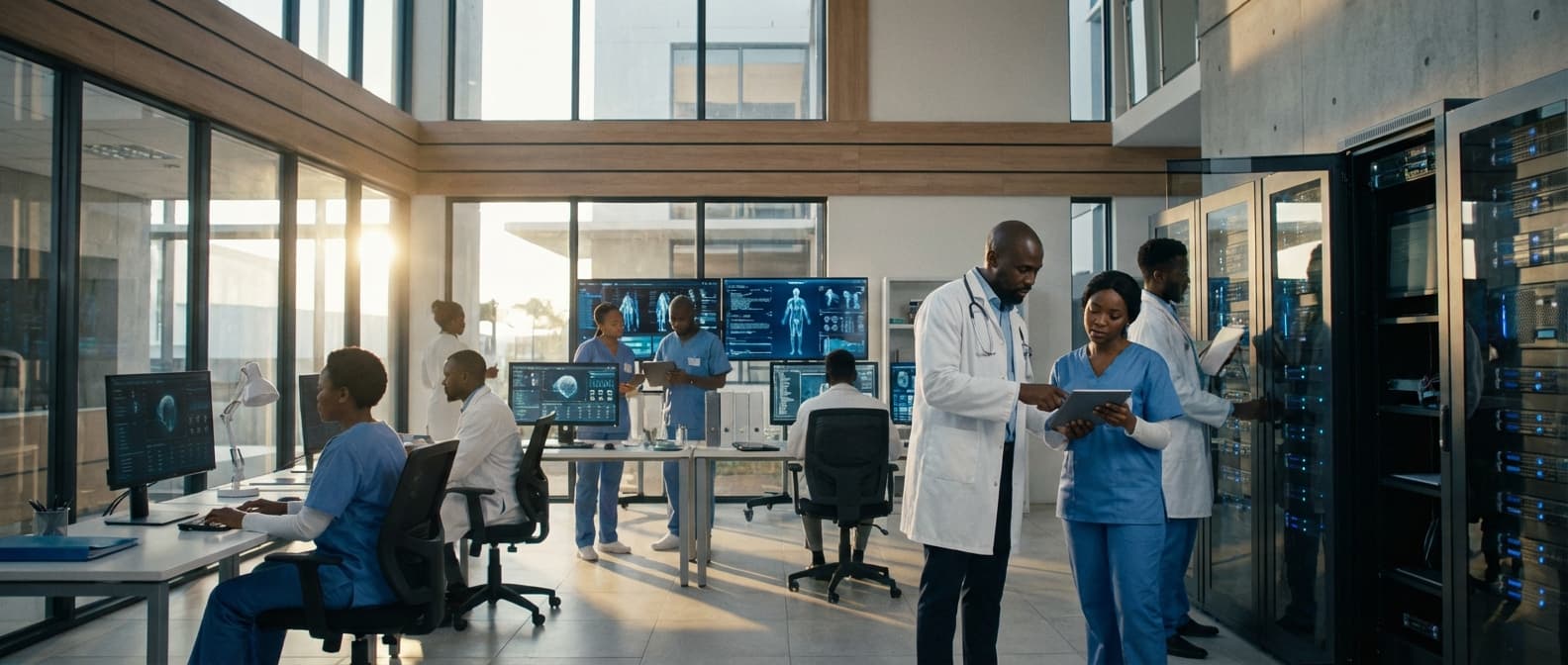
Medical IT Consultation in Zimbabwe
Engineering Excellence & Technical Support
Strategic technology consulting to optimize healthcare operations, streamline workflows, and integrate cutting-edge medical information systems. High-standard technical execution following OEM protocols and local regulatory frameworks.
Robust Cybersecurity Fortification
We implement industry-leading cybersecurity solutions tailored for the unique regulatory and infrastructure landscape of Zimbabwe. Our expertise ensures the protection of sensitive patient data and healthcare systems against evolving cyber threats, guaranteeing compliance and operational integrity.
Scalable Cloud Infrastructure Deployment
Leveraging scalable and cost-effective cloud solutions, we empower Zimbabwean healthcare providers to enhance data accessibility, improve collaboration, and reduce on-premise hardware dependencies. Our approach optimizes performance and ensures business continuity.
Data Analytics & Clinical Decision Support
We enable the transformation of raw medical data into actionable insights. By deploying advanced analytics platforms and clinical decision support systems, we help healthcare organizations in Zimbabwe improve patient outcomes, optimize resource allocation, and drive evidence-based medical practices.
What Is Medical It Consultation In Zimbabwe?
Medical IT Consultation in Zimbabwe refers to the provision of specialized information technology expertise and advisory services tailored to the unique needs and challenges of the healthcare sector within the Zimbabwean context. This service aims to optimize the design, implementation, and utilization of technology solutions to improve healthcare delivery, operational efficiency, data management, and patient outcomes within the nation's healthcare infrastructure. It encompasses strategic planning, system selection, integration, cybersecurity, and ongoing support for digital health initiatives.
| Who Needs Medical IT Consultation in Zimbabwe | Typical Use Cases |
|---|---|
| Public Healthcare Facilities: Ministry of Health and Child Care (MoHCC) facilities, provincial hospitals, district hospitals, and rural health centers seeking to modernize their IT infrastructure, implement EHRs, and improve data collection for public health surveillance. | Implementing a nationwide EHR system for better patient record management and disease surveillance. Establishing a secure Health Information Exchange (HIE) to facilitate inter-facility referrals and continuity of care. Deploying telemedicine solutions to reach remote populations. Enhancing cybersecurity measures to protect critical health data from evolving threats. |
| Private Hospitals and Clinics: Large private hospital groups, smaller specialized clinics, and diagnostic centers aiming to enhance patient experience, streamline administrative processes, and improve clinical decision-making through advanced IT solutions. | Adopting cloud-based EHR systems for improved accessibility and scalability. Integrating PACS for digital imaging. Implementing appointment scheduling and billing systems for enhanced efficiency. Upgrading network infrastructure for faster data transfer and system responsiveness. |
| Non-Governmental Organizations (NGOs) and International Health Organizations: Organizations involved in health programs, research, and humanitarian aid within Zimbabwe, requiring robust IT systems for data collection, program management, and reporting. | Developing custom databases for tracking specific health interventions (e.g., HIV/AIDS, malaria programs). Implementing secure data collection tools for field surveys and program monitoring. Establishing communication infrastructure for remote field teams. Ensuring data compliance with donor requirements. |
| Medical Research Institutions and Universities: Academic bodies and research centers focusing on health sciences, needing IT support for data analysis, research collaboration, and digital library management. | Setting up high-performance computing clusters for genomic research. Implementing secure platforms for collaborative research projects. Managing large datasets for epidemiological studies. Ensuring secure storage and access to research data. |
| Healthcare Startups and Innovators: New ventures in the health tech space in Zimbabwe looking for guidance on technology selection, architecture design, and regulatory compliance. | Developing mobile health (mHealth) applications. Designing platforms for health insurance claims processing. Establishing cybersecurity frameworks for new digital health services. Advising on data analytics for predictive health outcomes. |
| IT Departments within Healthcare Organizations: Internal IT teams needing external expertise to address complex challenges, implement new technologies, or validate existing strategies. | Conducting a comprehensive IT security audit and recommending remediation strategies. Assisting in the migration of legacy systems to modern cloud-based solutions. Providing specialized training on emerging healthcare IT trends. Developing a robust disaster recovery plan. |
Key Components of Medical IT Consultation in Zimbabwe
- Needs Assessment and Strategic Planning: Evaluating existing IT infrastructure, identifying gaps, and developing a technology roadmap aligned with organizational goals and national health priorities.
- System Selection and Procurement: Advising on the selection of appropriate Electronic Health Records (EHR) systems, Picture Archiving and Communication Systems (PACS), Laboratory Information Systems (LIS), and other specialized healthcare software, considering factors like interoperability, scalability, and local support.
- Implementation and Deployment: Overseeing the installation, configuration, and integration of new IT systems, ensuring minimal disruption to clinical workflows.
- Data Management and Analytics: Establishing robust data governance policies, implementing data warehousing solutions, and leveraging analytics for population health management, research, and performance improvement.
- Cybersecurity and Data Privacy: Developing and implementing comprehensive security protocols to protect sensitive patient data in compliance with local regulations and international best practices, addressing threats like ransomware and unauthorized access.
- Interoperability and Health Information Exchange (HIE): Facilitating the seamless exchange of patient information between different healthcare facilities and systems, crucial for coordinated care.
- Telemedicine and Remote Health Solutions: Advising on the implementation of telemedicine platforms and remote monitoring technologies to extend healthcare access to underserved areas.
- Infrastructure Design and Optimization: Recommending and designing reliable and scalable network infrastructure, server environments, and cloud solutions suitable for healthcare operations.
- Training and Change Management: Developing and delivering training programs for healthcare professionals on new IT systems and fostering adoption through effective change management strategies.
- Regulatory Compliance and Auditing: Ensuring adherence to national health IT policies, data protection laws (e.g., Data Protection Act), and international standards.
- Disaster Recovery and Business Continuity Planning: Developing strategies to ensure the availability of critical IT systems and data in the event of disruptions.
- Vendor Management: Assisting in selecting and managing IT vendors to ensure quality service delivery and adherence to contractual obligations.
Who Needs Medical It Consultation In Zimbabwe?
Medical IT consultation in Zimbabwe is a vital service for healthcare organizations looking to modernize their operations, improve patient care, and ensure data security and compliance. The increasing adoption of technology in the healthcare sector, coupled with specific challenges faced within Zimbabwe, makes expert IT guidance essential. From implementing electronic health records (EHRs) to optimizing network infrastructure and safeguarding sensitive patient data, professional IT consultation can bridge the gap between existing capabilities and future healthcare demands.
| Department/Function | Key IT Needs & Benefits of Consultation |
|---|---|
| Information Technology (IT) Department | Network infrastructure optimization, cybersecurity strategy, hardware/software procurement and management, cloud migration, disaster recovery planning. |
| Clinical Services/Medical Records | Implementation and optimization of Electronic Health Records (EHRs) and Electronic Medical Records (EMRs), data migration, interoperability between systems, patient portal development. |
| Administration & Management | Patient appointment scheduling systems, billing and revenue cycle management software, resource allocation tools, strategic IT planning, budget management. |
| Finance & Accounting | Integration of financial systems with patient management, secure payment processing, financial reporting tools, fraud detection. |
| Radiology & Imaging | Picture Archiving and Communication Systems (PACS), integration with EHRs, digital imaging workflows, cybersecurity for imaging data. |
| Pharmacy & Dispensary | Inventory management systems, prescription management software, drug interaction checking, supply chain tracking. |
| Laboratory Services | Laboratory Information Management Systems (LIMS), sample tracking, results reporting, integration with EHRs, quality control IT solutions. |
| Human Resources | HR information systems, payroll processing, staff training management (especially IT-related), secure employee data management. |
| Research & Development | Data analytics platforms, secure data storage for research, collaboration tools, compliance with research data regulations. |
| Security & Compliance | HIPAA/POPIA equivalent compliance, data encryption, access controls, vulnerability assessments, incident response planning, audit trail management. |
Target Customers and Departments for Medical IT Consultation in Zimbabwe
- {"title":"Hospitals (Public & Private)","description":"Hospitals are complex institutions with a wide range of IT needs, from patient management to sophisticated diagnostic equipment."}
- {"title":"Clinics & Health Centers (Urban & Rural)","description":"These facilities, often with limited resources, can greatly benefit from optimized IT solutions for record-keeping, appointment scheduling, and remote consultations."}
- {"title":"Diagnostic Laboratories","description":"Laboratories require robust IT systems for managing test results, equipment calibration, and secure data storage."}
- {"title":"Pharmaceutical Companies & Pharmacies","description":"IT consultation can help with inventory management, supply chain optimization, and customer relationship management."}
- {"title":"Medical Device Manufacturers & Suppliers","description":"Support for integrating medical devices with hospital IT systems and ensuring data interoperability."}
- {"title":"Healthcare Regulatory Bodies","description":"Assistance with developing and implementing IT standards, data privacy regulations, and cybersecurity frameworks."}
- {"title":"NGOs & International Health Organizations","description":"Organizations working on health initiatives can leverage IT consultation for project management, data collection, and impact assessment."}
- {"title":"Medical Training Institutions","description":"Support for implementing e-learning platforms, virtual simulation tools, and managing student records."}
Medical It Consultation Process In Zimbabwe
The Medical IT Consultation Process in Zimbabwe outlines the structured approach taken to provide IT expertise to healthcare facilities. This process ensures that client needs are understood, appropriate solutions are identified, and implementations are successful, ultimately enhancing the efficiency and effectiveness of medical operations through technology.
| Phase | Description | Key Activities | Deliverables/Outcomes |
|---|---|---|---|
| Inquiry & Initial Contact | First engagement with a healthcare facility needing IT expertise. | Receiving inquiry, initial communication, scheduling discovery. | Understanding of initial client need. |
| Needs Assessment & Discovery | Understanding the client's current state, goals, and constraints. | Meetings, interviews, site visits, infrastructure review, budget discussion. | Detailed requirements document, understanding of challenges. |
| Proposal Development | Creating a tailored plan for IT solutions. | Defining scope, outlining solutions, estimating costs and timeline, methodology. | Formal proposal document. |
| Proposal Review & Agreement | Client reviews, provides feedback, and formally agrees to the proposal. | Discussion and negotiation, contract signing. | Signed service agreement/contract. |
| Information Gathering & Analysis | Deep dive into existing systems and workflows. | Technical audits, data analysis, workflow mapping. | Comprehensive system analysis report. |
| Solution Design & Planning | Developing the blueprint for the IT solution. | System architecture design, software selection, implementation strategy, risk assessment. | Detailed solution design document, implementation plan. |
| Procurement & Setup | Acquiring and preparing necessary IT resources. | Vendor selection, purchasing hardware/software, installation and basic configuration. | Installed and configured hardware/software. |
| Implementation & Integration | Putting the designed solutions into practice. | Software deployment, system configuration, data migration, integration with existing systems. | Operational IT systems, integrated workflows. |
| Testing & Quality Assurance | Ensuring the solution is functional, secure, and meets requirements. | Unit testing, system testing, integration testing, User Acceptance Testing (UAT). | Tested and validated IT systems, UAT sign-off. |
| Training & Handover | Empowering staff to use the new systems. | Developing training materials, conducting user training sessions, providing documentation. | Trained staff, user manuals, system handover. |
| Post-Implementation Support & Monitoring | Providing assistance after deployment and ensuring ongoing performance. | Helpdesk support, troubleshooting, performance monitoring, issue resolution. | Stable and performing IT systems, resolved issues. |
| Review & Optimization | Evaluating the effectiveness of the solution and identifying improvements. | Performance review, user feedback collection, identifying areas for enhancement. | Optimization recommendations, performance improvement plan. |
| Project Closure | Formal completion of the consultation engagement. | Final reporting, knowledge transfer, final sign-off. | Closed project, final documentation. |
Medical IT Consultation Workflow in Zimbabwe
- Inquiry & Initial Contact: The process begins with a healthcare facility (hospital, clinic, laboratory, etc.) expressing a need for IT consultation. This can be through direct outreach, referrals, or online inquiries.
- Needs Assessment & Discovery: A preliminary meeting or call is scheduled to understand the client's specific challenges, goals, existing IT infrastructure, budget, and regulatory requirements (e.g., data privacy laws relevant to Zimbabwe).
- Proposal Development: Based on the needs assessment, a tailored proposal is drafted. This document outlines the scope of work, proposed solutions, methodology, timeline, deliverables, and associated costs.
- Proposal Review & Agreement: The proposal is presented to the client for review. Discussions follow to clarify any points, make adjustments, and ultimately reach a mutual agreement. A formal contract or service agreement is signed.
- Information Gathering & Analysis: Detailed information is collected on the client's current systems, workflows, data management practices, and user needs. This may involve site visits, interviews, and technical audits.
- Solution Design & Planning: The IT consultant or team designs specific IT solutions, which could include Electronic Health Records (EHR) implementation, network upgrades, cybersecurity measures, telemedicine solutions, or data analytics strategies. A detailed implementation plan is created.
- Procurement & Setup (if applicable): If new hardware or software is required, the procurement process is managed, followed by the installation and configuration of these components.
- Implementation & Integration: The designed solutions are put into practice. This involves software installation, system configuration, data migration, and integration with existing systems. Training for staff is a crucial part of this phase.
- Testing & Quality Assurance: Thorough testing is conducted to ensure that all systems function as intended, are secure, and meet the client's requirements. User Acceptance Testing (UAT) is performed with the client's staff.
- Training & Handover: Comprehensive training is provided to the healthcare facility's staff on how to use the new or upgraded IT systems effectively and securely. The client is formally handed over the operational systems.
- Post-Implementation Support & Monitoring: Ongoing support is offered to address any immediate issues. The consultant may also provide monitoring services to ensure system performance and identify potential problems proactively.
- Review & Optimization: Periodically, a review of the implemented solutions is conducted to assess their effectiveness, gather feedback, and identify opportunities for further optimization or future upgrades.
- Project Closure: Once the project objectives are met and the client is satisfied, the consultation process is formally closed. Documentation and knowledge transfer are finalized.
Medical It Consultation Cost In Zimbabwe
Medical IT consultation costs in Zimbabwe are influenced by a variety of factors, leading to a broad range of pricing in the local currency (Zimbabwean Dollar, ZWL). These consultations are crucial for healthcare providers seeking to optimize their technological infrastructure, implement electronic health records (EHRs), enhance cybersecurity, or navigate digital transformation initiatives. The exact cost will depend on the complexity of the project, the consultant's expertise and reputation, the duration of the engagement, and the specific services required.
| Service Type | Estimated Range (ZWL) | Notes |
|---|---|---|
| Initial IT Assessment/Audit | 15,000 - 60,000 | Basic review of existing systems, hardware, and software. |
| EHR/EMR System Consultation (Selection/Planning) | 50,000 - 200,000+ | Includes needs analysis, vendor research, and implementation strategy. |
| Cybersecurity Assessment & Recommendations | 25,000 - 150,000 | Focus on data protection, network security, and compliance. |
| Network Infrastructure Design/Optimization | 40,000 - 180,000 | Planning and improving wired and wireless networks. |
| Cloud Integration Strategy | 35,000 - 160,000 | Guidance on migrating to or utilizing cloud services. |
| IT Support & Managed Services Strategy | 20,000 - 80,000 | Consulting on outsourcing or structuring internal IT support. |
| Data Migration Planning | 30,000 - 120,000 | Strategy for moving data between systems. |
| Full Project Management (IT Projects) | Negotiable (Percentage of Project Cost or Daily Rate) | For larger, complex implementations. |
Key Pricing Factors for Medical IT Consultations in Zimbabwe:
- Scope and Complexity of the Project: Larger and more intricate projects, such as full EHR system implementation or network infrastructure overhaul, will naturally command higher fees than smaller, targeted consultations like advice on a specific software choice or basic cybersecurity assessment.
- Consultant's Experience and Reputation: Highly experienced consultants or established IT firms with a proven track record in the healthcare sector often charge premium rates. Their expertise translates into efficient problem-solving and effective strategy development, justifying the higher cost.
- Duration of Engagement: Consultations can range from a few hours for a quick assessment to several months for a comprehensive project. The total cost is directly proportional to the time spent by the consultant.
- Specific Services Required: Different IT services have varying market values. For example, cybersecurity audits, data migration, cloud integration, and custom software development will likely be priced differently.
- Travel and On-Site Requirements: If the consultant needs to travel extensively within Zimbabwe or requires significant on-site presence, these costs (transportation, accommodation) may be factored into the overall fee.
- Technology Stack and Vendor Selection: Advice on selecting specific vendors or technologies can influence pricing, as consultants may have preferred partners or require specialized knowledge of certain platforms.
- Urgency of the Request: Expedited consultations or projects with tight deadlines might incur a surcharge.
- Size and Type of Healthcare Facility: A small rural clinic will have different IT needs and budgets compared to a large urban hospital. Consultants may adjust their pricing based on the scale of the organization they are serving.
Affordable Medical It Consultation Options
Navigating the complexities of Medical IT can be daunting, especially for practices looking to optimize their technology without breaking the bank. Fortunately, several affordable medical IT consultation options exist, focusing on delivering value through smart pricing models and cost-saving strategies. Understanding these approaches can help healthcare providers make informed decisions and maximize their return on investment in IT support and strategy.
| Cost-Saving Strategy | Description | Benefits for Medical Practices | Potential Drawbacks |
|---|---|---|---|
| Leverage Value Bundles | Purchasing a package of services (e.g., network monitoring, endpoint security, helpdesk support) at a bundled price. | Predictable monthly costs, reduced administrative overhead, comprehensive coverage of essential IT functions. | May include services not immediately needed, potential for overpaying if some services are underutilized. |
| Adopt Managed IT Services (MSP) | Outsourcing day-to-day IT management to a third-party provider for a fixed monthly fee. | Proactive maintenance, 24/7 monitoring, access to expert IT staff, improved cybersecurity posture, reduced in-house IT burden. | Requires trust in the MSP, potential for vendor lock-in, communication clarity is crucial. |
| Utilize Open-Source Software | Implementing and customizing free and open-source IT solutions where applicable (e.g., some EHR components, collaboration tools). | Significant software licensing cost savings, flexibility and customization, community support. | Requires internal technical expertise for implementation and maintenance, potential learning curve for staff, may lack some advanced features of proprietary software. |
| Prioritize Cloud-Based Solutions | Migrating data and applications to cloud platforms (e.g., Microsoft Azure, AWS, Google Cloud) for storage, computing, and software. | Reduced hardware investment and maintenance costs, scalability, improved data accessibility and disaster recovery. | Ongoing subscription fees, reliance on internet connectivity, data security and compliance considerations are paramount. |
| Focus on Remote Support and Training | Utilizing remote access tools for troubleshooting and providing staff training sessions online. | Reduced on-site visit costs, faster resolution times for many issues, convenience for staff. | Not suitable for all hardware-related issues, requires reliable internet for both parties, potential for miscommunication if not managed well. |
| Negotiate Long-Term Contracts | Securing service agreements or software licenses with extended terms in exchange for better pricing. | Guaranteed pricing for a defined period, potential for significant discounts compared to short-term commitments. | Requires a commitment to the provider, less flexibility if needs change significantly. |
| Regular IT Audits and Optimization | Periodically reviewing IT infrastructure, software licenses, and service contracts to identify inefficiencies and cost-saving opportunities. | Ensures you are not overpaying for unused services, identifies redundant systems, improves overall IT efficiency. | Requires dedicated time and resources for audits, necessitates action based on audit findings. |
Understanding Affordable Medical IT Consultation
- Value Bundles: These are pre-packaged service offerings that combine multiple IT services at a discounted rate compared to purchasing them individually. They are designed to meet common needs of medical practices.
- Subscription-Based Models (Managed Services): Instead of ad-hoc hourly rates, practices pay a fixed monthly fee for ongoing IT management, monitoring, and support. This provides predictable costs and proactive problem-solving.
- Project-Based Consultations: For specific IT initiatives (e.g., EHR implementation, network upgrade), consultants offer fixed-price quotes for clearly defined scopes of work.
- Retainer Agreements: Similar to subscriptions, but often for a set number of hours or a specific level of access for a recurring fee, offering flexibility for evolving needs.
- Specialized Niche Consultants: Focusing on specific areas like HIPAA compliance, cybersecurity for healthcare, or telehealth integration can sometimes be more cost-effective than generalist IT firms.
Verified Providers In Zimbabwe
Finding reliable and trustworthy healthcare providers is crucial for individuals and families in Zimbabwe. "Verified Providers" are those who have undergone a rigorous vetting process, ensuring they meet high standards of professionalism, ethical conduct, and quality of care. Franance Health stands out as a leading platform committed to connecting users with such verified professionals. Their stringent credentialing process is designed to build confidence and provide peace of mind, making them the best choice for your healthcare needs.
| Provider Type | Franance Health Verification Standards | Benefits for Patients |
|---|---|---|
| Doctors (GPs & Specialists) | Valid Medical Council Registration, verified degrees and postgraduate qualifications, clean disciplinary record. | Access to qualified and ethical medical professionals, accurate diagnoses, and effective treatment plans. |
| Nurses | Registered Nurse (RN) or equivalent registration with the relevant nursing council, verified training and certifications. | Receive high-quality, compassionate nursing care, assistance with recovery, and patient education. |
| Pharmacists | Registered Pharmacist with the Pharmaceutical Society of Zimbabwe, verified pharmacy degree, adherence to dispensing regulations. | Safe and accurate dispensing of medications, professional advice on drug usage and interactions. |
| Therapists (Physio, Occupational etc.) | Accredited professional body membership, verified degrees and relevant certifications in their specialization. | Benefit from specialized rehabilitation and therapeutic interventions to improve physical function and well-being. |
| Dentists | Registered Dentist with the Dental Association of Zimbabwe, verified dental qualifications and any specialist training. | Access to comprehensive oral healthcare services from qualified and experienced dental professionals. |
Why Franance Health's Verified Providers are the Best Choice:
- Rigorous Vetting Process: Franance Health employs a multi-stage verification process for all its providers. This includes checking medical licenses, educational qualifications, professional certifications, and background checks.
- Commitment to Quality: Beyond basic credentials, Franance Health assesses providers for their commitment to continuous professional development and adherence to best practices in healthcare.
- Patient-Centric Approach: Verified providers on Franance Health are evaluated for their patient-centric approach, emphasizing empathy, clear communication, and patient safety.
- Transparency and Trust: By clearly displaying verified credentials, Franance Health fosters transparency, allowing users to make informed decisions about their healthcare providers.
- Comprehensive Coverage: Franance Health aims to provide access to a wide range of medical specialties and services, ensuring you can find a verified provider for almost any health concern.
- Ease of Access: The platform simplifies the process of finding and booking appointments with verified healthcare professionals, saving you time and effort.
Scope Of Work For Medical It Consultation
This Scope of Work (SOW) outlines the services to be provided by a Medical IT Consultant. The objective is to assess, recommend, and implement solutions to improve the efficiency, security, and compliance of medical IT systems within the client's organization. This includes a focus on Electronic Health Records (EHR) systems, network infrastructure, cybersecurity measures, and data management practices, all in adherence to relevant healthcare regulations such as HIPAA. The technical deliverables are detailed below, along with standard specifications where applicable. The consultation will involve analysis of current systems, identification of gaps and risks, development of a strategic roadmap, and support for implementation and ongoing optimization.
| Deliverable | Description | Standard Specifications / Key Considerations | Timeline (Estimated) |
|---|---|---|---|
| Comprehensive IT Infrastructure Assessment Report | Detailed analysis of current hardware, software, network, and telecommunications infrastructure. | Includes server performance, workstation capabilities, network bandwidth, Wi-Fi coverage, and physical security. Compliance with HIPAA Security Rule and HITECH Act requirements. | 2-4 weeks |
| EHR System Optimization Recommendations and Implementation Plan | Review of current EHR functionality, user adoption, and integration with other systems. | Recommendations for workflow improvements, module utilization, data integrity, interoperability (e.g., HL7 standards), and system updates. Vendor-specific best practices. | 3-6 weeks |
| Cybersecurity Risk Assessment and Mitigation Strategy | Identification of vulnerabilities and threats to sensitive patient data. | Includes penetration testing, vulnerability scanning, access control reviews, data encryption standards (e.g., AES-256), incident response plan development, and compliance with HIPAA Security Rule safeguards (administrative, physical, and technical). | 4-8 weeks |
| Data Governance and Management Policy Framework | Establishment of policies and procedures for data lifecycle management. | Covers data creation, storage, access, retention, disposal, and audit trails. Adherence to HIPAA Privacy Rule, data de-identification standards. | 2-3 weeks |
| IT Policy and Procedure Manual | Development or update of comprehensive IT policies. | Includes acceptable use, password management, remote access, data backup, and incident reporting. Alignment with organizational needs and regulatory requirements. | 2-4 weeks |
| Vendor Selection and Management Guidance | Assistance in selecting new IT systems or service providers. | Includes defining requirements, evaluating proposals, contract review, and establishing service level agreements (SLAs). Due diligence on vendor HIPAA compliance. | Ongoing, as needed |
| Training and Staff Development Plan | Creation of a plan for user training on new or updated IT systems. | Focus on EHR usability, cybersecurity awareness, and data privacy. Tailored to different user roles and skill levels. | 1-2 weeks |
| Post-Implementation Review and Performance Metrics Report | Evaluation of implemented solutions against defined objectives. | Includes user satisfaction surveys, system performance benchmarks, and ROI analysis. Continuous improvement recommendations. | 2-3 weeks post-implementation |
| Disaster Recovery and Business Continuity Plan (DR/BCP) | Development of plans to ensure operational continuity during disruptions. | Includes data backup strategies, recovery point objectives (RPO), recovery time objectives (RTO), and communication protocols. Compliance with HIPAA requirements for data backup and disaster recovery. | 3-5 weeks |
| Network Topology and Security Diagram | Visual representation of the network infrastructure. | Illustrates all network devices, connections, IP addressing schemes, and security zones. Essential for troubleshooting and security audits. | 1-2 weeks |
Technical Deliverables
- Comprehensive IT Infrastructure Assessment Report
- EHR System Optimization Recommendations and Implementation Plan
- Cybersecurity Risk Assessment and Mitigation Strategy
- Data Governance and Management Policy Framework
- IT Policy and Procedure Manual (updated or new)
- Vendor Selection and Management Guidance (if applicable)
- Training and Staff Development Plan for IT Systems
- Post-Implementation Review and Performance Metrics Report
- Disaster Recovery and Business Continuity Plan (DR/BCP)
- Network Topology and Security Diagram
Service Level Agreement For Medical It Consultation
This Service Level Agreement (SLA) outlines the response times and uptime guarantees for medical IT consultation services provided by [Your Company Name] to [Client Name]. This SLA is an addendum to the Master Services Agreement dated [Date].
| Service Category | Priority Level | Response Time Target | Resolution Time Target | Uptime Guarantee |
|---|---|---|---|---|
| Critical System Outage (e.g., EHR downtime impacting patient care) | P1 - Urgent | 15 minutes (acknowledgment) | 4 business hours | 99.9% |
| Major System Malfunction (e.g., inability to access critical patient data) | P2 - High | 1 hour (acknowledgment) | 8 business hours | 99.5% |
| Minor System Issue (e.g., slow performance, non-critical application error) | P3 - Medium | 4 business hours (acknowledgment) | 2 business days | 99.0% |
| General IT Inquiry/Request (e.g., software installation, user training) | P4 - Low | 8 business hours (acknowledgment) | 5 business days | N/A |
Key Service Metrics
- Response Time: The maximum time allowed to acknowledge and begin addressing a reported issue.
- Resolution Time: The target time to fully resolve a reported issue, contingent on the issue's complexity and client cooperation.
- Uptime Guarantee: The percentage of time the specified IT services are available and functional.
Frequently Asked Questions

Ready when you are
Let's scope your Medical IT Consultation in Zimbabwe project in Zimbabwe.

Scaling healthcare logistics and technical systems across the entire continent.