
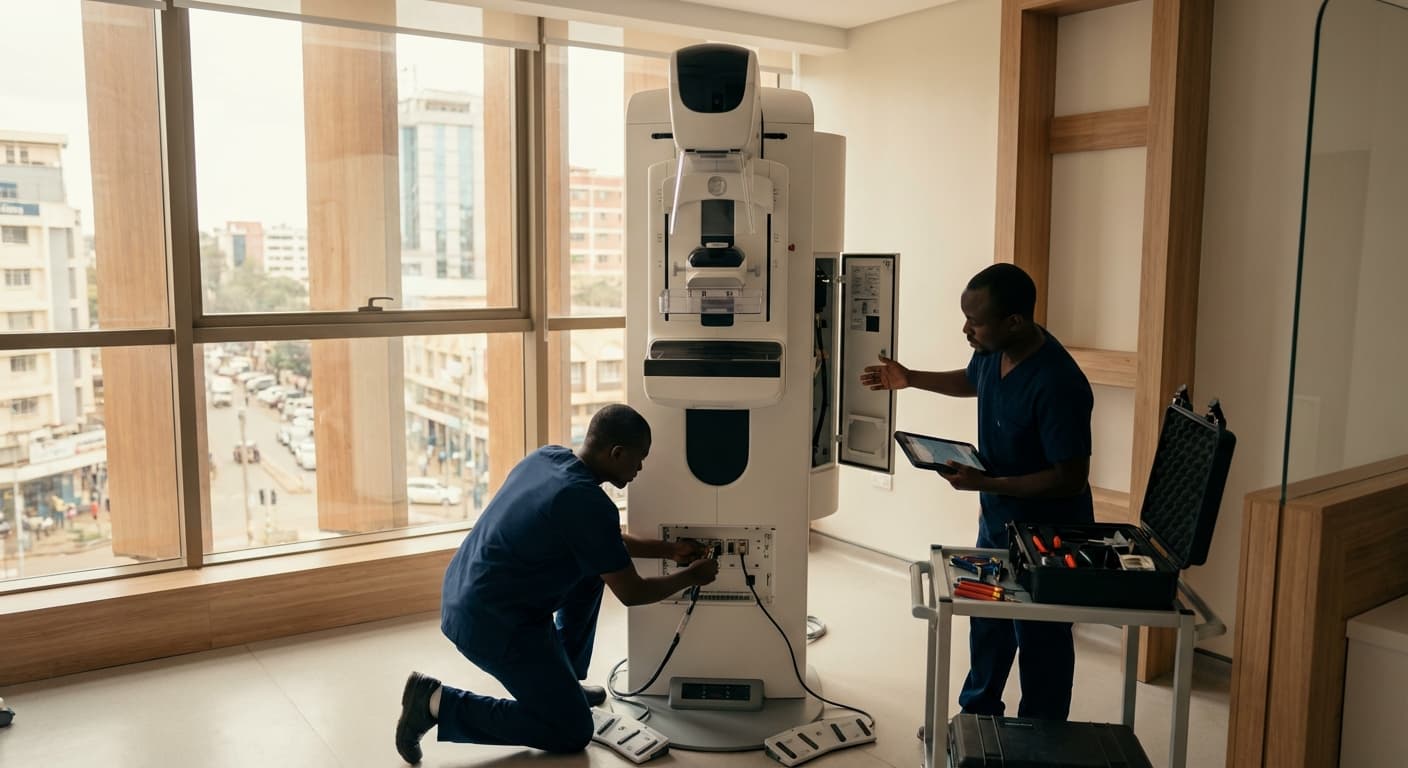
Mammography Installation Service in Zimbabwe
Engineering Excellence & Technical Support
Mammography Installation Service High-standard technical execution following OEM protocols and local regulatory frameworks.
Expert Installation & Calibration
Our certified technicians ensure your mammography equipment is installed with precision and calibrated to international standards, guaranteeing optimal image quality and diagnostic accuracy from day one.
Seamless Integration & Workflow Optimization
We ensure your new mammography system integrates flawlessly with your existing PACS and EMR, streamlining workflows and enhancing radiologist efficiency for better patient care.
On-site Training & Support
We provide comprehensive on-site training for your radiology staff, coupled with readily available technical support, ensuring continuous operation and maximum utilization of your mammography investment.
What Is Mammography Installation Service In Zimbabwe?
Mammography Installation Service in Zimbabwe refers to the specialized process of setting up, calibrating, and commissioning mammography equipment within healthcare facilities in the country. This service encompasses the physical installation of the mammography unit, its integration with existing or new imaging infrastructure (including Picture Archiving and Communication Systems - PACS and Electronic Health Records - EHR), and rigorous quality assurance testing to ensure optimal performance and diagnostic accuracy. It is a critical step in establishing or upgrading breast imaging capabilities, vital for early detection and diagnosis of breast cancer.
| Who Needs Mammography Installation Service? | Typical Use Cases | |||||||
|---|---|---|---|---|---|---|---|---|
| Hospitals (public and private) seeking to establish or enhance their diagnostic imaging departments, particularly those offering women's health services. | Establishment of new breast imaging centers or screening programs. | Clinics and diagnostic centers focused on women's health and early cancer detection. | Upgrading existing mammography equipment to newer, more advanced models with improved imaging capabilities and reduced radiation dose. | Government health initiatives aimed at increasing access to breast cancer screening across Zimbabwe. | Research institutions requiring specialized mammography setups for clinical trials and studies. | Facilities undergoing expansion or renovation that necessitates the relocation or reinstallation of mammography equipment. | Implementation of digital mammography or 3D mammography (Tomosynthesis) systems to improve diagnostic accuracy and patient outcomes. | Ensuring compliance with national and international quality standards for medical imaging equipment. |
Key Components of Mammography Installation Service:
- Site preparation and assessment (ensuring adequate space, power, shielding, and environmental controls).
- Unpacking, assembly, and precise positioning of the mammography system and associated components (e.g., detector, workstation).
- Electrical and network connectivity setup, ensuring compliance with local regulations and manufacturer specifications.
- Software installation and configuration, including integration with PACS/EHR for image archival and retrieval.
- Initial calibration and alignment of X-ray tube, collimator, and detector for optimal image quality.
- Performance testing and quality control (QC) procedures, including dose measurements, image acquisition optimization, and artifact detection.
- User training for radiographers and technicians on equipment operation, basic maintenance, and QC protocols.
- Commissioning report generation, documenting all installation steps, tests performed, and performance benchmarks.
- Post-installation support and troubleshooting.
Who Needs Mammography Installation Service In Zimbabwe?
Mammography installation services are crucial for ensuring that medical facilities in Zimbabwe are equipped with state-of-the-art diagnostic imaging technology. This service is not just about physically setting up the equipment; it encompasses calibration, testing, training, and integration into the existing healthcare infrastructure. Proper installation guarantees accurate readings, patient safety, and efficient workflow for radiology departments. It's an essential step for any institution aiming to provide comprehensive breast cancer screening and diagnostic services.
| Target Customer Group | Key Departments Involved |
|---|---|
| Public Hospitals | Radiology Department, Biomedical Engineering, Procurement Department, IT Department |
| Private Hospitals | Radiology Department, Clinical Engineering, Procurement, IT Department, Administration |
| Diagnostic Imaging Centers | Radiology Department, Technical Operations, Administration, IT Support |
| Cancer Treatment Centers | Radiology Department, Oncology Department, Medical Physics, IT Department |
| Rural Health Clinics/Mobile Units | Clinical Staff, Biomedical Technicians (if available), Ministry of Health Representatives |
| Government Health Ministries | Procurement, Health Infrastructure Development Unit, Public Health Programs Division |
Who Needs Mammography Installation Service in Zimbabwe? Target Customers & Departments
- Hospitals (Public and Private)
- Diagnostic Imaging Centers
- Specialized Cancer Treatment Centers
- Rural Health Clinics and Mobile Units (for outreach programs)
- Government Health Ministries (for public health initiatives)
Mammography Installation Service Process In Zimbabwe
This document outlines the typical workflow for mammography installation services in Zimbabwe, from initial client inquiry to the final execution of the installation. This process ensures a smooth and efficient deployment of essential medical imaging equipment.
| Stage | Description | Key Activities | Responsible Parties | Typical Timeline |
|---|---|---|---|---|
| The initial contact from a healthcare facility or individual seeking mammography installation services. | Client expresses need, initial discussion of requirements, budget, and desired equipment type. Provider offers preliminary information and guidance. | Client (Healthcare Facility/Individual), Service Provider | 1-3 Days |
| A detailed evaluation of the intended installation site to determine feasibility and specific requirements. | On-site visit to assess space, power supply, ventilation, radiation shielding needs, room dimensions, and accessibility. Development of a preliminary installation plan. | Service Provider (Technical Team), Client (Facility Management) | 3-7 Days |
| Formal proposal outlining the scope of work, costs, timelines, and terms of service. | Preparation and submission of a detailed quotation. Negotiation of terms. Signing of a service agreement or contract. | Service Provider, Client | 5-10 Days |
| Acquisition and transportation of the mammography equipment and any necessary accessories. | Ordering of equipment from manufacturers/suppliers. Coordination of shipping, customs clearance, and delivery to the installation site. | Service Provider (Procurement/Logistics), Client (for import duties/taxes if applicable) | Varies (depending on equipment availability and shipping times, can be weeks to months) |
| Ensuring the installation location meets all technical and safety specifications. | Electrical upgrades, plumbing adjustments, HVAC installation/verification, radiation shielding installation/verification, network connectivity setup, and any necessary structural modifications. | Client (Facility Maintenance/Contractors), Service Provider (Consultation/Supervision) | Varies (depending on site readiness, can be days to weeks) |
| The physical installation and assembly of the mammography unit and associated components. | Unpacking, positioning, connecting power and data cables, assembling components according to manufacturer specifications. | Service Provider (Installation Technicians/Engineers) | 2-5 Days |
| Verifying the correct functionality and accuracy of the installed mammography equipment. | Performance testing, image quality assessment, calibration against established standards, radiation safety checks, and integration with Picture Archiving and Communication Systems (PACS) if applicable. | Service Provider (Certified Engineers/Physicists) | 1-3 Days |
| Educating the end-users on the operation and basic maintenance of the mammography system. | Hands-on training for radiographers, technologists, and potentially maintenance staff on system operation, image acquisition techniques, troubleshooting, and basic care. | Service Provider (Application Specialists/Trainers), Client (End-Users) | 1-3 Days |
| Formal transfer of the installed system and provision of all necessary documentation. | Demonstration of the fully functional system, provision of user manuals, service manuals, warranty information, test reports, and certification of installation. | Service Provider, Client | 1 Day |
| Ongoing assistance and maintenance after the system has been successfully installed and commissioned. | Warranty support, scheduled preventative maintenance, troubleshooting, remote diagnostics, and availability of spare parts. | Service Provider (Technical Support/Maintenance Team) | Ongoing (as per service agreement) |
Mammography Installation Service Process in Zimbabwe
- Inquiry and Consultation
- Site Assessment and Planning
- Quotation and Agreement
- Equipment Procurement and Logistics
- Site Preparation
- Installation and Setup
- Testing and Calibration
- Training
- Handover and Documentation
- Post-Installation Support
Mammography Installation Service Cost In Zimbabwe
The cost of mammography installation services in Zimbabwe can vary significantly based on several factors. These include the type of mammography equipment being installed (e.g., analog, digital, 3D tomosynthesis), the complexity of the installation process, the geographic location within Zimbabwe, and the service provider's expertise and reputation. Additional factors influencing the final price often involve site preparation requirements, any necessary electrical upgrades, networking and software integration, and post-installation calibration and training for medical staff. It's crucial for healthcare facilities to obtain detailed quotes from multiple reputable suppliers and installers to ensure competitive pricing and understand the full scope of services included.
| Service Component | Estimated Cost Range (ZWL) | Notes |
|---|---|---|
| Basic Digital Mammography Installation | 30,000 - 80,000 | Includes equipment setup, basic calibration, and initial power connection. Excludes extensive site prep. |
| Advanced Digital Mammography/3D Tomosynthesis Installation | 60,000 - 150,000+ | Covers more complex setup, advanced calibration, integration with PACS (Picture Archiving and Communication System), and may include more comprehensive training. |
| Site Preparation (if required) | 15,000 - 50,000+ | Can involve radiation shielding, room modifications, and dedicated power circuits. Highly variable based on existing infrastructure. |
| Software Integration and PACS Setup | 10,000 - 30,000 | Essential for digital mammography workflows. Cost depends on the complexity of the existing IT infrastructure. |
| On-site Training for Technologists and Radiologists | 8,000 - 25,000 | Duration and depth of training will affect the cost. |
| Transportation and Logistics (for remote areas) | 5,000 - 15,000 | Covers travel and accommodation for the installation team. |
Key Pricing Factors for Mammography Installation in Zimbabwe
- Type of Mammography Equipment (Analog, Digital, 3D Tomosynthesis)
- Complexity of the Installation Process
- Geographic Location within Zimbabwe (e.g., Harare, Bulawayo, rural areas)
- Service Provider's Expertise and Reputation
- Site Preparation and Infrastructure Requirements (e.g., room shielding, power supply)
- Electrical Upgrades and Cabling
- Networking and Software Integration
- Calibration and Quality Assurance
- Training for Medical Personnel
- Warranty and After-Sales Support
Affordable Mammography Installation Service Options
Installing a mammography machine is a significant investment, and understanding the available service options can lead to substantial cost savings. This guide explores affordable installation service options, focusing on value bundles and cost-saving strategies to help healthcare facilities optimize their budgets.
| Cost-Saving Strategy | Description | Potential Savings |
|---|---|---|
| Bundle Deals | Purchasing installation services as part of a package with the mammography equipment itself or from a specialized installation provider. | 5-15% off individual service costs, reduced administrative overhead. |
| Negotiate Service Level Agreements (SLAs) | Discussing and negotiating the terms of ongoing maintenance and support contracts at the time of installation to lock in favorable rates. | 10-20% reduction in annual maintenance costs over the life of the equipment. |
| Phased Installation & Training | Breaking down the installation and training into manageable phases, allowing for payment flexibility and potentially utilizing in-house resources for less critical tasks. | Can spread capital expenditure and reduce upfront costs. |
| Compare Multiple Quotes | Obtaining detailed quotes from several reputable installation service providers and comparing not only price but also scope of services and experience. | Up to 20% difference in installation costs is common. |
| Leverage Manufacturer Support | Exploring if the mammography equipment manufacturer offers their own in-house installation services or preferred partners, which can sometimes be more cost-effective. | Potentially bundled pricing or preferred rates. |
| Off-Peak Installation Scheduling | If possible, scheduling installation during less busy periods for the service provider, which might offer some flexibility on pricing. | Negotiable discounts, typically 5-10%. |
| Consider Refurbished Equipment with Installation | Purchasing a high-quality refurbished mammography unit that includes a comprehensive installation and warranty package. | Significant upfront cost savings on the equipment, with installation costs often integrated. |
Understanding Value Bundles
- {"title":"What are Value Bundles?","description":"Value bundles are packages offered by service providers that combine multiple essential services at a discounted price compared to purchasing each service individually. For mammography installation, these bundles typically include aspects like site assessment, equipment delivery, physical installation, calibration, initial testing, and sometimes even basic training."}
- {"title":"Benefits of Value Bundles","description":"Opting for a value bundle often streamlines the installation process, ensuring all critical steps are managed by a single, coordinated team. This can reduce coordination headaches, minimize potential delays, and provide a more predictable overall cost. Bundles can also include service level agreements (SLAs) for ongoing maintenance, offering long-term peace of mind."}
- {"title":"Common Components of Mammography Installation Bundles","description":"Typical components include: \n- Site Survey & Planning: Assessing the installation space, power requirements, and environmental controls.\n- Equipment Delivery & Placement: Safe and secure transportation and positioning of the mammography unit.\n- Physical Installation: Connecting power, data, and any necessary plumbing.\n- Calibration & Quality Assurance Testing: Ensuring the machine meets all regulatory and performance standards.\n- Basic Operator Training: Familiarizing staff with the new equipment's fundamental operations.\n- PACS Integration Support: Assistance with connecting the mammography unit to Picture Archiving and Communication Systems."}
Verified Providers In Zimbabwe
In Zimbabwe's evolving healthcare landscape, identifying verified and reputable providers is paramount for individuals seeking quality and trustworthy medical services. Franance Health stands out as a beacon of excellence, distinguished by its rigorous credentialing process and unwavering commitment to patient well-being. This dedication ensures that every provider associated with Franance Health meets the highest standards of professionalism, expertise, and ethical practice. Choosing Franance Health means partnering with a system that prioritizes your health with verified, top-tier medical professionals.
| Provider Type | Key Credentials Verified by Franance Health | Why This Matters to You |
|---|---|---|
| General Practitioners | Medical Degree (MBChB or equivalent), General Medical Council (GMC) Registration, Current Practicing Certificate | Ensures you receive competent primary care from a licensed and qualified physician. |
| Specialist Doctors (e.g., Cardiologists, Pediatricians, Surgeons) | Medical Degree, Postgraduate Specialist Qualification (e.g., MMED, FCPath), Specialist Board Certification, GMC Registration | Guarantees you are treated by an expert with advanced training and experience in their specific field. |
| Dentists | Dental Degree (BDS or equivalent), Dental Association of Zimbabwe (DAZ) Registration, Current Practicing License | Confirms your dental care is provided by a qualified and licensed professional. |
| Nurses | Nursing Diploma/Degree, Zimbabwe Nurses Association (ZINA) Membership, Current Practicing Certificate | Assures you that your nursing care is delivered by trained and registered professionals. |
| Pharmacists | Pharmacy Degree (BPharm or equivalent), Pharmaceutical Society of Zimbabwe (PSZ) Registration, Current Practicing License | Ensures your medication is dispensed and advised upon by a qualified and licensed pharmacist. |
Why Franance Health Providers are the Best Choice:
- Rigorous Verification Process: Franance Health meticulously vets all its affiliated healthcare professionals, confirming their qualifications, licenses, and ethical standing.
- Commitment to Excellence: We partner only with providers who demonstrate a dedication to continuous learning and staying abreast of the latest medical advancements.
- Patient-Centric Approach: Franance Health providers are chosen for their empathy, communication skills, and commitment to delivering personalized care.
- Comprehensive Network: Our network spans a wide range of medical specialties, ensuring you can find the right expert for your specific health needs.
- Trust and Reliability: By choosing Franance Health, you are assured of accessing healthcare services from accredited and trusted professionals.
Scope Of Work For Mammography Installation Service
This Scope of Work (SOW) outlines the requirements for the installation of a new mammography system at [Hospital Name], located at [Hospital Address]. The project aims to integrate a state-of-the-art mammography unit, ensuring optimal performance, patient safety, and compliance with all relevant regulatory standards. This document details the technical deliverables and standard specifications expected from the vendor. The installation will encompass the physical placement of the equipment, necessary power and network connectivity, calibration, testing, and initial user training.
| Category | Specification | Standard/Requirement | Vendor Responsibility |
|---|---|---|---|
| Equipment Placement | Mammography unit positioning | As per architectural drawings, radiation shielding requirements, and ergonomic best practices. | Accurate positioning, ensuring accessibility for operation and maintenance. |
| Electrical Requirements | Power supply | Dedicated circuit, 3-phase, specific voltage and amperage as per manufacturer's specifications (e.g., 208V/240V, XXA). | Installation of dedicated power circuits, breaker, and appropriate plug/receptacle. |
| Electrical Requirements | Backup power (UPS) | Optional, but recommended for uninterrupted operation during brief power outages. | Installation and connection of UPS if specified in the order. |
| Network Connectivity | Data interface | Gigabit Ethernet connection to PACS/RIS network. DICOM compliance is mandatory. | Installation of network drops, cabling, and configuration for seamless data transfer. |
| Network Connectivity | Network security | Adherence to hospital's IT security policies and protocols. | Secure network configuration and access control. |
| Radiation Shielding | Lead shielding | Installation and verification of lead shielding in walls, doors, and viewing windows as per regulatory standards (e.g., NCRP, state regulations). | Verification of existing shielding and installation of any required supplementary shielding. |
| Environmental Conditions | Temperature and Humidity | Within manufacturer's recommended operating ranges (e.g., 18-24°C, 30-60% RH). | Ensuring the installation environment meets these conditions. |
| Environmental Conditions | Lighting | Appropriate lighting levels for optimal viewing of images and console operation. | Assessment and adjustment of ambient lighting if necessary. |
| Calibration and Testing | Initial Calibration | Full manufacturer's calibration procedures to ensure optimal image quality and dose accuracy. | Execution of all calibration steps and generation of calibration reports. |
| Calibration and Testing | Quality Assurance (QA) Testing | Performance of all required QA tests as per ACR (American College of Radiology) standards and internal hospital QA protocols. | Execution of all QA tests, documentation of results, and corrective actions if required. |
| Calibration and Testing | Image Archiving and Retrieval | Successful transmission, archiving in PACS, and retrieval of test images. | Verification of DICOM conformance and PACS integration. |
| User Training | Operator Training | Comprehensive training for radiologists, technologists, and relevant support staff on system operation, imaging protocols, and basic troubleshooting. | Delivery of training sessions and provision of training materials. |
| Documentation | System Manuals | Complete set of user, service, and maintenance manuals in English. | Provision of digital and/or physical copies as agreed. |
| Documentation | Installation and Test Reports | Detailed reports of all installation activities, calibration results, and QA tests. | Submission of all relevant reports for review and acceptance. |
| Safety | Patient Safety Features | Verification of all built-in safety features (e.g., interlocks, emergency stop buttons). | Testing and confirmation of all safety mechanisms. |
| Safety | Personnel Safety | Confirmation of adherence to radiation safety protocols and interlock functionalities. | Verification of safety interlocks and system behavior. |
Technical Deliverables
- Site preparation and readiness assessment report.
- Detailed installation plan and schedule.
- Physically installed and connected mammography system (including all components: X-ray generator, detector, gantry, console, PACS interface, etc.).
- Completion of all required electrical and data cabling as per specifications.
- Successful power-on and system initialization.
- Successful integration with the existing Picture Archiving and Communication System (PACS) and Radiology Information System (RIS).
- Completion of all manufacturer-recommended calibration procedures.
- Performance and quality assurance testing reports (e.g., ACR accreditation standards).
- System documentation and user manuals (digital and/or physical copies).
- Initial operator training sessions and attendance records.
- Post-installation support and warranty information.
- Final acceptance and sign-off documentation.
Service Level Agreement For Mammography Installation Service
This Service Level Agreement (SLA) outlines the response times and uptime guarantees for the Mammography Installation Service provided by [Your Company Name] to [Client Name]. This SLA is an integral part of the overall service contract.
| Service Component | Uptime Guarantee | Response Time (during Business Hours) | Response Time (outside Business Hours - if applicable) | Resolution Target (Critical Issue) | Resolution Target (Major Issue) | Resolution Target (Minor Issue) |
|---|---|---|---|---|---|---|
| Mammography Equipment Operational Uptime | 99.5% | N/A | N/A | N/A | N/A | N/A |
| Initial Remote Support | N/A | Within 4 Business Hours | Within 8 Business Hours (if 24/7 support is contracted) | Within 2 Business Hours | Within 4 Business Hours | Within 8 Business Hours |
| Field Service Technician Dispatch (if remote troubleshooting fails) | N/A | Within 24 Business Hours | Within 48 Business Hours (if 24/7 support is contracted) | Within 8 Business Hours | Within 24 Business Hours | Within 48 Business Hours |
Key Definitions
- Installation Service: The process of delivering, setting up, configuring, and testing the mammography equipment at the client's designated facility.
- Downtime: Any period during which the mammography equipment is unavailable for use due to a malfunction, error, or failure requiring intervention from [Your Company Name]'s technical support or field service personnel.
- Business Hours: [Specify Business Hours, e.g., Monday to Friday, 8:00 AM to 5:00 PM Local Time, excluding public holidays].
- Critical Issue: A problem that renders the mammography equipment completely non-operational, impacting the ability to perform patient scans.
- Major Issue: A problem that significantly degrades the performance or functionality of the mammography equipment, but does not completely prevent its operation.
- Minor Issue: A problem that causes cosmetic defects or minor functional impairments that do not significantly impact patient care or diagnostic accuracy.
- Response Time: The time elapsed from when a support ticket is officially logged and acknowledged by [Your Company Name]'s support system until a qualified technician begins remote troubleshooting or dispatch.
Frequently Asked Questions

Ready when you are
Let's scope your Mammography Installation Service in Zimbabwe project in Zimbabwe.

Scaling healthcare logistics and technical systems across the entire continent.