
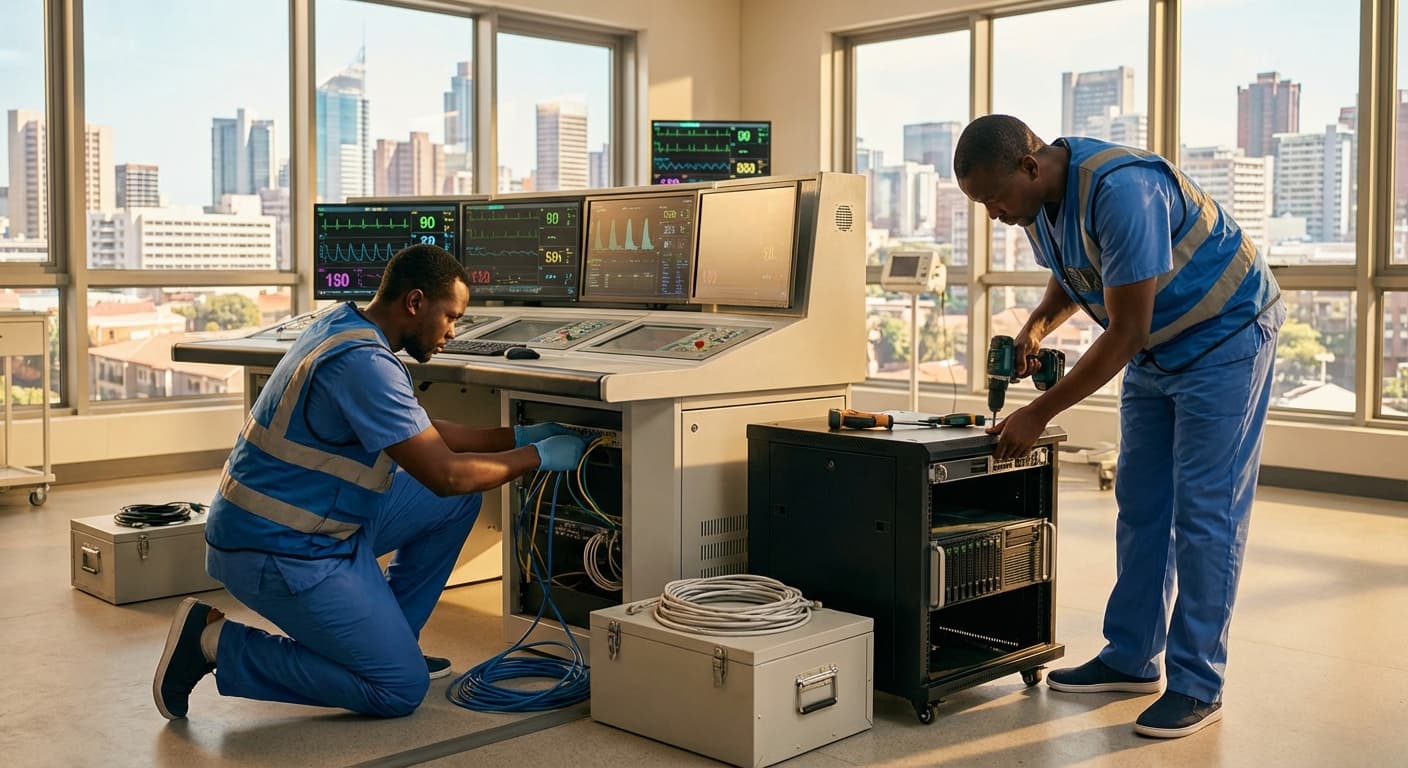
ICU Central Monitoring Station Installation Service in Zimbabwe
Engineering Excellence & Technical Support
ICU Central Monitoring Station Installation Service High-standard technical execution following OEM protocols and local regulatory frameworks.
Seamless Cloud-Based Monitoring Integration
We architect and implement robust cloud-based integration for your ICU central monitoring station, ensuring real-time data accessibility and secure remote access for authorized medical personnel across Zimbabwe. Benefit from enhanced data redundancy and simplified system updates.
High-Availability Network Infrastructure
Our expert technicians design and deploy resilient, high-availability network infrastructures tailored for critical care environments. We guarantee uninterrupted data flow from bedside monitors to the central station, minimizing latency and ensuring mission-critical patient data is always available.
Secure Data Transmission & HIPAA Compliance
We prioritize the security of patient data. Our installation service includes implementing advanced encryption protocols and access controls to ensure compliance with international data privacy standards, safeguarding sensitive health information within your ICU central monitoring system.
What Is Icu Central Monitoring Station Installation Service In Zimbabwe?
ICU Central Monitoring Station Installation Service in Zimbabwe refers to the comprehensive process of setting up and configuring a centralized system designed to continuously monitor critical patient vital signs and other physiological parameters within Intensive Care Units (ICUs). This service ensures that healthcare facilities in Zimbabwe have a robust and integrated platform for real-time surveillance of critically ill patients, facilitating timely clinical intervention and improving patient outcomes. The installation encompasses the deployment of network infrastructure, central monitoring consoles, bedside patient monitors, and associated software, all configured to transmit, display, and analyze data efficiently. This service is crucial for healthcare institutions aiming to enhance the quality of critical care delivery.
| Stakeholder/Institution | Reason for Requiring Service | Typical Use Cases |
|---|---|---|
| Public Hospitals in Zimbabwe | To upgrade critical care infrastructure, improve patient surveillance capabilities, and ensure continuous monitoring of a high volume of critically ill patients, often with limited resources. | Monitoring multiple patients simultaneously in a large ICU; enabling nurses to manage patient loads more effectively; facilitating rapid response to deteriorating patient conditions. |
| Private Healthcare Facilities/Hospitals | To provide advanced, high-fidelity patient monitoring aligned with international standards, enhance patient safety, and offer competitive critical care services. | Real-time trend analysis of vital signs; remote monitoring capabilities for senior clinicians; integration with advanced diagnostic tools; research data collection. |
| Mission Hospitals and NGOs Operating ICUs | To establish or enhance essential critical care services in underserved areas, ensuring that limited personnel can effectively manage a larger number of critical patients. | Centralized oversight of patients in smaller ICU units; improved staff efficiency in resource-constrained environments; early detection of subtle physiological changes. |
| Specialized Clinics with ICU Capabilities | To ensure sophisticated and reliable monitoring for patients undergoing complex procedures or with specific critical conditions (e.g., cardiac, neurological). | Continuous hemodynamic monitoring; advanced waveform analysis; integration with specialized therapeutic devices (e.g., ventilators, ECMO). |
Key Components and Stages of ICU Central Monitoring Station Installation
- Needs Assessment and Site Survey: Detailed evaluation of the ICU's existing infrastructure, patient load, and specific monitoring requirements to determine optimal system architecture and component selection.
- Hardware Procurement and Deployment: Acquisition and installation of central monitoring consoles, bedside monitors (e.g., ECG, SpO2, NIBP, respiration, temperature, invasive pressures), and associated accessories.
- Network Infrastructure Setup: Establishment of a reliable and secure network (wired or wireless) capable of handling real-time data transmission from multiple patient monitors to the central station.
- Software Installation and Configuration: Deployment of the central monitoring software platform, including user interface customization, alarm parameter configuration, data logging, and integration with Electronic Health Records (EHR) systems if applicable.
- System Integration and Testing: Verification of seamless data flow between bedside monitors and the central station, rigorous testing of alarm functionalities, data accuracy, and system responsiveness under simulated critical conditions.
- User Training and Documentation: Comprehensive training for clinical staff (doctors, nurses) on the operation, data interpretation, and troubleshooting of the central monitoring system, along with provision of detailed user manuals.
- Post-Installation Support and Maintenance: Ongoing technical support, software updates, and scheduled maintenance to ensure optimal system performance and longevity.
Who Needs Icu Central Monitoring Station Installation Service In Zimbabwe?
Installation services for ICU Central Monitoring Stations are crucial for healthcare facilities in Zimbabwe seeking to enhance critical care capabilities. These systems provide real-time, centralized surveillance of multiple Intensive Care Unit (ICU) patients, enabling proactive medical intervention, improved patient outcomes, and efficient resource allocation. The installation requires specialized expertise to ensure seamless integration with existing infrastructure and adherence to medical device regulations.
| Target Customer Type | Primary Department(s) Benefiting | Specific Needs Addressed |
|---|---|---|
| Large Public Hospitals | Intensive Care Unit (ICU), Coronary Care Unit (CCU), High Dependency Unit (HDU) | Managing a high volume of critically ill patients, optimizing nurse-to-patient ratios, early detection of patient deterioration, improving overall ICU efficiency. |
| Private Hospitals | ICU, CCU, Neonatal ICU (NICU) | Offering advanced critical care services, maintaining high standards of patient monitoring, enhancing patient safety, competitive advantage through cutting-edge technology. |
| Mission Hospitals | ICU, General Wards with critical patients | Extending critical care capabilities beyond larger urban centers, improving patient survival rates with limited resources, enabling remote monitoring support. |
| University Teaching Hospitals | ICU, CCU, Transplant Units, Neuro ICU | Facilitating medical education and research, providing real-time data for clinical trials, supporting complex surgical recovery, training future intensivists. |
| Specialized Cardiac Centers | CCU, ICU | Continuous monitoring of complex cardiac arrhythmias, post-operative cardiac surgery recovery, immediate response to cardiac events. |
| Oncology Centers | ICU, HDU | Monitoring patients undergoing intensive chemotherapy or radiation therapy, managing side effects and complications, ensuring stability during treatment. |
| Trauma and Emergency Centers | ICU, Emergency Department (for immediate post-trauma stabilization) | Rapid assessment and continuous monitoring of trauma patients, tracking vital signs during critical resuscitation phases, seamless handover to the ICU. |
Target Customers & Departments in Zimbabwe Requiring ICU Central Monitoring Station Installation Service
- Large Public Hospitals
- Private Hospitals
- Mission Hospitals
- University Teaching Hospitals
- Specialized Cardiac Centers
- Oncology Centers
- Trauma and Emergency Centers
Icu Central Monitoring Station Installation Service Process In Zimbabwe
This document outlines the standard workflow for the installation service of ICU Central Monitoring Stations in Zimbabwe, from initial customer inquiry to project completion and handover. The process is designed to be comprehensive, transparent, and efficient, ensuring a seamless experience for healthcare facilities.
Key stages of the process include:
- Initial Inquiry & Consultation: The process begins with a prospective client (hospital, clinic, or healthcare provider) expressing interest in an ICU Central Monitoring Station installation. This often comes through a phone call, email, or website contact form. Our sales or technical team will engage with the client to understand their specific needs, facility size, existing infrastructure, budget, and desired features. This initial consultation might involve preliminary site assessments (if feasible remotely) or scheduling an on-site visit for a more detailed evaluation.
- Needs Assessment & Site Survey: A dedicated technical team will conduct a thorough on-site survey of the intended installation location(s). This involves assessing the physical space, power availability and reliability, network infrastructure (wired and wireless), environmental conditions (temperature, humidity), potential electromagnetic interference, and any specific architectural constraints. The team will also consult with hospital IT, biomedical engineering, and nursing staff to gather crucial information about workflow, existing equipment, and integration requirements.
- Solution Design & Proposal Generation: Based on the needs assessment and site survey, a customized solution will be designed. This includes selecting the appropriate central monitoring system components (servers, workstations, software, network devices, etc.), patient monitors, and any necessary accessories. A detailed proposal will be generated, outlining the proposed system configuration, technical specifications, project timeline, deliverables, costs (including equipment, installation, training, and any optional services), and payment terms. This proposal will be presented to the client for review and approval.
- Contracting & Agreement: Upon client approval of the proposal, a formal contract or service agreement will be drafted and signed. This document legally binds both parties, detailing the scope of work, responsibilities, payment schedules, warranty information, and service level agreements (SLAs).
- Procurement & Logistics: Once the contract is signed, the necessary equipment and materials are procured from our suppliers. This phase also involves meticulous planning for logistics, including shipping, customs clearance (if applicable), and delivery to the installation site in Zimbabwe. We ensure all equipment arrives in good condition and in a timely manner.
- Pre-Installation & Site Preparation: Before physical installation begins, final preparations are made at the client's site. This may involve ensuring adequate power outlets, network ports, and clear pathways for cable runs. Minor structural modifications or electrical work may be coordinated with the client's facilities management team if required and agreed upon in the contract.
- Installation & Configuration: The technical installation team will arrive at the site to install the central monitoring station hardware and software. This includes setting up servers, workstations, and networking equipment, as well as configuring the central monitoring software to meet the specific requirements of the ICU. Patient monitors will be integrated and connected to the central system, and initial testing will be performed to ensure proper data flow and functionality.
- Testing & Calibration: Rigorous testing and calibration are critical to ensure the accuracy and reliability of the central monitoring system. This involves simulating patient data, testing alarm functions, verifying data integrity, and performing system diagnostics. The system will be calibrated according to manufacturer specifications and relevant medical standards.
- User Training: Comprehensive training will be provided to the relevant hospital staff, including nurses, doctors, and biomedical technicians. This training covers the operation of the central monitoring system, understanding displayed data, managing alarms, troubleshooting basic issues, and maintaining the system. Training sessions are typically hands-on and tailored to the specific user groups.
- System Handover & Sign-off: After successful installation, testing, calibration, and training, the system is formally handed over to the client. A detailed system documentation package, including user manuals, technical specifications, and warranty certificates, will be provided. The client will then review and sign off on the installation, confirming that all agreed-upon deliverables have been met and the system is operational.
- Post-Installation Support & Maintenance: Our commitment extends beyond installation. We provide ongoing post-installation support, including troubleshooting, maintenance services, and software updates as per the agreed SLA. This ensures the continued optimal performance and longevity of the ICU Central Monitoring Station.
| Stage | Description | Key Activities | Deliverables | Responsible Parties |
|---|---|---|---|---|
| Understanding client requirements and providing initial guidance. | Receive inquiry, initial discussion of needs, budget, and facility overview. | Understanding of client needs, preliminary scope definition. | Client, Sales/Technical Representative |
| Detailed evaluation of the installation environment. | On-site inspection of space, power, network, environmental factors; consultation with hospital staff. | Detailed site survey report, understanding of infrastructure and operational needs. | Technical Team, Client Facilities/IT/Clinical Staff |
| Developing a tailored system configuration and costing. | System design, equipment selection, software configuration planning, cost estimation. | Customized system proposal, technical specifications, project timeline, quotation. | Technical Team, Sales Department |
| Formalizing the project scope and terms. | Review and signing of contract/service agreement. | Signed contract, legal agreement. | Client, Service Provider |
| Acquiring and transporting equipment to Zimbabwe. | Ordering equipment, managing shipping, customs clearance, and delivery. | Procured equipment, delivery confirmation. | Procurement Department, Logistics Team, Client |
| Ensuring the site is ready for installation. | Coordinating with client for necessary infrastructure readiness (power, network, space). | Site readiness confirmation. | Client Facilities/IT, Technical Team |
| Physical setup of hardware and software. | Mounting equipment, connecting cables, installing and configuring software, integrating patient monitors. | Installed and configured central monitoring system. | Technical Installation Team |
| Verifying system performance and accuracy. | System diagnostics, functional testing, alarm testing, data validation, calibration. | Calibrated and fully functional system, test reports. | Technical Installation Team |
| Educating hospital staff on system operation. | Hands-on training sessions for nurses, doctors, and technicians on system use, alarms, and basic troubleshooting. | Trained hospital staff, training materials. | Training Specialist, Technical Team, Client Staff |
| Formal transfer of the installed system to the client. | Demonstration of final system, provision of documentation, client review and acceptance. | Completed installation, system documentation, client sign-off. | Project Manager, Technical Team, Client Representative |
| Ongoing support and upkeep of the system. | Troubleshooting, routine maintenance, software updates, warranty support as per SLA. | Continued system operability, technical support. | Support Team, Technical Team, Client |
Workflow Stages for ICU Central Monitoring Station Installation Service in Zimbabwe
- Initial Inquiry & Consultation
- Needs Assessment & Site Survey
- Solution Design & Proposal Generation
- Contracting & Agreement
- Procurement & Logistics
- Pre-Installation & Site Preparation
- Installation & Configuration
- Testing & Calibration
- User Training
- System Handover & Sign-off
- Post-Installation Support & Maintenance
Icu Central Monitoring Station Installation Service Cost In Zimbabwe
Installing an ICU central monitoring station in Zimbabwe involves a range of costs influenced by several factors. These include the complexity of the system, the number of patient monitoring units, the type of equipment chosen (e.g., brand reputation, features), the extent of integration with existing hospital infrastructure (like HIS/EMR systems), installation and commissioning labor, training for hospital staff, and potential ongoing maintenance agreements. The Zimbabwean market for such advanced medical technology is influenced by import duties, currency fluctuations, and the availability of specialized technicians. Prices are typically quoted in USD but will be settled in ZWL at the prevailing interbank rate, making precise ZWL figures highly variable. However, for a comprehensive installation, one can expect a significant investment, often running into tens of thousands to hundreds of thousands of US dollars equivalent.
| Component/Service | Estimated Cost Range (USD Equivalent) |
|---|---|
| Central Monitoring Station Hardware (Console, Servers) | $10,000 - $50,000+ |
| Patient Monitoring Units (Bedside Monitors) | $3,000 - $15,000 per unit |
| Networking and Cabling Infrastructure | $2,000 - $10,000+ |
| Software Licenses and Integration | $5,000 - $25,000+ |
| Installation and Commissioning Labor | $5,000 - $20,000+ |
| Staff Training | $2,000 - $8,000+ |
| Import Duties and Taxes (Variable) | Varies significantly based on equipment value |
| Contingency (10-15%) | Recommended for unforeseen costs |
Key Pricing Factors for ICU Central Monitoring Station Installation in Zimbabwe
- System Complexity and Scope
- Number of Patient Monitoring Units
- Equipment Brand and Features
- Integration with Existing Hospital Systems (HIS/EMR)
- Installation and Commissioning Labor Costs
- Staff Training Requirements
- Import Duties and Taxes
- Currency Exchange Rate Fluctuations (USD to ZWL)
- After-Sales Support and Maintenance Packages
- Vendor's Reputation and Experience
Affordable Icu Central Monitoring Station Installation Service Options
Setting up an Intensive Care Unit (ICU) central monitoring station is a critical investment for any healthcare facility. Ensuring patients receive continuous and accurate observation is paramount for timely intervention and improved outcomes. While the initial outlay can seem significant, numerous affordable installation service options and cost-saving strategies exist. This guide explores value bundles and practical methods to reduce expenses without compromising on quality or essential functionality.
| Value Bundle Options | Included Components | Potential Cost Savings | Best For |
|---|---|---|---|
| Essential Monitoring Package | Core monitoring parameters (ECG, SpO2, NIBP), central station software, basic network infrastructure, and standard installation services. | Lower upfront cost, streamlined procurement, predictable installation timeline. | New or smaller ICUs, facilities with budget constraints, those prioritizing core functionalities. |
| Integrated Care Solution | Includes essential monitoring, advanced analytics, EMR/HIS integration capabilities, patient data management tools, and comprehensive training. | Reduced integration costs, improved workflow efficiency, potential for better clinical decision-making, bundled support. | Medium to large ICUs, facilities seeking seamless data flow and advanced patient insights. |
| Future-Ready Expansion Bundle | Starts with essential monitoring but includes pre-configured pathways and hardware for easy addition of advanced modules (e.g., invasive pressure monitoring, respiration, temperature) and future software upgrades. | Avoids costly retrofitting, phased investment, flexibility to adapt to changing needs. | Facilities anticipating growth, those who may not need all advanced features immediately but want future-proofing. |
| Refurbished Equipment & Service Package | Utilizes certified refurbished central monitoring units and bedside monitors, bundled with installation, testing, and a limited warranty. May include basic software. | Significant reduction in hardware acquisition costs, environmentally friendly option. | Budget-conscious facilities, research or teaching hospitals, those needing to replace aging equipment cost-effectively. |
Key Considerations for Affordable ICU Central Monitoring Installation
- Understanding your specific ICU needs: The number of beds, required monitoring parameters (ECG, SpO2, NIBP, IBP, EtCO2, etc.), and integration with existing EMR/HIS systems will dictate the scope and cost.
- Scalability: Opt for systems that allow for future expansion as your facility grows or patient needs evolve.
- Vendor reputation and support: Choose established vendors with a proven track record for reliable equipment and responsive technical support.
- Training: Factor in the cost and importance of adequate training for your clinical staff on operating the new system.
- Maintenance agreements: Understand the ongoing costs of service contracts and planned preventative maintenance.
- Compliance and certifications: Ensure the chosen system and installation adhere to all relevant healthcare regulations and standards.
Verified Providers In Zimbabwe
In the dynamic landscape of healthcare in Zimbabwe, identifying and trusting verified providers is paramount. Franance Health stands out as a beacon of reliability and quality, meticulously vetting its network to ensure patients receive the highest standard of care. Their commitment to stringent credentialing processes means that every practitioner and facility associated with Franance Health has undergone rigorous evaluation, offering peace of mind and confidence to those seeking medical services.
| Credentialing Aspect | Franance Health's Approach | Patient Benefit |
|---|---|---|
| Medical Licensure & Certification | Verifies up-to-date and valid licenses from recognized medical boards. | Ensures providers are legally qualified and competent. |
| Professional Experience & Qualifications | Assesses educational background, specialized training, and years of practice. | Guarantees access to experienced and skilled medical professionals. |
| Reputation & Peer Review | Conducts background checks and considers peer recommendations. | Confirms a history of ethical practice and positive patient outcomes. |
| Infrastructure & Equipment (for Facilities) | Evaluates the quality and maintenance of medical facilities and equipment. | Ensures a safe and effective healthcare environment. |
| Adherence to Ethical Standards | Confirms compliance with professional codes of conduct and patient rights. | Promotes trust and respect in patient-provider relationships. |
Why Franance Health Represents the Best Choice:
- Unwavering commitment to patient safety and quality of care.
- Rigorous vetting process for all healthcare providers.
- Access to a comprehensive network of specialists and facilities.
- Transparent and ethical medical practices.
- Focus on patient well-being and satisfaction.
Scope Of Work For Icu Central Monitoring Station Installation Service
This Scope of Work (SOW) outlines the requirements for the installation service of an Intensive Care Unit (ICU) Central Monitoring Station (CMS). The project encompasses the complete installation, configuration, testing, and commissioning of a new CMS, including all necessary hardware, software, cabling, and integration with existing ICU patient monitoring equipment. The objective is to establish a reliable and efficient central hub for real-time patient data visualization and management within the ICU.
| Technical Deliverable | Description | Standard Specification |
|---|---|---|
| Central Monitoring Station Workstation(s) | High-performance computer(s) for displaying patient data. Includes monitor(s), keyboard, mouse, and necessary peripherals. | Minimum 24-inch high-resolution (1920x1080 or higher) displays. Latest generation multi-core processor. Minimum 16GB RAM. Solid-state drive (SSD) for fast boot and application loading. Integrated UPS for uninterrupted power. |
| Server Hardware (if applicable) | Server to host CMS software, data storage, and potentially data archival. | Rack-mountable server with redundant power supplies. Sufficient processing power and RAM for concurrent data streams. RAID configuration for data redundancy. Adequate storage capacity based on retention policies. |
| Network Infrastructure | Installation of network cabling and associated hardware to connect patient monitors to the CMS. | Category 6A (or higher) Ethernet cabling. Structured cabling system adhering to TIA-568 standards. Network switches with sufficient port density and bandwidth. DHCP and static IP addressing scheme. Firewall configuration for secure network access. |
| Software Installation and Configuration | Installation and setup of the CMS software, including patient data acquisition, display, alarm management, and reporting modules. | Latest stable version of the CMS software. Configuration of patient bed mapping, alarm limits, user roles, and access permissions. Integration with existing HL7-compliant hospital information system (HIS) and electronic medical record (EMR) systems. |
| Power Management | Installation of power outlets and UPS systems for all CMS components. | Dedicated power circuits for CMS workstations and servers. Appropriate capacity UPS systems with sufficient runtime for graceful shutdown or continued operation during power outages. |
| Data Cabling & Termination | Running, terminating, and testing all required data cables. | Cables to be neatly routed and secured, minimizing potential for damage. Proper labeling of all cables and ports. Termination using industry-standard connectors (e.g., RJ45). Performance testing to ensure signal integrity. |
| Integration with Patient Monitors | Establishing reliable data flow from existing ICU patient monitoring devices to the CMS. | Compatibility with existing patient monitor models and communication protocols (e.g., proprietary, HL7, DICOM). Successful bidirectional communication for data acquisition and potentially remote parameter adjustment (if supported). |
| Alarm Management System | Configuration and testing of the CMS alarm system to alert clinicians to critical patient events. | Configurable alarm priority levels. Audible and visual alarm notifications. Alarm logging and acknowledgment features. Integration with potential nurse call systems. |
| System Documentation | Provision of comprehensive documentation for the installed CMS. | As-built drawings, network diagrams, software configuration guides, user manuals, maintenance procedures, and warranty information. |
| Testing and Validation Reports | Detailed reports documenting all testing and validation activities. | Functional testing results, performance testing results, integration testing reports, and user acceptance testing (UAT) sign-off. |
| Commissioning Report | Formal report certifying the successful installation and operational readiness of the CMS. | Summary of all work performed, test results, and confirmation that all requirements of the SOW have been met. |
Key Project Phases
- Site Survey and Planning
- Equipment Procurement and Delivery
- Installation and Cabling
- Software Configuration and Integration
- Testing and Validation
- Commissioning and Handover
- Training
Service Level Agreement For Icu Central Monitoring Station Installation Service
This Service Level Agreement (SLA) outlines the response times and uptime guarantees for the installation services of the ICU Central Monitoring Station provided by [Your Company Name]. This SLA is an integral part of the Master Services Agreement (MSA) between [Your Company Name] and [Client Name].
| Service Component | Response Time (for critical issues) | Resolution Target (for critical issues) | Uptime Guarantee |
|---|---|---|---|
| Installation Site Readiness Assessment | 2 business days from notification of readiness | N/A (completion within agreed project timeline) | N/A |
| On-site Installation & Configuration | 4 business hours from arrival at site (scheduled) | Within 5 business days of commencement (subject to site readiness and client cooperation) | N/A |
| System Testing & Validation | 2 business days from completion of installation | Within 1 business day of testing commencement | N/A |
| Post-Installation Support (Warranty Period) | 2 business hours for Severity 1 issues (system down/major malfunction) | 8 business hours for Severity 1 issues | 99.5% availability of the installed monitoring station during the warranty period (excluding scheduled maintenance) |
| Post-Installation Support (Warranty Period) | 8 business hours for Severity 2 issues (significant performance degradation) | 2 business days for Severity 2 issues | N/A |
| Post-Installation Support (Warranty Period) | 1 business day for Severity 3 issues (minor functionality issues) | 5 business days for Severity 3 issues | N/A |
Scope of Service
- Installation of the ICU Central Monitoring Station hardware and software.
- Configuration and integration of the monitoring station with existing ICU equipment (as specified in the Statement of Work).
- Initial system testing and validation.
- Basic user training for ICU staff on operating the monitoring station.
- Post-installation support during the warranty period (as defined in the MSA).
Frequently Asked Questions

Ready when you are
Let's scope your ICU Central Monitoring Station Installation Service in Zimbabwe project in Zimbabwe.

Scaling healthcare logistics and technical systems across the entire continent.