
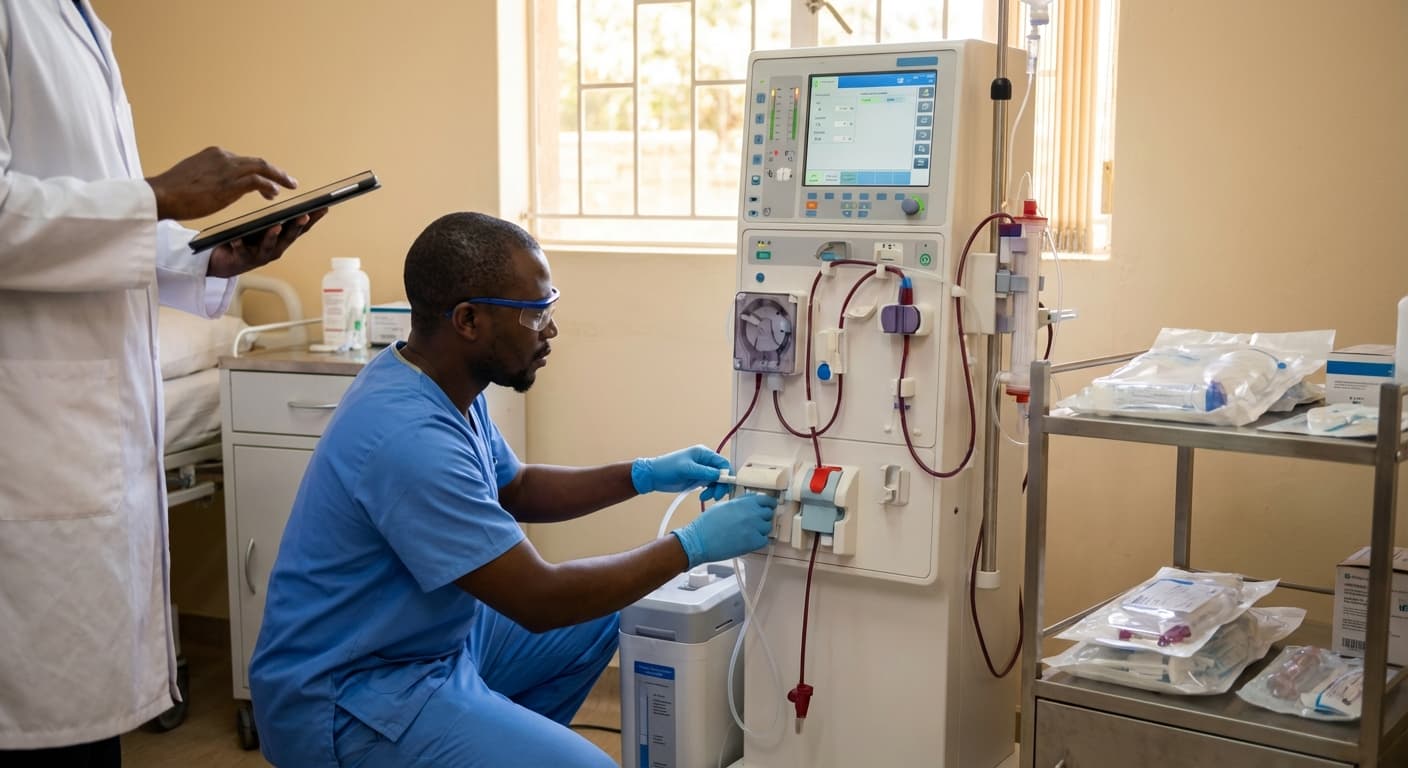
Hemodialysis Machine Installation Service in Zimbabwe
Engineering Excellence & Technical Support
Hemodialysis Machine Installation Service High-standard technical execution following OEM protocols and local regulatory frameworks.
Certified Installation & Compliance
Our certified technicians ensure your hemodialysis machines are installed to the highest international and Zimbabwean health standards, guaranteeing safe and effective operation from day one.
Seamless Integration & Calibration
We provide expert integration with existing hospital infrastructure and precise calibration of all hemodialysis machine components, minimizing downtime and maximizing treatment reliability.
Remote Monitoring & Support Readiness
Our installation service includes setup for remote monitoring capabilities (where applicable), enabling proactive issue detection and rapid, efficient support for your vital dialysis equipment across Zimbabwe.
What Is Hemodialysis Machine Installation Service In Zimbabwe?
Hemodialysis Machine Installation Service in Zimbabwe refers to the specialized process of setting up, configuring, and validating hemodialysis equipment within healthcare facilities across Zimbabwe. This service ensures that the machines are operational, calibrated to specific patient needs, and compliant with relevant safety and performance standards. It encompasses the physical placement of the machine, connection to essential utilities (water purification systems, power, and waste disposal), and initial testing to verify functionality and ensure patient safety before the commencement of dialysis treatments. The objective is to provide a reliable and effective platform for renal replacement therapy.
| Who Needs Hemodialysis Machine Installation Service | Typical Use Cases | ||
|---|---|---|---|
| Hospitals and Medical Centers: Establishing or expanding their nephrology departments to provide regular hemodialysis for patients with End-Stage Renal Disease (ESRD). | Setting up new dialysis units within existing hospitals to accommodate an increasing patient population or to serve a wider geographical area. | Replacing outdated or malfunctioning hemodialysis machines with newer, more advanced models. | Hospitals requiring installation in newly constructed wings or specialized renal care facilities. |
| Renal Dialysis Clinics: Standalone facilities dedicated to providing hemodialysis treatment to outpatients. | New clinic establishments requiring a complete setup of multiple hemodialysis machines and supporting infrastructure. | Expansion of existing clinics necessitating the installation of additional machines to increase patient capacity. | Clinics upgrading their equipment to meet evolving clinical standards and patient throughput demands. |
| Government and Public Health Institutions: Public hospitals and health centers providing essential renal services, often in underserved areas. | Government-funded initiatives to expand access to dialysis treatment across Zimbabwe. | Installation in regional or district hospitals to decentralize specialized medical services. | |
| Non-Governmental Organizations (NGOs) and Charities: Organizations partnering with the Ministry of Health or operating independently to provide healthcare services. | Setting up temporary or permanent dialysis facilities in response to specific health crises or to address chronic shortages of equipment. | Projects aimed at improving renal care infrastructure in impoverished regions. |
Key Components of Hemodialysis Machine Installation Service
- Site Preparation and Assessment: Evaluating the designated area for space, ventilation, power supply, and water quality to ensure suitability for hemodialysis equipment.
- Equipment Unpacking and Positioning: Careful removal of the hemodialysis machine from its packaging and precise placement according to manufacturer specifications and facility layout.
- Utilities Connection: Integrating the machine with the facility's medical-grade water purification system, electrical supply (often requiring dedicated circuits), and effluent drainage systems.
- System Priming and Calibration: Flushing the machine's internal lines and dialyzer with sterile solutions, followed by calibration of sensors and flow rates to meet prescribed parameters.
- Functional Testing and Validation: Conducting a series of diagnostic tests to confirm operational integrity, including ultrafiltration control, blood pump performance, dialysate delivery, and alarm systems.
- User Training: Providing initial training for biomedical engineers, nurses, and technicians on the operation, maintenance, and troubleshooting of the installed hemodialysis unit.
- Documentation and Handover: Completing all necessary installation records, service reports, and providing comprehensive user manuals and warranty information.
Who Needs Hemodialysis Machine Installation Service In Zimbabwe?
Hemodialysis machine installation services are critical for any healthcare facility in Zimbabwe that provides or plans to provide renal replacement therapy. This specialized service ensures that these complex medical devices are set up correctly, safely, and in compliance with all relevant standards, guaranteeing optimal patient care and machine longevity. The demand for such services is directly linked to the prevalence of kidney disease and the capacity of healthcare providers to offer dialysis.
| Customer Type | Relevant Departments/Units |
|---|---|
| Public Hospitals | Nephrology Department, Internal Medicine, Renal Unit, Surgical Department (for related procedures) |
| Private Hospitals | Nephrology Department, Dialysis Unit, Critical Care Unit, Internal Medicine |
| Renal Dialysis Centers | Clinical Operations, Patient Care, Technical Services |
| Government Health Initiatives | Planning & Infrastructure Departments, Public Health Units, Procurement Departments |
| NGOs/Charities | Program Implementation Units, Healthcare Management, Technical Support Teams |
| Medical Equipment Suppliers | Technical Service Department, Installation & Training Teams, Sales & Logistics |
| Research Institutions | Research Laboratories, Clinical Trials Departments, Biomedical Engineering |
Target Customers & Departments Requiring Hemodialysis Machine Installation Service in Zimbabwe
- Hospitals (Public and Private): The primary consumers of these services. This includes general hospitals, specialized medical centers, and teaching hospitals that operate or intend to operate dialysis units.
- Renal Dialysis Centers: Dedicated facilities focused solely on providing dialysis treatments to patients with chronic kidney disease.
- Government Health Ministries and Agencies: For public health initiatives, equipping government-run hospitals, and establishing new dialysis facilities.
- Non-Governmental Organizations (NGOs) and Charities: Organizations involved in improving healthcare access, particularly for underserved populations, may establish or support dialysis units.
- Medical Equipment Suppliers and Distributors: Companies that sell hemodialysis machines often offer or partner with services for their installation and maintenance as part of their sales package.
- Research Institutions and Universities: For setting up training facilities or research projects involving hemodialysis.
Hemodialysis Machine Installation Service Process In Zimbabwe
This document outlines the typical workflow for the installation of a hemodialysis machine in Zimbabwe, from the initial customer inquiry to the final execution and handover. The process is designed to ensure a smooth, efficient, and compliant installation, meeting the specific needs of healthcare facilities.
| Stage | Description | Key Activities | Responsible Party |
|---|---|---|---|
| Inquiry & Consultation | Initial contact and understanding needs. | Needs assessment, requirement gathering, budget discussion. | Client & Service Provider |
| Site Assessment & Planning | Evaluating the installation environment. | Space evaluation, infrastructure check, plan development. | Service Provider (Technical Team) |
| Quotation & Agreement | Formalizing the service scope and cost. | Cost estimation, proposal submission, contract signing. | Service Provider & Client |
| Procurement & Logistics | Acquiring and transporting the equipment. | Machine ordering, shipping, customs, delivery. | Service Provider |
| Pre-Installation Preparation | Preparing the facility for installation. | Electrical, plumbing, structural modifications. | Client (with Service Provider guidance) |
| Installation & Assembly | Physically setting up the machine. | Connecting power, water, drainage, component assembly. | Service Provider (Technical Team) |
| Testing & Calibration | Ensuring machine functionality and accuracy. | Functional tests, parameter calibration, performance checks. | Service Provider (Technical Team) |
| User Training | Educating staff on machine operation. | Hands-on training, safety protocols, troubleshooting. | Service Provider (Trainer) |
| Final Inspection & Commissioning | Verifying installation quality and readiness. | Quality check, formal handover approval. | Service Provider (Senior Technician/Engineer) |
| Documentation & Handover | Providing all necessary paperwork. | Manuals, warranty, service reports, sign-off. | Service Provider |
| Post-Installation Support | Ongoing assistance and maintenance. | Preventive maintenance, technical support, spare parts. | Service Provider |
Hemodialysis Machine Installation Service Process in Zimbabwe
- Inquiry and Initial Consultation: The process begins with a healthcare facility expressing interest in purchasing or installing a hemodialysis machine. This involves initial contact with the service provider, followed by a detailed consultation to understand their specific requirements, existing infrastructure, budget, and preferred machine models.
- Site Assessment and Planning: A technical team visits the facility to conduct a thorough site assessment. This includes evaluating the available space, power supply (including backup generators), water purification systems, drainage, ventilation, and any necessary structural modifications. A detailed installation plan is then developed.
- Quotation and Agreement: Based on the consultation and site assessment, a comprehensive quotation is provided, outlining the cost of the machine, installation services, required accessories, and any associated training. Once agreed upon, a formal contract is signed.
- Procurement and Logistics: The hemodialysis machine and all necessary components are procured. The service provider manages the logistics, including shipping, customs clearance, and transportation to the installation site in Zimbabwe.
- Pre-Installation Preparations: Before the machine arrives, the healthcare facility, in coordination with the service provider, completes any necessary preparatory work identified during the site assessment. This might include electrical upgrades, plumbing modifications, or space preparation.
- Machine Delivery and Unpacking: Upon arrival, the hemodialysis machine is carefully delivered to the designated installation area and unpacked. A thorough visual inspection is conducted to ensure no damage occurred during transit.
- Installation and Assembly: The technical team proceeds with the physical installation of the machine, connecting it to the power supply, water purification system, and drainage. This stage involves precise assembly and configuration according to the manufacturer's specifications and the approved installation plan.
- Testing and Calibration: Once installed, the machine undergoes rigorous testing and calibration. This includes functional tests of all components, ensuring optimal performance, and accurate calibration of parameters like blood flow rates, dialysate composition, and pressure settings.
- Water Purification System Integration and Testing: If a new water purification system is being installed or integrated, this stage involves its setup and comprehensive testing to ensure it meets the required standards for hemodialysis water.
- User Training: Comprehensive training is provided to the healthcare facility's medical staff (nurses, technicians, and doctors) on the operation, maintenance, troubleshooting, and safety protocols of the hemodialysis machine. This training is crucial for effective and safe patient care.
- Final Inspection and Commissioning: After successful installation, testing, and training, a final inspection is conducted by the service provider's senior technician or engineer. The machine is formally commissioned and declared ready for clinical use.
- Documentation and Handover: All relevant documentation, including user manuals, service records, warranty information, and installation reports, are handed over to the facility. A formal handover ceremony or sign-off confirms the completion of the service.
- Post-Installation Support and Maintenance: The service provider typically offers ongoing post-installation support, including scheduled preventive maintenance, technical assistance, and readily available spare parts to ensure the machine's long-term reliability and performance.
Hemodialysis Machine Installation Service Cost In Zimbabwe
Installing a hemodialysis machine is a critical process that requires specialized expertise and adherence to stringent medical equipment standards. In Zimbabwe, the cost of this service is influenced by several factors, leading to a range of potential expenses for healthcare facilities. These factors include the complexity of the installation, the specific model and brand of the hemodialysis machine, the location of the facility, and the qualifications of the installation technicians. It's essential for clinics and hospitals to obtain detailed quotes from reputable biomedical engineering service providers to accurately budget for this service.
| Service Component | Estimated Cost Range (ZWL) |
|---|---|
| Basic Installation (Standard Machine, Well-Prepared Site) | 15,000 - 35,000 |
| Complex Installation (Advanced Machine, Site Modifications Required) | 30,000 - 70,000+ |
| On-site Consultation & Assessment | 2,000 - 5,000 |
| Water System Integration/Modification | 5,000 - 15,000+ |
| Electrical System Upgrades | 3,000 - 10,000+ |
| Testing, Calibration & Training | 4,000 - 8,000 |
Factors Influencing Hemodialysis Machine Installation Costs in Zimbabwe:
- Machine Specifications: The make, model, and technological sophistication of the hemodialysis machine itself can impact installation complexity and cost. Newer, more advanced machines might require more intricate setup.
- Site Preparation: The existing infrastructure of the healthcare facility plays a significant role. This includes the availability and capacity of water supply (often requiring purified water systems), electrical outlets, drainage, and adequate ventilation. Modifications or upgrades to these systems will add to the cost.
- Technician Expertise and Certification: The qualifications, experience, and any specific certifications required by the manufacturer or local regulations for the installation technicians will affect their hourly rates or project fees.
- Geographic Location: Installation costs can vary depending on the specific city or region within Zimbabwe. Factors like transportation costs for technicians and equipment, as well as local market rates, contribute to these differences.
- Warranty and Service Agreements: The cost of installation might be bundled with initial warranty periods or ongoing service agreements, influencing the overall price.
- Additional Equipment and Accessories: The installation may require ancillary equipment such as specialized tubing, filters, monitoring systems, or UPS (Uninterruptible Power Supply) units, which will add to the total cost.
- Testing and Calibration: Thorough testing and calibration of the installed machine to ensure optimal performance and patient safety are crucial and are part of the installation service cost.
Affordable Hemodialysis Machine Installation Service Options
Ensuring access to reliable hemodialysis treatment requires the proper installation of specialized medical equipment. For individuals and healthcare facilities seeking cost-effective solutions, understanding available installation service options, value bundles, and strategic cost-saving measures is crucial. This guide outlines how to approach affordable hemodialysis machine installation.
| Value Bundle Component | Description | Cost-Saving Potential |
|---|---|---|
| Basic Installation | Includes machine setup, initial connection to water and power, and basic operational check. | Lower upfront cost, but may require additional services later. |
| Standard Installation Package | Includes basic installation plus full calibration, safety checks, and initial user training. | Good balance of comprehensiveness and cost; prevents future issues. |
| Premium Installation & Training Bundle | Includes standard installation plus extended training for multiple staff members, preventative maintenance schedule setup, and emergency support contact. | Higher initial cost but offers long-term value through reduced downtime and enhanced staff proficiency. |
| Bundled with Machine Purchase | Negotiating installation as part of the overall machine purchase agreement. | Can lead to significant discounts on installation fees. |
| Extended Warranty & Service Contracts | Bundling installation with a long-term service agreement. | Provides predictable costs for maintenance and repairs, potentially saving money compared to ad-hoc service calls. |
Understanding Hemodialysis Machine Installation Service Options
- {"title":"Manufacturer-Provided Installation","description":"Direct installation services offered by the hemodialysis machine manufacturer. Often includes initial training and calibration. Can be comprehensive but may come at a premium."}
- {"title":"Third-Party Biomedical Service Providers","description":"Independent companies specializing in the installation, maintenance, and repair of medical equipment. Can offer competitive pricing and specialized expertise."}
- {"title":"In-House Biomedical Engineering Teams","description":"For larger healthcare institutions, an in-house team can handle installations, potentially reducing external costs. Requires significant investment in personnel and training."}
- {"title":"Certified Independent Technicians","description":"Highly skilled and certified technicians who operate independently. Can be a flexible and cost-effective option for specific installations."}
Verified Providers In Zimbabwe
In Zimbabwe's evolving healthcare landscape, identifying trusted and qualified medical providers is paramount for ensuring quality care. Franance Health stands out as a premier organization, meticulously vetting its network of healthcare professionals and facilities. This rigorous credentialing process, focusing on expertise, ethical practice, and patient satisfaction, distinguishes Franance Health providers as the most reliable choice for your health needs.
| Provider Type | Franance Health Verification Criteria | Benefits for Patients |
|---|---|---|
| Doctors (General & Specialists) | Medical Council registration, verified degrees and certifications, peer reviews, evidence of continuous professional development. | Access to highly qualified physicians with proven expertise in their respective fields. |
| Hospitals & Clinics | Accreditation, adherence to health and safety regulations, advanced equipment, qualified medical staff, positive patient feedback. | Safe and well-equipped facilities offering comprehensive healthcare services. |
| Diagnostic Laboratories | NABL accreditation (or equivalent), certified technicians, quality control measures, up-to-date technology. | Accurate and reliable diagnostic results for informed medical decisions. |
| Pharmacies | Pharmacy Council registration, licensed pharmacists, proper storage and dispensing of medication, authentic drug sourcing. | Safe and legitimate access to prescribed medications. |
Why Franance Health Providers are the Best Choice:
- Rigorous Credentialing: Franance Health employs a multi-faceted verification process that goes beyond basic licensing. This includes thorough background checks, verification of qualifications and experience, and ongoing performance reviews.
- Commitment to Quality: Providers within the Franance Health network are committed to upholding the highest standards of medical care, adhering to evidence-based practices and prioritizing patient safety.
- Patient-Centric Approach: The emphasis is on compassionate and personalized care, ensuring that patients receive attentive service and clear communication throughout their healthcare journey.
- Access to Specialized Expertise: Franance Health curates a diverse network, offering access to a wide range of medical specialists and cutting-edge treatments.
- Trust and Transparency: By choosing a Franance Health verified provider, you gain peace of mind knowing you are engaging with professionals who have met stringent criteria for competence and integrity.
Scope Of Work For Hemodialysis Machine Installation Service
This Scope of Work (SOW) outlines the requirements for the installation of hemodialysis machines at [Client Facility Name/Location]. The objective is to ensure the safe, efficient, and compliant installation of the specified hemodialysis machines, preparing them for clinical operation. This SOW details the technical deliverables and standard specifications that must be adhered to throughout the project.
| Category | Specification / Requirement | Standard / Reference |
|---|---|---|
| Hemodialysis Machine Model | Specify exact model numbers of all hemodialysis machines to be installed. | Manufacturer's Technical Specification Sheet |
| Electrical Power Requirements | Voltage: [e.g., 110-120V or 200-240V], Frequency: [e.g., 50/60 Hz], Power Consumption: [e.g., max 1500W]. Dedicated circuits with appropriate breaker rating [e.g., 15A or 20A]. Surge protection recommended. | Manufacturer's Installation Manual, Local Electrical Codes (e.g., NEC, IEC) |
| Plumbing & Water Supply | Potable water supply at minimum pressure of [e.g., 30 psi] and maximum pressure of [e.g., 60 psi]. Water temperature: [e.g., 20-25°C]. Connection points with [e.g., 3/4 inch NPT] threaded fittings. Backflow prevention measures. | Manufacturer's Installation Manual, Local Plumbing Codes, AAMI Water Standards (if applicable for water treatment integration) |
| Drainage | Adequate drainage capacity to handle machine effluent. Dedicated drain line with a minimum diameter of [e.g., 1.5 inches]. Gravity or pumped drain as per site assessment. | Manufacturer's Installation Manual, Local Plumbing Codes |
| Environmental Conditions | Operating Temperature: [e.g., 15-30°C], Relative Humidity: [e.g., 30-75%], Ambient Pressure: Standard atmospheric pressure. Adequate ventilation to prevent overheating. No direct sunlight or excessive dust. | Manufacturer's User Manual |
| Antiseptic/Disinfectant Compatibility | All materials in contact with fluids must be compatible with common hemodialysis disinfectants (e.g., citric acid, peracetic acid, bleach). | Manufacturer's Disinfection/Cleaning Protocols |
| Grounding | All units must be properly grounded to prevent electrical hazards. | Local Electrical Codes, Manufacturer's Installation Manual |
| Testing & Calibration | All installed machines must undergo functional testing, including blood pump calibration, dialysate conductivity, temperature, pressure, and flow rate verification. Leak tests and alarm system checks. | Manufacturer's Testing Protocols, On-site Performance Verification Checklist |
| Safety Features | Verification of all safety features, including air bubble detectors, pressure limits, conductivity alarms, and circuit interrupters. | Manufacturer's Safety Specifications |
| Service Access | Sufficient clearance around each machine for maintenance and servicing as specified by the manufacturer. | Manufacturer's Installation Manual |
Technical Deliverables
- Fully installed and functionally tested hemodialysis machines as per manufacturer specifications.
- All necessary plumbing and electrical connections completed and certified.
- Water treatment system integrated and validated for hemodialysis use (if applicable and within scope).
- Installation and configuration of any associated accessories (e.g., dialyzers, bloodlines, monitors).
- Comprehensive site preparation report detailing all modifications and environmental checks.
- User training materials and session logs.
- As-built drawings reflecting the final installation.
- Service manuals and operational guides for each installed unit.
- Calibration certificates for all testing equipment used during installation.
- Final acceptance report signed by both client and service provider.
Service Level Agreement For Hemodialysis Machine Installation Service
This Service Level Agreement (SLA) outlines the terms and conditions for the installation services of Hemodialysis Machines provided by [Your Company Name] to [Client Name]. It defines the expected response times for support requests and the uptime guarantees for the installed equipment post-installation.
| Service Component | Response Time Target | Resolution Time Target | Uptime Guarantee |
|---|---|---|---|
| Critical Failure (Machine completely inoperable, impacting patient care) | 1 Hour (from initial contact) | 4 Hours (for initial diagnosis and attempted resolution) | 98% Uptime (excluding scheduled maintenance and planned downtime) |
| Major Failure (Machine functioning with significant errors, impacting treatment quality) | 2 Business Hours (from initial contact) | 8 Business Hours (for initial diagnosis and attempted resolution) | 98% Uptime (excluding scheduled maintenance and planned downtime) |
| Minor Failure (Non-critical error, machine operational but with reduced functionality) | 4 Business Hours (from initial contact) | 24 Business Hours (for initial diagnosis and attempted resolution) | 98% Uptime (excluding scheduled maintenance and planned downtime) |
| General Inquiry/Request for Information (Installation related) | 8 Business Hours (from initial contact) | N/A (informational) | N/A |
Scope of Services
- On-site installation of Hemodialysis Machines.
- Initial testing and calibration of installed machines.
- Basic user training on machine operation.
- Post-installation technical support for identified installation-related issues.
Frequently Asked Questions

Ready when you are
Let's scope your Hemodialysis Machine Installation Service in Zimbabwe project in Zimbabwe.

Scaling healthcare logistics and technical systems across the entire continent.