
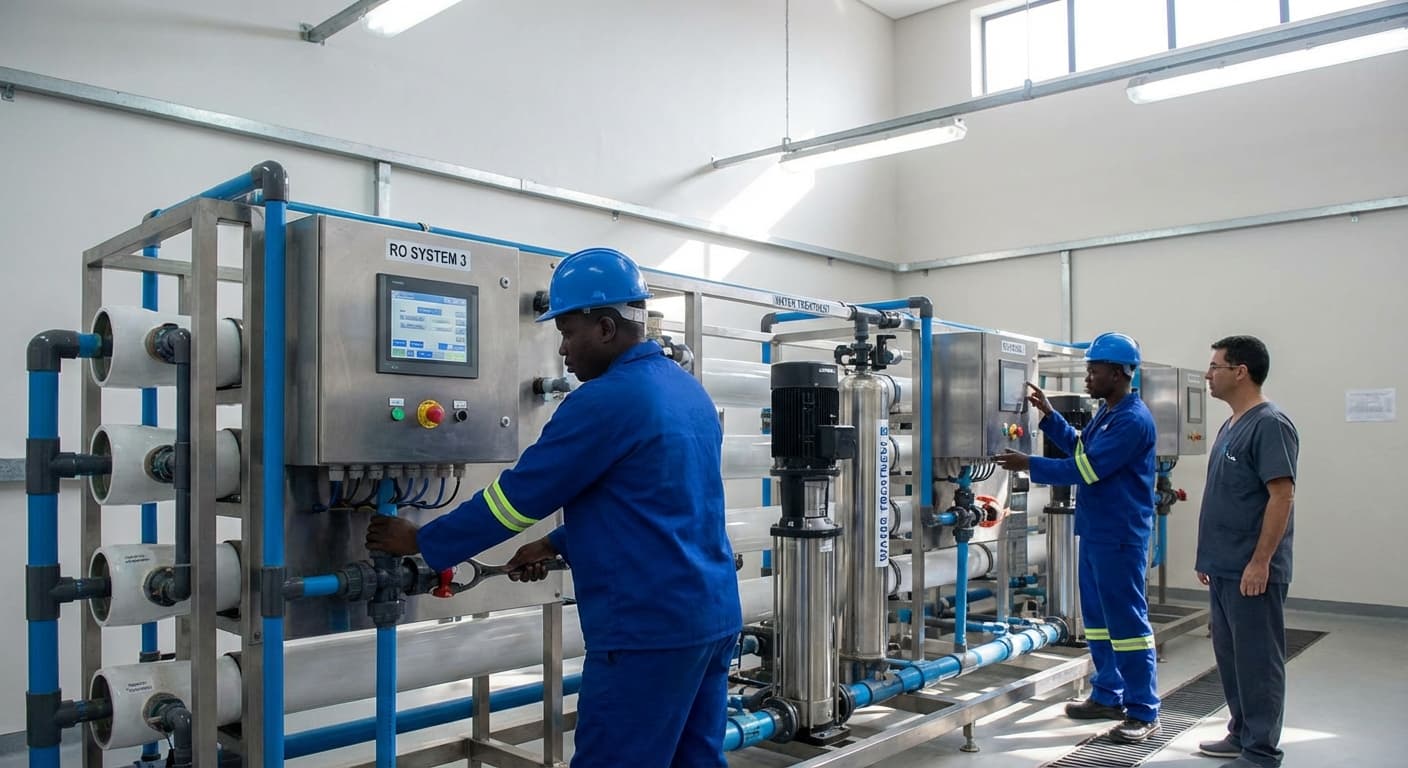
Dialysis RO/Water Treatment Plant Installation Service in Zimbabwe
Engineering Excellence & Technical Support
Dialysis RO/Water Treatment Plant Installation Service High-standard technical execution following OEM protocols and local regulatory frameworks.
Advanced RO Membrane Technology
Our installations leverage cutting-edge Reverse Osmosis (RO) membrane technology, ensuring ultra-pure water for dialysis, exceeding international standards and safeguarding patient health. We specialize in selecting and integrating high-performance membranes optimized for local water conditions in Zimbabwe.
Robust Water Treatment System Design
We design and implement comprehensive water treatment systems, integrating multi-stage filtration, UV sterilization, and meticulous disinfection protocols. Our solutions are engineered for reliability and efficiency, minimizing downtime and ensuring a consistent, high-quality water supply for your dialysis facility.
Localized Expertise & Sustainable Solutions
With in-depth knowledge of Zimbabwe's water sources and environmental challenges, we provide tailored RO and water treatment plant installations. Our commitment extends to sustainable practices, offering energy-efficient designs and local training for optimal plant operation and maintenance.
What Is Dialysis Ro/water Treatment Plant Installation Service In Zimbabwe?
Dialysis RO/Water Treatment Plant Installation Service in Zimbabwe refers to the professional provision of systems designed to purify water for use in hemodialysis procedures. This service encompasses the design, engineering, procurement, installation, commissioning, and ongoing maintenance of Reverse Osmosis (RO) and associated water treatment technologies. The primary objective is to produce ultrapure water that meets stringent medical standards, removing contaminants such as dissolved solids, bacteria, endotoxins, chlorine, and heavy metals that could be harmful to dialysis patients. This is critical because hemodialysis involves circulating the patient's blood through an artificial kidney, where it comes into direct contact with dialysate, a fluid prepared using treated water. Any impurities in the water can lead to serious complications for the patient.
| Beneficiary | Primary Need | Typical Use Cases |
|---|---|---|
| Hospitals and Dialysis Clinics | To ensure the availability of safe, high-purity water for hemodialysis treatments, complying with international and local healthcare regulations. | Providing dialysate for in-center hemodialysis, both for routine and emergency treatments. Ensuring water quality for peritoneal dialysis solution preparation in some advanced facilities. |
| Medical Equipment Suppliers and Integrators | To offer complete, turnkey solutions for healthcare facilities establishing or upgrading dialysis services, including the critical water supply infrastructure. | Integrating water treatment plants as part of a comprehensive dialysis unit setup, ensuring all components are compatible and functional. |
| Government Health Ministries and Public Health Facilities | To equip public healthcare institutions with the necessary infrastructure to provide essential dialysis services to the population, especially in underserved areas. | Establishing dialysis centers in regional hospitals or national health complexes to manage chronic kidney disease (CKD) patients. |
| Private Healthcare Providers | To deliver premium dialysis services with the highest safety standards, attracting patients and ensuring a reliable operational framework. | Operating standalone dialysis centers or dialysis units within private hospitals. |
Key Components and Processes of Dialysis Water Treatment Plant Installation
- Pre-treatment Systems: Including sediment filtration, activated carbon filtration (for chlorine and organic removal), and water softening (to prevent scaling).
- Reverse Osmosis (RO) Units: The core of the system, employing semi-permeable membranes to remove a vast majority of dissolved salts, minerals, and other contaminants.
- Post-treatment Systems: Often includes ultrafiltration (UF) to remove any remaining particulate matter and endotoxins, and potentially UV sterilization or ozonation for disinfection.
- Storage and Distribution Systems: Including tanks constructed from inert materials and piping designed to prevent biofilm formation and maintain water quality.
- Monitoring and Control Systems: Incorporating sensors and alarms to continuously monitor water quality parameters (e.g., conductivity, total organic carbon) and operational status.
- Installation and Commissioning: Physical setup of the plant, connection to water sources and dialysis machines, and rigorous testing to validate performance against established standards (e.g., AAMI, ISO).
- Training and Handover: Providing comprehensive training to facility staff on operation, maintenance, and troubleshooting.
- Maintenance and Support: Offering scheduled preventative maintenance, emergency repairs, and water quality testing services.
Who Needs Dialysis Ro/water Treatment Plant Installation Service In Zimbabwe?
In Zimbabwe, the demand for reliable and high-quality water treatment solutions for dialysis facilities is paramount. Dialysis centers, both public and private, require specialized Reverse Osmosis (RO) and water treatment plants to ensure the purified water used in hemodialysis meets stringent medical standards. This prevents complications and ensures patient safety. Beyond healthcare, research institutions and educational facilities with medical training programs may also require such installations for practical training and research purposes.
| Target Customer Segment | Key Departments/Stakeholders | Specific Needs/Considerations |
|---|---|---|
| Hospitals (Public and Private) | Nephrology Department, Biomedical Engineering Department, Procurement Department, Facility Management | High-volume water purification for multiple dialysis machines, adherence to international and local health standards, long-term maintenance and support, reliability and uptime. |
| Renal Dialysis Clinics | Clinic Management, Medical Director, Operations Manager, Technical Staff | Dedicated RO systems for dialysis, cost-effectiveness, efficient water usage, compliance with regulatory requirements, space optimization. |
| Medical Research Institutions | Research Labs, Biomedical Science Departments, Facilities Management | Purified water for laboratory experiments, consistent water quality, potential for customization based on research needs, integration with existing laboratory infrastructure. |
| Universities and Colleges with Medical/Nursing Programs | Medical Schools, Nursing Departments, Biomedical Engineering Departments, Training Labs, Facilities Management | Water treatment systems for student training and practical sessions, educational demonstration units, adherence to safety protocols, scalability for growing programs. |
| Government Health Ministries/Departments | Public Health Infrastructure Division, Procurement Agencies, Regulatory Bodies | Standardization of water quality across public healthcare facilities, large-scale tenders, long-term service agreements, capacity building for local technicians, ensuring access in underserved areas. |
Target Customers for Dialysis RO/Water Treatment Plant Installation Service in Zimbabwe
- Hospitals (Public and Private)
- Renal Dialysis Clinics
- Medical Research Institutions
- Universities and Colleges with Medical/Nursing Programs
- Government Health Ministries/Departments
Dialysis Ro/water Treatment Plant Installation Service Process In Zimbabwe
This document outlines the comprehensive workflow for the installation of Dialysis Reverse Osmosis (RO) and Water Treatment Plants in Zimbabwe. It details the process from the initial client inquiry to the final handover and ongoing support, ensuring a smooth and efficient project execution.
| Phase | Key Activities | Deliverables/Outcomes |
|---|---|---|
| Inquiry & Consultation | Initial contact, requirement gathering, preliminary site assessment. | Understanding of client needs, identification of potential challenges. |
| Needs Assessment & Site Survey | Detailed water source analysis, infrastructure evaluation, space assessment. | Comprehensive report on site conditions and technical requirements. |
| System Design & Proposal | Customized system design, component selection, cost estimation. | Detailed proposal with technical specifications and pricing. |
| Client Approval & Contract | Proposal review and modification, contract negotiation and signing. | Signed contract, confirmed project scope and terms. |
| Procurement & Logistics | Sourcing equipment, quality control, transportation to Zimbabwe. | All necessary components delivered to the site. |
| On-site Installation & Setup | Physical installation of the RO and water treatment plant. | Fully assembled and connected water treatment system. |
| Commissioning & Testing | System startup, functional tests, water quality analysis. | Validated system performance, certified water quality. |
| Operator Training | Instruction on operation, maintenance, and troubleshooting. | Trained client personnel. |
| Handover & Documentation | Formal transfer of the system, provision of manuals and certificates. | Complete handover package, client acknowledgment. |
| Post-Installation Support | Ongoing maintenance, repairs, spare parts, performance monitoring. | Ensured long-term operational efficiency and reliability. |
Dialysis RO/Water Treatment Plant Installation Process in Zimbabwe
- Inquiry & Consultation: The process begins with a potential client reaching out with a need for a dialysis water treatment system. This initial contact triggers a detailed consultation to understand the client's specific requirements, including patient volume, existing infrastructure, water source analysis, budget, and desired system capacity. Site visits may be conducted at this stage for a thorough assessment.
- Needs Assessment & Site Survey: A more in-depth analysis of the client's facility is performed. This includes evaluating the water source quality (testing for contaminants, hardness, chlorine levels, etc.), available space for the plant, power supply capacity, plumbing infrastructure, and any specific regulatory requirements or preferences.
- System Design & Proposal Generation: Based on the needs assessment and site survey, a customized RO and water treatment system design is developed. This includes selecting appropriate technologies (e.g., pre-filtration, RO membranes, post-treatment, disinfection methods), sizing components, and specifying materials. A detailed proposal is then generated, outlining the system specifications, scope of work, timeline, cost breakdown, warranty information, and payment terms.
- Client Approval & Contract Signing: The client reviews the proposal, and any necessary modifications are discussed and incorporated. Upon mutual agreement, a formal contract is signed, outlining the responsibilities of both parties and project milestones.
- Procurement & Logistics: Once the contract is signed, all necessary equipment, components, and consumables are procured from reliable suppliers. This involves managing inventory, ensuring quality control of delivered materials, and arranging for secure transportation and logistics to the installation site in Zimbabwe.
- On-site Installation & Setup: A team of qualified technicians and engineers arrives at the site to commence the installation. This phase involves: * Site preparation (clearing space, ensuring access). * Plumbing and electrical connections. * Assembly and mounting of the RO and water treatment plant components. * Installation of piping, valves, and control systems. * Integration with existing hospital or clinic infrastructure.
- System Commissioning & Testing: After installation, the system undergoes rigorous commissioning and testing. This includes: * Flushing the system to remove any installation debris. * Testing individual components for functionality. * Running the system under load conditions. * Conducting comprehensive water quality testing to ensure it meets the stringent standards required for dialysis (e.g., USP, AAMI standards).
- Operator Training: A crucial step is providing comprehensive training to the client's designated personnel. This training covers the operation, routine maintenance, troubleshooting, and safety procedures for the installed system, empowering them to manage it effectively.
- Handover & Documentation: Upon successful commissioning, testing, and training, the system is formally handed over to the client. This includes providing all relevant documentation, such as operation and maintenance manuals, equipment specifications, warranty certificates, and test results.
- Post-Installation Support & Maintenance: Our commitment extends beyond installation. We offer ongoing support, including: * Routine maintenance services. * Scheduled inspections. * Troubleshooting and repair services. * Supply of spare parts and consumables. * Periodic performance monitoring and optimization.
Dialysis Ro/water Treatment Plant Installation Service Cost In Zimbabwe
Installing a Reverse Osmosis (RO) and water treatment plant for dialysis in Zimbabwe involves a significant investment. The cost is influenced by several critical factors, making it difficult to provide a single definitive price. These factors range from the scale and complexity of the system to the specific equipment chosen and the associated installation services. Understanding these elements is crucial for accurate budgeting and planning for healthcare facilities requiring reliable, high-purity water for hemodialysis. The local currency, the Zimbabwean Dollar (ZWL), is subject to volatility, which can impact the final cost, especially for imported components. Therefore, it's essential to obtain detailed quotes from reputable suppliers and installers who are experienced in the Zimbabwean market.
| System Type/Capacity | Estimated Cost Range (ZWL) |
|---|---|
| Small-Scale Dialysis RO System (e.g., for 1-2 stations, <50 LPH) | 15,000 - 45,000 ZWL |
| Medium-Scale Dialysis RO System (e.g., for 3-5 stations, 50-150 LPH) | 45,000 - 120,000 ZWL |
| Large-Scale Dialysis RO System (e.g., for 6+ stations, >150 LPH, with extensive pre-treatment) | 120,000 - 300,000+ ZWL |
| Full Water Treatment Plant (including advanced pre-treatment, RO, and potentially post-treatment) | Can significantly exceed 300,000 ZWL, depending on complexity and capacity. |
Key Pricing Factors for Dialysis RO/Water Treatment Plant Installation in Zimbabwe:
- System Capacity (Liters per Hour/Day): The volume of purified water required dictates the size and complexity of the RO system, directly impacting its cost. Larger capacity systems are more expensive.
- Technology and Components: The specific RO membranes, pre-filters (sediment, carbon), post-filters (sterilization, UV), pumps, storage tanks, and control systems used will vary in quality and price. High-end, durable components will cost more.
- Water Source Quality: If the source water (e.g., borehole, municipal supply) has high levels of contaminants (TDS, hardness, specific ions), more advanced pre-treatment stages will be necessary, increasing the overall cost.
- Level of Automation and Monitoring: Fully automated systems with advanced sensors, data logging, and remote monitoring capabilities will be more expensive than simpler manual systems.
- Installation Complexity: This includes site preparation, plumbing, electrical work, pipe material choices (e.g., PVC, stainless steel), and the accessibility of the installation location.
- Brand and Manufacturer: Different brands have varying price points based on their reputation, warranty, and perceived quality. Well-established international brands might be more expensive but often offer better reliability.
- Supplier and Installer Reputation/Experience: Experienced and reputable companies in Zimbabwe may charge a premium for their expertise, quality assurance, and after-sales support.
- Commissioning and Training: The cost of properly commissioning the plant to ensure it meets dialysis standards and providing training to facility staff is often a separate, but essential, component of the total cost.
- Ancillary Equipment: This can include water softeners, deionizers (if required as a secondary treatment), backwash systems, and emergency bypass systems.
- Permits and Approvals: Any required local authority permits or health department approvals can add to the administrative costs.
- Delivery and Logistics: Transportation of equipment to the installation site, especially in remote areas, will influence the final price.
- Warranty and After-Sales Service: The length and scope of the warranty, along with the availability and cost of ongoing maintenance and spare parts, should be considered.
Affordable Dialysis Ro/water Treatment Plant Installation Service Options
Finding affordable dialysis RO/water treatment plant installation services is crucial for healthcare facilities to ensure patient safety and operational efficiency without breaking the budget. This involves understanding different service options, particularly value bundles, and implementing smart cost-saving strategies. Value bundles often package installation with essential components like maintenance, training, and initial water quality testing, offering a more comprehensive and potentially cost-effective solution than procuring services piecemeal. Cost-saving strategies can range from selecting energy-efficient equipment to negotiating bulk discounts and exploring phased installation approaches.
| Value Bundle Component | Description | Potential Cost Savings |
|---|---|---|
| Installation & Commissioning | Professional setup and initial testing of the RO/water treatment system. | Avoids costly errors and downtime from DIY or inexperienced installations. |
| Essential Equipment Supply | Includes membranes, filters, pumps, and control systems. | Bulk purchasing by the provider can lead to lower unit costs than individual purchases. |
| Initial Water Quality Testing | Comprehensive analysis of incoming water and post-treatment water quality. | Ensures compliance from the start, preventing re-testing fees and potential patient health risks. |
| Operator Training | Training for facility staff on system operation, basic maintenance, and troubleshooting. | Reduces reliance on external technicians for minor issues, saving on call-out fees. |
| Preventive Maintenance Package (Optional) | Scheduled maintenance visits and replacement of consumables. | Extends equipment lifespan, prevents costly breakdowns, and ensures consistent water quality, avoiding emergency repair costs. |
| Extended Warranty | Covers unexpected equipment failures beyond the standard warranty period. | Provides peace of mind and protects against significant repair bills. |
Key Considerations for Affordable Dialysis RO/Water Treatment Plant Installation
- Understanding different service provider tiers (e.g., full-service, component-based).
- Evaluating the long-term operational costs beyond initial installation (e.g., energy consumption, consumables, maintenance).
- Prioritizing compliance with relevant health and water quality standards.
- Assessing the vendor's experience and reputation in the dialysis water treatment sector.
- Exploring options for used or refurbished equipment where appropriate and compliant.
- Investigating potential government grants or subsidies for healthcare infrastructure.
Verified Providers In Zimbabwe
In Zimbabwe's rapidly evolving healthcare landscape, identifying reliable and credentialed healthcare providers is paramount for patients seeking quality care. Verified providers offer a crucial layer of assurance, ensuring that practitioners meet stringent professional standards and ethical guidelines. This focus on verification is particularly important in a market where distinguishing genuine expertise from unqualified services can be challenging. Among the leading entities dedicated to this task, Franance Health stands out for its rigorous credentialing process and commitment to patient well-being.
| Aspect of Verification | Franance Health's Approach | Benefit to Patients |
|---|---|---|
| Educational Qualifications | Thorough scrutiny of degrees, diplomas, and specialized training from accredited institutions. | Ensures providers possess the foundational knowledge and expertise required for their practice. |
| Professional Licenses & Registration | Verification of current and valid licenses with the Medical and Dental Practitioners Council of Zimbabwe (MDPCZ) and other relevant professional bodies. | Confirms that providers are legally authorized and regulated to practice. |
| Clinical Experience | Assessment of practical experience, including duration, areas of specialization, and any relevant fellowships or internships. | Guarantees that providers have hands-on experience in treating diverse medical conditions. |
| Reputation & Disciplinary Record | Checks for any past disciplinary actions or adverse findings from regulatory bodies or professional associations. | Safeguards against providers with a history of malpractice or unethical behavior. |
| Continuing Professional Development (CPD) | Ensures providers are actively engaged in ongoing learning and skill enhancement to stay abreast of medical advancements. | Confirms that providers are up-to-date with the latest medical knowledge and techniques. |
Franance Health: A Beacon of Verified Healthcare in Zimbabwe
- Comprehensive Verification Process: Franance Health employs a multi-faceted approach to verify healthcare providers. This includes rigorous checks on educational qualifications, professional licenses, registration with relevant medical councils, and a thorough review of their clinical experience and practice history.
- Commitment to Ethical Practice: Beyond mere qualifications, Franance Health assesses providers for adherence to ethical codes of conduct and best practices in patient care. This ensures a focus on patient safety, privacy, and informed consent.
- Ongoing Monitoring and Re-evaluation: Verification is not a one-time event. Franance Health maintains an ongoing monitoring system to ensure that providers continue to meet their high standards. This includes mechanisms for patient feedback and periodic re-evaluations.
- Access to Quality Care: By partnering with Franance Health, patients gain access to a curated network of demonstrably qualified and trustworthy healthcare professionals across various specialities. This streamlines the process of finding suitable care and reduces the risk of encountering unqualified practitioners.
- Promoting Patient Confidence: The Franance Health seal of verification serves as a strong indicator of competence and reliability, fostering greater confidence among patients when making critical healthcare decisions.
Scope Of Work For Dialysis Ro/water Treatment Plant Installation Service
This Scope of Work (SOW) outlines the requirements for the installation services of a Dialysis Reverse Osmosis (RO)/Water Treatment Plant. The service provider will be responsible for all aspects of the installation, commissioning, and initial testing of the provided RO/Water Treatment Plant system, ensuring it meets the specified technical requirements and standard specifications for safe and effective operation in a dialysis setting. The goal is to deliver a fully functional and compliant water treatment system ready for patient use.
| Deliverable Category | Specific Technical Deliverable | Standard Specification / Requirement | Verification Method |
|---|---|---|---|
| System Installation | Complete physical installation of all RO/Water Treatment Plant components (pre-filters, RO membranes, post-filters, storage tanks, distribution loop, etc.) | As per manufacturer's installation manual and site-specific engineering drawings. All connections to be leak-free and robust. | Visual inspection, pressure testing, leak detection. |
| Piping and Plumbing | Installation of all necessary piping for water intake, treatment stages, purified water storage, and distribution to dialysis stations. Material to be food-grade, non-corrosive (e.g., NSF-certified UPVC, PEX, or stainless steel). | ASTM/ASME standards for plumbing, adherence to local health and building codes. Minimum pipe diameter to ensure adequate flow rates as per design. | Visual inspection of pipe material and joint integrity. Hydrostatic testing for leak detection. |
| Electrical Connections | Safe and compliant electrical wiring and connection of all system components (pumps, control panels, sensors, UV sterilizers, etc.) to the main power supply. | Compliance with local electrical codes (e.g., NEC, IEC). Proper grounding and surge protection. Wiring diagrams to be followed meticulously. | Electrical testing (continuity, insulation resistance), visual inspection of connections, functional testing of powered components. |
| Sanitization and Sterilization | Thorough flushing and chemical/UV sanitization of the entire system to eliminate microbial contamination prior to commissioning. | Adherence to AAMI standards (e.g., AAMI RD62) for water quality and sanitation. Use of approved sanitizing agents. | Microbiological testing of water at key points post-sanitization. Turbidity and TOC testing. |
| Commissioning | System startup, calibration of all sensors (pressure, flow, conductivity, pH), and initial operational checks. | Manufacturer's commissioning procedures. All setpoints to be verified and adjusted as per design specifications. | Functional testing of all components, sensor readings verification, operational parameter logging. |
| Performance Testing | Testing of the purified water quality against established standards after reaching stable operation. | AAMI/ISO/local regulatory standards for dialysis water quality (e.g., total dissolved solids < 2 ppm, conductivity < 1 µS/cm @ 25°C, endotoxin levels, total viable microbial count). | On-site water quality testing using calibrated meters and validated laboratory analysis for microbiological and chemical parameters. |
| System Documentation | Provision of comprehensive installation, operation, and maintenance (IOM) manuals, as-built drawings, test reports, and certificates. | Manufacturer's standard documentation. As-built drawings to accurately reflect the final installed system. All test results to be signed and dated. | Review of provided documentation for completeness and accuracy. |
| Operator Training | Training of designated facility personnel on the operation, routine maintenance, troubleshooting, and emergency procedures for the RO/Water Treatment Plant. | Comprehensive coverage of all operational aspects. Practical demonstration of routine tasks. | Participant comprehension assessment, post-training observation of operator proficiency. |
| Material and Workmanship | All materials used (piping, fittings, sealants, etc.) and workmanship shall be of the highest quality and suitable for potable water applications in a healthcare environment. | NSF/ANSI standards, FDA-approved materials where applicable. Workmanship to be performed by qualified and experienced technicians. | Material certifications review, visual inspection of workmanship. |
Key Stages of Installation Service
- Site Survey and Assessment
- Equipment Delivery and Unpacking
- Piping and Plumbing Installation
- Electrical Wiring and Connection
- System Assembly and Integration
- Flushing and Sanitization
- Commissioning and System Startup
- Performance Testing and Validation
- Operator Training
- Documentation and Handover
Service Level Agreement For Dialysis Ro/water Treatment Plant Installation Service
This Service Level Agreement (SLA) outlines the response times and uptime guarantees for the installation services of Dialysis Reverse Osmosis (RO)/Water Treatment Plants provided by [Your Company Name] to [Client Name]. This SLA is an addendum to the main Service Agreement dated [Date of Main Agreement].
| Service Component | Response Time | Resolution Time | Uptime Guarantee |
|---|---|---|---|
| Initial Site Assessment & Planning | Within 2 business days of request | N/A (Completion based on project scope) | N/A |
| On-site Installation Commencement | Within 5 business days of site readiness confirmation | N/A (Completion based on project scope) | N/A |
| Critical System Malfunction (Post-Installation within warranty period, affecting core RO/UF function) | Within 4 business hours | Within 24 business hours | 99.5% system uptime during operational hours (excluding scheduled maintenance) |
| Non-Critical System Issue (e.g., minor sensor alert, pump issue not impacting core function) | Within 8 business hours | Within 48 business hours | N/A (Client availability may impact resolution) |
| Water Quality Parameter Deviation (outside specified limits) | Within 4 business hours | Within 12 business hours | N/A (Resolution focused on corrective action) |
Scope of Service
- Installation of new Dialysis RO/Water Treatment Plant systems.
- Configuration and commissioning of the installed systems.
- Initial training for client personnel on system operation and basic maintenance.
- Post-installation verification of water quality parameters as per agreed specifications.
Frequently Asked Questions

Ready when you are
Let's scope your Dialysis RO/Water Treatment Plant Installation Service in Zimbabwe project in Zimbabwe.

Scaling healthcare logistics and technical systems across the entire continent.