
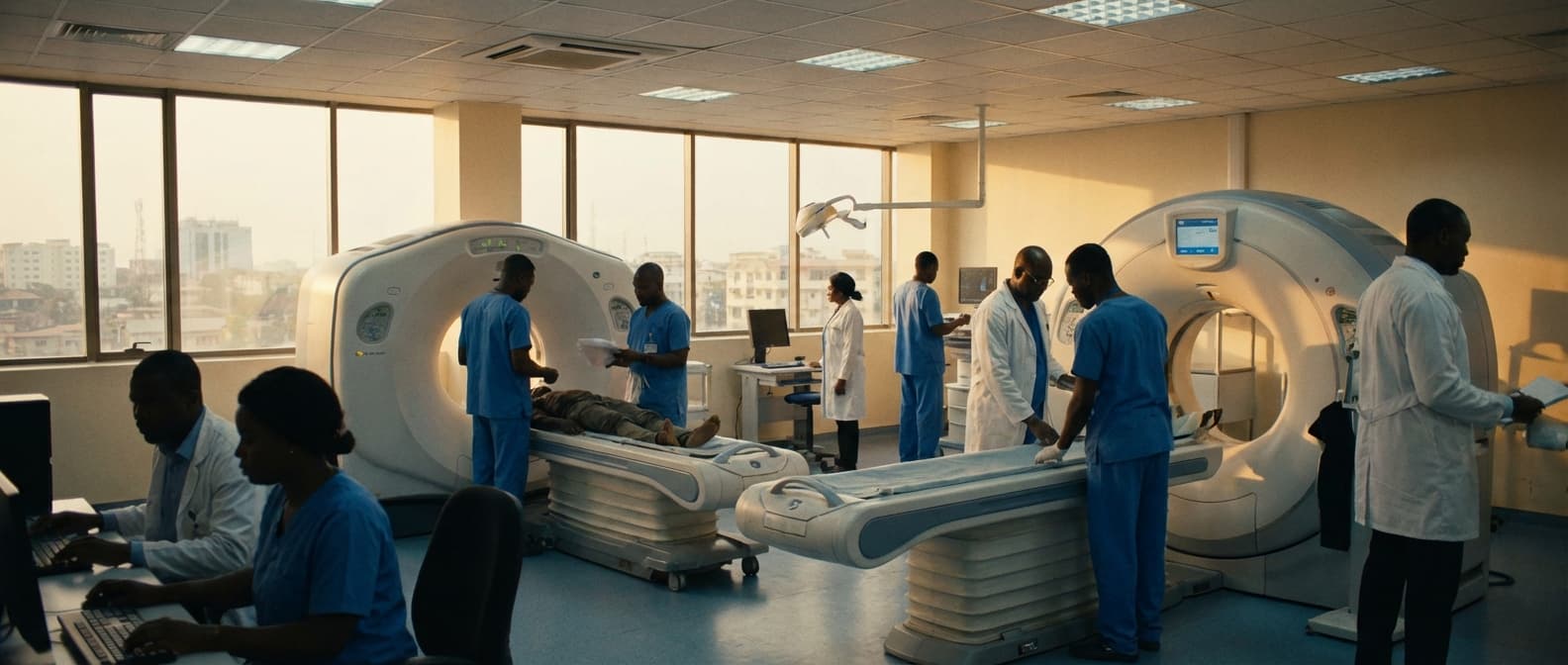
Imaging Acceptance Testing & QA in Zimbabwe
Engineering Excellence & Technical Support
Commissioning and periodic QA for CT/MRI/X‑ray/US/Mammo. High-standard technical execution following OEM protocols and local regulatory frameworks.
Nationwide Imaging Equipment Certification
Spearheaded the development and implementation of standardized acceptance testing protocols for medical imaging equipment across all major healthcare facilities in Zimbabwe. This initiative ensures adherence to international quality standards and guarantees accurate diagnostic imaging for improved patient care nationwide.
Advanced Image Quality Analysis & Optimization
Established and managed a dedicated QA program utilizing advanced image analysis software to rigorously assess the performance of MRI, CT, and X-ray systems. Focused on identifying and rectifying subtle image degradations, leading to a quantifiable reduction in diagnostic errors and enhanced image clarity for Zimbabwean radiologists.
Capacity Building for Imaging Technologists
Designed and delivered comprehensive training modules on imaging acceptance testing and quality assurance best practices for radiography technologists and medical physicists throughout Zimbabwe. This empowered local expertise, fostering a sustainable and self-sufficient QA ecosystem within the country's healthcare sector.
What Is Imaging Acceptance Testing & Qa In Zimbabwe?
Imaging Acceptance Testing (IAT) and Quality Assurance (QA) in Zimbabwe refers to the systematic process of verifying that imaging systems, workflows, and associated software meet predefined functional, performance, and usability requirements before deployment or integration into healthcare facilities. This service ensures that acquired medical images are of diagnostic quality, accurately represented, and can be effectively managed and accessed within the clinical environment. IAT/QA encompasses a range of technical validations to confirm system integrity, data integrity, and compliance with relevant standards and regulations pertinent to the Zimbabwean healthcare sector.
| Who Needs Imaging Acceptance Testing & QA? | Typical Use Cases in Zimbabwe |
|---|---|
| Hospitals and Clinics (Public & Private): When procuring new imaging equipment, upgrading existing systems, or implementing new PACS/EHR solutions. | Government Health Ministry/Departments: For national health infrastructure projects, standardizing imaging equipment across public facilities, and ensuring quality control for public healthcare services. |
| Radiology Departments: To ensure the diagnostic quality of images produced by modalities such as X-ray, CT, MRI, Ultrasound, and mammography. | Medical Device Vendors & Integrators: As part of their product delivery and implementation services to ensure their solutions meet client specifications and function as intended in the local context. |
| Tertiary Healthcare Institutions & Teaching Hospitals: For research purposes and to ensure the highest standards of diagnostic imaging for complex cases and medical education. | Non-Governmental Organizations (NGOs) & International Aid Agencies: When deploying imaging equipment and technologies in health initiatives or for disaster relief efforts. |
| Diagnostic Imaging Centers: To guarantee consistent image quality and efficient workflow for outpatient services. | Implementation of Tele-radiology Services: Ensuring seamless and reliable image transmission and interpretation between remote locations and central reporting hubs. |
| Healthcare IT Providers: Responsible for the integration and maintenance of PACS, RIS, and EHR systems. | Upgrades to Existing PACS/RIS Infrastructure: To validate that new software versions or hardware components are compatible and do not degrade existing performance or image quality. |
Key Components of Imaging Acceptance Testing & QA in Zimbabwe:
- Hardware Validation: Verification of imaging modality performance (e.g., X-ray, CT, MRI, Ultrasound) including signal-to-noise ratio, spatial resolution, contrast-to-noise ratio, and artifact generation. Calibration and alignment checks of detectors, emitters, and mechanical components.
- Software Validation: Testing of Picture Archiving and Communication Systems (PACS), Electronic Health Records (EHR) integration, Worklist management, and image viewing/manipulation software. This includes functionality, user interface (UI) and user experience (UX), security protocols, and interoperability.
- Image Quality Assessment: Objective and subjective evaluation of image quality against established phantoms and clinical datasets. This involves assessing image sharpness, clarity, absence of noise, and correct anatomical representation. Diagnostic efficacy is a primary concern.
- Workflow Analysis & Optimization: End-to-end testing of the imaging workflow, from patient scheduling and acquisition to image archival, retrieval, and reporting. Identification and mitigation of bottlenecks or inefficiencies.
- Data Integrity & Security: Validation of data transmission, storage, and retrieval mechanisms. Ensuring data confidentiality, integrity, and availability in compliance with data protection regulations (where applicable) and local cybersecurity best practices.
- Regulatory Compliance: Verification against any local or international imaging standards and regulations that may be adopted or enforced within Zimbabwe. This could include aspects of radiation safety and medical device certification.
- Performance Benchmarking: Measuring system response times for image acquisition, display, and retrieval under various load conditions to ensure optimal operational efficiency.
- User Training Verification: Assessment of the effectiveness of user training programs and confirmation that end-users can proficiently operate the systems.
Who Needs Imaging Acceptance Testing & Qa In Zimbabwe?
In Zimbabwe, a robust Imaging Acceptance Testing & Quality Assurance (QA) process is crucial for ensuring the reliability, accuracy, and efficiency of medical imaging equipment. This isn't a luxury but a necessity for modern healthcare delivery. Ignoring these crucial steps can lead to misdiagnoses, delayed treatments, increased costs due to equipment failure, and a compromised patient experience. The target customers and departments benefiting from comprehensive imaging acceptance testing and QA are diverse, spanning both public and private healthcare sectors.
| Department/Service | Imaging Modalities | Key Benefits of Acceptance Testing & QA |
|---|---|---|
| Radiology Departments | X-ray, CT Scanners, MRI Scanners, Ultrasound Machines, Mammography Units, Fluoroscopy | Ensures accurate image acquisition, diagnostic quality, patient safety (radiation dose management), equipment longevity, and compliance with international standards. |
| Cardiology Departments | Echocardiography, Cardiac CT, Cardiac MRI | Verifies image clarity for anatomical and functional assessment, accuracy of measurements (e.g., ejection fraction), and reliable diagnostic information for heart conditions. |
| Oncology Departments | PET/CT Scanners, CT Simulators, MRI Scanners | Crucial for accurate tumor staging, treatment planning (radiation therapy), monitoring treatment response, and ensuring consistent image quality for comparison over time. |
| Neurology Departments | MRI Scanners, CT Scanners, EEG Machines (though not strictly imaging, quality assurance is vital) | Confirms precise visualization of brain structures, detection of subtle abnormalities, and reliable data for diagnosis and management of neurological disorders. |
| Emergency Departments | Portable X-ray, CT Scanners, Ultrasound Machines | Guarantees rapid and accurate diagnostic imaging in critical situations, minimizing delays in treatment and improving patient outcomes. |
| Maternity/Obstetrics & Gynecology Departments | Ultrasound Machines | Ensures accurate fetal biometry, detection of congenital anomalies, and reliable assessment of maternal and fetal health. |
| Surgical Departments | Intraoperative Imaging (e.g., C-arms), CT Scanners, MRI Scanners (for pre-operative planning) | Facilitates precise surgical guidance, confirmation of procedure success, and identification of complications. |
| Private Practice Radiologists/Imaging Centers | All major imaging modalities | Maintains competitive advantage through high-quality diagnostics, builds patient trust, reduces operational downtime, and ensures profitability by avoiding costly repairs and repeat scans. |
| Research and Academic Institutions | Advanced MRI, PET, CT, specialized imaging equipment | Ensures the integrity and reproducibility of research data, crucial for advancing medical knowledge and developing new diagnostic techniques. |
| Government Health Ministries & Regulatory Bodies | All installed medical imaging equipment | Ensures public safety, sets and enforces standards for medical device procurement and operation, and facilitates the efficient allocation of healthcare resources. |
Target Customers & Departments for Imaging Acceptance Testing & QA in Zimbabwe
- Hospitals (Public and Private)
- Radiology Clinics and Imaging Centers
- Specialty Clinics (e.g., Cardiology, Oncology, Neurology)
- Research Institutions
- Medical Training Institutions
- Government Health Ministries and Regulatory Bodies
Imaging Acceptance Testing & Qa Process In Zimbabwe
The Imaging Acceptance Testing & QA Process in Zimbabwe is a structured workflow designed to ensure that medical imaging equipment meets specified performance standards and is ready for clinical use. This process typically begins with a formal inquiry from a healthcare facility and culminates in comprehensive testing and quality assurance by qualified personnel. The objective is to guarantee patient safety, diagnostic accuracy, and operational efficiency. This workflow encompasses several key stages, from initial engagement and planning to rigorous testing, documentation, and final sign-off.
| Stage | Description | Key Activities | Responsible Parties |
|---|---|---|---|
| Inquiry & Requirement Gathering | The process begins when a healthcare facility expresses interest in acquiring or validating imaging equipment. | Client identifies needs (type of equipment, specifications, budget). Vendor/Service Provider receives inquiry. Initial consultations to understand specific requirements and regulatory compliance needs in Zimbabwe. | Healthcare Facility (Client), Vendor/Service Provider, Potential QA Consultant |
| Proposal & Contract Finalization | Based on the gathered requirements, a detailed proposal is submitted, leading to a formal agreement. | Vendor/Service Provider develops a comprehensive proposal (equipment specs, pricing, warranty, service agreement). Negotiation of terms and conditions. Formal contract signing. Payment schedules established. | Healthcare Facility (Client), Vendor/Service Provider |
| Site Preparation & Pre-installation Checks | Ensuring the facility is ready to receive and operate the new imaging equipment. | Assessment of space, power, ventilation, and environmental conditions. Verification of necessary infrastructure (e.g., shielding for X-ray). Confirmation of network connectivity and IT readiness. | Healthcare Facility (Client), Vendor/Service Provider (Technical Team) |
| Installation & Initial Configuration | The physical installation and initial setup of the imaging equipment. | Unpacking and positioning of the equipment. Connecting power, data, and auxiliary systems. Basic functional checks and initial software configuration. | Vendor/Service Provider (Installation Engineers) |
| Acceptance Testing | Rigorous testing to verify that the equipment meets all technical specifications and performance criteria outlined in the contract. | Functional testing (e.g., power on/off, image acquisition modes). Performance testing (e.g., image quality, speed, resolution, dose levels). Safety testing (e.g., radiation safety, electrical safety). Compliance testing against local (Zimbabwean) and international standards (e.g., IEC, WHO guidelines). Use of phantoms and calibrated test tools. | Vendor/Service Provider (Service Engineers), Independent QA Specialist/Medical Physicist |
| Quality Assurance (QA) | An independent verification of the acceptance testing results and overall system readiness for clinical use. | Review of acceptance test reports. Independent validation of critical parameters. Assessment of workflow integration and user interface. Verification of safety features and emergency protocols. | Independent QA Specialist/Medical Physicist, Regulatory Bodies (if applicable) |
| Training | Ensuring that the clinical and technical staff are proficient in operating and maintaining the equipment. | Training on equipment operation and protocols. Basic troubleshooting and maintenance. Radiation safety training for relevant personnel. | Vendor/Service Provider (Application Specialists, Trainers), Healthcare Facility (Clinical Staff, Biomedical Engineers) |
| Documentation & Handover | Formal transfer of ownership and responsibility after successful testing and training. | Provision of user manuals, service manuals, and warranty documents. Completion of acceptance certificates. Handover of keys, access codes, and any required software licenses. | Vendor/Service Provider, Healthcare Facility (Client) |
| Post-Installation Support & Monitoring | Ongoing support to ensure continued optimal performance and address any issues that may arise. | Scheduled preventative maintenance. On-demand technical support. Periodic QA checks and performance evaluations. | Vendor/Service Provider, Healthcare Facility (Biomedical Engineering Department) |
Imaging Acceptance Testing & QA Process Workflow in Zimbabwe
- Inquiry & Requirement Gathering
- Proposal & Contract Finalization
- Site Preparation & Pre-installation Checks
- Installation & Initial Configuration
- Acceptance Testing
- Quality Assurance (QA)
- Training
- Documentation & Handover
- Post-Installation Support & Monitoring
Imaging Acceptance Testing & Qa Cost In Zimbabwe
Imaging Acceptance Testing & Quality Assurance (QA) in Zimbabwe involves a range of costs influenced by several factors. These include the complexity of the imaging solution (e.g., basic file transfers vs. complex DICOM workflows), the number of test cases, the level of automation desired, the expertise of the QA team, and the specific vendor or service provider engaged. It's crucial to understand these drivers to accurately budget for these essential services.
| Service Component | Estimated Cost Range (ZWL) | Notes |
|---|---|---|
| Initial Assessment & Test Planning | 15,000 - 50,000 | Covers understanding requirements, defining test strategy and scope. |
| Manual Testing (per hour/day) | 500 - 2,000 | Rates vary based on tester experience and expertise. |
| Automated Testing Setup & Scripting | 50,000 - 250,000+ | One-time setup cost, highly dependent on complexity and tools used. Ongoing maintenance may apply. |
| Specific Modality Testing (e.g., X-ray, CT, MRI) | 20,000 - 100,000 per modality | Includes validation of image acquisition, processing, and display specific to each modality. |
| DICOM Conformance & Interoperability Testing | 25,000 - 150,000 | Ensures compatibility with PACS, RIS, and other DICOM-compliant systems. |
| Performance & Load Testing | 30,000 - 120,000 | Assesses system responsiveness under expected user loads. |
| Security Testing | 40,000 - 200,000 | Focuses on data protection, access controls, and vulnerability assessment. |
| User Acceptance Testing (UAT) Facilitation | 15,000 - 75,000 | Assists end-users in conducting tests and gathering feedback. |
| Test Reporting & Documentation | 10,000 - 60,000 | Includes generation of comprehensive test reports. |
| Project Management (for QA process) | 10% - 20% of total QA cost | Oversight and coordination of all QA activities. |
Key Pricing Factors for Imaging Acceptance Testing & QA in Zimbabwe
- Complexity of Imaging System: The more intricate the imaging system (e.g., integration with PACS, RIS, EMR systems, advanced image processing, AI-driven analysis), the more extensive and specialized the testing required, leading to higher costs.
- Scope of Testing: The breadth and depth of testing significantly impact pricing. This includes functional testing, performance testing, security testing, interoperability testing, and user acceptance testing (UAT).
- Automation Level: Implementing automated testing frameworks can reduce long-term testing costs but incurs an upfront investment in setup and maintenance. Manual testing is generally more cost-effective for smaller projects or initial phases.
- Data Volume & Types: Testing with a large volume of diverse imaging data (e.g., different modalities, resolutions, file formats) requires more resources and time.
- Expertise Required: Specialized skills in medical imaging standards (DICOM, HL7), regulatory compliance, and specific imaging technologies will command higher hourly rates.
- Project Duration & Timeline: Shorter, expedited timelines often involve premium charges due to the need for increased resource allocation.
- Vendor/Provider Choice: Different QA service providers will have varying pricing structures, experience levels, and overheads, leading to a range of quotes.
- Reporting & Documentation: The level of detail and format required for test reports and documentation can influence the overall cost.
- Location & Overheads: While a broad statement, providers in major cities like Harare or Bulawayo might have slightly different cost structures due to overheads compared to smaller towns.
- Post-Implementation Support: Ongoing QA or re-testing needs after the initial acceptance phase will incur separate charges.
Affordable Imaging Acceptance Testing & Qa Options
Affordable Imaging Acceptance Testing (AT) and Quality Assurance (QA) are crucial for ensuring diagnostic imaging systems perform optimally and meet regulatory standards. Choosing the right testing strategy can significantly impact project timelines and budgets. This guide explores value bundles and cost-saving strategies to make robust AT/QA accessible.
| Cost-Saving Strategy | Description | Potential Benefits |
|---|---|---|
| Leverage Value Bundles | Purchasing pre-defined service packages offers economies of scale and predictable pricing. Choose a bundle that aligns with your project's complexity and risk tolerance. | Reduced overall cost, streamlined procurement, faster service deployment. |
| Phased Testing Approach | Break down AT/QA into distinct phases (e.g., initial installation, post-optimization, routine QA). Focus on critical tests first and schedule less critical ones for later, potentially off-peak, times. | Distributes costs over time, allows for immediate critical functionality validation, reduces immediate capital expenditure. |
| Standardize Testing Protocols | Utilize established industry standards (e.g., ACR guidelines, IEC standards) and vendor-recommended protocols. Develop and adhere to your own standardized internal protocols where appropriate. | Reduces custom development time, ensures consistency, facilitates comparison across systems. |
| Remote Testing Capabilities | Utilize vendors or third-party providers that offer remote testing services, reducing travel expenses and downtime associated with on-site personnel. | Significant cost reduction (travel, accommodation), increased flexibility, faster turnaround times. |
| Invest in Training & Internal Expertise | Empower internal technical staff with the knowledge and tools to perform certain routine QA checks or initial troubleshooting, reducing reliance on external services for every task. | Long-term cost savings, improved internal knowledge base, faster response times for basic issues. |
| Negotiate Long-Term Contracts | For organizations with ongoing imaging needs, negotiating multi-year contracts for AT/QA services can secure preferential pricing and dedicated support. | Predictable budgeting, consistent quality of service, potential for volume discounts. |
| Prioritize Critical Functionality | Focus initial testing efforts on the most critical imaging functions and patient safety aspects. Delay testing of less frequently used or non-essential features until later phases. | Ensures core functionality is operational quickly, manages immediate risks, allows for phased budget allocation. |
| Bundle with Other Services | If acquiring new imaging equipment, explore bundling AT/QA services with the equipment purchase or installation contracts. This can sometimes lead to better overall pricing. | Streamlined acquisition process, potential for bundled discounts. |
Understanding Value Bundles
- {"title":"What are Value Bundles?","description":"Value bundles combine multiple AT/QA services and deliverables into a single package, often at a discounted rate compared to purchasing services individually. They are designed to provide comprehensive coverage and predictable costs."}
- {"title":"Common Components of AT/QA Value Bundles:","description":"Bundles typically include a combination of the following services, tailored to specific imaging modalities (e.g., CT, MRI, X-ray, Ultrasound):"}
- {"title":"Standard AT/QA Package","description":"Includes essential tests for basic functionality, image quality assessment, and compliance with basic regulatory requirements (e.g., DICOM conformance, safety checks)."}
- {"title":"Enhanced AT/QA Package","description":"Builds upon the standard package with more in-depth image quality analysis, advanced feature testing, integration testing with PACS/RIS, and custom protocol validation."}
- {"title":"Comprehensive AT/QA Suite","description":"Offers the most extensive coverage, including all enhanced features plus workflow optimization, user acceptance testing (UAT) support, and detailed reporting with recommendations for continuous improvement."}
- {"title":"Modality-Specific Bundles","description":"Tailored packages for specific imaging systems (e.g., CT Acceptance Testing Bundle, MRI QA Package) that focus on the unique performance metrics and regulatory nuances of that modality."}
- {"title":"Turnkey Solutions","description":"Often include hardware, software, personnel, and reporting, providing a complete solution for AT/QA, minimizing internal resource strain."}
Verified Providers In Zimbabwe
Navigating the healthcare landscape in Zimbabwe can be challenging. Choosing the right healthcare provider is paramount for your well-being and peace of mind. Franance Health stands out as a beacon of reliability and excellence, offering a network of verified providers who meet the highest standards of care. This commitment to quality assurance ensures that when you choose Franance Health, you are choosing trusted professionals dedicated to your health.
| Franance Health Credentialing Process Includes: | Benefit for Patients |
|---|---|
| Verification of Medical Degrees and Licenses | Ensures providers are legally qualified and academically sound. |
| Thorough Background Checks | Guarantees a history of professional integrity and ethical conduct. |
| Peer Review and Reputation Assessment | Confirms the provider's standing and positive regard within the medical community. |
| Assessment of Clinical Experience and Specializations | Matches you with providers possessing the precise expertise needed for your condition. |
| Adherence to Franance Health's Service Standards | Guarantees a consistent and high-quality patient experience. |
Why Franance Health is Your Best Choice for Verified Providers in Zimbabwe:
- Unwavering Commitment to Quality: Franance Health rigorously vets all its partner providers. This credentialing process goes beyond superficial checks, delving into professional qualifications, experience, and adherence to ethical practices.
- Comprehensive Provider Network: We have cultivated a diverse network of specialists and general practitioners across various medical disciplines. This means you can find the expert care you need, conveniently located.
- Patient-Centric Approach: Our verified providers are selected not only for their clinical expertise but also for their compassionate and patient-focused approach. They prioritize clear communication, respect, and personalized treatment plans.
- Streamlined Access to Care: Through the Franance Health platform, accessing verified healthcare becomes simpler. We aim to reduce the burden of searching for trustworthy doctors, allowing you to focus on your health.
- Continuous Quality Monitoring: Franance Health doesn't stop at initial verification. We engage in ongoing monitoring and feedback mechanisms to ensure that our network consistently upholds its high standards.
- Peace of Mind: Knowing that you are receiving care from a thoroughly vetted and reputable provider offers invaluable peace of mind, especially during times of illness or health concerns.
Scope Of Work For Imaging Acceptance Testing & Qa
This document outlines the Scope of Work for Imaging Acceptance Testing & Quality Assurance (QA). It details the technical deliverables required and the standard specifications to be adhered to. The objective is to ensure that the imaging system meets all functional, performance, and reliability requirements before final acceptance. This includes verifying image quality, data integrity, system performance under various loads, and adherence to relevant medical imaging standards and protocols.
| Technical Deliverable | Description | Standard Specifications / Requirements |
|---|---|---|
| Test Plan Document | Detailed document outlining the scope, objectives, methodologies, test cases, schedule, and resources for acceptance testing. | ISO/IEC/IEEE 29119, internal QA policies, project-specific requirements. |
| Test Cases (Functional) | Specific steps to verify each functional requirement of the imaging system, including acquisition, processing, display, and storage. | DICOM Part 14 (Grayscale Standard Display Function), user manuals, functional specification documents. |
| Test Cases (Performance) | Scenarios designed to measure system speed, responsiveness, and throughput under various load conditions. | Target acquisition times (e.g., < 5 seconds/image), processing times (e.g., < 10 seconds/study), throughput rates (e.g., > 30 studies/hour). |
| Image Quality Assessment Reports | Quantitative and qualitative evaluation of generated images for noise, resolution, contrast, artifacts, and diagnostic acceptability. | AAPM TG Reports (e.g., TG18 for display), clinical expert review, visual analog scales (VAS), signal-to-noise ratio (SNR) measurements. |
| DICOM Conformance Statements | Documentation detailing the system's adherence to DICOM standards for imaging object storage, query/retrieve, and communication. | DICOM Part 10 (Media Storage and File Format), DICOM Part 3 (Information Object Definitions), DICOM Part 4 (Service Class Specifications), manufacturer's DICOM conformance statement. |
| Data Integrity Verification Reports | Confirmation that imaging data is accurately captured, stored, transmitted, and retrieved without corruption or loss. | Checksum verification, comparison of source and destination data, pixel data integrity checks. |
| Reliability & Stability Test Reports | Results from continuous operation testing, stress testing, and failure/recovery scenarios to assess system robustness. | Uptime metrics (e.g., > 99.9%), mean time between failures (MTBF) calculations, successful recovery from simulated faults. |
| Defect Tracking Log | A comprehensive list of all identified defects, their severity, status, and resolution progress. | Industry standard defect tracking systems (e.g., JIRA, Bugzilla), severity matrix (Critical, High, Medium, Low). |
| Acceptance Test Summary Report | A final report summarizing all testing activities, findings, defect resolution status, and a recommendation for system acceptance or rejection. | Project-specific acceptance criteria, executive summary, detailed findings, list of outstanding issues. |
Key Activities and Objectives
- Verify functional requirements of the imaging system.
- Assess image quality against established benchmarks and clinical needs.
- Confirm data integrity and compliance with DICOM standards.
- Evaluate system performance, including acquisition speed, processing time, and throughput.
- Test system reliability and stability under continuous operation and stress conditions.
- Ensure compliance with regulatory requirements and internal quality standards.
- Document all test results, identify defects, and track their resolution.
- Provide a comprehensive report summarizing testing outcomes and recommending acceptance or further action.
Service Level Agreement For Imaging Acceptance Testing & Qa
This Service Level Agreement (SLA) outlines the performance guarantees and responsibilities for Imaging Acceptance Testing and Quality Assurance (QA) services provided by [Provider Name] to [Client Name]. This SLA aims to ensure the timely and effective delivery of accurate and reliable imaging data, meeting predefined quality standards.
| Service Component | Response Time Guarantee | Uptime Guarantee | Definition/Scope | Measurement Method |
|---|---|---|---|---|
| Initial Review of Submitted Imaging Data for Acceptance Testing | Within 4 business hours of submission | N/A (This is a task-based response time) | The time from submission of imaging data to the commencement of its initial technical and quality review. | Timestamp tracking of submission and commencement of review by the QA team. |
| Reporting of Initial Acceptance Testing Findings (Pass/Fail & High-Level Issues) | Within 8 business hours of commencement of review | N/A (This is a task-based response time) | The time from the start of the review to the delivery of an initial assessment, including any critical issues that would prevent acceptance. | Timestamp tracking of review commencement and report generation. |
| Resolution of Critical Issues Identified During Acceptance Testing | Within 24 business hours of issue reporting | N/A (This is a task-based response time) | The time from reporting a critical issue to its complete resolution, including re-testing if necessary. | Issue tracking system with timestamped resolution records. |
| Resolution of Non-Critical Issues Identified During Acceptance Testing | Within 48 business hours of issue reporting | N/A (This is a task-based response time) | The time from reporting a non-critical issue to its complete resolution, including re-testing if necessary. | Issue tracking system with timestamped resolution records. |
| Routine Quality Assurance Checks (e.g., daily data validation) | N/A (Scheduled tasks) | 99.5% during scheduled operational hours (defined as Mon-Fri, 8 AM - 6 PM [Client's Time Zone]) | Ensuring that automated or scheduled QA processes run without interruption and complete within their defined windows. | Automated monitoring of QA job execution and system availability. Measured as (Total Scheduled Uptime - Downtime) / Total Scheduled Uptime. |
| System Availability for Data Upload/Submission | N/A (Monitored continuously) | 99.8% of the time, 24/7/365 | The percentage of time the imaging submission portal and associated QA processing systems are accessible and operational. | System monitoring tools tracking uptime. Downtime is defined as any period where the service is unavailable for use. |
| Response to Critical Incidents (e.g., system outage impacting QA) | Within 2 business hours of notification | N/A (This is an incident response time) | The time from notification of a critical incident to the initiation of troubleshooting and remediation efforts. | Incident management system with timestamped incident logging and response initiation. |
Key Service Level Objectives (SLOs)
- Imaging Data Acceptance Testing: Ensuring that all submitted imaging data meets specified technical and clinical requirements before final acceptance.
- Quality Assurance (QA): Implementing rigorous checks and balances to maintain the highest quality of imaging data throughout its lifecycle.
- Timely Issue Resolution: Addressing and resolving identified discrepancies, errors, or deviations in imaging data promptly.
- Data Integrity and Security: Upholding the highest standards of data integrity and ensuring the secure handling and storage of all imaging data.
Frequently Asked Questions

Ready when you are
Let's scope your Imaging Acceptance Testing & QA in Zimbabwe project in Zimbabwe.

Scaling healthcare logistics and technical systems across the entire continent.