
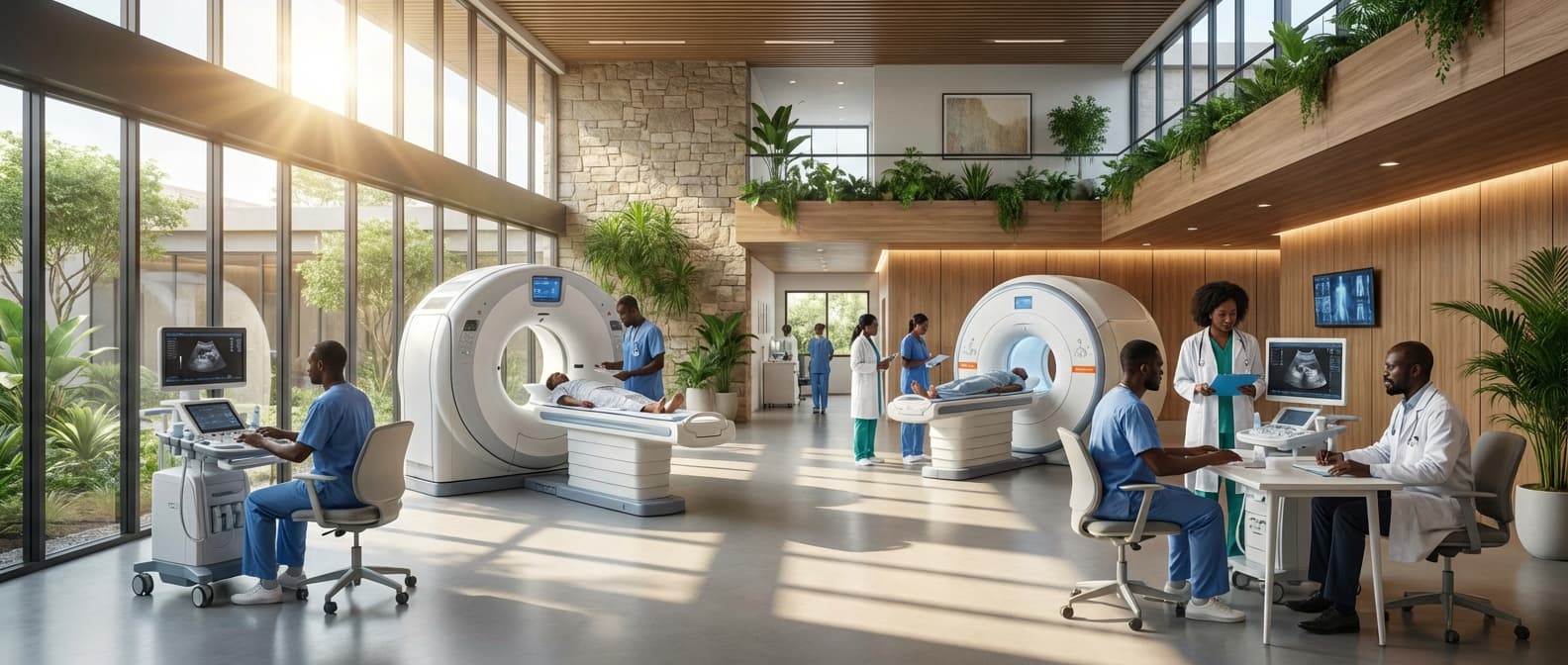
Diagnostic Imaging in Zimbabwe
Engineering Excellence & Technical Support
High-resolution imaging systems including CT scanners, MRI, X-ray, and ultrasound technology for accurate clinical diagnosis. High-standard technical execution following OEM protocols and local regulatory frameworks.
AI-Powered Tuberculosis Detection
Leveraging advanced AI algorithms integrated with digital X-ray machines, we enable rapid and accurate identification of pulmonary tuberculosis, significantly improving diagnostic speed and reducing radiologist workload in underserved areas.
Remote Ultrasound Interpretation Network
Establishing a robust telemedicine platform for remote interpretation of ultrasound scans. This initiative connects rural clinics to specialized radiologists in urban centers, expanding access to vital obstetric and abdominal imaging diagnostics across Zimbabwe.
Mobile CT Scanner Fleet
Deploying a fleet of mobile computed tomography (CT) scanners to reach remote communities and emergency situations. This innovative solution bypasses the need for fixed infrastructure, bringing advanced diagnostic capabilities directly to patients in need, especially for stroke and trauma cases.
What Is Diagnostic Imaging In Zimbabwe?
Diagnostic imaging in Zimbabwe refers to the use of various medical imaging technologies to visualize the internal structures of the human body for the purpose of diagnosis, disease monitoring, and interventional guidance. This involves a suite of non-invasive and minimally invasive techniques that generate detailed anatomical and physiological information, crucial for accurate clinical decision-making. The service encompasses a range of modalities, each with specific applications and technical specifications.
| Who Needs Diagnostic Imaging? | Typical Use Cases |
|---|---|
| Patients presenting with undiagnosed symptoms indicating potential internal pathology (e.g., pain, swelling, neurological deficits, respiratory distress). | Assessment of fractures and dislocations. Evaluation of chest conditions (e.g., pneumonia, tuberculosis, lung nodules). Detection and staging of cancers (e.g., abdominal tumors, lung masses, bone metastases). Investigation of gastrointestinal issues (e.g., bowel obstruction, appendicitis). Neurological assessments (e.g., stroke, brain tumors, spinal cord injuries). Cardiovascular evaluations (e.g., assessing heart chambers, blood flow). Obstetric and gynecological assessments (e.g., fetal development, uterine abnormalities). Monitoring treatment response and disease progression. |
| Patients requiring pre-operative assessment or post-operative follow-up. | Guiding interventional procedures such as biopsies, drain placements, and angioplasty. Screening for certain conditions (e.g., mammography for breast cancer). Evaluating trauma patients to identify injuries quickly and accurately. |
| Individuals with a family history of certain diseases or risk factors. | Routine health check-ups to screen for potential abnormalities (though often limited to specific indications). Confirmation of diagnoses made through other clinical means. |
Key Modalities and Their Principles
- {"term":"Radiography (X-ray)","definition":"Utilizes electromagnetic radiation to create 2D images of internal body structures. Differential absorption of X-rays by tissues of varying densities produces an image."}
- {"term":"Computed Tomography (CT Scan)","definition":"Employs X-rays taken from multiple angles around the body, processed by a computer to create cross-sectional images (slices). Provides greater detail and anatomical distinction than conventional radiography."}
- {"term":"Ultrasound (Sonography)","definition":"Uses high-frequency sound waves to create images of internal organs and tissues. Sound waves are transmitted into the body and reflected back by different structures, with the echoes processed into visual images."}
- {"term":"Magnetic Resonance Imaging (MRI)","definition":"Leverages strong magnetic fields and radio waves to generate detailed, cross-sectional images of organs and tissues. It is particularly effective for visualizing soft tissues, brain, and spinal cord."}
- {"term":"Mammography","definition":"A specialized type of X-ray used for the examination of breast tissue, primarily for the early detection of breast cancer."}
- {"term":"Fluoroscopy","definition":"A type of medical imaging that uses X-rays to obtain real-time moving images of the internal structures of a patient. Often used to guide procedures."}
Who Needs Diagnostic Imaging In Zimbabwe?
Diagnostic imaging plays a critical role in modern healthcare, offering non-invasive methods to visualize internal body structures and aid in diagnosis, treatment planning, and monitoring of diseases. In Zimbabwe, the demand for these services is driven by a diverse range of healthcare providers and patient populations, all seeking to improve health outcomes.
| Department/Facility Type | Key Needs/Applications | Typical Imaging Modalities Utilized |
|---|---|---|
| Public Hospitals (e.g., Parirenyatwa Group of Hospitals, United Bulawayo Hospitals) | Diagnosis and management of a wide spectrum of common and complex diseases, trauma assessment, public health screening programs (e.g., TB, cancer), chronic disease management. | X-ray, Ultrasound, CT Scans, MRI (where available) |
| Private Hospitals & Clinics (e.g., Avenues Clinic, HealthPoint) | Specialized diagnostics for elective procedures, advanced disease detection, patient comfort and faster turnaround times, specialized imaging for cardiology, neurology, oncology. | X-ray, Ultrasound, CT Scans, MRI, Mammography, Angiography |
| District Hospitals & Rural Health Centers | Basic diagnostic capabilities for common ailments, initial screening for referrals, limited trauma assessment, maternal and child health imaging. | X-ray, Ultrasound (often portable) |
| NGOs & Mission Hospitals (e.g., health facilities run by Christian missions) | Providing essential diagnostic services to underserved populations, focus on primary healthcare needs, infectious disease diagnosis, maternal and child health. | X-ray, Ultrasound |
| University Medical Schools & Research Institutions | Teaching and training of radiologists and radiographers, research into disease patterns and treatment efficacy, advanced imaging for clinical trials. | X-ray, Ultrasound, CT Scans, MRI, PET-CT (limited/research-focused) |
| Occupational Health Clinics & Corporate Wellness Programs | Pre-employment medicals, fitness-to-work assessments, monitoring of work-related conditions (e.g., respiratory diseases in mining/industrial sectors). | X-ray (especially chest X-rays), Ultrasound |
| Specialty Clinics (e.g., Cardiology, Oncology, Neurology) | Detailed imaging for specific organ systems, interventional radiology procedures, treatment response monitoring. | Ultrasound (echocardiography), CT Angiography, MRI of brain/spine, PET-CT |
Target Customers for Diagnostic Imaging in Zimbabwe
- Public Healthcare Facilities
- Private Healthcare Facilities
- Non-Governmental Organizations (NGOs) & Mission Hospitals
- Research Institutions
- Occupational Health Services
- Individual Patients (through direct referrals)
Diagnostic Imaging Process In Zimbabwe
The diagnostic imaging process in Zimbabwe involves a structured workflow to ensure accurate and timely patient care. This process typically begins with a referral from a healthcare professional and concludes with the delivery of imaging reports. While specific procedures might vary slightly between public and private institutions, the general pathway remains consistent. The key stages involve patient identification, examination request, scheduling, the imaging procedure itself, image processing and interpretation, and finally, reporting and follow-up.
| Stage | Description | Key Stakeholders | Typical Duration | Common Challenges in Zimbabwe |
|---|---|---|---|---|
| Patient Referral & Inquiry | A clinician identifies the need for diagnostic imaging for a patient and initiates a request. This can be a verbal request, a written referral form, or an electronic order (less common in some areas). The patient or their caregiver may also inquire about imaging services. | Referring Clinician, Patient/Caregiver, Receptionist/Admitting Staff | Immediate to 24 hours | Lack of awareness of available services, accessibility of referral forms, communication gaps between referring clinicians and imaging departments. |
| Information Gathering & Pre-authorization | The imaging department collects patient details, clinical history, and the specific imaging modality requested. For insured patients or those seeking services in private facilities, pre-authorization from medical aid societies may be required. | Receptionist/Admitting Staff, Patient/Caregiver, Medical Aid Administrator | 15 minutes to 24 hours | Delays in medical aid pre-authorization, incomplete patient information, lack of standardized referral forms. |
| Scheduling & Appointment Confirmation | Based on urgency, availability of equipment, and radiologist schedules, an appointment is booked. Patients are informed of the date, time, and any specific preparation instructions. | Scheduling Officer, Patient/Caregiver, Radiographer | 1 hour to several days (depending on urgency and availability) | Long waiting lists for certain modalities (e.g., MRI, CT), limited equipment capacity, equipment downtime, geographical distance for rural patients. |
| Patient Preparation | The patient follows specific instructions to prepare for the imaging procedure. This can include fasting, dietary restrictions, hydration, or wearing specific clothing. For contrast-enhanced studies, consent and allergy screening are crucial. | Patient/Caregiver, Radiographer/Technician, Nurse (if applicable) | Variable (from immediate to 24-48 hours prior) | Lack of clear and accessible preparation instructions, patient compliance issues, unavailability of necessary preparation materials (e.g., contrast agents). |
| Imaging Procedure Execution | The radiographer or technician performs the imaging scan using the specified modality (X-ray, Ultrasound, CT, MRI, Mammography, etc.). Patient positioning, image acquisition parameters, and safety protocols are followed. | Radiographer/Technician, Radiologist (for guidance/supervision) | 15 minutes to 1 hour (depending on the modality and complexity) | Equipment malfunction or unavailability, power outages, shortage of trained radiographers, limited supply of consumables (e.g., contrast agents, films/digital storage). Inadequate image quality due to patient movement or poor technique. |
| Image Processing & Quality Assurance | Acquired images are processed (if film-based) or digitally reviewed. Quality control checks are performed to ensure diagnostic value. Images are then securely stored and made accessible for interpretation. | Radiographer/Technician, IT Support (for digital systems) | 5 minutes to 30 minutes | Limited access to advanced processing software, insufficient digital archiving capacity, potential data loss, insufficient quality control protocols. |
| Radiologist Interpretation & Reporting | A qualified radiologist reviews the images, correlates them with the clinical information, and dictates or writes a diagnostic report outlining findings and recommendations. This is a critical step for diagnosis. | Radiologist, Medical Transcriptionist (if applicable) | 1 hour to 24-48 hours (depending on urgency and radiologist workload) | Shortage of radiologists, high workload for existing radiologists, communication challenges for remote reporting, interpretation errors due to fatigue or lack of specialist knowledge. |
| Report Delivery & Patient Follow-up | The final imaging report is transmitted to the referring clinician. The patient is then typically advised to follow up with their clinician to discuss the results and plan subsequent management. In some cases, patients may collect a hard copy report. | Radiologist, Referring Clinician, Patient/Caregiver, Administrative Staff | 24-72 hours (after interpretation) | Delayed report delivery, miscommunication of results, difficulty for patients to access and understand reports, lack of a clear referral loop for follow-up care. |
Diagnostic Imaging Workflow in Zimbabwe
- Patient Referral & Inquiry
- Information Gathering & Pre-authorization
- Scheduling & Appointment Confirmation
- Patient Preparation
- Imaging Procedure Execution
- Image Processing & Quality Assurance
- Radiologist Interpretation & Reporting
- Report Delivery & Patient Follow-up
Diagnostic Imaging Cost In Zimbabwe
Diagnostic imaging plays a crucial role in modern healthcare, enabling accurate diagnosis and treatment planning. In Zimbabwe, the cost of these essential services can vary significantly due to a confluence of factors. These include the type of imaging modality used, the complexity of the examination, the specific medical facility (ranging from public hospitals to private specialized centers), the geographical location within the country, and the availability of specialized equipment and personnel. Furthermore, the prevailing economic conditions, including inflation and foreign currency exchange rates, heavily influence the pricing in local currency (Zimbabwean Dollar - ZWL). The cost of consumables, imported equipment maintenance, and the expertise of radiographers and radiologists all contribute to the final price patients pay. For instance, a simple X-ray will be considerably cheaper than an MRI scan. Similarly, advanced techniques like contrast-enhanced scans or 3D reconstructions will incur higher costs.
| Imaging Modality | Estimated Cost Range (ZWL) | Notes |
|---|---|---|
| X-ray (Basic) | 1,000 - 5,000 | Cost varies by number of views and body part. |
| Ultrasound (Abdomen/Pelvis) | 2,500 - 10,000 | More specialized ultrasounds (e.g., Doppler, obstetric) can be higher. |
| CT Scan (Head/Chest/Abdomen) | 15,000 - 50,000+ | Contrast-enhanced scans and multi-detector CTs are at the higher end. |
| MRI Scan (Brain/Spine/Joint) | 40,000 - 150,000+ | MRI is generally the most expensive due to equipment and operational costs. Contrast agents add to the price. |
| Mammography | 5,000 - 15,000 | Often includes screening protocols. |
Key Factors Influencing Diagnostic Imaging Costs in Zimbabwe
- Imaging Modality (X-ray, Ultrasound, CT Scan, MRI, etc.)
- Examination Complexity (e.g., number of views, contrast agents used, specific anatomical region)
- Type of Healthcare Facility (Public Hospital vs. Private Clinic/Specialist Center)
- Geographical Location (Major cities vs. rural areas)
- Availability of Advanced Equipment and Technology
- Expertise of Radiologists and Radiographers
- Economic Factors (Inflation, Exchange Rates)
- Cost of Consumables and Maintenance
- Demand for Services
Affordable Diagnostic Imaging Options
Accessing diagnostic imaging can be a significant expense for patients. Fortunately, various affordable options and cost-saving strategies exist. Value bundles, in particular, offer a way to receive comprehensive care at a potentially lower price point. These bundles typically group related services together, such as a doctor's consultation, the imaging procedure itself, and any necessary follow-up appointments, all for a single, often discounted, price. By understanding and utilizing these value bundles, alongside other cost-saving measures, patients can significantly reduce their out-of-pocket expenses for essential diagnostic imaging.
| Type of Service | Potential Cost-Saving Strategy | Description |
|---|---|---|
| MRI Scan | Value Bundle | May include scan, radiologist report, and follow-up visit. |
| CT Scan | Price Comparison | Independent imaging centers often offer lower rates than hospitals. |
| X-ray | Urgent Care Center | Generally more affordable for common X-rays than emergency rooms. |
| Ultrasound | Self-Pay Discount | Negotiate cash prices if uninsured or with high deductible. |
| Mammogram | Insurance Navigation | Verify in-network provider status to maximize coverage. |
| PET Scan | HSA/FSA Utilization | Use pre-tax funds for eligible imaging procedures. |
Cost-Saving Strategies for Diagnostic Imaging
- Inquire about Value Bundles: Ask your healthcare provider or imaging center if they offer bundled pricing for common diagnostic pathways. This can include the imaging scan, radiologist's interpretation, and a follow-up consultation.
- Compare Prices: Don't settle for the first option. Shop around and compare prices at different imaging centers, including independent facilities, hospitals, and urgent care centers. Prices can vary significantly.
- Understand Your Insurance Coverage: Thoroughly review your health insurance plan. Know your deductible, co-pays, and co-insurance for diagnostic imaging. In-network providers will almost always be cheaper than out-of-network.
- Negotiate Self-Pay Rates: If you are uninsured or have a high deductible, ask about self-pay discounts. Many facilities are willing to negotiate a lower cash price.
- Utilize Health Savings Accounts (HSAs) or Flexible Spending Accounts (FSAs): If you have an HSA or FSA, use these pre-tax dollars to pay for eligible diagnostic imaging services.
- Consider Generic Imaging Centers: Independent imaging centers often have lower overhead costs than hospital-affiliated centers, which can translate to lower prices.
- Ask About Package Deals: Some centers offer discounts for multiple imaging tests or for patients paying upfront.
- Seek Referrals: Discuss cost-saving options with your doctor. They may be aware of specific facilities or programs that offer more affordable imaging.
- Explore Imaging at Urgent Care Centers: For certain types of imaging (like X-rays or ultrasounds), urgent care centers can be a more cost-effective alternative to emergency rooms or specialized imaging facilities.
- Review Your Bill Carefully: After receiving services, meticulously review your bill for any errors or duplicate charges.
Verified Providers In Zimbabwe
In Zimbabwe's healthcare landscape, finding genuinely verified and reputable providers is paramount for ensuring quality care. Franance Health stands out as a leading platform that rigorously vets its network, offering patients peace of mind and access to trusted medical professionals. Their commitment to credential verification and stringent quality control makes them the discerning choice for healthcare needs in Zimbabwe.
| Provider Type | Franance Health Verification Focus | Key Benefit for Patients |
|---|---|---|
| Doctors (General Practitioners & Specialists) | Medical Council registration, specialist certifications, post-graduate qualifications, ethical conduct checks. | Ensures access to licensed and qualified medical experts. |
| Nurses | Nursing Council registration, relevant certifications, practical experience verification. | Guarantees skilled and registered nursing care. |
| Pharmacists | Pharmacists Council registration, current practice licenses, dispensing accuracy audits (where applicable). | Ensures safe and accurate medication management. |
| Therapists (Physio, Occupational, etc.) | Professional body registration, relevant degree qualifications, clinical experience. | Confirms competency in specialized therapeutic services. |
| Diagnostic Laboratories & Imaging Centers | Accreditation with relevant health authorities, quality control measures, equipment calibration. | Assures reliable and accurate diagnostic results. |
Why Franance Health is the Best Choice for Verified Providers in Zimbabwe:
- Rigorous Credential Verification: Franance Health implements a multi-stage verification process for all healthcare professionals on their platform, including checking licenses, qualifications, and professional histories.
- Commitment to Quality Assurance: Beyond initial checks, Franance Health actively monitors provider performance and patient feedback to maintain high standards of care.
- Comprehensive Network: Access a wide range of specialists and general practitioners across various medical disciplines.
- Patient-Centric Approach: The platform is designed to be user-friendly, making it easy to find and book appointments with verified professionals.
- Transparency and Trust: Franance Health prioritizes transparency, providing detailed profiles of their providers to empower patients in their healthcare decisions.
Scope Of Work For Diagnostic Imaging
This Scope of Work (SOW) outlines the requirements for the provision of diagnostic imaging services, including the necessary technical deliverables and standard specifications. The goal is to ensure high-quality, accurate, and timely diagnostic imaging to support patient care and clinical decision-making.
| Service Area | Modalities Included | Technical Deliverables | Standard Specifications |
|---|---|---|---|
| Radiography (X-ray) | General Radiography, Fluoroscopy, Mammography, Bone Densitometry (DEXA) | High-resolution digital images (DICOM format), patient reports (PDF/HL7 format), audit trails. | Resolution: Minimum 300 dpi for printed reports, appropriate pixel dimensions for digital images. AEC (Automatic Exposure Control) utilized where applicable. Image acquisition parameters optimized for specific examinations. Contrast media administration guidelines followed. Mammography: MQSA compliant. |
| Computed Tomography (CT) | Multi-detector CT (MDCT) | Axial and multi-planar reformatted (MPR) images (DICOM format), 3D reconstructions, cine loops, detailed diagnostic reports. | Slice thickness: As per clinical indication (e.g., <1mm for vascular studies). Spatial resolution: High. Contrast-to-noise ratio: Optimized. Dose reduction techniques employed (e.g., iterative reconstruction). Reconstruction kernel selection based on study type. |
| Magnetic Resonance Imaging (MRI) | High-field MRI (1.5T, 3T) | Multi-sequence images (T1, T2, FLAIR, DWI, etc.), specialized sequences (e.g., spectroscopy, fMRI), contrast-enhanced studies, detailed diagnostic reports. | SNR (Signal-to-Noise Ratio): High. Image artifacts: Minimized. Spatial resolution: Adequate for anatomical detail. Contrast agent administration protocols adhered to. Scan times optimized for patient comfort and diagnostic quality. |
| Ultrasound | Diagnostic Ultrasound, Doppler, Echocardiography | Real-time images, Doppler flow information, cine loops, 3D/4D imaging (where applicable), detailed diagnostic reports. | Image quality: Clear delineation of anatomical structures. Doppler sensitivity: Adequate for detecting blood flow. Measurement accuracy: Calibrated probes. Acoustic gel usage protocol followed. Standardized probe selection based on examination. |
| Nuclear Medicine | SPECT, PET, PET/CT | Static and dynamic images, quantitative analysis, functional imaging data, detailed diagnostic reports. | Image resolution: Sufficient for lesion detection. Count statistics: Adequate for diagnostic accuracy. Radiopharmaceutical administration and uptake monitored. Patient preparation protocols followed. Attenuation correction and scatter correction implemented. |
| Picture Archiving and Communication System (PACS) | Image Storage, Retrieval, and Distribution | Secure, searchable image archive, rapid image retrieval, remote viewing capabilities, integration with RIS/HIS, audit trails for all access. | DICOM compliance: Latest standard. Storage capacity: Scalable and sufficient for projected growth. Data redundancy and backup procedures: Robust. Security protocols: HIPAA compliant, encrypted data transmission. User access controls: Role-based. Workflow integration: Seamless with reporting and scheduling. |
| Reporting System (RIS/EMR Integration) | Report Generation and Distribution | Structured reporting templates, voice recognition integration, electronic signature, report distribution to EMR/HIS, templated reports for common findings. | HL7 compliance: For seamless integration. Report turnaround time: Defined SLAs. Report accessibility: Secure and timely. Standardized terminology: Employed where possible. Typographical accuracy: Ensured. |
| Equipment Maintenance and Calibration | All Imaging Modalities | Regular preventative maintenance schedules, calibration records, service reports, uptime guarantees. | Manufacturer recommendations: Adhered to. Calibration frequency: As per manufacturer and regulatory guidelines. Downtime: Minimized. Service response time: Defined SLAs. |
| Quality Assurance (QA) and Quality Control (QC) | All Imaging Modalities | Regular QA/QC testing, phantom studies, dose monitoring, image quality assessments, corrective action plans. | Adherence to ACR (American College of Radiology) or equivalent standards. Regular phantom testing for all modalities. Dose audits for CT and X-ray. Image quality review by radiologists. Documentation of all QA/QC activities. |
Key Objectives
- To provide comprehensive diagnostic imaging services across various modalities.
- To ensure the delivery of high-resolution images meeting established diagnostic standards.
- To implement efficient workflows for image acquisition, processing, and reporting.
- To maintain a robust and secure Picture Archiving and Communication System (PACS).
- To adhere to all relevant regulatory and accreditation requirements.
- To ensure ongoing training and competency of imaging personnel.
Service Level Agreement For Diagnostic Imaging
This Service Level Agreement (SLA) outlines the performance standards for Diagnostic Imaging services provided by [Provider Name] to [Client Name]. It specifies the expected response times for various service requests and the uptime guarantees for critical imaging systems and reporting platforms.
| Service Type / Metric | Target Response Time | Uptime Guarantee | Notes |
|---|---|---|---|
| Emergency Study Interpretation | Within 30 minutes of study completion | N/A | For critically ill patients where immediate diagnosis is required. |
| Urgent Study Interpretation | Within 2 hours of study completion | N/A | For conditions requiring prompt but not immediate diagnosis. |
| Routine Study Interpretation | Within 24 hours of study completion | N/A | Standard turnaround for non-urgent cases. |
| PACS System Availability | N/A | 99.8% | Excludes scheduled maintenance. Downtime exceeding 0.2% may result in service credits. |
| RIS/Reporting Platform Availability | N/A | 99.8% | Excludes scheduled maintenance. Downtime exceeding 0.2% may result in service credits. |
| Image Acquisition Equipment Availability | Scheduled for next available slot within 8 business hours for non-emergent technical issues | N/A | Focus on prompt scheduling of repairs. |
| Scheduled Maintenance Notification | Minimum 7 days in advance | N/A | Communication of planned downtime to minimize disruption. |
Key Service Areas and Definitions
- Diagnostic Imaging Services: Includes but is not limited to X-ray, CT scans, MRI, Ultrasound, and PET scans.
- Emergency Studies: Imaging requests requiring immediate interpretation and reporting, typically due to acute patient conditions.
- Routine Studies: Imaging requests that do not pose an immediate threat to patient life or limb and can be scheduled within a defined timeframe.
- Report Turnaround Time (TAT): The time elapsed from the completion of an imaging study to the availability of a finalized, signed report.
- System Uptime: The percentage of time that specified diagnostic imaging systems and reporting platforms are available and functional.
- Downtime: Any period when a specified system is unavailable or not functional.
- Scheduled Maintenance: Planned periods of downtime for system updates, upgrades, or preventative maintenance, communicated in advance.
- Unscheduled Downtime: Any downtime not covered by scheduled maintenance.
Frequently Asked Questions

Ready when you are
Let's scope your Diagnostic Imaging in Zimbabwe project in Zimbabwe.

Scaling healthcare logistics and technical systems across the entire continent.