
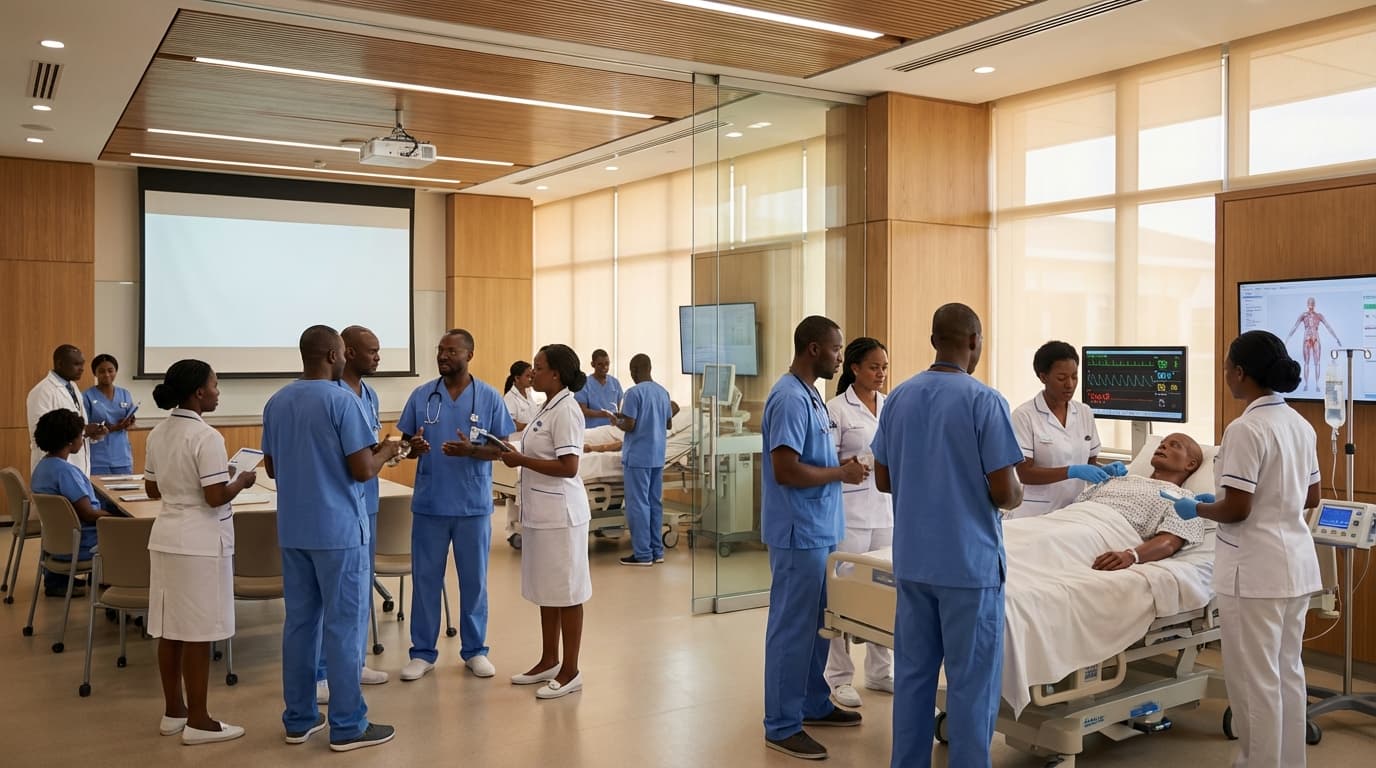
Equipment Training & Education in Zambia
Engineering Excellence & Technical Support
Comprehensive equipment training and certification programs High-standard technical execution following OEM protocols and local regulatory frameworks.
Hands-on Mechanical Skills Workshops
Providing practical, in-person training sessions focused on the operation, maintenance, and troubleshooting of critical agricultural and industrial equipment. These workshops are designed to build confidence and proficiency in Zambian technicians and operators.
Localized Digital Learning Modules
Developing and deploying e-learning content in local languages, tailored to the specific equipment models prevalent in Zambia. This includes interactive simulations, video tutorials, and assessments accessible on mobile devices for flexible and remote learning.
Train-the-Trainer Programs for Sustainability
Empowering local Zambian experts to become certified trainers. This initiative ensures the long-term sustainability of technical knowledge transfer, creating a ripple effect of skilled individuals capable of training their peers across various regions and industries.
What Is Equipment Training & Education In Zambia?
Equipment Training & Education in Zambia refers to structured programs designed to impart the necessary knowledge and practical skills for the safe, efficient, and effective operation, maintenance, and troubleshooting of various types of machinery and equipment. This service is crucial for individuals and organizations operating in sectors reliant on mechanical, electrical, and electronic systems. The objective is to enhance operational uptime, minimize downtime due to user error or poor maintenance, ensure compliance with safety regulations, and optimize equipment lifespan. The training can range from basic operational familiarization to advanced diagnostics and repair, delivered through a combination of theoretical instruction, practical demonstrations, simulated environments, and on-the-job mentoring. Emphasis is placed on understanding technical specifications, control systems, preventative maintenance schedules, and emergency procedures. This service plays a pivotal role in workforce development, contributing to increased productivity and safety standards within Zambian industries.
| Who Needs Equipment Training & Education? | Typical Use Cases/Sectors |
|---|---|
| Equipment Operators: Individuals responsible for the daily use of machinery. | Mining Sector: Operation and maintenance of heavy machinery (e.g., excavators, haul trucks, drills, crushers, conveyor systems). |
| Maintenance Technicians & Engineers: Personnel tasked with the upkeep, repair, and servicing of equipment. | Agriculture Sector: Operation and maintenance of tractors, harvesters, irrigation systems, and processing equipment. |
| Supervisors & Managers: Individuals overseeing operational teams and responsible for equipment performance and safety. | Manufacturing Sector: Operation and maintenance of production lines, assembly machines, CNC machines, and material handling equipment. |
| Health & Safety Officers: Professionals responsible for ensuring workplace safety and compliance. | Construction Sector: Operation and maintenance of cranes, earthmoving equipment, concrete mixers, and power tools. |
| New Entrants to the Workforce: Individuals requiring foundational skills for employment in equipment-intensive industries. | Energy Sector: Operation and maintenance of power generation equipment (e.g., turbines, generators, transformers) and distribution systems. |
| Organizations seeking to upskill their workforce: Companies aiming to improve productivity, reduce operational costs, and enhance safety. | Transportation & Logistics: Operation and maintenance of forklifts, specialized vehicles, and loading/unloading equipment. |
| Individuals seeking specialized certifications: Professionals aiming to validate their competence in operating specific types of equipment. | Healthcare Sector: Operation and maintenance of medical imaging equipment, laboratory instruments, and life support systems. |
Key Components of Equipment Training & Education
- Operational Procedures: Comprehensive instruction on start-up, shutdown, normal operation, and emergency stop protocols.
- Safety Protocols: Training on personal protective equipment (PPE), hazard identification, lockout/tagout procedures, and safe working practices specific to the equipment.
- Maintenance & Troubleshooting: Education on routine inspection, lubrication, cleaning, preventative maintenance schedules, and systematic methods for diagnosing and resolving common faults.
- Technical Documentation Interpretation: Skills in reading and understanding operator manuals, service manuals, schematics, and technical diagrams.
- Performance Monitoring: Training on interpreting sensor data, control panel indicators, and performance metrics to ensure optimal operation.
- Regulatory Compliance: Awareness of relevant Zambian and international standards, certifications, and legal requirements pertaining to equipment operation and safety.
- Hands-on Practical Application: Supervised practice on actual equipment or realistic simulators to reinforce theoretical knowledge.
Who Needs Equipment Training & Education In Zambia?
In Zambia, comprehensive equipment training and education are crucial for a wide range of individuals and organizations to ensure safe, efficient, and productive use of machinery across various sectors. This training bridges the knowledge gap, enhances skills, and ultimately contributes to economic growth and development by minimizing accidents, reducing downtime, and improving overall operational effectiveness.
| Sector/Industry | Key Departments Requiring Training | Examples of Equipment Requiring Training |
|---|---|---|
| Construction | Operations, Site Management, Maintenance, Safety Officers, Machine Operators | Excavators, Bulldozers, Cranes, Loaders, Graders, Compactors, Scaffolding, Power Tools |
| Mining | Mine Operations, Engineering, Maintenance, Health and Safety, Geology | Haul Trucks, Drills, Loaders, Crushers, Conveyor Systems, Ventilation Equipment, Underground Mining Machinery |
| Agriculture | Farm Management, Agronomy, Mechanics, Operations | Tractors, Harvesters, Planters, Sprayers, Irrigation Systems, Ploughing Equipment, Processing Machinery |
| Manufacturing & Industrial | Production, Maintenance, Quality Control, Logistics, Operations | Lathes, Milling Machines, Welding Equipment, Forklifts, Assembly Line Machinery, Packaging Machines, Industrial Presses |
| Energy & Utilities | Operations, Maintenance, Engineering, Safety, Field Services | Generators, Transformers, Power Line Equipment, Substation Equipment, Welding Machines for pipeline maintenance |
| Transportation & Logistics | Warehouse Operations, Fleet Management, Maintenance, Loading/Unloading | Forklifts, Reach Trucks, Pallet Jacks, Cranes (port operations), Vehicle Maintenance Equipment |
| Public Sector (e.g., Roads Department, Water Utilities) | Maintenance Crews, Operators, Supervisors, Engineers | Road Rollers, Asphalt Pavers, Water Pumps, Sewage Treatment Equipment, Graders, Excavators for infrastructure maintenance |
Target Customers for Equipment Training & Education in Zambia
- {"title":"Individuals Seeking Employment or Career Advancement","description":"Job seekers looking to acquire new skills for employment in industries that utilize heavy machinery, construction equipment, agricultural tools, and industrial machinery. Existing employees seeking to upgrade their skills, obtain certifications, or specialize in operating specific equipment."}
- {"title":"Small and Medium Enterprises (SMEs)","description":"Businesses operating in agriculture, construction, manufacturing, mining, and logistics that rely on equipment for their operations. SMEs often have limited budgets for in-house training and benefit from accessible, cost-effective external training programs."}
- {"title":"Large Corporations and Parastatals","description":"Companies in sectors like mining, energy, telecommunications, and large-scale agriculture that possess extensive fleets of complex and specialized equipment. These organizations require ongoing training for their workforce to ensure compliance, safety standards, and optimal performance of their assets."}
- {"title":"Government Ministries and Agencies","description":"Departments responsible for infrastructure development, public works, disaster management, and regulatory oversight. They need trained personnel to operate and maintain public assets and to enforce safety regulations."}
- {"title":"Educational Institutions and Vocational Training Centers","description":"Schools, colleges, and technical training institutes that offer vocational courses related to various equipment operations. They require up-to-date training materials and instructors to provide relevant education to their students."}
- {"title":"Non-Governmental Organizations (NGOs) and Community-Based Organizations (CBOs)","description":"Organizations involved in community development, agriculture, and humanitarian aid often utilize equipment for projects. Training ensures that their staff and beneficiaries can operate machinery safely and effectively."}
Equipment Training & Education Process In Zambia
The equipment training and education process in Zambia is a structured workflow designed to ensure individuals and organizations effectively learn to operate and maintain various types of equipment. This process typically begins with an inquiry from a potential client (individual or company) seeking training. This leads to a needs assessment to understand the specific equipment, skill level of trainees, and desired learning outcomes. Based on this, a customized training proposal is developed, outlining the curriculum, duration, cost, and methodology. Upon proposal acceptance, a training schedule is agreed upon, and the necessary logistics (venue, equipment, instructors) are arranged. The execution phase involves delivering the training through a combination of theoretical instruction, practical demonstrations, and hands-on exercises. Post-training, an evaluation is conducted to assess knowledge retention and skill proficiency, followed by the issuance of certificates. Ongoing support and refresher courses may also be offered.
| Stage | Description | Key Activities | Responsible Party |
|---|---|---|---|
| Inquiry & Initial Contact | The process begins when a potential client expresses interest in equipment training. | Submitting an inquiry form, making a phone call, sending an email. | Client |
| Needs Assessment & Requirements Gathering | Understanding the client's specific training needs. | Discussions about equipment type, number of trainees, existing skill levels, learning objectives. | Training Provider & Client |
| Proposal Development & Submission | Creating a tailored offer based on the assessed needs. | Defining curriculum, duration, instructors, cost, methodology, training dates. | Training Provider |
| Proposal Acceptance & Contractual Agreement | Formal agreement to proceed with the training. | Client review and acceptance of the proposal, signing of a contract or agreement. | Client & Training Provider |
| Training Schedule & Logistics Planning | Organizing the practical arrangements for the training. | Confirming training dates, booking venues, ensuring equipment availability, arranging instructor travel, participant communication. | Training Provider |
| Training Delivery (Theory & Practical) | The core of the process where learning occurs. | Lectures, presentations, demonstrations, hands-on practice sessions, case studies, Q&A. | Instructor & Trainees |
| Trainee Evaluation & Assessment | Measuring the effectiveness of the training and trainee comprehension. | Quizzes, practical assessments, observation of skills, post-training surveys. | Instructor & Trainees |
| Certification & Documentation | Formal recognition of successful completion. | Issuing training certificates, providing training reports to the client. | Training Provider |
| Post-Training Support & Follow-up | Providing ongoing assistance and ensuring long-term success. | Answering queries, offering refresher courses, providing technical support. | Training Provider |
Key Stages in the Zambia Equipment Training & Education Process
- Inquiry & Initial Contact
- Needs Assessment & Requirements Gathering
- Proposal Development & Submission
- Proposal Acceptance & Contractual Agreement
- Training Schedule & Logistics Planning
- Training Delivery (Theory & Practical)
- Trainee Evaluation & Assessment
- Certification & Documentation
- Post-Training Support & Follow-up
Equipment Training & Education Cost In Zambia
Equipment training and education costs in Zambia can vary significantly based on several factors. The type and complexity of the equipment, the duration of the training, the provider's reputation, and the location within Zambia all play a role in determining the final price. Demand for specific skills also influences pricing, as does the inclusion of specialized materials or certifications. Training can range from basic operational understanding to advanced maintenance and troubleshooting.
| Training Category | Typical Price Range (ZMW) | Notes |
|---|---|---|
| Basic Equipment Operation (e.g., forklifts, generators) | 1,500 - 5,000 | Typically 1-2 day courses, focus on safe and efficient use. |
| Intermediate Equipment Operation & Basic Maintenance (e.g., agricultural machinery, construction equipment) | 3,000 - 10,000 | Multi-day courses including routine checks and minor repairs. |
| Advanced Technical Training & Troubleshooting (e.g., industrial machinery, specialized vehicles) | 7,000 - 25,000+ | In-depth training for skilled technicians, potentially including certification. |
| Specialized Software & IT Equipment Training | 4,000 - 15,000 | Can vary widely depending on software complexity and duration. |
| Medical Equipment Training | 10,000 - 50,000+ | Highly specialized, often conducted by manufacturers or accredited bodies, very dependent on equipment type. |
| Safety & Compliance Training (related to equipment use) | 1,000 - 6,000 | Often integrated or standalone courses focusing on regulatory requirements. |
| On-site Custom Training (per day/group) | 5,000 - 20,000+ | Negotiated based on scope, duration, and number of participants. |
Key Pricing Factors for Equipment Training & Education in Zambia
- Equipment Type & Complexity: Simple machinery requires less intensive training than complex industrial equipment or specialized medical devices.
- Training Duration & Depth: Shorter, introductory courses will be cheaper than comprehensive, multi-day programs or certifications.
- Provider's Reputation & Accreditation: Established, certified training institutions may command higher fees than informal or new providers.
- Location: Training conducted in major cities like Lusaka or Kitwe might be more expensive due to overheads compared to rural areas.
- Customization: Tailored training programs designed to meet specific company needs will often incur additional costs.
- Materials & Resources: The cost of manuals, simulations, practical exercises, and assessment tools can be factored in.
- Certification & Assessment: Fees for examinations and official certifications add to the overall expense.
- Instructor Expertise: Highly experienced and specialized instructors may lead to higher training costs.
- Group Size: Per-person costs can decrease for larger groups, but overall training fees might increase.
- Mode of Delivery: On-site training at the client's premises versus training at the provider's facility.
Affordable Equipment Training & Education Options
Investing in proper equipment training and education is crucial for safety, efficiency, and maximizing the lifespan of your machinery. Fortunately, there are numerous affordable options available. This guide explores value bundles and cost-saving strategies to help you acquire the necessary knowledge without breaking the bank.
| Cost-Saving Strategy | Description | Example Application |
|---|---|---|
| Online & E-Learning | Utilizing online platforms for self-paced courses and virtual learning. This significantly reduces travel and accommodation costs associated with in-person training. | Accessing a library of pre-recorded video tutorials on equipment operation and maintenance from your desk. |
| Group Discounts | Many training providers offer reduced rates for multiple participants from the same organization. The more individuals trained, the greater the per-person savings. | Enrolling 5 employees in a safety training course and receiving a 10% discount on the total cost. |
| Train-the-Trainer Programs | Investing in a program that trains key personnel within your organization to then train other employees. This creates internal expertise and reduces reliance on external trainers for ongoing needs. | Sending a senior technician to an advanced maintenance workshop so they can train junior staff on new procedures. |
| Leveraging Manufacturer Resources | Many equipment manufacturers offer free or low-cost training materials, webinars, and even in-person sessions as part of their product support. Always check with your equipment supplier first. | Downloading user manuals and watching manufacturer-provided instructional videos for your specific machinery. |
| Government & Industry Grants | Investigate if there are any government subsidies, industry association grants, or local economic development programs that offer funding or discounted training for businesses. | Applying for a workforce development grant to offset the cost of specialized equipment training for your team. |
| Apprenticeship Programs | Partnering with vocational schools or industry bodies to establish apprenticeship programs where trainees learn on the job while receiving structured education. | Hiring an apprentice and having them attend a local college for certified equipment operation courses. |
| Subscription-Based Training | Some platforms offer monthly or annual subscriptions that grant access to a wide range of training content. This can be cost-effective for organizations with ongoing training needs. | Subscribing to an online learning portal for unlimited access to all their equipment operation and safety modules for a fixed annual fee. |
| Bundling with Equipment Purchase | Negotiate training as part of the purchase agreement when buying new equipment. Manufacturers may offer bundled training packages at a more attractive price. | Requesting a complimentary basic operation training session to be included in the price of a new forklift. |
Value Bundles Explained
- {"title":"What are Value Bundles?","description":"Value bundles are packages that combine multiple training modules, courses, or resources at a discounted price compared to purchasing them individually. They are designed to offer comprehensive learning experiences at a reduced overall cost."}
- {"title":"Common Bundle Components","description":"Bundles can include a mix of online courses, in-person workshops, practical hands-on sessions, e-books, webinars, and ongoing support services."}
- {"title":"Benefits of Bundles","description":"Bundles offer convenience by providing a structured learning path, ensure a holistic understanding of equipment operation and maintenance, and deliver significant cost savings."}
- {"title":"Examples of Value Bundles","description":"These might include an 'Operator Certification Package' (basic operation, safety protocols, common troubleshooting) or a 'Maintenance Essentials Bundle' (routine checks, preventative maintenance, minor repairs)."}
Verified Providers In Zambia
In Zambia, navigating the healthcare landscape and finding reliable, high-quality providers can be a daunting task. Ensuring you choose services that are not only effective but also adhere to stringent ethical and professional standards is paramount. Franance Health has emerged as a leading name, distinguished by its commitment to verified excellence and comprehensive patient care. This document outlines what it means for a provider to be 'verified' in the Zambian context and specifically highlights why Franance Health's credentials position them as the premier choice for your healthcare needs.
| Credential/Attribute | Franance Health's Commitment | Why it Matters for Patients |
|---|---|---|
| Licensed Practitioners | All medical professionals at Franance Health are fully licensed by the HPCZ and possess recognized international qualifications. | Guarantees that you are being treated by competent and legally recognized healthcare experts. |
| Advanced Medical Equipment | Franance Health invests in state-of-the-art diagnostic and treatment equipment, regularly maintained and updated. | Ensures accurate diagnoses and effective, modern treatment options. |
| Specialized Medical Departments | Offers a comprehensive range of specialized departments, including [mention 2-3 key specialties like Cardiology, Oncology, Maternity, etc.], staffed by experts in their respective fields. | Provides holistic care under one roof, reducing the need for referrals and ensuring continuity of care. |
| Patient-Centric Approach | Emphasizes compassionate care, clear communication, and personalized treatment plans for every patient. | Fosters trust and empowers patients to actively participate in their healthcare journey. |
| Quality Assurance Protocols | Adheres to strict internal quality assurance protocols and participates in external audits to maintain high standards of care. | Provides assurance of consistent, safe, and effective medical services. |
| Accessibility and Affordability | Strives to make high-quality healthcare accessible through various payment options and a commitment to fair pricing. | Removes financial barriers and ensures that essential healthcare is within reach for more people. |
Understanding 'Verified Providers' in Zambia
- {"title":"Regulatory Compliance","description":"Verified providers in Zambia undergo rigorous checks to ensure they meet all established national health regulations and licensing requirements set by the Health Professions Council of Zambia (HPCZ) and other relevant bodies."}
- {"title":"Professional Qualifications","description":"This verification process includes thorough vetting of the academic and professional credentials of all healthcare practitioners, ensuring they possess the necessary qualifications, experience, and ongoing professional development."}
- {"title":"Ethical Standards and Practice","description":"Verified providers are committed to upholding the highest ethical standards, patient confidentiality, and best practices in healthcare delivery, often evidenced by adherence to international quality benchmarks."}
- {"title":"Facility Standards","description":"For healthcare facilities, verification includes inspections of infrastructure, equipment, hygiene, safety protocols, and the availability of essential medical supplies."}
- {"title":"Patient Feedback Mechanisms","description":"Reputable verified providers actively solicit and act upon patient feedback, demonstrating a commitment to continuous improvement and patient satisfaction."}
Scope Of Work For Equipment Training & Education
This Scope of Work (SOW) outlines the requirements for comprehensive equipment training and education services. The objective is to ensure that end-users and technical support personnel possess the necessary knowledge and skills to operate, maintain, and troubleshoot the specified equipment effectively and safely. This SOW details the technical deliverables, training methodologies, and standard specifications for the educational program.
| Category | Specification/Requirement | Description | Deliverable | Standard |
|---|---|---|---|---|
| Training Personnel | Qualifications | Trainers must possess demonstrable expertise in the specific equipment and proven training delivery capabilities. | Certified Trainers | Minimum 5 years of experience in similar training, relevant certifications (e.g., manufacturer-specific), pedagogical training. |
| Training Content | Curriculum Development | Content must be tailored to the target audience (operators, maintenance, advanced technicians) and cover all aspects of equipment operation, maintenance, and troubleshooting. | Approved Training Curriculum | Aligned with manufacturer specifications, industry best practices, and client operational needs. |
| Training Materials | Format | Training manuals, presentations, and other supporting documents shall be clear, concise, and easily understandable. | Digital and/or Hardcopy Materials | PDF, Word documents, PowerPoint presentations. High-resolution images and diagrams. |
| Training Methodology | Approach | A blended learning approach combining theoretical instruction with practical, hands-on exercises is preferred. | Interactive Training Sessions | Lecture, demonstration, group discussion, Q&A, practical exercises, case studies. |
| Assessment & Certification | Evaluation | Methods to assess participant understanding and proficiency shall be implemented. | Competency Assessments & Certificates | Written tests, practical evaluations, post-training surveys. Certificates of completion/competency. |
| Training Environment | Facilities | Training shall be conducted in a safe, well-equipped environment conducive to learning. | Suitable Training Venue & Equipment | Adequate space, power, lighting, access to the actual equipment or a representative simulation, PPE. |
| Post-Training Support | Follow-up | Provision for follow-up support to address any emergent questions or issues. | Post-Training Support Plan | Defined contact points, response times, access to online resources. |
| Safety | Compliance | All training activities must strictly adhere to relevant safety regulations and guidelines. | Safety Compliance Documentation | Adherence to OSHA, manufacturer safety guidelines, and client-specific safety policies. |
Technical Deliverables
- Comprehensive Training Manuals (digital and/or hard copy)
- Hands-on Practical Training Sessions
- Simulated Environment Training Modules (if applicable)
- Troubleshooting Guides and Flowcharts
- Post-Training Assessment and Certification
- Train-the-Trainer Program Materials
- Equipment Operation & Maintenance Videos (optional)
- Safety Protocols and Procedures Documentation
Service Level Agreement For Equipment Training & Education
This Service Level Agreement (SLA) outlines the terms and conditions for Equipment Training & Education services provided by [Your Company Name] (hereinafter referred to as "Provider") to [Client Company Name] (hereinafter referred to as "Client"). This SLA focuses on response times for support requests and uptime guarantees for the learning management system (LMS) and associated training materials.
| Service Metric | Severity Level | Response Time Target | Resolution Target | Uptime Guarantee |
|---|---|---|---|---|
| LMS/Platform Availability | Critical (System Outage, unable to access any training) | 15 minutes | 4 hours | 99.5% |
| LMS/Platform Availability | High (Major functionality unavailable, impacting most users) | 30 minutes | 8 hours | 99.5% |
| LMS/Platform Availability | Medium (Minor functionality unavailable, impacting a subset of users) | 1 hour | 24 hours | 99.5% |
| LMS/Platform Availability | Low (Cosmetic issues, non-critical feature bug) | 4 business hours | 3 business days | 99.5% |
| Training Content Access/Download Issues | Critical (Unable to access/download essential training materials) | 30 minutes | 4 hours | N/A |
| Training Content Access/Download Issues | High (Intermittent access issues to essential training materials) | 1 hour | 8 hours | N/A |
| Support Request (General Inquiries, Account Issues) | Standard | 4 business hours | 1 business day | N/A |
Key Service Metrics
- Response Time: The maximum time allowed for the Provider to acknowledge and begin addressing a support request from the Client.
- Uptime Guarantee: The minimum percentage of time the Provider's LMS and training platform will be available and accessible to the Client.
Frequently Asked Questions

Ready when you are
Let's scope your Equipment Training & Education in Zambia project in Zambia.

Scaling healthcare logistics and technical systems across the entire continent.