
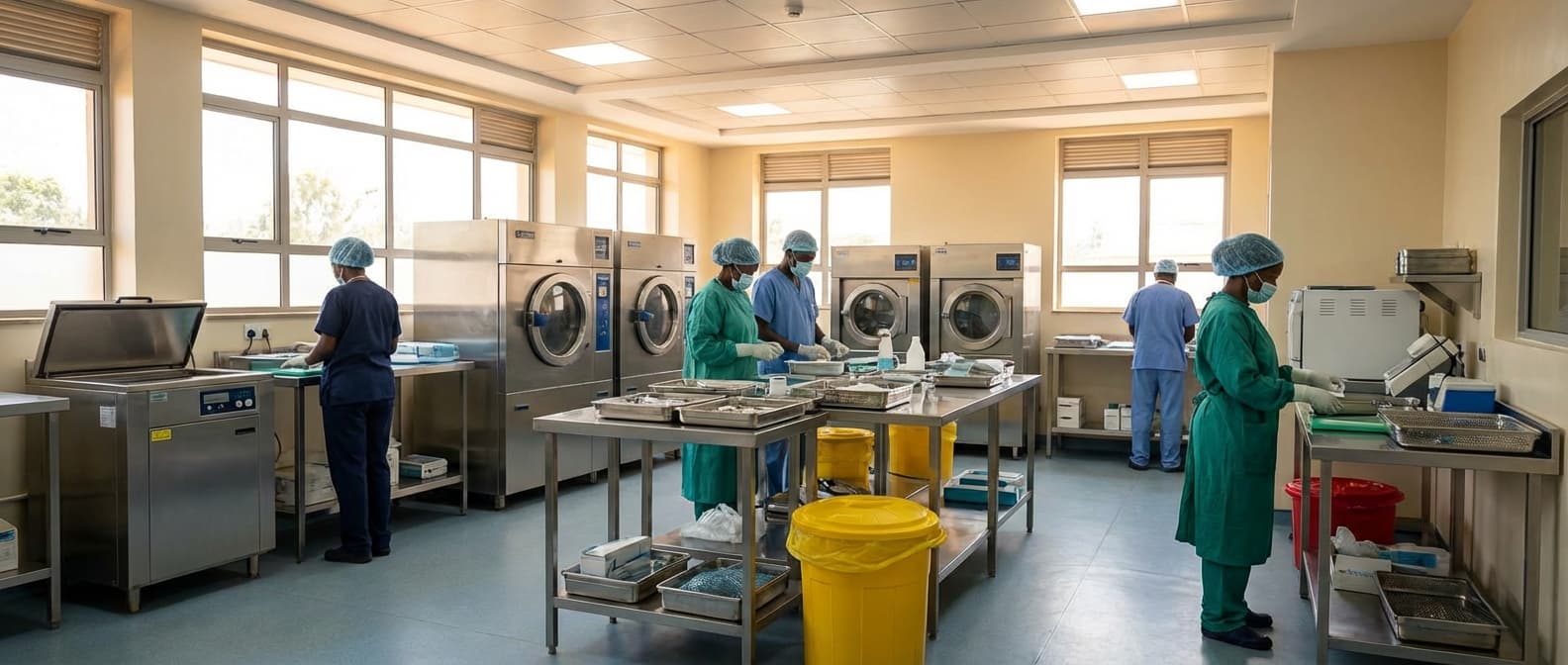
Endoscope Reprocessing Equipment Support Service in Zambia
Engineering Excellence & Technical Support
Endoscope Reprocessing Equipment Support Service High-standard technical execution following OEM protocols and local regulatory frameworks.
Certified Technicians & Rapid On-Site Support
Our Zambian-based technical team comprises certified engineers with specialized training in endoscope reprocessing equipment. We offer swift on-site diagnostics and repair, minimizing downtime and ensuring your critical reprocessing workflows remain uninterrupted.
Optimized Parts & Preventative Maintenance
Leveraging our robust local inventory and efficient logistics network across Zambia, we ensure genuine replacement parts are readily available. Our proactive preventative maintenance programs are designed to enhance equipment longevity and prevent costly breakdowns.
Compliance Assurance & Training
We go beyond equipment repair, offering comprehensive support to ensure your reprocessing practices meet Zambian and international standards. Our services include staff training on proper equipment operation, maintenance, and compliance protocols.
What Is Endoscope Reprocessing Equipment Support Service In Zambia?
Endoscope reprocessing equipment support services in Zambia refer to the specialized technical and operational assistance provided for the maintenance, repair, calibration, and validation of automated and manual equipment used in the disinfection and sterilization of endoscopes. This encompasses a comprehensive suite of activities designed to ensure the efficacy, safety, and compliance of the endoscope reprocessing workflow. These services are critical for healthcare facilities to prevent the transmission of infections associated with inadequately reprocessed flexible endoscopes, which are notoriously difficult to clean due to their complex internal lumens and delicate materials. The objective is to guarantee that reprocessed endoscopes meet stringent national and international standards for patient safety and infection control.
| Service Element | Description | Target Audience | Typical Use Case |
|---|---|---|---|
| Preventive Maintenance | Scheduled inspections, cleaning, lubrication, and replacement of wear-and-tear parts. | Hospitals, Clinics, Endoscopy Units with installed reprocessing equipment. | Ensuring automated endoscope reprocessors (AERs) and washer-disinfectors operate reliably between scheduled use, preventing downtime during critical procedures. |
| Corrective Maintenance & Repair | On-demand troubleshooting and repair of malfunctioning equipment. | Any healthcare facility experiencing an equipment failure or error. | A malfunctioning AER fails to complete a disinfection cycle or displays an error code, requiring immediate intervention to restore functionality and prevent procedure delays. |
| Calibration | Adjustment and verification of critical parameters (e.g., temperature, water pressure, disinfectant concentration). | Facilities performing high-volume endoscopy or facing regulatory scrutiny. | Verifying that the disinfectant concentration and contact time in an AER meet manufacturer specifications for high-level disinfection (HLD) of critical endoscopes. |
| Validation & Verification | Process challenge devices (PCDs) and microbiological testing to confirm cleaning and disinfection efficacy. | Accredited facilities, new equipment installations, or following significant repairs. | Utilizing a PCD to confirm that a new washer-disinfector model can effectively remove simulated biological soil and achieve the required level of disinfection on a complex endoscope lumen. |
| Technical Training | Instruction on equipment operation, basic maintenance, and troubleshooting. | Biomedical technicians, nursing staff, and infection control practitioners. | Training a hospital's biomedical department on the specific maintenance procedures for a newly acquired suite of AERs and associated drying cabinets. |
Key Components of Endoscope Reprocessing Equipment Support Services
- Preventive Maintenance: Scheduled servicing, cleaning, lubrication, and component replacement to minimize the risk of equipment failure and extend its operational lifespan.
- Corrective Maintenance & Repair: Diagnosis and resolution of equipment malfunctions, including troubleshooting, part replacement, and restoration of full functionality.
- Calibration: Adjustment of equipment parameters (e.g., temperature, pressure, flow rates, cycle times) to ensure adherence to manufacturer specifications and regulatory requirements.
- Validation & Verification: Performance testing and documentation to confirm that the equipment consistently achieves the intended level of disinfection or sterilization, often involving process challenge devices (PCDs).
- Technical Training: Education for biomedical engineers, technicians, and reprocessing staff on the proper operation, maintenance, and troubleshooting of specific equipment models.
- Consumable Management: Advising on and potentially supplying compatible detergents, disinfectants, and other consumables necessary for effective reprocessing.
- Regulatory Compliance Support: Ensuring equipment and processes align with Zambian Ministry of Health guidelines, international standards (e.g., ISO, AAMI), and manufacturer recommendations.
- Documentation and Record Keeping: Providing detailed service reports, calibration certificates, and validation records for audit purposes.
Who Needs Endoscope Reprocessing Equipment Support Service In Zambia?
In Zambia, robust and reliable endoscope reprocessing equipment support services are crucial for ensuring patient safety and operational efficiency in healthcare facilities. These services are essential for hospitals, clinics, and diagnostic centers that utilize flexible and rigid endoscopes for various medical procedures. The proper functioning and maintenance of endoscope reprocessing equipment are paramount to prevent the transmission of infections and maintain the integrity of sensitive medical devices.
| Target Customer/Department | Specific Needs and Importance | Key Endoscopic Procedures Involved |
|---|---|---|
| Gastroenterology Departments | Handle a high volume of procedures requiring meticulous cleaning and disinfection of endoscopes. Equipment malfunctions can lead to significant delays and increased infection risk. Need for regular servicing, calibration, and prompt repair of washer-disinfectors and drying cabinets. | Gastroscopy, Colonoscopy, Sigmoidoscopy, ERCP (Endoscopic Retrograde Cholangiopancreatography) |
| Pulmonology Departments | Require sterile or high-level disinfected bronchoscopes. Support is needed for automated reprocessors, leak testing equipment, and drying systems to prevent microbial contamination. | Bronchoscopy |
| Urology Departments | Utilize cystoscopes and ureteroscopes. Support services are vital for maintaining the functionality of reprocessing equipment to ensure the safety of urinary tract procedures. | Cystoscopy, Ureteroscopy |
| Gynecology Departments | Employ hysteroscopes. Ensuring proper reprocessing is critical for preventing post-operative infections and complications. | Hysteroscopy |
| Surgical Departments (where endoscopy is integrated) | Departments performing laparoscopic or other endoscopic surgical procedures. Support for reprocessing equipment directly impacts surgical workflow and patient safety. | Laparoscopy, Arthroscopy (if endoscope reprocessing is managed internally) |
| Central Sterile Services Departments (CSSD) / Endoscopy Units | Often responsible for the overall management and reprocessing of endoscopes. They require comprehensive support for all their reprocessing machinery, including preventative maintenance, validation, and emergency repairs. | All types of endoscopic procedures as per the hospital's service offerings. |
| Infection Prevention and Control Teams | While not directly operating the equipment, they rely on properly functioning reprocessing systems to uphold infection control standards. They are interested in the validation and efficacy of the reprocessing processes. | Not directly involved in procedures, but oversee the outcomes of reprocessing. |
| Biomedical Engineering Departments | In larger institutions, they may be involved in the initial setup, routine maintenance, and troubleshooting of reprocessing equipment. They benefit from specialized training and support from service providers. | All equipment within the facility, including endoscope reprocessing machines. |
Target Customers and Departments Requiring Endoscope Reprocessing Equipment Support Service in Zambia
- Hospitals (Public and Private)
- Specialty Clinics (e.g., Gastroenterology, Pulmonology, Urology, Gynecology)
- Diagnostic Centers
- Surgical Centers
- Referral Hospitals
Endoscope Reprocessing Equipment Support Service Process In Zambia
This document outlines the Endoscope Reprocessing Equipment Support Service Process in Zambia, detailing the workflow from initial customer inquiry to the successful execution and completion of support services. The process is designed to ensure efficient, timely, and effective maintenance and repair of endoscope reprocessing equipment, critical for infection control in healthcare facilities.
| Stage | Description | Key Activities | Responsible Party | Deliverables |
|---|---|---|---|---|
| The customer contacts the support provider with a service need for their endoscope reprocessing equipment. | Receive and log inquiry, understand the nature of the issue (e.g., breakdown, maintenance, installation), gather basic equipment details. | Customer, Support Provider (Service Desk/Reception) | Logged Inquiry, Initial understanding of service requirement |
| Based on the initial assessment, a formal service request is created and a quotation for the services is prepared. | Create a detailed service request, diagnose the issue further (remotely if possible), estimate labor and parts cost, generate and submit quotation to the customer. | Support Provider (Technical Support/Sales) | Service Request Form, Detailed Quotation |
| Upon customer approval of the quotation, the service is scheduled, and necessary resources are assigned. | Confirm customer availability, schedule service visit, assign qualified technician(s), ensure availability of tools and basic spare parts. | Support Provider (Service Coordinator/Manager) | Confirmed Service Schedule, Assigned Technician(s) |
| The assigned technician(s) visit the customer's facility to perform the required service. | Travel to customer site, perform detailed diagnosis and troubleshooting, conduct repairs, perform routine maintenance. | Support Provider (Field Service Technician) | Repaired/Maintained Equipment, Preliminary Service Notes |
| If specialized or unavailable parts are needed, they are procured and then installed. | Identify required parts, place order with suppliers, track delivery, receive and install parts on-site. | Support Provider (Parts Department/Technician) | Installed Spare Parts |
| After service execution and parts installation (if applicable), the equipment is thoroughly tested to ensure proper functionality. | Perform functional tests, diagnostic checks, calibration, and validation procedures according to manufacturer's specifications. | Support Provider (Field Service Technician) | Verified Equipment Functionality |
| All service activities, findings, and resolutions are documented, and a comprehensive service report is generated. | Record all work performed, parts used, test results, and any recommendations. Generate and provide a detailed service report to the customer. | Support Provider (Field Service Technician/Service Coordinator) | Completed Service Report |
| Following the successful completion of the service, the customer is invoiced, and payment is processed. | Generate and send final invoice to the customer based on the approved quotation and actual service rendered. Process payment. | Support Provider (Finance Department) | Final Invoice, Payment Confirmation |
| The support provider seeks feedback from the customer and may conduct follow-up to ensure satisfaction. | Request customer feedback on the service received, address any lingering concerns, schedule follow-up checks if necessary. | Support Provider (Customer Service/Account Manager) | Customer Satisfaction Feedback, Resolved Concerns |
Endoscope Reprocessing Equipment Support Service Process Workflow
- Inquiry & Initial Assessment
- Service Request & Quotation
- Service Scheduling & Resource Allocation
- On-site Service Execution
- Parts Procurement & Installation (if required)
- Testing & Verification
- Documentation & Service Report
- Invoicing & Payment
- Customer Feedback & Follow-up
Endoscope Reprocessing Equipment Support Service Cost In Zambia
The cost of endoscope reprocessing equipment support services in Zambia is influenced by several factors, leading to a range of pricing in local currency (Zambian Kwacha - ZMW). These services are crucial for ensuring the safety and efficacy of endoscopic procedures by maintaining the proper functioning and sterility of reprocessing equipment like automated endoscope reprocessors (AERs), washer-disinfectors, and drying cabinets.
Key Pricing Factors:
- Type of Equipment: Different types of reprocessing equipment have varying complexities and maintenance needs. AERs, being the most sophisticated, generally command higher service costs than simpler drying cabinets. The number of channels and specific functionalities of an endoscope will also indirectly affect the complexity and thus the cost of reprocessing, and by extension, the maintenance of the equipment itself.
- Service Level Agreement (SLA): Whether a client opts for a basic annual maintenance contract, a comprehensive preventative maintenance plan, or a reactive repair service significantly impacts the cost. SLAs often include scheduled check-ups, calibration, software updates, and priority response times.
- Frequency and Scope of Service: Regular preventative maintenance, which includes cleaning, lubrication, and testing of components, is typically more cost-effective in the long run than emergency repairs. The extent of the service (e.g., basic inspection vs. full overhaul) will also dictate the price.
- Downtime and Response Time Guarantees: Services that offer guaranteed rapid response times and minimize equipment downtime often come at a premium.
- Parts and Consumables: The cost of genuine manufacturer parts and specific consumables (e.g., filters, seals) required during maintenance or repair will be factored into the overall service fee. Availability of these parts locally in Zambia can also influence pricing due to import costs and lead times.
- Technician Expertise and Travel: The qualification and experience of the service technician, as well as travel costs (especially for remote locations within Zambia), contribute to the overall service expense.
- Equipment Age and Condition: Older equipment or units in poor condition might require more frequent or extensive maintenance, potentially increasing the cost of support services.
- Service Provider: Different service providers (authorized distributors, third-party repair companies) will have varying pricing structures based on their overhead, expertise, and brand reputation.
- Location within Zambia: While less of a primary driver for the service itself, logistical costs for the service provider to reach facilities in different cities or regions within Zambia can influence quoted prices.
Pricing Ranges in Zambian Kwacha (ZMW):
The pricing for endoscope reprocessing equipment support services in Zambia can vary significantly. Below are estimated ranges, which are indicative and subject to change. It is highly recommended to obtain formal quotes from multiple service providers for specific equipment and service needs.
- Annual Preventative Maintenance Contract (per AER): ZMW 15,000 - ZMW 40,000+
- Ad-hoc Repair Service (labor and parts): ZMW 5,000 - ZMW 25,000+ (highly dependent on the issue)
- Service Call-out Fee (including basic inspection): ZMW 2,000 - ZMW 8,000
- Comprehensive Service Package (including parts and labor for minor repairs): ZMW 25,000 - ZMW 70,000+ per year
These figures are broad estimates and can be further influenced by the specific make and model of the endoscope reprocessing equipment.
| Service Type | Estimated Price Range (ZMW) | Notes |
|---|---|---|
| Annual Preventative Maintenance Contract (per AER) | 15,000 - 40,000+ | Covers scheduled checks, calibration, and basic tune-ups. Excludes major part replacements. |
| Ad-hoc Repair Service | 5,000 - 25,000+ | Cost for unexpected breakdowns; includes labor and parts. Varies greatly by issue. |
| Service Call-out Fee | 2,000 - 8,000 | Covers the technician's visit and initial assessment. May be credited towards repair costs. |
| Comprehensive Service Package | 25,000 - 70,000+ per year | Often includes preventative maintenance, priority response, and potentially some parts/labor for minor issues. |
Factors Influencing Endoscope Reprocessing Equipment Support Service Costs in Zambia
- Type of Endoscope Reprocessing Equipment (e.g., AERs, Washer-Disinfectors)
- Complexity and Functionality of the Equipment
- Service Level Agreement (SLA) Scope (Preventative vs. Reactive, Response Times)
- Frequency and Depth of Scheduled Maintenance
- Inclusion of Genuine Manufacturer Parts and Consumables
- Technician's Skill Level, Certification, and Travel Expenses
- Age and Current Condition of the Equipment
- Reputation and Service Model of the Support Provider
- Geographical Location of the Healthcare Facility within Zambia
- Contractual Terms and Guarantees on Downtime Reduction
Affordable Endoscope Reprocessing Equipment Support Service Options
Maintaining the integrity and functionality of endoscope reprocessing equipment is crucial for patient safety and operational efficiency. This service focuses on providing cost-effective support solutions to healthcare facilities, ensuring their reprocessing systems remain in optimal working order without breaking the budget. We understand that capital expenses for advanced reprocessing technology can be significant, and ongoing maintenance and repair costs can add up. Our goal is to offer flexible and affordable options that minimize downtime and maximize the lifespan of your equipment.
| Strategy/Bundle | Description | Potential Cost Savings | Key Benefit |
|---|---|---|---|
| Comprehensive Preventative Maintenance | Scheduled inspections, cleaning, calibration, and replacement of common wear items. | 15-30% reduction in emergency repair costs, extended equipment lifespan. | Minimized downtime, predictable maintenance budget. |
| All-Inclusive Extended Warranty | Covers parts and labor for a set period beyond the manufacturer's warranty. | Up to 20% lower than ad-hoc repair costs, avoids price increases. | Budget certainty, protection against unexpected large expenses. |
| Multi-Unit Service Discount | Consolidated service contracts for multiple AERs, washers, and dryers. | Volume discounts of 10-25% on individual service agreements. | Simplified vendor management, increased negotiation power. |
| Refurbished Parts Option | Use of high-quality, certified refurbished parts for repairs. | 30-60% cost reduction on individual parts compared to new. | Faster repair times with exchange programs, lower overall repair bills. |
| Remote Support Package | Initial troubleshooting and diagnostics via remote access. | Avoids 20-40% of unnecessary on-site service calls. | Rapid resolution of minor issues, reduced technician travel costs. |
Value Bundles & Cost-Saving Strategies
- Preventative Maintenance Packages: Proactive maintenance is key to preventing costly breakdowns. Bundles often include regular scheduled inspections, calibration, cleaning, and replacement of wear-and-tear parts. This can significantly reduce the likelihood of unexpected and expensive emergency repairs.
- Extended Service Contracts: Beyond the manufacturer's warranty, extended service contracts offer peace of mind and predictable budgeting. These can be tailored to cover specific components or the entire system, often at a lower per-year cost than month-to-month repairs.
- Multi-Equipment Agreements: For facilities with multiple reprocessing units (e.g., washers, dryers, leak testers, Automated Endoscope Reprocessors - AERs), consolidating service agreements can unlock volume discounts. This simplifies management and often leads to better overall pricing.
- Refurbished Parts & Exchange Programs: Utilizing certified refurbished parts can offer substantial savings compared to brand-new components. Exchange programs for specific modules or components allow for quicker turnaround times and reduced downtime, often at a fraction of the cost of a full replacement.
- Remote Diagnostics & Troubleshooting: Leveraging remote access technology allows for initial troubleshooting and problem diagnosis without requiring an on-site technician. This can resolve minor issues quickly and avoid unnecessary service calls, saving on labor and travel expenses.
- Training & Operator Education: Properly trained staff are less likely to misuse equipment or miss early signs of malfunction, thus reducing the need for repairs. Offering training as part of a support package can be a long-term cost-saving measure.
- Tiered Service Levels: Different facilities have varying needs and budgets. Offering tiered service levels allows you to choose the support that best fits your operational demands, from basic break-fix to comprehensive uptime guarantees.
Verified Providers In Zambia
Finding reliable and trustworthy healthcare providers in Zambia is crucial for maintaining well-being. Verified providers stand out due to their adherence to strict quality standards and ethical practices, offering a level of assurance that is paramount in healthcare. Franance Health has established itself as a leading entity in this space, meticulously vetting and endorsing healthcare professionals and facilities across Zambia. Their rigorous credentialing process ensures that all listed providers meet the highest benchmarks for patient care, professional expertise, and operational integrity. This commitment to quality makes Franance Health's endorsed providers the best choice for individuals seeking safe, effective, and compassionate medical services. By choosing a Franance Health verified provider, patients can have confidence in the quality of care they will receive, backed by a trusted authority.
| Criteria | Franance Health Verified Provider Standards | Benefit to Patients |
|---|---|---|
| Professional Qualifications & Licensing | Mandatory verification of all medical licenses and accreditations. | Ensures providers have the legal and educational basis to practice. |
| Clinical Experience & Expertise | Assessment of past performance, specializations, and continuous professional development. | Guarantees access to skilled professionals with relevant experience. |
| Ethical Conduct & Patient Rights | Adherence to a strict code of ethics and patient advocacy principles. | Promotes respectful, transparent, and patient-centered care. |
| Facility Standards & Equipment | Inspection of facilities for hygiene, safety, and availability of necessary medical equipment. | Ensures a safe and well-equipped environment for treatment. |
| Reputation & Patient Feedback | Consideration of patient testimonials and professional references. | Provides an added layer of trust based on real-world experiences. |
Why Franance Health Verified Providers in Zambia Are the Best Choice
- Uncompromising commitment to quality and patient safety.
- Rigorous vetting process ensures adherence to high healthcare standards.
- Access to experienced and ethically practicing medical professionals.
- Peace of mind knowing you are receiving care from a trusted source.
- Streamlined process for finding reliable healthcare services across Zambia.
Scope Of Work For Endoscope Reprocessing Equipment Support Service
This Scope of Work (SOW) outlines the requirements for Endoscope Reprocessing Equipment Support Service. The service aims to ensure the optimal performance, reliability, and compliance of endoscope reprocessing equipment within the healthcare facility. It encompasses preventative maintenance, corrective maintenance, technical support, and adherence to standard specifications and regulatory requirements.
| Equipment Category | Key Equipment Type | Manufacturer (Examples) | Standard Specification Reference | Performance Metrics | Maintenance Frequency |
|---|---|---|---|---|---|
| Washer-Disinfectors | Automated Endoscope Reprocessor (AER) | Olympus, STERIS, Getinge | AAMI ST91, ISO 15883 series, FDA Guidance | Cleaning efficacy, Disinfection efficacy, Cycle completeness, Water quality | Quarterly PM, Annual calibration |
| Drying and Storage Cabinets | Endoscope Drying & Storage Cabinet | Sterrad, Cytologix | HTM 01-01, CFPP 01-07 | Airflow rates, Filtration efficacy, Temperature/humidity control | Semi-annual PM |
| Leak Testing Equipment | Manual/Automated Leak Tester | Various | Manufacturer's Instructions for Use (IFU), facility protocols | Leak detection sensitivity, Air pressure maintenance | As needed, during CM |
| Chemical Indicators/Integrators | Class 4/5/6 Indicators | 3M, Apex, Tuttnauer | ISO 11140 series | Color change consistency, Correlation with process parameters | Batch testing by manufacturer, visual inspection by user |
| Ultra-violet (UV-C) Disinfection Systems | UV-C Cabinet | Various | Manufacturer's IFU, facility protocols | UV intensity, Exposure time validation | Annual performance verification |
Technical Deliverables
- Preventative Maintenance (PM) Schedule and Execution
- Corrective Maintenance (CM) Response and Resolution
- On-Site Technical Support and Troubleshooting
- Spare Parts Management and Inventory
- Calibration and Performance Verification
- Software Updates and Upgrades (as applicable)
- Training for Facility Biomedical Staff
- Reporting and Documentation (PM reports, CM logs, incident reports)
- Compliance Audit Support
- End-of-Life Assessment and Recommendations
Service Level Agreement For Endoscope Reprocessing Equipment Support Service
This Service Level Agreement (SLA) outlines the support services provided for Endoscope Reprocessing Equipment, focusing on response times for issues and uptime guarantees for critical components. The objective is to ensure minimal disruption to clinical workflows and patient safety.
| Service Level | Description | Response Time Target (Business Hours) | Resolution Time Target (Business Hours) | Uptime Guarantee (Monthly) |
|---|---|---|---|---|
| Critical Failure (Complete Unit Downtime) | Equipment is completely non-functional, preventing any reprocessing. | 2 Hours | 8 Business Hours | 98% |
| Major Failure (Partial Functionality Loss) | Significant functionality is lost, impacting reprocessing capacity or safety features, but some limited reprocessing may still be possible. | 4 Business Hours | 16 Business Hours | 99% |
| Minor Failure (Non-critical Issue) | Issues that do not directly impact the core reprocessing function but may affect efficiency, reporting, or user interface. Includes software glitches or minor component failures. | 8 Business Hours | 48 Business Hours | 99.5% |
| Preventive Maintenance | Scheduled maintenance activities to ensure optimal equipment performance and prevent future issues. | N/A (Scheduled) | N/A (Scheduled) | N/A |
Key Service Components
- Proactive Maintenance Schedule
- Reactive Support for Equipment Malfunctions
- Software Updates and Patches
- Remote Diagnostics and Troubleshooting
- On-site Service Engineer Dispatch
- Replacement Parts Provisioning
- Endoscope Reprocessing Equipment Uptime Monitoring
- Reporting and Performance Review
Frequently Asked Questions

Ready when you are
Let's scope your Endoscope Reprocessing Equipment Support Service in Zambia project in Zambia.

Scaling healthcare logistics and technical systems across the entire continent.