
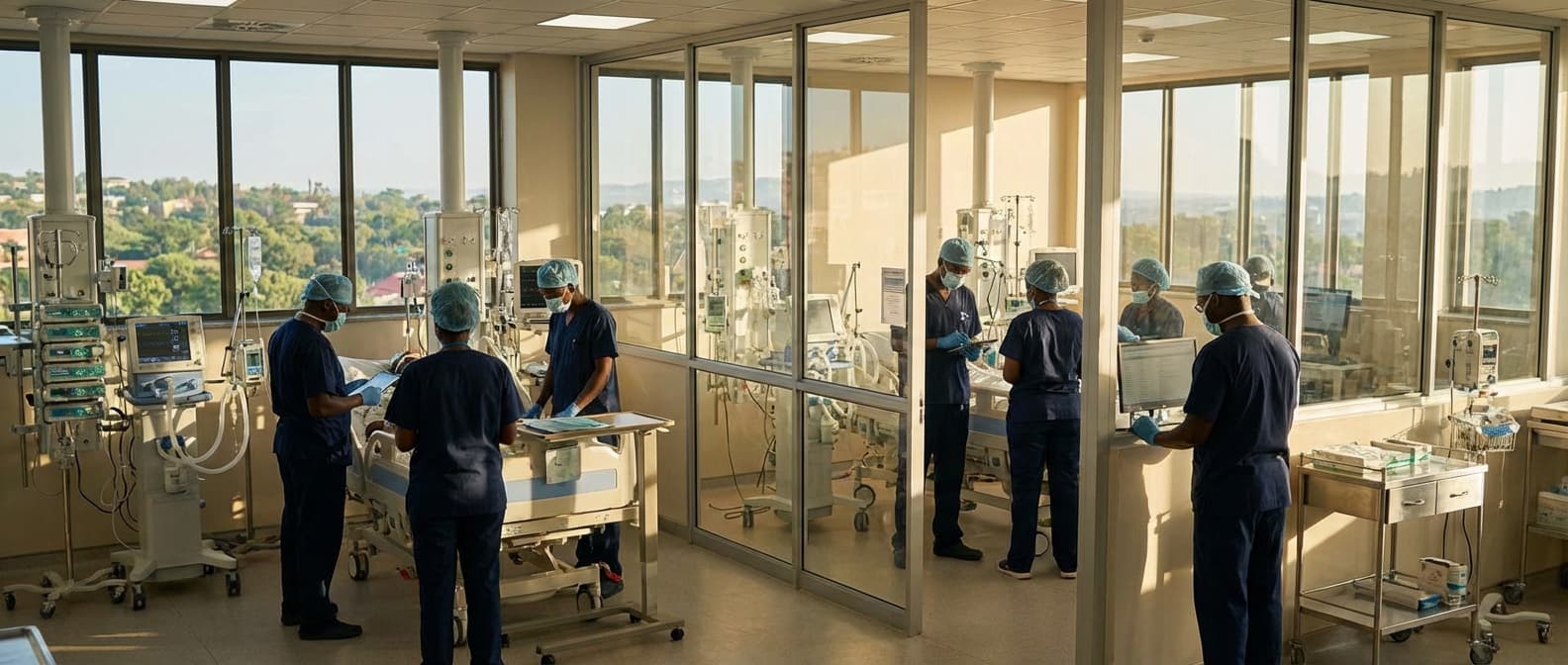
Ventilator Fleet Management & PM in Zambia
Engineering Excellence & Technical Support
Preventive maintenance and fleet management for ICU ventilators High-standard technical execution following OEM protocols and local regulatory frameworks.
Enhanced Ventilator Uptime
Implemented proactive preventative maintenance schedules and remote monitoring capabilities, significantly reducing unplanned downtime and ensuring critical ventilator availability for patient care across Zambia's healthcare facilities.
Optimized Inventory & Allocation
Developed a centralized inventory management system with real-time tracking and demand forecasting, allowing for efficient allocation of ventilators to regions with the greatest need and minimizing wastage.
Skilled Technician Network
Established and trained a robust network of biomedical technicians nationwide, equipped with specialized diagnostic tools and remote support infrastructure, to ensure prompt and effective maintenance and repair of ventilators in all provinces.
What Is Ventilator Fleet Management & Pm In Zambia?
Ventilator Fleet Management & Preventative Maintenance (PM) in Zambia refers to the comprehensive operational oversight and proactive upkeep of mechanical ventilators within healthcare facilities. This service ensures optimal functionality, extends equipment lifespan, and minimizes critical failures during patient care. It encompasses a range of activities from acquisition and deployment to routine servicing, calibration, repair, and eventual decommissioning. The core objective is to guarantee the availability and reliability of life-support equipment, particularly crucial in resource-constrained environments where equipment downtime can have severe consequences. This integrated approach to fleet management aims to standardize maintenance protocols, optimize resource allocation, and maintain a high level of clinical readiness.
| Service Component | Description | Relevance in Zambia |
|---|---|---|
| Inventory Management | Comprehensive cataloging of all ventilators (make, model, serial number, acquisition date, location). | Essential for tracking a potentially diverse and aging fleet, identifying gaps, and managing limited resources effectively. |
| Preventative Maintenance (PM) | Scheduled inspections, cleaning, lubrication, calibration, and functional testing. | Crucial for maximizing the operational lifespan of ventilators and preventing unexpected failures, which are particularly impactful in areas with limited access to rapid replacement or repair services. |
| Corrective Maintenance & Repair | Timely diagnosis and repair of equipment malfunctions. | Minimizes critical patient care disruptions. Requires skilled local technicians and access to spare parts, which can be challenging. |
| Calibration & Performance Verification | Ensuring ventilators deliver precise respiratory parameters accurately. | Directly impacts patient safety and treatment efficacy. Requires specialized test equipment and trained personnel. |
| Parts & Consumables Management | Maintaining adequate stock of essential spare parts and consumables. | Proactive management is vital to avoid prolonged downtime due to unavailability of critical components, often exacerbated by import challenges. |
| Training & Competency | Developing and maintaining skilled personnel for operation and maintenance. | Addresses the shortage of highly specialized biomedical engineers and technicians, fostering local capacity building. |
Key Components of Ventilator Fleet Management & PM in Zambia
- Inventory Management: Cataloging all ventilators, including make, model, serial number, purchase date, and current location.
- Deployment & Allocation: Strategically assigning ventilators to clinical areas based on patient load, acuity, and regional needs.
- Preventative Maintenance (PM) Scheduling: Implementing a structured schedule for routine inspections, cleaning, lubrication, and functional checks as per manufacturer recommendations and local regulations.
- Calibration & Performance Verification: Regularly calibrating ventilators to ensure accurate delivery of ventilation parameters (tidal volume, respiratory rate, pressure, etc.) and verifying performance against established standards.
- Corrective Maintenance & Repair: Diagnosing and rectifying malfunctions promptly to minimize downtime.
- Parts & Consumables Management: Maintaining an adequate stock of essential spare parts, filters, tubing, and accessories.
- Training & Competency Assessment: Ensuring biomedical engineers, technicians, and clinical staff are adequately trained on ventilator operation, basic troubleshooting, and PM procedures.
- Service History Tracking: Maintaining detailed records of all maintenance activities, repairs, and part replacements for each unit.
- Asset Lifecycle Management: Planning for equipment replacement, upgrades, and responsible decommissioning.
- Regulatory Compliance: Adhering to national and international standards for medical device maintenance and safety.
Who Needs Ventilator Fleet Management & Pm In Zambia?
Ventilator fleet management and preventative maintenance (PM) are crucial for ensuring the operational readiness and longevity of critical medical equipment like ventilators. In Zambia, where healthcare resources can be stretched, robust management of these devices is paramount. This service guarantees that ventilators are consistently available, properly calibrated, and safe for patient use, minimizing downtime and the risk of equipment failure during critical medical interventions. It also plays a vital role in cost-effectiveness by extending the lifespan of expensive medical assets and preventing costly emergency repairs.
| Customer Type | Key Departments/Units Involved | Primary Need | Impact of Poor Management |
|---|---|---|---|
| Government Hospitals | Biomedical Engineering, ICU, Anesthesiology, Administration | Ensuring consistent availability for critical care, compliance with national health standards, cost-effective asset utilization. | Increased patient mortality due to equipment failure, higher repair costs, compromised service delivery, reputational damage. |
| Mission/Faith-Based Hospitals | Clinical Staff, Maintenance Staff, Administration | Reliable equipment for patient care, often serving underserved populations, maximizing limited budgets. | Inability to treat patients requiring ventilation, reliance on external unreliable services, financial strain from frequent repairs. |
| Private Hospitals & Clinics | Biomedical Engineering, ICU, Anesthesiology, Procurement | Maintaining high standards of patient care, brand reputation, efficient operation of specialized services. | Loss of patient trust, decreased revenue due to unavailability of services, potential lawsuits from equipment malfunction. |
| NGOs in Healthcare | Project Managers, Clinical Leads, Logistics Staff | Ensuring equipment readiness for medical outreach programs, disaster relief, and capacity building initiatives. | Failure to deliver essential medical services, waste of donated resources, inability to respond effectively to health crises. |
| Medical Equipment Suppliers | Service & Maintenance Department, Sales Department | Fulfilling service level agreements (SLAs) with clients, generating recurring revenue from maintenance contracts, ensuring customer satisfaction. | Breach of contracts, loss of business opportunities, damage to supplier reputation, increased warranty claims. |
Target Customers & Departments in Zambia Requiring Ventilator Fleet Management & PM
- Government Hospitals (Central, Provincial, and District)
- Mission Hospitals and Faith-Based Healthcare Facilities
- Private Hospitals and Specialist Clinics
- Non-Governmental Organizations (NGOs) involved in healthcare provision
- Medical Equipment Suppliers and Distributors (for after-sales service contracts)
- Ministry of Health (Central and Provincial levels for oversight and planning)
- Biomedical Engineering Departments/Units
- Intensive Care Units (ICUs) and High Dependency Units (HDUs)
- Anesthesiology Departments
- Emergency and Trauma Departments
- Pediatric and Neonatal Units
Ventilator Fleet Management & Pm Process In Zambia
This document outlines the workflow for ventilator fleet management and preventive maintenance (PM) processes in Zambia. It covers the entire lifecycle from an initial inquiry or need identification through the execution of maintenance tasks and final reporting. The goal is to ensure optimal functionality and longevity of the ventilator fleet, contributing to improved patient care.
| Phase | Stage | Key Activities | Responsible Parties | Inputs | Outputs | Key Considerations/Notes |
|---|---|---|---|---|---|---|
| 1: Inquiry & Needs Assessment | Initial Request | Receive inquiry for new ventilator acquisition, repair, or scheduled PM. Identify the specific need (e.g., equipment malfunction, new facility opening, routine check-up). Gather preliminary information on the ventilator type, location, and reported issue (if any). | Hospital/Clinic Staff, Biomedical Engineering Department (BED), Ministry of Health (MoH) Procurement | Report of malfunction, budget allocation, new facility plan, existing equipment inventory | Needs assessment report, initial request form | Timeliness of reporting critical issues is paramount. Clarity on the type of service required. |
| 1: Inquiry & Needs Assessment | Assessment & Prioritization | Biomedical engineers assess the reported issue or determine PM requirements. Prioritize requests based on urgency (e.g., critical patient care needs, equipment downtime). Determine if a new acquisition or repair is more feasible. | Biomedical Engineering Department (BED) | Initial request form, equipment maintenance history, patient impact assessment | Prioritized list of maintenance/acquisition needs, repair/acquisition recommendation | Understanding the clinical impact of a non-functional ventilator. |
| 2: Planning & Scheduling | Resource Allocation | Allocate necessary personnel (technicians, engineers) for the task. Identify required spare parts and consumables. Secure necessary tools and testing equipment. | Biomedical Engineering Department (BED) Management | Prioritized needs list, inventory of spare parts, availability of technicians | Assigned technician team, list of required parts and tools | Ensuring availability of specialized parts and trained personnel. |
| 2: Planning & Scheduling | Scheduling & Authorization | Schedule the PM or repair appointment, coordinating with clinical staff to minimize disruption to patient care. Obtain necessary approvals and work orders from BED management and hospital administration. If acquisition, initiate procurement process according to MoH guidelines. | Biomedical Engineering Department (BED) Management, Hospital Administration, MoH Procurement | Resource allocation plan, clinical schedule, budget approval | Approved work order, scheduled maintenance date, procurement order (if applicable) | Advance notification to clinical teams is crucial. Adherence to procurement protocols. |
| 3: Pre-Maintenance Preparation | Site Preparation | Ensure the ventilator is accessible and safely situated for maintenance. Prepare the immediate environment to prevent contamination or interference. | Clinical Staff, Biomedical Engineering Department (BED) | Scheduled maintenance date and time, work order | Prepared workstation, clear access to the ventilator | Safety of both patients and technicians. |
| 3: Pre-Maintenance Preparation | Parts & Tools Verification | Confirm all required spare parts, consumables, and tools are on-site and in good working order. | Biomedical Engineering Department (BED) Technicians | Work order, list of required parts and tools | All necessary items gathered and verified | Prevent delays due to missing components. |
| 4: Execution of Preventive Maintenance (PM) | Initial Inspection & Testing | Perform a thorough visual inspection of the ventilator. Conduct initial functional tests to establish baseline performance. | Biomedical Engineering Department (BED) Technicians | Work order, manufacturer's PM checklist, testing equipment | Inspection report, initial test results | Documenting existing condition before commencing work. |
| 4: Execution of Preventive Maintenance (PM) | Cleaning & Disinfection | Clean and disinfect all accessible parts of the ventilator according to manufacturer guidelines and infection control protocols. | Biomedical Engineering Department (BED) Technicians | Cleaning supplies, disinfectants, infection control protocols | Cleaned ventilator | Strict adherence to infection control standards. |
| 4: Execution of Preventive Maintenance (PM) | Component Replacement & Calibration | Replace scheduled wear-and-tear components (filters, batteries, seals) as per PM schedule. Calibrate sensors and alarms to ensure accuracy. | Biomedical Engineering Department (BED) Technicians | Manufacturer's PM checklist, approved spare parts, calibration tools | Replaced components, calibrated ventilator | Using genuine or approved spare parts. |
| 4: Execution of Preventive Maintenance (PM) | Final Functional Testing & Troubleshooting | Conduct comprehensive functional tests on all modes and settings. Troubleshoot any identified issues or deviations from expected performance. | Biomedical Engineering Department (BED) Technicians | Manufacturer's service manual, testing equipment, work order | Pass/fail test results, list of resolved issues | Thoroughness in testing all functionalities. |
| 5: Post-Maintenance & Quality Assurance | Documentation of Work Done | Record all performed maintenance activities, parts replaced, and any observations in the work order. Update the equipment's maintenance log. | Biomedical Engineering Department (BED) Technicians | Completed work order, maintenance log | Fully documented work order, updated maintenance log | Accurate and detailed records are vital for future reference. |
| 5: Post-Maintenance & Quality Assurance | Quality Check & Handover | A senior technician or supervisor reviews the completed work and test results. Hand over the functional ventilator back to clinical staff with confirmation of satisfactory performance. | Biomedical Engineering Department (BED) Supervisor/Senior Technician, Clinical Staff | Completed work order, test reports, clinical feedback | Approved handover, confirmation of functionality | Ensuring clinical staff are aware of any limitations or specific operational notes. |
| 6: Reporting & Data Management | Data Entry & Analysis | Enter all maintenance data (frequency, type of work, parts used, downtime) into the fleet management system. Analyze data to identify trends, recurring issues, and inform future planning. | Biomedical Engineering Department (BED) Data Manager/Administrator | Completed work orders, fleet management system | Updated fleet database, maintenance reports | Proactive identification of systemic problems. |
| 6: Reporting & Data Management | Report Generation | Generate regular reports on fleet status, PM compliance, equipment availability, and maintenance costs for BED management and MoH. | Biomedical Engineering Department (BED) Management/Data Manager | Fleet management system data, analysis of trends | Fleet status reports, PM compliance reports, cost analysis | Data-driven decision-making for resource allocation and policy. |
Ventilator Fleet Management & PM Process Workflow in Zambia
- Phase 1: Inquiry & Needs Assessment
- Phase 2: Planning & Scheduling
- Phase 3: Pre-Maintenance Preparation
- Phase 4: Execution of Preventive Maintenance (PM)
- Phase 5: Post-Maintenance & Quality Assurance
- Phase 6: Reporting & Data Management
Ventilator Fleet Management & Pm Cost In Zambia
Ventilator fleet management and preventive maintenance (PM) costs in Zambia are influenced by a variety of factors, leading to a range of pricing. Effective fleet management is crucial for ensuring the optimal functioning and longevity of vital medical equipment like ventilators, especially in resource-constrained settings. Preventive maintenance aims to identify and address potential issues before they lead to equipment failure, thereby reducing costly emergency repairs and downtime.
The primary factors influencing PM costs for ventilators in Zambia include:
- Ventilator Type and Complexity: Different ventilator models, from basic transport units to sophisticated ICU ventilators with advanced monitoring and ventilation modes, will have varying PM requirements and associated costs for parts and specialized technician expertise.
- Age and Condition of the Ventilator: Older ventilators may require more frequent servicing and replacement parts, increasing overall PM costs. The current condition also dictates the scope of work needed.
- Service Provider: The choice of service provider significantly impacts pricing. This can range from in-house biomedical engineering departments (if adequately staffed and equipped), local third-party biomedical service companies, to original equipment manufacturer (OEM) service contracts.
- Frequency of PM: Regulatory guidelines and manufacturer recommendations typically dictate the schedule for PM (e.g., semi-annually, annually). More frequent PM generally leads to higher annual costs but can prevent more expensive breakdowns.
- Availability and Cost of Spare Parts: The cost and accessibility of original or compatible spare parts are major determinants. Importing specialized parts for certain ventilator models can incur significant customs duties, shipping fees, and lead times, driving up costs.
- Geographic Location within Zambia: While less of a direct cost factor for the PM service itself, travel and accommodation costs for technicians to reach remote healthcare facilities can add to the overall expenditure.
- Contractual Agreements: Whether PM is part of a comprehensive service contract, a standalone service agreement, or a pay-per-service arrangement will influence pricing structures and potential discounts.
- Scope of Service: Basic PM checks versus comprehensive servicing that includes calibration, software updates, and minor repairs will result in different cost levels.
| Service Type | Estimated Annual Cost Range (ZMW) | Notes |
|---|---|---|
| Basic Annual Preventive Maintenance (per ventilator) | 8,000 - 25,000 | Covers routine checks, cleaning, calibration, and minor part replacement. Varies by ventilator complexity. |
| Comprehensive Annual Preventive Maintenance (per ventilator) | 20,000 - 60,000 | Includes detailed servicing, software checks, potential replacement of wear-and-tear parts, and extended diagnostics. Higher for advanced ICU ventilators. |
| Emergency Repair Call-Out Fee (local provider) | 2,000 - 7,000 | Typically covers the technician's visit and initial assessment. Parts and labor for actual repair are additional. |
| Emergency Repair Call-Out Fee (OEM/international provider) | 5,000 - 15,000+ | Higher due to potential travel, import duties on parts, and specialized technician rates. |
| Cost of Common Spare Parts (e.g., filters, sensors, batteries) | 500 - 5,000+ | Highly variable. Imported parts can be significantly more expensive. |
| Annual Service Contract (for multiple ventilators, including PM and some repairs) | Negotiable (e.g., 15-25% of equipment value) | Often offers better value and guaranteed response times, especially for larger institutions. |
Key Pricing Factors for Ventilator PM in Zambia
- Ventilator Model and Technology
- Age and Operational Hours of Equipment
- Service Provider Reputation and Expertise (Local vs. OEM)
- Frequency and Thoroughness of Maintenance Schedule
- Cost and Importation of Spare Parts
- Geographic Accessibility of Facility
- Inclusion in Service Level Agreements (SLAs)
- Scope of Work (Basic Check vs. Full Servicing)
Affordable Ventilator Fleet Management & Pm Options
Managing a fleet of ventilators effectively and cost-efficiently is crucial for healthcare providers. This involves not only ensuring their availability and functionality through robust preventive maintenance (PM) programs but also exploring options for fleet acquisition and ongoing management. Affordable solutions often lie in understanding value bundles and implementing smart cost-saving strategies that can significantly reduce operational expenses without compromising patient care.
| Value Bundle Component | Cost-Saving Strategy | Description | Potential Benefits |
|---|---|---|---|
| Comprehensive PM & Repair Package | Bundled Service Agreements | Includes scheduled PMs, unlimited on-site repairs, and replacement parts under a single contract. | Predictable budgeting, reduced downtime, extended equipment lifespan, lower per-incident repair costs. |
| Extended Warranty & Service Plans | Proactive Maintenance | Extends manufacturer warranties and offers discounted service rates for a fixed period. | Protects against unexpected repair costs, ensures access to expert technicians. |
| Parts & Consumables Management | Bulk Purchasing & Strategic Sourcing | Includes pre-negotiated pricing on essential parts and consumables. | Reduced cost of goods, ensured availability of critical components, minimized stockouts. |
| Equipment Leasing with Integrated PM | Leasing Options | Monthly or annual fees cover equipment use and all associated PM and repair services. | Lower upfront capital expenditure, predictable operating costs, easy upgrades, includes maintenance. |
| Fleet Optimization & Replacement Planning | Data-Driven Decision Making | Services that assess fleet age, condition, and usage to recommend optimal replacement cycles and fleet size. | Avoids over-investing in outdated equipment, reduces maintenance burden on older units, ensures access to modern technology. |
| Remote Monitoring & Diagnostics | Technology Integration | Bundles include systems for remote monitoring of ventilator performance and early detection of issues. | Proactive issue resolution, reduced need for on-site visits, improved equipment reliability. |
Key Components of Affordable Ventilator Fleet Management & PM Options
- Value Bundles: These are pre-packaged service and acquisition offerings that combine multiple benefits at a reduced overall cost compared to purchasing services individually. They often include PM, repair services, parts, software updates, and sometimes even equipment leasing or replacement programs.
- Preventive Maintenance (PM): Regular, scheduled maintenance to identify and correct potential issues before they lead to breakdowns. This includes cleaning, calibration, functional testing, and replacement of wear-and-tear parts.
- Cost-Saving Strategies: Proactive approaches to minimize expenses throughout the ventilator lifecycle, from purchase to disposal.
- Fleet Assessment & Optimization: Analyzing current ventilator utilization, age, and condition to determine optimal fleet size and type, reducing unnecessary inventory and maintenance costs.
- Third-Party Service Providers: Partnering with specialized companies that offer cost-effective PM and repair services, often with flexible service level agreements (SLAs).
- Parts Management: Strategic sourcing and inventory management of spare parts to minimize costs and ensure availability.
- Staff Training & Competency: Empowering in-house biomedical engineering teams with the skills and knowledge for efficient PM and basic repairs, reducing reliance on external services.
- Leasing vs. Purchasing: Evaluating the financial benefits of leasing ventilators, which can offer lower upfront costs and predictable expenses, versus outright purchase.
- Refurbished Equipment: Considering certified refurbished ventilators, which can provide significant cost savings while meeting performance standards.
Verified Providers In Zambia
In Zambia's evolving healthcare landscape, identifying reliable and qualified healthcare providers is paramount for individuals seeking quality medical services. Franance Health stands out as a leading network of verified healthcare professionals, offering a robust platform that ensures both patient safety and excellent medical outcomes. This commitment to verification and quality makes them the best choice for those prioritizing their health and well-being.
| Credential Type | Franance Health Verification | Importance for Patients |
|---|---|---|
| Medical License | Verified for active and valid status | Confirms legal authorization to practice medicine |
| Professional Qualifications (Degrees & Diplomas) | Academic credentials are confirmed with issuing institutions | Ensures foundational medical education and training |
| Specialty Certifications | Validation of specific postgraduate training and expertise | Guarantees specialized knowledge for complex conditions |
| Continuing Medical Education (CME) | Requirement for providers to demonstrate ongoing learning | Ensures practitioners stay updated with the latest medical advancements |
| Professional Memberships & Accreditations | Membership in recognized medical bodies and hospital accreditations are checked | Indicates adherence to professional standards and quality assurance practices |
| Clean Disciplinary Record | Background checks to ensure no history of malpractice or ethical violations | Provides assurance of ethical practice and patient well-being |
Why Franance Health is the Best Choice for Verified Providers in Zambia:
- Rigorous Verification Process: Franance Health implements a comprehensive vetting system for all its affiliated providers. This includes scrutinizing medical licenses, professional qualifications, certifications, and any necessary accreditations. This meticulous approach guarantees that only genuinely qualified and legitimate healthcare professionals are part of their network.
- Commitment to Patient Safety: Patient safety is at the core of Franance Health's mission. By verifying credentials, they minimize the risk of encountering unqualified practitioners, ensuring patients receive care from individuals who adhere to the highest ethical and professional standards.
- Access to Expertise: The Franance Health network comprises a diverse range of medical specialists and general practitioners, covering various healthcare needs. This accessibility means patients can find the right expert for their specific condition, from routine check-ups to complex treatments.
- Enhanced Trust and Transparency: In a sector where trust is crucial, Franance Health provides a transparent platform. Patients can be confident that the providers listed have been thoroughly vetted, reducing anxiety and promoting informed decision-making.
- Promoting Quality Healthcare Standards: By setting a high bar for its network, Franance Health actively contributes to raising the overall standard of healthcare delivery in Zambia. This benefits not only their patients but the entire healthcare ecosystem.
- Streamlined Healthcare Access: Franance Health aims to simplify the process of finding and accessing quality healthcare. Their verified network serves as a reliable directory, saving patients time and effort in their search for trustworthy medical professionals.
Scope Of Work For Ventilator Fleet Management & Pm
This Scope of Work (SOW) outlines the requirements for the Ventilator Fleet Management and Preventative Maintenance (PM) program. It details the technical deliverables and standard specifications necessary to ensure the optimal performance, reliability, and lifespan of the organization's ventilator fleet. The program aims to proactively identify and address potential issues, minimize downtime, and ensure patient safety through rigorous maintenance protocols and comprehensive fleet oversight.
| Category | Technical Deliverable | Standard Specification / Requirement | Frequency | Responsibility |
|---|---|---|---|---|
| Fleet Inventory & Asset Management | Comprehensive Ventilator Asset Register | Includes: Serial Number, Manufacturer, Model, Purchase Date, Location, PM History, Service Contract Details, Calibration Due Date, Current Status (Active, In Repair, Decommissioned). | Ongoing (upon acquisition/decommissioning) | Biomedical Engineering Department (BMED) |
| Preventative Maintenance (PM) | Scheduled Preventative Maintenance Checks | Adherence to manufacturer's recommended PM schedule and procedures. Includes functional tests, calibration, filter replacement, battery checks, visual inspection, cleaning, and documentation of all actions taken. | As per manufacturer's recommendations (e.g., semi-annually, annually) | BMED / Authorized Service Provider |
| Preventative Maintenance (PM) | PM Completion Reports | Detailed reports for each PM event, including date performed, technician, actions taken, test results, parts replaced, and any identified issues. Reports must be signed and dated. | Upon completion of each PM | BMED / Authorized Service Provider |
| Calibration & Performance Verification | Annual Calibration and Performance Verification | Verification of all critical parameters (e.g., tidal volume, respiratory rate, pressure, FiO2) against NIST-traceable standards. Results must be documented and within manufacturer specifications. | Annually, or as per manufacturer recommendation | BMED / Certified Calibration Technician |
| Calibration & Performance Verification | Calibration Certificates | Formal documentation of calibration results, including pre- and post-calibration readings, equipment used, and technician's certification. | Upon completion of each calibration | BMED / Certified Calibration Technician |
| Corrective Maintenance | Timely Repair of Malfunctioning Ventilators | Response time for critical equipment failure to be < 2 hours. Repair to be completed within manufacturer guidelines and patient safety prioritized. Use of genuine or approved replacement parts. | As needed | BMED / Authorized Service Provider |
| Corrective Maintenance | Repair Logs | Detailed record of all corrective maintenance activities, including date of report, nature of fault, parts replaced, labor involved, and technician's name. | Upon completion of each repair | BMED / Authorized Service Provider |
| Training & Competency | Technician Training Records | Documentation of training received by BMED staff or external technicians on specific ventilator models and maintenance procedures. Includes training dates, content, and assessment results. | Upon initial training and refresher courses | BMED Management / Training Provider |
| Training & Competency | Competency Assessments | Regular assessment of technicians' skills and knowledge related to ventilator maintenance and repair. | Periodically (e.g., annually) | BMED Management |
| Parts & Supplies Management | Spare Parts Inventory Management | Maintain an adequate stock of critical spare parts for common repairs and PM activities. Utilize a FIFO (First-In, First-Out) system for parts. Track usage and reorder points. | Ongoing | BMED / Materials Management |
| Parts & Supplies Management | Parts Usage and Inventory Reports | Regular reports detailing spare parts consumed, current inventory levels, and reorder recommendations. | Monthly | BMED Management |
| Data Management & Reporting | Centralized Maintenance Database | Utilize a Computerized Maintenance Management System (CMMS) for recording all PM, repair, calibration, and inventory data. | Ongoing | BMED / IT Department |
| Data Management & Reporting | Monthly Fleet Performance Reports | Summarized reports on fleet status, PM completion rates, critical equipment downtime, repair turnaround times, and key performance indicators (KPIs). | Monthly | BMED Management |
| Data Management & Reporting | Annual Fleet Utilization and Cost Analysis Report | Analysis of ventilator usage patterns, total cost of ownership, and recommendations for fleet optimization or replacement. | Annually | BMED Management / Finance Department |
| Regulatory Compliance | Compliance with Manufacturer Guidelines | All maintenance and repair activities must strictly adhere to the manufacturer's service manuals and technical bulletins. | Ongoing | BMED / Authorized Service Provider |
| Regulatory Compliance | Compliance with Healthcare Regulations | Ensure all activities meet relevant local and national healthcare equipment regulations (e.g., FDA, local health authorities). | Ongoing | BMED Management |
Key Objectives
- Ensure consistent and reliable operation of all ventilators within the fleet.
- Minimize unplanned equipment downtime and associated patient care disruptions.
- Extend the operational lifespan of ventilators through proactive maintenance.
- Maintain compliance with all relevant regulatory standards and manufacturer recommendations.
- Provide accurate and timely data for fleet performance analysis and decision-making.
- Optimize resource allocation for maintenance activities and spare parts management.
- Enhance patient safety by ensuring ventilators are calibrated and functioning within specified parameters.
Service Level Agreement For Ventilator Fleet Management & Pm
This Service Level Agreement (SLA) outlines the commitment for Ventilator Fleet Management and Preventive Maintenance (PM) services. It defines response times for critical issues and uptime guarantees for the managed ventilator fleet to ensure optimal patient care and operational efficiency.
| Service Component | Service Level Objective (SLO) | Measurement Period | Reporting Frequency |
|---|---|---|---|
| Critical Issue Response Time | For critical issues, a qualified technician will acknowledge and begin diagnostic efforts within 4 business hours of notification. | 24/7/365 | Monthly |
| Routine Service Response Time | For non-critical issues (e.g., non-urgent repair requests, inquiries), a qualified technician will acknowledge and schedule a visit/remote support within 1 business day. | Business Hours (Mon-Fri, 8 AM - 5 PM, excluding holidays) | Monthly |
| Preventive Maintenance (PM) Completion | All scheduled PM tasks will be completed within the manufacturer's recommended service intervals, or as agreed upon in the PM schedule. | Per PM schedule | Quarterly |
| Ventilator Fleet Uptime Guarantee | The Managed Ventilator Fleet will achieve an overall uptime of 98.5%. | Monthly | Monthly |
Key Definitions
- Managed Ventilator Fleet: All ventilators owned or leased by the Client that are under the scope of this SLA for management and PM.
- Critical Issue: A ventilator malfunction that renders it inoperable, poses an immediate risk to patient safety, or significantly impacts critical care operations. Examples include complete power failure, inability to ventilate, or critical alarm failures.
- Preventive Maintenance (PM): Scheduled maintenance activities performed on ventilators to ensure their optimal performance, safety, and longevity, as per manufacturer guidelines and regulatory requirements.
- Response Time: The maximum allowable time from the initiation of a support request (for Critical Issues) until a qualified technician has acknowledged the issue and begun diagnostic/remediation efforts.
- Uptime Guarantee: The percentage of time the Managed Ventilator Fleet is expected to be operational and available for use.
Frequently Asked Questions

Ready when you are
Let's scope your Ventilator Fleet Management & PM in Zambia project in Zambia.

Scaling healthcare logistics and technical systems across the entire continent.