
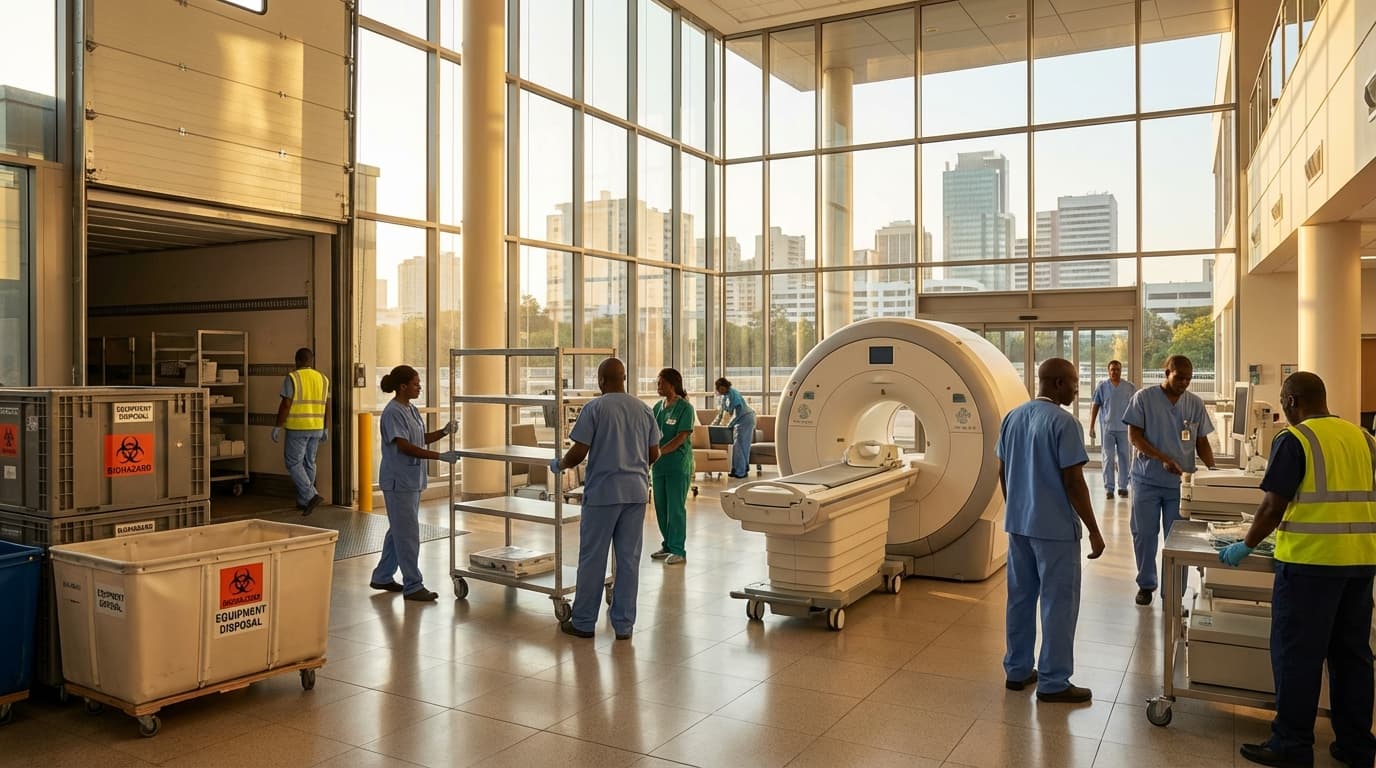
Heavy Medical Equipment De-Installation Service (MRI/CT/Cath Lab) in Zambia
Engineering Excellence & Technical Support
Heavy Medical Equipment De-Installation Service (MRI/CT/Cath Lab) High-standard technical execution following OEM protocols and local regulatory frameworks.
Certified De-Installation Technicians
Our team comprises certified and experienced technicians trained specifically in the safe and meticulous de-installation of high-value medical imaging equipment, including MRI, CT scanners, and Cath Labs, adhering to international safety standards and manufacturer guidelines.
Specialized De-Installation Tools & Procedures
We utilize specialized, calibrated tools and employ proprietary de-installation methodologies designed to prevent damage to sensitive components, ensure proper disassembly, and maintain equipment integrity throughout the process, safeguarding your investment.
Secure Transportation & Logistics Management
Beyond de-installation, we offer comprehensive logistics support, including secure packing, transportation arrangements, and adherence to all regulatory requirements for moving heavy medical equipment within Zambia, ensuring a seamless transition from site to site.
What Is Heavy Medical Equipment De-installation Service (Mri/ct/cath Lab) In Zambia?
Heavy Medical Equipment De-Installation Service (MRI/CT/Cath Lab) in Zambia refers to the specialized process of carefully dismantling, disconnecting, and preparing high-value, complex medical imaging and interventional systems for relocation, decommissioning, or disposal. These systems, including Magnetic Resonance Imaging (MRI), Computed Tomography (CT) scanners, and Cardiac Catheterization (Cath) Laboratories, are characterized by their significant weight, intricate infrastructure dependencies (e.g., specialized power, cooling, shielding), and sensitive components. The service is executed by certified technicians with expertise in the specific equipment models, adhering to stringent safety protocols and regulatory requirements. It encompasses the entire lifecycle from initial shutdown and disconnection of power and data, to the mechanical disassembly of major components (e.g., magnet coils, gantry, patient table), packaging, and readiness for transport. This service is crucial for maintaining operational continuity, ensuring asset value preservation, and mitigating risks associated with improper handling.
| Who Needs the Service | Typical Use Cases | Equipment Examples |
|---|---|---|
| Hospitals and Medical Facilities undergoing renovation or expansion. | Relocation of equipment to a new wing or a different facility within the same institution. | MRI Scanners, CT Scanners, Cath Labs |
| Healthcare providers upgrading their diagnostic imaging capabilities. | Decommissioning of obsolete or end-of-life equipment for disposal or resale. | PET/CT Scanners, Linear Accelerators (radiotherapy) |
| Manufacturers or third-party service providers involved in equipment moves or installations. | Asset management for equipment leases or rental agreements. | Angiography Systems, Ultrasound Machines (high-end) |
| Government health ministries or public health organizations during infrastructure changes. | Consolidation of medical services or closure of facilities. | Endoscopy suites (complex configurations) |
| Research institutions incorporating new imaging modalities. | Transfer of equipment between different departments or research centers. | Interventional Radiology Suites |
Key Aspects of Heavy Medical Equipment De-Installation Service
- System Assessment and Planning: Detailed site surveys, equipment condition evaluation, and development of a comprehensive de-installation plan.
- Controlled Shutdown and Disconnection: Safe cessation of system operation, disconnection of all power, data, cooling, and ancillary systems.
- Mechanical Disassembly: Precision dismantling of major equipment components, often requiring specialized lifting and handling equipment.
- Component Isolation and Securing: Ensuring all sensitive parts are properly isolated, secured, and protected from damage.
- Packaging and Cradling: Utilizing industry-standard, custom, or specialized packaging solutions to prevent in-transit damage.
- Logistical Coordination: Planning and executing the movement of disassembled components from the installation site.
- Safety and Compliance: Strict adherence to occupational health and safety regulations and environmental guidelines.
- Documentation: Comprehensive record-keeping of the de-installation process, including photographs and reports.
Who Needs Heavy Medical Equipment De-installation Service (Mri/ct/cath Lab) In Zambia?
Heavy medical equipment de-installation services, specifically for MRI, CT scanners, and Cath Labs, are crucial in Zambia for a variety of reasons. These sophisticated and high-value machines require specialized expertise for safe dismantling, packing, and transportation. This service caters to a range of institutions and departments undergoing upgrades, relocations, or decommissioning of facilities. Understanding the target customers and their specific departmental needs is key to identifying the demand for such specialized services in Zambia.
| Target Customer/Department | Specific Need for De-Installation | Equipment Involved |
|---|---|---|
| Public Hospitals | Upgrading outdated equipment, relocation of departments, or facility renovations. | MRI, CT Scanners, Cath Labs |
| Private Hospitals & Advanced Medical Centers | Installation of newer, more advanced imaging modalities, expansion of services, or closure/consolidation of specific units. | MRI, CT Scanners, Cath Labs |
| Diagnostic Imaging Centers | Relocation to larger or more strategic locations, replacement of aging machines with newer models, or downsizing. | MRI, CT Scanners, Cath Labs |
| University Teaching Hospitals (Medical Schools) | Modernizing teaching and research facilities, replacing equipment used for both patient care and academic purposes. | MRI, CT Scanners, Cath Labs |
| Specialty Clinics (e.g., Cardiology, Neurology) | Relocation or upgrade of specialized imaging equipment within their practice. | Cath Labs, CT Scanners (for neurological imaging) |
| Government Health Ministries/Agencies | Managing the decommissioning or relocation of public health facilities, ensuring proper asset management. | MRI, CT Scanners, Cath Labs |
| Medical Equipment Suppliers/Distributors | When receiving used equipment for refurbishment, resale, or relocating demonstration units. | MRI, CT Scanners, Cath Labs |
Target Customers and Departments Requiring Heavy Medical Equipment De-Installation in Zambia
- Hospitals (Public and Private)
- Diagnostic Imaging Centers
- University Teaching Hospitals
- Specialty Clinics
- Government Health Ministries/Agencies
- Medical Equipment Suppliers/Distributors (for relocation/refurbishment)
Heavy Medical Equipment De-installation Service (Mri/ct/cath Lab) Process In Zambia
This document outlines the comprehensive workflow for the Heavy Medical Equipment De-Installation Service (MRI/CT/Cath Lab) in Zambia, from initial inquiry to the successful completion of the de-installation process. This service is crucial for equipment relocation, upgrades, or decommissioning, requiring specialized expertise to ensure safety, prevent damage, and comply with regulatory standards.
| Stage | Key Activities | Responsible Parties | Deliverables/Outcomes | Timeline (Typical) |
|---|---|---|---|---|
| Inquiry and Initial Consultation | Client contacts service provider with de-installation needs. Discussion of equipment type, location, and desired timeline. Initial information gathering. | Client, Service Provider (Sales/Inquiry Team) | Understanding of client's requirements, preliminary feasibility assessment. | 1-3 Business Days |
| Site Assessment and Planning | On-site visit by technical team to assess the specific equipment, surrounding infrastructure (power, cooling, room access), potential challenges, and safety protocols. Detailed planning of the de-installation strategy, including lifting, dismantling, and transportation routes. | Service Provider (Technical Team Lead, Engineers) | Detailed site survey report, de-installation plan, risk assessment, required tools and personnel identified. | 3-7 Business Days |
| Proposal and Quotation | Development of a comprehensive proposal detailing the scope of work, methodologies, timeline, safety measures, personnel, and a detailed cost breakdown. Presentation of the proposal to the client for review and approval. | Service Provider (Project Manager, Sales) | Formal proposal document, detailed quotation. | 2-5 Business Days |
| Contract and Agreement | Upon acceptance of the proposal, a formal contract is drafted and signed, outlining terms, conditions, payment schedules, liabilities, and service level agreements. | Client, Service Provider (Legal/Management) | Signed service contract. | 2-5 Business Days |
| Pre-De-Installation Preparations | Procurement of specialized tools, equipment, and transportation. Confirmation of all necessary permits and regulatory clearances. Communication with facility management regarding access and power isolation. Final confirmation of the de-installation schedule with the client. | Service Provider (Project Manager, Logistics Team) | All required resources and permissions secured. Schedule confirmed. | Varies (depending on equipment and lead times, can be 1-3 weeks) |
| Equipment De-Installation Execution | Systematic dismantling of the medical equipment by certified technicians, adhering to the de-installation plan and safety protocols. This includes disconnection of power, cooling, and data lines, removal of components, and careful packaging. | Service Provider (De-Installation Crew, Technicians, Safety Officer) | Dismantled and safely packaged medical equipment. Site left clean and safe. | Varies (depending on equipment complexity and size, 1-5 Days per major equipment) |
| Testing and Verification (Post-De-Installation) | While the primary service is de-installation, basic verification may include ensuring all components are accounted for and secured for transport. Comprehensive testing is usually part of re-installation. | Service Provider (Technical Lead) | Confirmation of completeness of de-installation and secure packaging. | Concurrent with execution |
| Documentation and Handover | Preparation of a final de-installation report, including photographic evidence, a list of all components, and any relevant notes or observations. Formal handover of the de-installed equipment to the client or their designated logistics partner. | Service Provider (Project Manager, Technical Lead) | De-installation report, signed handover certificate. | 1-2 Business Days |
De-Installation Workflow Stages
- Inquiry and Initial Consultation
- Site Assessment and Planning
- Proposal and Quotation
- Contract and Agreement
- Pre-De-Installation Preparations
- Equipment De-Installation Execution
- Testing and Verification (Post-De-Installation)
- Documentation and Handover
Heavy Medical Equipment De-installation Service (Mri/ct/cath Lab) Cost In Zambia
De-installing heavy medical equipment such as MRI, CT scanners, and Cath Labs in Zambia involves specialized skills, significant logistical considerations, and adherence to stringent safety protocols. The cost of these services can vary widely based on several factors, making it crucial for healthcare facilities to obtain detailed quotes. This discussion outlines the key pricing factors and provides an estimated cost range in Zambian Kwacha (ZMW).
| Equipment Type | Estimated Cost Range (ZMW) | Notes |
|---|---|---|
| CT Scanner | 25,000 - 70,000+ | Excludes significant travel, complex rigging, or specialized transport for very large units. |
| MRI Scanner | 40,000 - 150,000+ | Includes considerations for magnetic field containment, potential cryogenic gas handling, and complex dismantling. Costs can escalate significantly for larger bore or more advanced systems. |
| Cath Lab (Angiography Suite) | 30,000 - 90,000+ | Varies based on the number of imaging arms, associated consoles, and the complexity of the X-ray system. Includes specialized radiation safety measures. |
Key Pricing Factors for Heavy Medical Equipment De-Installation in Zambia
- Equipment Type and Complexity: MRI and CT scanners, due to their magnetic fields and intricate components, are generally more complex and costly to de-install than Cath Lab equipment. The size, weight, and specific model of the equipment will directly influence labor and logistical requirements.
- Site Assessment and Accessibility: A thorough site assessment is crucial to determine the feasibility of removal. Factors like building access points, the presence of elevators or cranes, the condition of pathways, and the proximity to loading docks all impact the complexity and cost.
- Labor Requirements: De-installation of this caliber of equipment requires a skilled team of technicians, engineers, and riggers. The number of personnel required, their expertise level, and the duration of the de-installation process are significant cost drivers.
- Specialized Tools and Equipment: The use of specialized lifting gear, anti-static equipment, cryogenic handling tools (for MRI), and transport vehicles all contribute to the overall cost.
- Transportation and Logistics: Moving heavy medical equipment from one location to another, whether within Zambia or for export, involves considerable logistical planning, specialized transportation, insurance, and potential customs duties if international transport is involved.
- Dismantling and Reassembly (if applicable): While this focuses on de-installation, some services might include initial dismantling steps that might be billed separately. If reassembly at a new site is also part of the scope, it will significantly increase the overall project cost.
- Safety and Regulatory Compliance: Adhering to strict health and safety regulations, including permits and insurance, is paramount. The cost associated with ensuring compliance, proper waste disposal (if any), and securing the site adds to the final price.
- Geographical Location: De-installation services in major cities like Lusaka might have slightly different pricing compared to more remote areas due to travel and accommodation costs for the specialized team.
- Urgency and Timeline: Rush or emergency de-installations often command a premium price due to the need for expedited mobilization and resource allocation.
Affordable Heavy Medical Equipment De-installation Service (Mri/ct/cath Lab) Options
Hiring professionals for the de-installation of heavy medical equipment like MRI, CT scanners, and Cath Labs is a critical but often expensive undertaking. Fortunately, there are strategies to manage costs without compromising safety or efficiency. This guide explores affordable options, value bundles, and cost-saving measures for de-installing specialized medical machinery. Understanding these aspects can help healthcare facilities budget more effectively for these essential services.
| Value Bundle Option | Description | Cost-Saving Strategy Alignment |
|---|---|---|
| Basic De-Installation Package | Includes core de-installation of the primary machinery, disconnection of essential services (power, cooling), and basic disassembly. Focuses on getting the equipment safely out of its installed location. | **Ideal for facilities with internal resources for packing/transport or if equipment is being moved to a nearby storage location. Lower upfront cost. |
| Full-Service De-Installation Bundle | Encompasses basic de-installation plus comprehensive packing, crating, and preparation for transport. May also include basic site cleanup and debris removal. | **Saves time and logistical headaches by consolidating services with one provider. Reduces the need to manage multiple vendors for packing and preparation. |
| De-Installation & Site Remediation Bundle | Includes full-service de-installation along with necessary site repairs or remediation. This could involve patching walls, restoring flooring, or removing specialized shielding. | **Streamlines the process, ensuring the space is ready for its next use without needing separate contractors for site restoration. Can be more cost-effective than hiring two distinct services. |
| De-Installation & Logistics Management Bundle | Combines de-installation with coordination of transportation, warehousing, or onward shipping of the equipment. The provider acts as a project manager for the entire move. | **Offers significant cost savings through potentially discounted shipping rates and reduced administrative burden. Minimizes the risk of delays and errors in the logistics chain. |
| Equipment Remarketing/Recycling Integration | For older or decommissioned equipment, this bundle can include de-installation and the service provider's assistance with remarketing, selling, or responsibly recycling the machinery. | **Can offset de-installation costs through potential revenue from resale or by utilizing cost-effective recycling services. Reduces disposal fees. |
Key Considerations for Affordable De-Installation
- Prioritize Safety and Compliance: While cost is a factor, never compromise on the safety of personnel and the integrity of the equipment. Ensure the de-installation team is certified, experienced, and adheres to all relevant regulations (e.g., radiation safety, electrical safety).
- Obtain Multiple Quotes: Always solicit proposals from at least three reputable de-installation service providers. Compare not just the price but also the scope of services included, the team's experience with your specific equipment, and their insurance coverage.
- Understand Service Inclusions: Be clear about what is and isn't included in the quote. Does it cover packing, crating, transportation of removed components, waste disposal, site remediation, or project management?
- Timing and Scheduling: Off-peak times might offer lower rates. Consider scheduling the de-installation during facility downtime or when other construction/renovation projects are less congested.
- Equipment Condition Assessment: Understanding the current state of the equipment can help prevent unexpected issues and costs during de-installation.
- Clear Communication: Maintain open and consistent communication with the de-installation team to address any potential challenges proactively and avoid costly delays or rework.
Verified Providers In Zambia
In Zambia's evolving healthcare landscape, identifying trusted and skilled medical professionals is paramount for ensuring quality patient care. This is where verified providers, particularly those with credentials from esteemed organizations like Franance Health, stand out. Franance Health's rigorous vetting process and commitment to excellence make their affiliated providers a benchmark for reliability and expertise.
| Category | Franance Health Verified Provider Advantage | Patient Benefit |
|---|---|---|
| Quality of Care | Ensures providers meet high standards of medical competence and knowledge. | Access to skilled and up-to-date medical expertise, leading to better health outcomes. |
| Trust and Reliability | Undergoes thorough background checks and credential verification. | Confidence in receiving care from a legitimate and trustworthy medical professional. |
| Safety | Confirms adherence to safety protocols and ethical medical practices. | Reduced risk of medical errors and ensures a safe healthcare environment. |
| Specialization | Often includes specialists with verified experience in various medical fields. | Easier access to specialized treatment for specific health conditions. |
| Peace of Mind | The Franance Health mark signifies a commitment to excellence. | Reduced anxiety and greater assurance regarding the medical care received. |
Why Franance Health Credentials Represent the Best Choice:
- Rigorous Verification: Franance Health employs a comprehensive vetting process that scrutinizes medical qualifications, licenses, and professional experience, ensuring that only genuinely competent practitioners are certified.
- Commitment to Ethical Practice: Beyond technical skills, Franance Health assesses adherence to ethical guidelines and best practices, fostering trust and integrity within their network.
- Continuous Professional Development: Providers affiliated with Franance Health are often encouraged or required to engage in ongoing learning and skill enhancement, keeping them at the forefront of medical advancements.
- Enhanced Patient Confidence: A Franance Health credential offers patients peace of mind, assuring them they are receiving care from a provider who has met stringent quality standards.
- Access to Specialized Expertise: The network often includes a diverse range of specialists, making it easier for patients to find the specific care they need from highly qualified individuals.
Scope Of Work For Heavy Medical Equipment De-installation Service (Mri/ct/cath Lab)
This Scope of Work (SOW) outlines the requirements for the de-installation of heavy medical imaging equipment, specifically Magnetic Resonance Imaging (MRI), Computed Tomography (CT), and Cardiac Catheterization (Cath Lab) systems. The service includes the safe, compliant, and efficient disconnection, dismantling, and preparation of the equipment for transportation. This SOW also details the technical deliverables and standard specifications that will govern the execution of this service.
| Deliverable | Description | Standard Specification / Requirement |
|---|---|---|
| De-installation Plan | A detailed, site-specific plan outlining the sequence of operations, safety protocols, resource allocation, and timeline for the de-installation process. | Must be approved by the client prior to commencement. Include risk assessment and mitigation strategies. Address any site-specific constraints (e.g., building structure, access points). |
| De-energization Report | Documentation confirming the safe and complete disconnection of all power sources, including primary power, backup power, and any auxiliary electrical systems connected to the equipment. | Must comply with local electrical codes and manufacturer guidelines. Include verification of zero voltage. Dated and signed by a qualified technician. |
| System Disassembly Report | A record of the de-installation process, detailing the systematic disassembly of the equipment into manageable components for transportation. | Manufacturer's service manual procedures to be followed. Components to be clearly labeled. Photographic documentation of critical disassembly steps recommended. |
| Component Inventory and Condition Report | A comprehensive list of all removed components, including their condition (e.g., operational, damaged, salvageable), serial numbers, and manufacturer details. | To be generated prior to packaging. Include photos of any significant damage. Client to be notified of any irreparable components. |
| Packaging Materials and Methods | Appropriate protective materials and techniques to ensure the safe transit of all disassembled equipment components. | Materials to include, but not be limited to, custom crating, shock-absorbent padding, anti-static wrapping (for sensitive electronics), and moisture-resistant coverings. Must adhere to international shipping standards if applicable. |
| Final Site Condition Report | Documentation of the equipment's de-installation site, confirming that all equipment has been removed and the area is prepared for subsequent activities. | Photographic evidence of the cleared site. Includes confirmation of any required structural or utility disconnection (e.g., HVAC, cooling lines). Site restoration to be clearly defined if within scope. |
| Qualified Personnel | All de-installation activities must be performed by certified and experienced technicians with specific training on the de-installation of MRI, CT, and Cath Lab systems. | Technicians must possess relevant certifications (e.g., medical equipment technician, electrical safety certified). Proof of training and experience to be provided upon request. Technicians must be familiar with manufacturer-specific de-installation procedures. |
| Safety Compliance | Adherence to all applicable safety regulations, including OSHA, local health and safety standards, and manufacturer-specific safety guidelines. | Implementation of lockout/tagout procedures, proper lifting techniques, and use of personal protective equipment (PPE). Site-specific safety plan to be developed and followed. |
| Environmental Compliance | Proper handling and disposal of any hazardous materials (e.g., refrigerants for MRI) encountered during the de-installation process, in accordance with environmental regulations. | Compliance with EPA regulations and any local environmental agency requirements. Documentation of proper disposal methods for all regulated materials. |
| Documentation and Handover | All reports, logs, and other relevant documentation generated during the de-installation process shall be formally handed over to the client. | Digital and/or hard copy format as agreed upon. All documents to be clearly organized and indexed for easy reference. |
Key Stages of De-Installation Service
- Site Assessment and Planning
- Equipment Disconnection and De-energization
- System Dismantling and Component Removal
- Packaging and Preparation for Transport
- Site Restoration (where applicable)
Service Level Agreement For Heavy Medical Equipment De-installation Service (Mri/ct/cath Lab)
This Service Level Agreement (SLA) outlines the terms and conditions for the de-installation of heavy medical equipment, specifically MRI, CT, and Cath Lab systems. It defines the expected response times and uptime guarantees for the de-installation process. This SLA is between [Client Name] (hereinafter referred to as 'Client') and [Service Provider Name] (hereinafter referred to as 'Provider').
| Service Component | Response Time (During Service Hours) | Resolution Time (Scheduled De-installation) | Uptime Guarantee (During Active De-installation Work) |
|---|---|---|---|
| MRI/CT De-installation - Initial Contact/Acknowledgement | 2 Business Hours | N/A | N/A |
| MRI/CT De-installation - On-Site Arrival (Scheduled) | N/A | Within 4 hours of scheduled start time. | 99.9% of scheduled active de-installation time. |
| Cath Lab De-installation - Initial Contact/Acknowledgement | 2 Business Hours | N/A | N/A |
| Cath Lab De-installation - On-Site Arrival (Scheduled) | N/A | Within 4 hours of scheduled start time. | 99.9% of scheduled active de-installation time. |
| Emergency De-installation Response (All Equipment Types) | 1 Business Hour (for acknowledgement and dispatch) | As agreed upon during emergency notification and assessment. | N/A (Emergency response prioritizes safety and efficiency over uptime guarantees during the critical phase). |
Key Definitions
- Service Hours: The hours during which the Provider offers de-installation services, typically Monday to Friday, 8:00 AM to 5:00 PM [Client's Time Zone], excluding national holidays.
- Emergency: An unplanned event that necessitates immediate de-installation and poses a significant risk to patient care or infrastructure.
- Scheduled De-installation: De-installation planned and agreed upon by both Client and Provider in advance.
- Downtime: The period during which the equipment is non-operational due to the de-installation process. This specifically excludes planned downtime for equipment upgrades or maintenance by the Client.
- Response Time: The maximum time allowed for the Provider to acknowledge and begin addressing a reported issue or to arrive on-site for a scheduled de-installation.
- Resolution Time: The maximum time allowed for the Provider to complete the de-installation, from the time of initial notification or scheduled start time.
Frequently Asked Questions

Ready when you are
Let's scope your Heavy Medical Equipment De-Installation Service (MRI/CT/Cath Lab) in Zambia project in Zambia.

Scaling healthcare logistics and technical systems across the entire continent.