
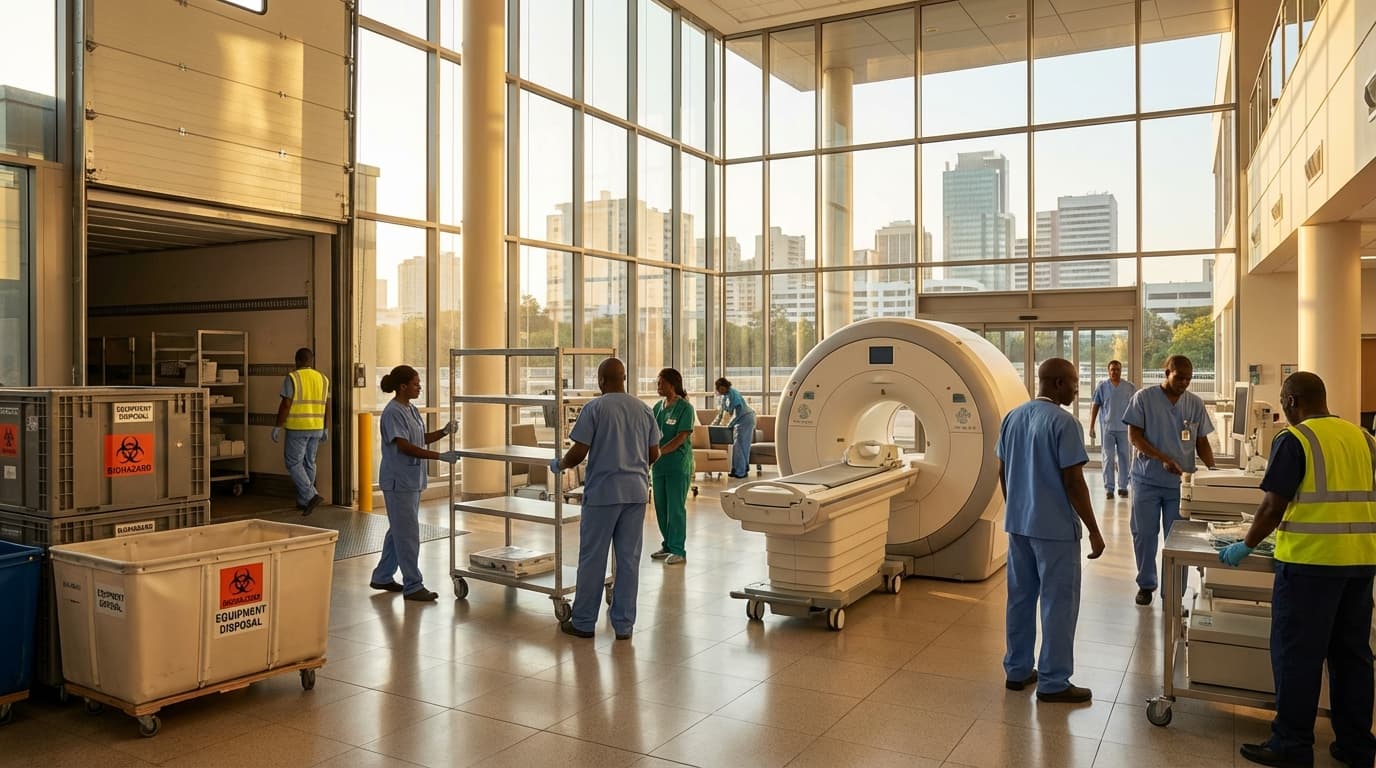
Decommissioning Service for Medical Devices in Zambia
Engineering Excellence & Technical Support
Decommissioning Service for Medical Devices High-standard technical execution following OEM protocols and local regulatory frameworks.
Regulatory Compliance Assurance
Our decommissioning services in Zambia meticulously adhere to all relevant Ministry of Health regulations and international best practices for medical device disposal, ensuring complete compliance and mitigating legal risks.
Environmentally Responsible Disposal
We prioritize environmentally sound decommissioning by implementing strict protocols for the segregation, recycling, and safe disposal of hazardous medical waste, minimizing ecological impact across Zambia.
Secure Data Eradication & Asset Tracking
Guaranteeing the complete and secure erasure of all patient and institutional data from decommissioned medical devices, coupled with transparent asset tracking and chain-of-custody documentation for full accountability in Zambia.
What Is Decommissioning Service For Medical Devices In Zambia?
Decommissioning service for medical devices in Zambia refers to the formal process of safely and responsibly removing a medical device from active clinical use. This encompasses a range of activities designed to ensure that the device is no longer functional, poses no risk to human health or the environment, and that all associated data is handled in accordance with regulatory requirements. The service is crucial for maintaining the integrity of healthcare infrastructure, ensuring compliance with national and international standards, and facilitating the responsible management of medical equipment lifecycles.
| Who Needs Decommissioning Service? | Typical Use Cases |
|---|---|
| Hospitals and Clinics (Public and Private) | End-of-life equipment replacement or upgrade. |
| Diagnostic Laboratories | Obsolescence due to technological advancements or wear and tear. |
| Research Institutions | Discontinuation of specific research projects requiring specialized equipment. |
| Medical Equipment Suppliers and Manufacturers (for returned or obsolete stock) | Equipment failure or irreparable damage. |
| Government Health Agencies (e.g., Ministry of Health) | Consolidation of services or rationalization of medical infrastructure. |
| Non-Governmental Organizations (NGOs) involved in healthcare | Closure of facilities or cessation of specific programs. |
| Any entity operating medical devices | Compliance with regulatory mandates for equipment lifecycle management. |
Key Aspects of Medical Device Decommissioning in Zambia:
- Disposal of Hazardous Materials: Identifying and safely removing or neutralizing any biohazardous, chemical, or radioactive components within the device.
- Data Sanitization and Destruction: Ensuring that all patient data and sensitive information stored on the device are securely erased or physically destroyed according to privacy regulations.
- Functional Disablement: Rendering the device inoperable to prevent its unauthorized use or resale.
- Environmental Compliance: Adhering to Zambian environmental regulations for the disposal of electronic and medical waste.
- Documentation and Certification: Maintaining comprehensive records of the decommissioning process, including certificates of destruction or disposal, for audit and compliance purposes.
- Asset Management: Updating inventory records to reflect the removal of the device from service.
Who Needs Decommissioning Service For Medical Devices In Zambia?
Decommissioning services for medical devices are crucial in Zambia for a variety of healthcare providers and institutions. This process ensures the safe, secure, and environmentally responsible disposal or repurposing of outdated, damaged, or end-of-life medical equipment. Failing to properly decommission devices can lead to data breaches, environmental contamination, and non-compliance with regulations. Therefore, any entity that utilizes medical equipment and is nearing its lifecycle end, or requires replacement, needs these specialized services.
| Customer Type | Specific Departments/Units Requiring Decommissioning | Reasons for Decommissioning |
|---|---|---|
| Hospitals (Public & Private) | Radiology, Cardiology, Oncology, Surgical Wards, Intensive Care Units (ICUs), Emergency Departments, Sterilization Units, Central Stores, IT Departments | Equipment obsolescence, upgrade to newer technology, failure to meet current standards, end-of-lease agreements, space optimization, data security of patient records |
| Clinics and Health Centers | General Consultation Rooms, Minor Procedure Rooms, Laboratory Sections, Pharmacy | Limited usage of specialized equipment, infrequent maintenance, budget constraints for repairs, replacement with more suitable devices |
| Diagnostic Laboratories | Hematology, Biochemistry, Microbiology, Pathology, Histology | Outdated diagnostic capabilities, calibration issues, high maintenance costs, need for automation or higher throughput equipment |
| Research Institutions | Various research labs, specialized equipment facilities | Research project completion, equipment no longer relevant to current research, need for specialized research tools, grant funding for new equipment |
| Medical Training Colleges and Universities | Simulation labs, practical training facilities, anatomical labs | Training equipment no longer representative of current medical practice, equipment damage from frequent use, updates to curriculum requiring new devices |
| NGOs & Ministry of Health Facilities | Mobile clinics, outreach programs, district health offices, specialized program units (e.g., maternal health) | Donated equipment reaching end-of-life, relocation of services, project closure, equipment surplus or inefficiency |
| Private Medical Practices | Dental clinics, physiotherapy centers, specialized diagnostic units | Practice expansion, technology upgrades, patient comfort and safety concerns, equipment malfunction |
Target Customers for Medical Device Decommissioning Services in Zambia
- Hospitals (Public and Private)
- Clinics and Health Centers
- Diagnostic Laboratories
- Research Institutions
- Medical Training Colleges and Universities
- Non-Governmental Organizations (NGOs) involved in healthcare
- Government Ministry of Health Facilities
- Private Medical Practices (e.g., dental, physiotherapy)
Decommissioning Service For Medical Devices Process In Zambia
This document outlines the typical workflow for a decommissioning service for medical devices in Zambia. The process ensures that medical equipment is safely and responsibly removed from service, adhering to regulatory requirements and environmental best practices. The workflow spans from the initial inquiry from a healthcare facility to the final execution of the decommissioning service, including documentation and disposal.
| Stage | Key Activities | Responsible Parties | Deliverables/Outcomes | Notes/Considerations |
|---|---|---|---|---|
| Healthcare facility contacts service provider to inquire about decommissioning services. Discussion of device type, quantity, location, and reasons for decommissioning. | Healthcare Facility (Client), Decommissioning Service Provider (DSP) | Understanding of client needs, initial scope identification. | Early engagement is crucial for effective planning. |
| DSP conducts a physical site visit to assess the condition and location of devices, identify potential hazards (e.g., hazardous materials), and determine access requirements. Develops a detailed decommissioning plan. | DSP, Healthcare Facility (for access and information) | Site assessment report, detailed decommissioning plan, risk assessment. | Involves engineers, technicians, and safety officers. |
| DSP submits a formal proposal outlining the scope of work, methodology, timeline, costs, safety protocols, and disposal plan. Includes a detailed quotation. | DSP | Comprehensive proposal and quotation. | Must clearly define responsibilities and liabilities. |
| Upon acceptance of the proposal, a formal contract is signed between the DSP and the healthcare facility, detailing all terms and conditions. | DSP, Healthcare Facility (Client) | Signed service contract. | Legal review of the contract is recommended. |
| DSP procures necessary tools, equipment, and safety gear. Coordinates with the facility for site access, power isolation, and any necessary preliminary preparations by the facility. | DSP, Healthcare Facility (for site access) | Preparedness for on-site execution, confirmed site access. | Includes training for DSP personnel. |
| DSP technicians safely and systematically dismantle, disable, and remove medical devices according to the approved plan. This may include data sanitization for devices with data storage capabilities. | DSP | Decommissioned medical devices, completed on-site work. | Adherence to strict safety and environmental protocols is paramount. |
| All components and waste generated are collected, segregated, and transported to approved disposal or recycling facilities, adhering to Zambian environmental regulations. | DSP | Properly managed and disposed of waste and device components. | Includes documentation of disposal methods and locations. |
| DSP provides a decommissioning certificate for each device, detailing the date, method, and confirmation of safe disposal or recycling. A comprehensive report of the entire process is generated. | DSP | Decommissioning certificates, final service report. | Essential for compliance and record-keeping. |
| A post-service review meeting may be held to discuss the execution, address any queries, and gather feedback from the client. Final invoicing and payment processing. | DSP, Healthcare Facility (Client) | Client satisfaction, finalized financial transaction. | Aims to continuously improve service delivery. |
Decommissioning Service for Medical Devices Process in Zambia: Workflow
- Initial Inquiry & Consultation
- Site Assessment & Planning
- Formal Proposal & Quotation
- Contract Agreement
- Pre-Decommissioning Preparations
- On-Site Decommissioning Execution
- Waste Management & Disposal
- Documentation & Certification
- Post-Service Review & Reporting
Decommissioning Service For Medical Devices Cost In Zambia
Decommissioning medical devices in Zambia involves a specialized process to ensure safe and environmentally responsible disposal. This service is crucial for healthcare facilities to comply with regulations, protect patient data, and prevent the spread of hazardous materials. The cost of decommissioning medical devices in Zambia is influenced by several factors, leading to a range of prices. These factors include the type and complexity of the device, the required level of data destruction, the location of the facility, and the chosen decommissioning service provider.
| Device Category | Estimated Cost Range (ZMW) | Notes |
|---|---|---|
| Small Basic Devices (e.g., BP monitors, thermometers, simple lab equipment) | 500 - 2,000 | Assumes standard disposal, minimal data concerns. |
| Medium Devices (e.g., patient monitors, infusion pumps, basic imaging peripherals) | 1,500 - 5,000 | May involve moderate data handling and more complex component disposal. |
| Large/Complex Devices (e.g., X-ray machines, ultrasound systems, anesthesia machines) | 4,000 - 15,000+ | Significant expertise, specialized handling, and robust data destruction usually required. |
| High-End/Specialized Equipment (e.g., MRI, CT scanners, linear accelerators) | 15,000 - 50,000+ | Requires highly specialized engineers, significant logistical planning, and often manufacturer involvement for safe dismantling. Data destruction is paramount. |
| Data Wiping Service (per device) | 200 - 1,000 | An add-on service for devices with data storage capabilities, if not included in the main decommissioning package. |
| On-site Dismantling Fee (if required) | 500 - 3,000 (variable) | For devices that cannot be transported intact, additional labor and tool costs apply. |
Key Pricing Factors for Medical Device Decommissioning in Zambia
- Device Type and Complexity: Larger, more complex, or specialized medical equipment (e.g., MRI machines, CT scanners, advanced surgical robots) will generally incur higher decommissioning costs due to the specialized knowledge, tools, and disposal methods required. Simpler devices like basic patient monitors or infusion pumps are typically less expensive.
- Data Destruction Requirements: Medical devices often store sensitive patient information. The level of data sanitization or physical destruction required for these devices significantly impacts cost. More robust data destruction methods (e.g., multiple overwrites, degaussing, physical shredding) are more expensive than basic wiping procedures.
- Location of the Facility: The geographical location of the healthcare facility plays a role. Decommissioning services in remote areas might incur additional transportation costs, increasing the overall price. Facilities in major urban centers like Lusaka might have a wider range of service providers, potentially leading to more competitive pricing.
- Service Provider Expertise and Reputation: Established decommissioning companies with specialized certifications, experienced technicians, and a strong reputation for compliance and environmental responsibility may command higher prices. Smaller or less experienced providers might offer lower rates.
- Volume of Devices: For facilities decommissioning a large number of devices, bulk discounts may be available. This can significantly reduce the per-unit cost.
- Environmental Disposal Compliance: The cost of safely and legally disposing of various medical device components (e.g., batteries, hazardous materials, electronic waste) is factored into the service fee. Compliance with Zambian environmental regulations adds to the operational cost for service providers.
- Certification and Documentation: The provision of certificates of destruction and detailed decommissioning reports is often included in the service, and the thoroughness of this documentation can influence pricing.
Affordable Decommissioning Service For Medical Devices Options
Navigating the decommissioning of medical devices requires a balance between compliance, safety, and cost-effectiveness. Affordable decommissioning services offer practical solutions for healthcare facilities and manufacturers, ensuring proper disposal, data sanitization, and environmental responsibility. Understanding value bundles and implementing cost-saving strategies are key to maximizing your return on investment.
| Value Bundle Component | Description | Cost-Saving Strategy/Benefit |
|---|---|---|
| On-Site Data Destruction | Physically destroying hard drives or using certified software erasure on-site. | Reduces transportation costs and provides immediate verification of data security. |
| Off-Site Certified Destruction | Devices are transported to a secure facility for shredding or degaussing. | Often more cost-effective for large volumes; ensures compliance with data sanitization standards. |
| Environmental Recycling Program | Responsible recycling of non-functional components and materials. | Minimizes landfill waste, potentially recovers valuable materials, and supports corporate sustainability goals. |
| Asset Value Recovery | Appraisal and resale of functional or refurbishable medical equipment. | Directly offsets decommissioning costs, turning potential waste into revenue. |
| Inventory Management and Reporting | Detailed tracking of devices throughout the decommissioning process, with comprehensive reports. | Ensures accountability, facilitates audits, and aids in future asset planning. |
| Certified Sanitization & Documentation | Providing certificates of data destruction and chain-of-custody documentation. | Essential for regulatory compliance and liability protection; avoids potential fines. |
| Customized Service Packages | Tailoring services to the specific needs and volume of devices. | Avoids paying for unnecessary services, leading to more efficient resource allocation. |
Key Considerations for Affordable Medical Device Decommissioning
- Regulatory Compliance: Adherence to HIPAA, FDA, EPA, and other relevant regulations is non-negotiable and impacts service choices.
- Data Security: Secure erasure or destruction of sensitive patient data is paramount.
- Environmental Responsibility: Proper disposal and recycling minimize environmental impact.
- Logistics and Transportation: Efficient handling and movement of devices can significantly affect costs.
- Asset Recovery: Exploring options for reselling or donating functional devices can offset expenses.
Verified Providers In Zambia
In Zambia, ensuring access to reliable healthcare services is paramount. Verified providers stand out as a crucial indicator of quality, safety, and trustworthiness. Among these, Franance Health has emerged as a leading name, distinguished by its rigorous credentialing process and commitment to patient well-being. Choosing a verified provider like Franance Health offers significant advantages, including assured professional standards, adherence to regulatory requirements, and a demonstrable track record of delivering excellent care. This verification process not only safeguards patients but also fosters confidence in the healthcare system.
| Aspect | Franance Health's Commitment | Patient Benefit |
|---|---|---|
| Professional Qualification | All healthcare professionals undergo thorough verification of their academic credentials, licenses, and certifications. | Ensures that you are treated by competent and legally recognized medical practitioners. |
| Experience and Competency | Franance Health assesses the practical experience and demonstrated competency of its providers. | Provides access to healthcare professionals with proven skills and a history of successful patient care. |
| Ethical Conduct | Providers are held to strict ethical codes of conduct and are monitored for patient interactions. | Guarantees respectful, empathetic, and professional treatment throughout your healthcare journey. |
| Regulatory Compliance | Franance Health ensures all its partners and facilities comply with Zambian healthcare regulations and licensing. | Offers peace of mind knowing that your healthcare is being delivered within a legal and safe framework. |
| Continuous Professional Development | Encourages and supports ongoing training and development for its healthcare team. | Ensures you receive care informed by the latest medical advancements and best practices. |
Why Franance Health Represents the Best Choice for Verified Providers in Zambia:
- Rigorous Credentialing and Verification Process
- Adherence to National and International Healthcare Standards
- Commitment to Patient Safety and Quality Care
- Experienced and Qualified Healthcare Professionals
- Transparent and Accountable Operations
- Positive Patient Outcomes and Satisfaction
- Ethical Medical Practices and Integrity
Scope Of Work For Decommissioning Service For Medical Devices
This Scope of Work (SOW) outlines the decommissioning services required for a defined set of medical devices. The objective is to safely and compliantly remove these devices from service, ensuring data security, environmental responsibility, and adherence to all relevant regulations and manufacturer guidelines. The SOW details the technical deliverables, standard specifications, and the overall process.
| Category | Specification/Requirement | Verification Method |
|---|---|---|
| Safety Procedures | All personnel involved must be trained in medical device handling and safety protocols. Use of appropriate Personal Protective Equipment (PPE) is mandatory. Lockout/tagout procedures for powered devices must be strictly followed. | Observation by Project Manager, Training Records Review. |
| Data Security | For devices storing patient data (e.g., PACS viewers, patient monitoring systems), data must be sanitized using industry-standard wiping algorithms (e.g., DoD 5220.22-M) or physically destroyed to a granular level. Encryption keys must be managed and invalidated. | Data Sanitization/Destruction Certificates, Witnessing of Destruction (if applicable). |
| Environmental Compliance | Disposal of all device components (including hazardous materials like mercury or batteries) must comply with local, state, and federal environmental regulations. Recycling of non-hazardous components will be prioritized. | Waste Disposal Manifests, Certificates of Recycling, Site Audit. |
| Manufacturer Guidelines | Decommissioning activities must adhere to any specific instructions or recommendations provided by the original equipment manufacturer (OEM) for the safe removal and disposal of their devices. | Review of OEM Service Manuals, Manufacturer Correspondence. |
| Regulatory Compliance | All activities must comply with relevant healthcare regulations such as HIPAA (for patient data privacy), FDA regulations (for medical device handling), and any applicable local ordinances regarding equipment disposal. | Compliance Audit, Documentation Review. |
| Documentation | All steps of the decommissioning process must be meticulously documented, including device serial numbers, asset tags, dates of activity, personnel involved, and any anomalies encountered. Photographs of key stages will be taken. | Review of Decommissioning Reports, Photographic Evidence. |
| Site Preparation & Cleanup | The decommissioning area will be secured and protected to prevent damage to surrounding equipment or facilities. Upon completion, the site will be cleaned to its original condition, free of debris and waste. | Pre- and Post-Cleanup Site Photographs, Site Inspection. |
| Transportation & Disposal | Devices and their components will be transported by licensed and insured entities. Final disposal will be at certified facilities that meet environmental and regulatory standards. | Transportation Licenses, Disposal Facility Certifications, Manifests. |
Technical Deliverables
- Comprehensive decommissioning plan tailored to each device type.
- Detailed site assessment and risk analysis report.
- Secure data sanitization and/or destruction certificates for devices with patient data.
- Device disassembly and component segregation reports.
- Waste disposal and recycling manifests, including proof of environmentally sound disposal.
- Decommissioning completion reports for each device, including photographs and status updates.
- Compliance documentation demonstrating adherence to relevant regulations (e.g., HIPAA, FDA, local environmental laws).
- Asset de-registration forms for internal inventory management.
- Post-decommissioning site cleanup verification.
- Final project report summarizing all activities and outcomes.
Service Level Agreement For Decommissioning Service For Medical Devices
This Service Level Agreement (SLA) outlines the response times and uptime guarantees for the Decommissioning Service for Medical Devices provided by [Your Company Name] (hereinafter referred to as "Provider") to [Client Company Name] (hereinafter referred to as "Client"). This SLA is an integral part of the Master Service Agreement between the Provider and the Client.
| Service Component | Response Time Target | Uptime Guarantee | Notes/Conditions |
|---|---|---|---|
| Urgent Decommissioning Request (e.g., device failure requiring immediate removal, critical data breach risk) | Within 4 Business Hours of Client notification. | N/A (This is event-driven, not uptime-based) | Client must clearly designate requests as 'Urgent'. Provider will prioritize these requests over routine activities. Availability of specialized equipment/personnel may influence actual commencement time. |
| Standard Decommissioning Request (e.g., scheduled device retirement) | Within 1 Business Day of Client request submission and confirmation. | 99.5% Monthly Uptime | Uptime is measured for the availability of our scheduling and coordination systems, and the readiness of our decommissioning teams. Does not include Client-side delays (e.g., device not accessible). |
| Data Sanitization Verification Reporting | Within 2 Business Days of completion of sanitization. | N/A | Reports will be provided electronically. Delays may occur if complex device configurations require extended verification. |
| Physical Destruction Confirmation (if applicable) | Within 3 Business Days of completion of physical destruction. | N/A | Confirmation will include appropriate documentation (e.g., certificates of destruction). Availability of certified destruction facilities may impact timelines. |
| Scheduled Maintenance | N/A | N/A | Planned maintenance will be communicated to the Client at least 7 days in advance. Downtime during planned maintenance is excluded from Uptime calculations. |
Definitions
- Decommissioning Service: The process of safely and securely retiring medical devices from service, including data sanitization, physical destruction (if applicable), and disposal in accordance with regulatory requirements and manufacturer specifications.
- Downtime: The period during which the Decommissioning Service is unavailable to the Client due to a failure in the Provider's systems or personnel, preventing the commencement or continuation of scheduled decommissioning activities. Planned maintenance is excluded from Downtime.
- Response Time: The maximum time allowed for the Provider to acknowledge and begin addressing a reported issue or to initiate a scheduled decommissioning task.
- Uptime: The percentage of time during the contract period that the Decommissioning Service is available and operational. For the purpose of this SLA, Uptime is calculated on a monthly basis.
Frequently Asked Questions

Ready when you are
Let's scope your Decommissioning Service for Medical Devices in Zambia project in Zambia.

Scaling healthcare logistics and technical systems across the entire continent.