
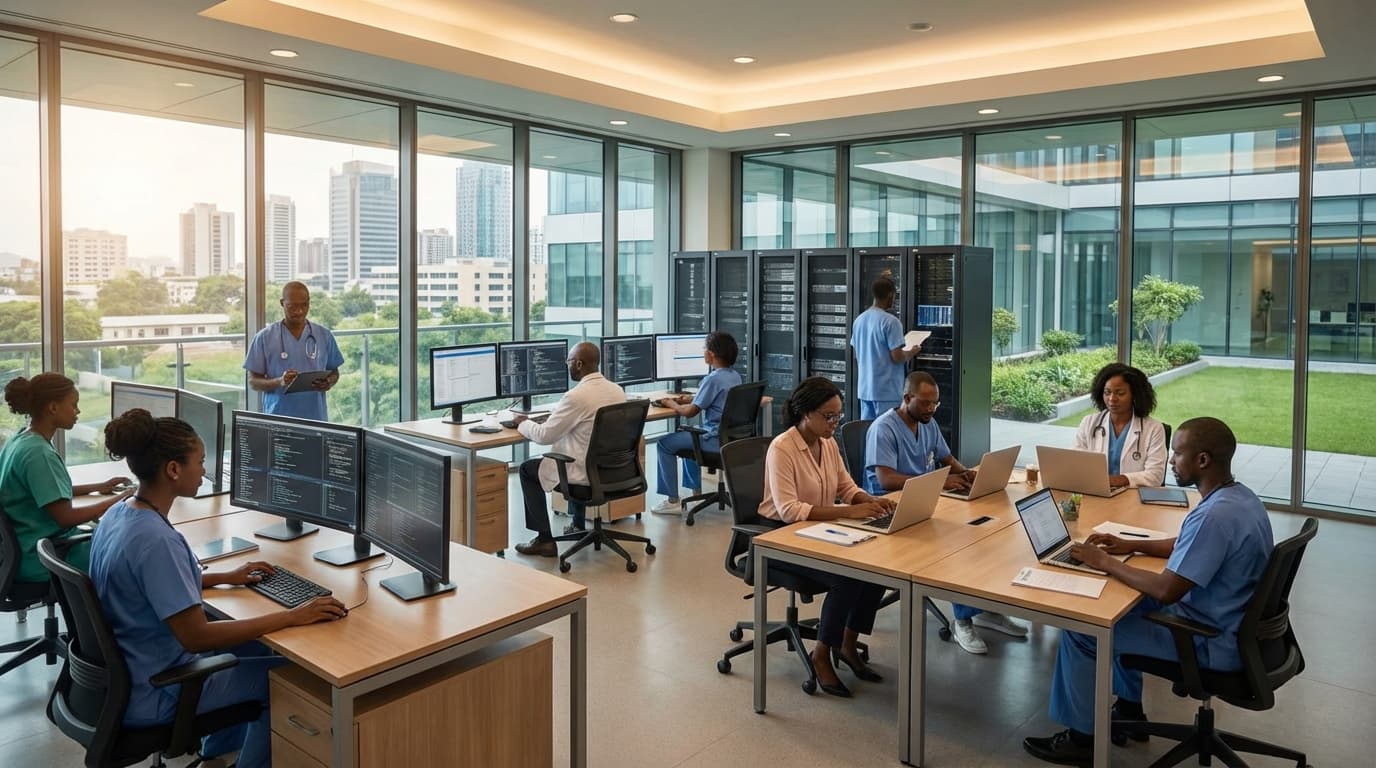
Radiology Reader & Reporting Support in Zambia
Engineering Excellence & Technical Support
Remote radiology reading and reporting services High-standard technical execution following OEM protocols and local regulatory frameworks.
AI-Powered Diagnostic Assistance
Leverage cutting-edge AI algorithms to automatically flag potential anomalies and highlight areas of interest on radiological images, significantly reducing radiologist workload and improving diagnostic accuracy in Zambia.
Real-time Workflow Optimization
Implement a dynamic dashboard that visualizes imaging queues, radiologist workloads, and report turnaround times, enabling proactive management and efficient allocation of resources for enhanced radiology service delivery across Zambia.
Collaborative Reporting Platform
Facilitate seamless collaboration among radiologists, referring physicians, and specialists through a secure, cloud-based platform for shared image viewing, annotation, and report generation, fostering multidisciplinary patient care in Zambia.
What Is Radiology Reader & Reporting Support In Zambia?
Radiology Reader & Reporting Support in Zambia refers to a specialized service that augments the diagnostic capabilities of healthcare facilities by providing remote or on-site expert interpretation of medical imaging studies and generation of comprehensive diagnostic reports. This service leverages advanced Picture Archiving and Communication Systems (PACS), Radiology Information Systems (RIS), and secure communication platforms to facilitate the transmission of medical images and associated patient data for interpretation by qualified radiologists. The primary objective is to address potential shortages of on-site radiologists, improve turnaround times for diagnostic reports, enhance diagnostic accuracy through subspecialty expertise, and extend access to high-quality radiology services to underserved areas within Zambia. This support system is crucial for ensuring timely and accurate diagnoses, which directly impact patient management and treatment outcomes.
| Who Needs Radiology Reader & Reporting Support? | Typical Use Cases |
|---|---|
| Hospitals & Clinics in Urban Areas | Managing high patient volumes, reducing radiologist burnout, providing subspecialty reads for complex cases, after-hours coverage. |
| Hospitals & Clinics in Rural/Remote Areas | Bridging the gap in radiologist availability, enabling access to advanced imaging interpretation, improving healthcare equity. |
| Diagnostic Imaging Centers | Augmenting in-house capacity, managing peak workloads, expanding service offerings with specialized interpretations. |
| Emergency Departments | Expediting interpretation of critical imaging studies (e.g., trauma, stroke) to facilitate rapid patient management, 24/7 coverage. |
| Specialized Medical Facilities (e.g., Oncology, Cardiology) | Providing specific subspecialty interpretations tailored to the needs of their patient populations. |
| Public Health Initiatives & Screening Programs | Facilitating large-scale image interpretation for disease screening and public health surveillance. |
Key Components of Radiology Reader & Reporting Support
- Image Acquisition & Transmission: Secure and efficient transfer of DICOM-formatted medical images (X-ray, CT, MRI, Ultrasound, etc.) from originating healthcare facilities to the reading service.
- Remote Interpretation (Teleradiology): Qualified radiologists, often located remotely, access and interpret acquired images using specialized viewing workstations.
- Report Generation: Creation of detailed, accurate, and standardized diagnostic reports based on image findings and clinical information, often utilizing structured reporting templates.
- Quality Assurance & Peer Review: Implementation of robust quality control mechanisms to ensure diagnostic accuracy and adherence to best practices.
- Integration with RIS/PACS: Seamless integration with existing hospital information systems to streamline workflows and data management.
- Subspecialty Expertise: Access to radiologists with specialized training in various subfields (e.g., neuroradiology, musculoskeletal radiology, pediatric radiology) for complex cases.
- Communication & Consultation: Facilitation of communication between referring physicians and interpreting radiologists for clarification and collaborative decision-making.
- Training & Capacity Building: Potential for providing training and mentorship to local healthcare professionals, including radiographers and junior clinicians.
Who Needs Radiology Reader & Reporting Support In Zambia?
Radiology reader and reporting support services are crucial for enhancing diagnostic accuracy, reducing radiologist workload, and improving patient care across various healthcare settings in Zambia. These services provide specialized expertise to interpret medical images and generate comprehensive reports, especially in areas with a shortage of qualified radiologists or for complex cases.
| Customer Type | Key Departments Requiring Support | Specific Needs Addressed |
|---|---|---|
| Public Hospitals | Radiology Department, Emergency Department, Oncology Department, Surgery Department, Pediatrics | Overcoming radiologist shortages, rapid turnaround for critical cases, second opinions for complex diagnoses, training and capacity building for local staff. |
| Private Hospitals & Clinics | Radiology Department, Outpatient Services, Cardiology, Neurology, Orthopedics | Enhancing diagnostic precision, offering specialized imaging interpretations (e.g., advanced MRI/CT), improving patient throughput, competitive differentiation through advanced reporting. |
| Diagnostic Imaging Centers | Radiology Department | Supplementing reporting capacity during peak times, providing expertise in sub-specialties (e.g., musculoskeletal, neuro-radiology), quality assurance of reports. |
| NGOs with Healthcare Programs | Mobile Clinics, Remote Health Posts, General Hospitals | Extending diagnostic services to underserved areas, supporting large-scale screening programs (e.g., TB, cancer), providing essential radiology support where local expertise is limited. |
| Government Health Ministries | National Referral Hospitals, Regional Hospitals, Public Health Initiatives | Developing national radiology guidelines, implementing quality control measures, supporting public health surveillance through imaging data, addressing national healthcare access gaps. |
Target Customers and Departments in Zambia:
- Hospitals (Public and Private)
- Specialty Clinics
- Diagnostic Imaging Centers
- Non-Governmental Organizations (NGOs) with Healthcare Programs
- Government Health Ministries
Radiology Reader & Reporting Support Process In Zambia
This document outlines the workflow for the Radiology Reader & Reporting Support Process in Zambia. This process ensures that medical imaging studies are efficiently reviewed by qualified radiologists and that comprehensive reports are generated to aid in patient diagnosis and treatment.
| Step | Activity | Responsible Party | Key Outputs/Documents | Notes/Considerations |
|---|---|---|---|---|
| 1 | Inquiry/Request Initiation | Referring Physician/Clinician | Completed Imaging Request Form/Order | Includes patient demographics, clinical history, suspected diagnosis, and specific imaging modality/protocol required. |
| 2 | Scheduling and Preparation | Radiology Department/RIS | Scheduled Appointment, Patient Preparation Instructions | Ensures appropriate equipment availability, patient readiness, and informed consent. May involve contrast administration protocols. |
| 3 | Image Acquisition | Radiology Technologist/Radiographer | Acquired Imaging Study (Digital Files - DICOM format) | Adheres to imaging protocols, ensures image quality, and correctly labels images with patient and study information. |
| 4 | Image Transmission and Archiving | Radiology Department/RIS/PACS (Picture Archiving and Communication System) | Digital Images Stored in PACS, Study Linked to Patient Record | Ensures secure and accessible storage of images for review and future reference. |
| 5 | Radiologist Assignment and Review | Radiology Department/RIS | Assigned Study for Interpretation | Studies are assigned to radiologists based on expertise, workload, and urgency. Critical findings may be prioritized. |
| 6 | Image Interpretation and Dictation | Radiology Reader/Radiologist | Dictated Radiology Report | Systematic review of images, identification of abnormalities, and formulation of diagnostic conclusions. Dictation captures findings and recommendations. |
| 7 | Reporting Support (Transcription/Formatting) | Reporting Support Staff (if applicable) or Radiologist (self-dictation/typing) | Draft Radiology Report | Transcribes dictation accurately, formats the report according to established standards, and checks for typographical errors. |
| 8 | Report Review and Finalization | Radiology Reader/Radiologist | Finalized and Signed Radiology Report | Radiologist reviews the transcribed/drafted report for accuracy, completeness, and clarity before signing off. |
| 9 | Report Distribution | Radiology Department/RIS | Radiology Report Sent to Referring Physician/Clinician, Patient Record Updated | Report is electronically or physically delivered to the referring physician. May include direct communication for critical findings. |
| 10 | Report Utilization | Referring Physician/Clinician | Clinical Decision Making, Patient Management Plan | The report informs diagnosis, treatment planning, and follow-up care for the patient. |
Key Stakeholders Involved
- Referring Physician/Clinician: Initiates the imaging request and provides clinical context.
- Radiology Technologist/Radiographer: Performs the imaging study.
- Radiology Department/Radiology Information System (RIS): Manages the workflow, scheduling, and storage of imaging studies and reports.
- Radiology Reader/Radiologist: Interprets the imaging study and dictates the report.
- Reporting Support Staff (if applicable): Transcribes dictations, formats reports, and ensures accuracy.
- Patient: Undergoes the imaging procedure and benefits from the diagnostic report.
Radiology Reader & Reporting Support Cost In Zambia
The cost of radiology reader and reporting support in Zambia is influenced by several factors, leading to a range of pricing. These services are crucial for effective diagnosis and patient care, particularly in a country where specialized radiologists may be concentrated in urban centers. Understanding the pricing structure is vital for healthcare providers and institutions to budget accordingly and ensure access to these essential services. The primary drivers of cost include the complexity of the imaging modality, the volume of studies requiring interpretation, the turnaround time requested, and the qualifications and experience of the interpreting radiologist. Geographic location within Zambia can also play a role, with services in major cities potentially having different cost structures than those in more remote areas, though the latter often face higher logistical costs if remote reading is employed. The specific type of service (e.g., primary interpretation, second opinion, subspecialty reads) will also impact the price. Emergency or STAT readings typically command a premium due to the urgency and the need for immediate availability of the interpreting physician. Many providers may offer tiered pricing based on volume, with discounts for higher throughput. The currency used for pricing is the Zambian Kwacha (ZMW).
| Service Type/Modality (Examples) | Estimated Price Range (ZMW) | Notes |
|---|---|---|
| Basic X-ray Interpretation (per study) | 150 - 400 | Standard interpretation for simple findings. |
| CT Scan Interpretation (per study) | 500 - 1,500 | Covers a single CT examination; complexity of protocol and findings can influence cost. |
| MRI Scan Interpretation (per study) | 700 - 2,500 | Generally higher cost due to complexity and scan time; specific sequences impact pricing. |
| Ultrasound Interpretation (per study) | 300 - 800 | Varies based on the area scanned (e.g., abdominal, pelvic, obstetric). |
| Mammography Interpretation (per study) | 250 - 600 | Includes screening and diagnostic mammograms. |
| STAT/Emergency Reading (additional fee) | 100 - 300 (on top of base fee) | For urgent interpretation with expedited turnaround. |
| Subspecialty Interpretation (e.g., Neuroradiology, Musculoskeletal) | 1.5x - 2.5x (of standard interpretation fee) | Requires specialized expertise and is priced accordingly. |
| Teleradiology Service (per study, volume-based) | 200 - 1,000 (average) | Price per study often decreases with higher volume commitments. This is a broad range depending on modality and volume. |
| Dedicated Radiologist Support (monthly retainer) | Negotiable (highly variable) | For institutions requiring consistent, ongoing reporting. Typically bespoke pricing based on expected workload and service level agreement. |
Key Pricing Factors for Radiology Reader & Reporting Support in Zambia
- Complexity of Imaging Modality (e.g., X-ray, CT, MRI, Ultrasound, Mammography)
- Volume of Studies for Interpretation
- Required Turnaround Time (e.g., routine, urgent, STAT)
- Radiologist Qualifications and Specialization (e.g., General Radiologist, Neuroradiologist, Musculoskeletal Radiologist)
- Geographic Location of Service Provider (urban vs. rural, accessibility)
- Type of Service (primary read, second opinion, subspecialty interpretation)
- Provider's Overhead and Operational Costs
- Technology and Software Used for Teleradiology/Reporting
- Contractual Agreements and Long-Term Commitments (volume discounts)
Affordable Radiology Reader & Reporting Support Options
Radiology departments are increasingly seeking cost-effective solutions for reading and reporting to manage growing workloads and budget constraints. This often involves exploring options beyond traditional in-house staffing. Value bundles and strategic cost-saving measures can significantly enhance efficiency and reduce expenditure. Value bundles typically combine multiple services, such as preliminary reads, final interpretations, and quality assurance, into a single package, offering a predictable cost structure and streamlined operations. Cost-saving strategies involve leveraging technology, optimizing workflow, and exploring flexible staffing models.
| Cost-Saving Strategy | Description | Potential Savings | Considerations |
|---|---|---|---|
| Value Bundles (e.g., Teleradiology Packages) | Pre-negotiated packages of reading and reporting services from a single vendor. Often includes preliminary reads, final interpretations, and quality control. | Reduced per-study costs, predictable budgeting, lower administrative burden. | Vendor reliability, turnaround times, integration with existing PACS/RIS. |
| As-Needed Teleradiology | Engaging teleradiology services only for specific needs, such as overflow, off-hours, or subspecialty coverage. | Pay only for services used, avoids fixed staffing costs, increased flexibility. | Requires robust communication and IT infrastructure, potential for inconsistent turnaround times if not managed well. |
| AI Integration | Utilizing AI tools to assist with image analysis and preliminary detection. | Improved radiologist efficiency (reduced reading time per study), potential for early detection, enhanced accuracy. | Initial investment in AI software, ongoing training, validation of AI performance, regulatory compliance. |
| Remote Reading for Specific Modalities/Times | Outsourcing interpretation of certain imaging types (e.g., plain films) or during specific time windows (e.g., nights, weekends). | Lower labor costs compared to in-house staffing for these specific needs, improved work-life balance for in-house staff. | Ensuring quality of interpretation, secure data transfer, clear communication protocols. |
| Managed Service Contracts | Outsourcing the management of specific radiology services or equipment maintenance. | Reduced operational overhead, access to specialized expertise, improved equipment uptime. | Vendor lock-in, ensuring service level agreements (SLAs) are met. |
Affordable Radiology Reader & Reporting Support Options
- {"title":"Tele-Radiology Services","description":"On-demand or dedicated teleradiology providers offer remote interpretation of medical images. This can be a cost-effective alternative to hiring full-time radiologists, especially for off-hours coverage, subspecialty reads, or to manage overflow."}
- {"title":"AI-Powered Reading Assistants","description":"Artificial intelligence tools can assist radiologists by flagging potential abnormalities, prioritizing urgent cases, and automating measurements. While not a replacement for human interpretation, AI can improve efficiency and accuracy, indirectly saving costs through reduced reading times."}
- {"title":"Hybrid Staffing Models","description":"Combining in-house radiologists with remote or locum tenens support allows for flexibility. This enables departments to scale their reading capacity up or down as needed, avoiding the overhead of permanent staff during slower periods."}
- {"title":"Subspecialty Coverage Services","description":"Accessing remote subspecialists for interpretations in niche areas (e.g., neuroradiology, pediatric radiology) can be more cost-effective than employing full-time subspecialists for every department."}
- {"title":"Radiology Workflow Optimization Software","description":"Implementing software that streamlines reporting, scheduling, and communication can reduce administrative overhead and improve radiologist productivity."}
Verified Providers In Zambia
In the evolving landscape of healthcare in Zambia, identifying and engaging with verified providers is paramount for ensuring quality and trustworthy medical services. Franance Health stands out as a leading example of a healthcare organization committed to upholding the highest standards of care, making them a compelling choice for individuals and families seeking reliable healthcare solutions. Their dedication to credentialing, patient-centric approach, and comprehensive services solidify their position as a top-tier provider.
| Franance Health Feature | Benefit to Patients | Why it Matters for Verified Providers |
|---|---|---|
| Certified Professionals | Access to highly skilled and qualified doctors, nurses, and specialists. | Ensures you receive care from individuals who have met stringent educational and competency requirements. |
| Accredited Facilities | State-of-the-art medical facilities adhering to international quality standards. | Guarantees a safe, clean, and well-equipped environment for diagnosis and treatment. |
| Transparent Pricing | Clear and upfront information on costs for services and treatments. | Builds trust and allows for informed decision-making regarding your healthcare budget. |
| Patient Feedback Mechanisms | Active solicitation and incorporation of patient reviews and feedback. | Demonstrates a commitment to continuous improvement and responsiveness to patient needs. |
| Adherence to Ethical Guidelines | Strict observance of medical ethics and professional conduct. | Protects your rights and ensures you receive respectful, unbiased, and confidential care. |
| Robust Emergency Response | Well-established protocols and resources for handling medical emergencies. | Provides peace of mind knowing that urgent medical needs will be met promptly and effectively. |
Why Franance Health is Your Best Choice:
- Rigorous Credentialing and Verification Processes
- Commitment to Patient Safety and Well-being
- Experienced and Qualified Medical Professionals
- Comprehensive Range of Medical Services
- Patient-Centric Care Philosophy
- Investment in Modern Medical Technology
- Strong Community Engagement and Outreach
Scope Of Work For Radiology Reader & Reporting Support
This Scope of Work (SOW) outlines the requirements for Radiology Reader & Reporting Support services. This document details the technical deliverables, standard specifications, and responsibilities for providing efficient and accurate radiology interpretation and reporting.
| Deliverable Type | Description | Standard Specifications | Format/Technology |
|---|---|---|---|
| Radiology Interpretation | Review and analysis of various imaging modalities (X-ray, CT, MRI, Ultrasound, Nuclear Medicine, Mammography, etc.) by qualified radiologists. | Interpretation must be based on best practice guidelines, relevant clinical history, and comparison with prior studies when available. Turnaround times (TAT) for preliminary and final reads will be defined in service level agreements (SLAs). | Digital images accessible via PACS. |
| Radiology Reports | Generation of detailed and structured reports for each interpreted study. | Reports must include: Patient demographics, clinical indication, technique used, findings (positive and negative), comparison with prior studies, impression/conclusion, and recommendations for further management or imaging. Reports will adhere to standardized reporting templates where applicable. | Electronic reports, integrated into RIS. Speech recognition or dictation software integration is expected. |
| Quality Assurance (QA) Reports | Regular reports summarizing QA metrics, including turnaround times, error rates, and peer review outcomes. | Reports will highlight areas for improvement and track progress against established QA benchmarks. Frequency of QA reporting to be specified (e.g., monthly, quarterly). | Electronic reports, typically in PDF or accessible via a dashboard. |
| Communication with Referring Physicians | Facilitation of direct communication with referring physicians for critical findings or clarification. | Established protocols for urgent communication, including phone calls and secure messaging systems. Documentation of all communications within the RIS. | Phone, secure email, or integrated messaging within RIS/PACS. |
| System Integration | Seamless integration with client's existing PACS and RIS. | Must support HL7 (Health Level Seven) standards for data exchange. API integration may be required for specific functionalities. Secure data transfer protocols (e.g., DICOM) are mandatory. | DICOM, HL7, FHIR (Fast Healthcare Interoperability Resources) APIs. |
| Data Security and Privacy | Strict adherence to all data security and patient privacy regulations (e.g., HIPAA, GDPR). | Implementation of robust security measures to protect patient health information (PHI). Regular security audits and compliance certifications. Access controls and audit trails. | Encrypted data transmission, secure storage, role-based access control. |
| Radiologist Qualifications | All interpreting radiologists must be board-certified or board-eligible in their respective specialties. | Verification of credentials, licensure, and malpractice insurance. Ongoing professional development and adherence to ethical guidelines. | Digital copies of certifications, licenses, and insurance. |
Key Objectives
- To provide timely and accurate interpretation of diagnostic imaging studies.
- To generate comprehensive and clinically relevant radiology reports.
- To ensure compliance with all relevant medical, regulatory, and professional standards.
- To maintain high-quality patient care through expert radiological analysis.
- To integrate seamlessly with existing PACS (Picture Archiving and Communication System) and RIS (Radiology Information System) workflows.
Service Level Agreement For Radiology Reader & Reporting Support
This Service Level Agreement (SLA) outlines the guaranteed response times and uptime for the Radiology Reader & Reporting Support service provided by [Your Company Name] to [Client Name]. This SLA aims to ensure efficient and reliable access to radiology reading and reporting resources.
| Service Metric | Target | Measurement Period | Remedy for Failure |
|---|---|---|---|
| Report Turnaround Time (TAT) | Routine studies: 24-48 business hours; STAT studies: within 1-2 business hours of request receipt. | Monthly | 10% service credit for each instance of exceeding TAT by more than 12 hours for routine studies, or 2 hours for STAT studies, up to a maximum of 25% of the monthly service fee. |
| Reader Availability (Uptime) | 99.5% uptime for the radiology reading platform and core services. | Monthly | 2% service credit for every 30 minutes of unscheduled downtime exceeding 0.5% of the monthly uptime target, up to a maximum of 15% of the monthly service fee. |
| Critical Issue Response Time | For critical system outages impacting reporting: Within 30 minutes of notification. | Per Incident | N/A - Immediate escalation and resolution priority is paramount. If resolution is not achieved within 4 business hours, a 5% service credit will be applied to the following month's invoice. |
| Non-Critical Issue Response Time | For non-critical platform issues or general inquiries: Within 4 business hours. | Per Incident | N/A - Focus on timely resolution. If not resolved within 1 business day, a 2% service credit will be applied to the following month's invoice. |
| Report Accuracy | 99.0% accuracy rate (excluding inherent interpretation variability). | Quarterly | For each identified instance of significant report inaccuracy leading to adverse patient outcome, a review will be conducted. If proven, a credit equal to the fee for that specific report will be issued, and a root cause analysis will be performed. This is reviewed on a case-by-case basis. |
Key Service Components
- Radiology Reader Support: Availability of qualified radiologists to review and interpret medical imaging studies.
- Reporting Support: Generation of accurate and timely radiology reports based on interpretations.
- Technical Support: Assistance with any issues related to the reporting platform or connectivity.
- Data Security & Confidentiality: Adherence to all relevant privacy regulations (e.g., HIPAA, GDPR) and robust security measures.
Frequently Asked Questions

Ready when you are
Let's scope your Radiology Reader & Reporting Support in Zambia project in Zambia.

Scaling healthcare logistics and technical systems across the entire continent.