
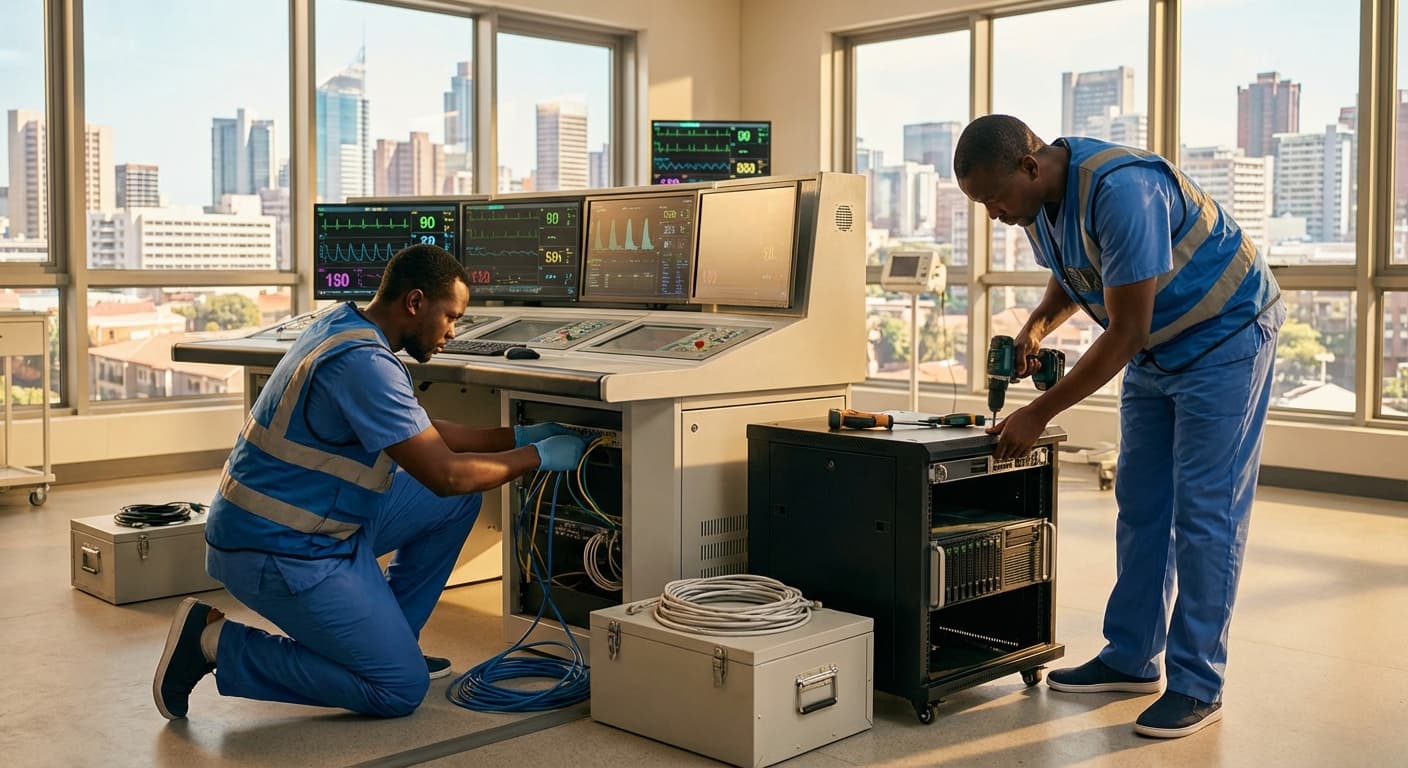
ICU Central Monitoring Station Installation Service in Zambia
Engineering Excellence & Technical Support
ICU Central Monitoring Station Installation Service High-standard technical execution following OEM protocols and local regulatory frameworks.
Robust Network Infrastructure
We design and implement high-availability, secure, and scalable network architectures specifically for ICU central monitoring systems, ensuring seamless real-time data transmission from bedside monitors to the central station. Our installations leverage redundant pathways and advanced quality-of-service (QoS) protocols to guarantee data integrity and minimal latency, even under heavy network load.
High-Performance Server & Storage Solutions
Our service includes the deployment of powerful, enterprise-grade servers and robust storage solutions optimized for continuous data acquisition, processing, and long-term archiving. We ensure ample processing power for real-time waveform analysis and critical alert generation, coupled with redundant storage configurations for data safety and compliance with medical record retention policies in Zambia.
Comprehensive Cybersecurity Measures
Patient data security is paramount. We integrate multi-layered cybersecurity defenses, including access control, data encryption (in transit and at rest), intrusion detection systems, and regular vulnerability assessments, to protect the ICU central monitoring system from unauthorized access and cyber threats, adhering to international best practices and local regulatory considerations in Zambia.
What Is Icu Central Monitoring Station Installation Service In Zambia?
ICU Central Monitoring Station Installation Service in Zambia refers to the comprehensive process of designing, procuring, installing, configuring, and commissioning a centralized command and control center for Intensive Care Units (ICUs) within healthcare facilities in Zambia. This service ensures that critical patient vital signs and other physiological data are continuously monitored, displayed, and managed from a single, dedicated location, enabling proactive clinical decision-making and improved patient outcomes. The service encompasses the integration of advanced patient monitoring devices, central display systems, data management software, and robust networking infrastructure, all tailored to the specific requirements and environmental conditions prevalent in Zambian healthcare settings.
| Service Recipient | Rationale for Need | Typical Use Cases |
|---|---|---|
| Hospitals (Public and Private) in Zambia: | To enhance patient safety and improve the quality of care in high-acuity settings. Centralized monitoring allows for immediate detection of critical changes in patient status, facilitating timely intervention by clinical teams. | Continuous surveillance of multiple critically ill patients in a single ICU. Real-time trend analysis for complex patient management. Facilitation of interdisciplinary team communication and rapid response to patient deterioration. Remote monitoring capabilities for situations with limited on-site staffing. |
| Specialized Care Units (e.g., Cardiac ICUs, Neuro ICUs): | To support the management of patients with complex cardiac or neurological conditions requiring constant, multi-parameter monitoring and immediate alarm notification. | Monitoring of advanced hemodynamic parameters (e.g., CVP, PAWP, Cardiac Output). Real-time analysis of neurological signals (e.g., EEG, ICP). Integration with specialized devices like ventilators and dialysis machines for comprehensive patient overview. |
| Emergency Departments (in facilities with critical care capacity): | To provide early identification and management of critically ill patients arriving at the ED, ensuring seamless transition to the ICU if necessary. | Initial stabilization and monitoring of unstable patients before transfer to definitive care. Pre-emptive monitoring of patients identified as high-risk for deterioration. |
| Research and Training Institutions: | To facilitate clinical research by enabling robust data acquisition and to provide a realistic training environment for future healthcare professionals. | Collection of high-resolution patient data for retrospective and prospective studies. Simulation of critical care scenarios for hands-on training of medical and nursing students. Development of new monitoring protocols and algorithms. |
Key Components and Scope of ICU Central Monitoring Station Installation Service:
- Needs Assessment and System Design: Detailed analysis of ICU bed count, patient demographics, existing infrastructure, and specific clinical workflow requirements to design a scalable and interoperable monitoring solution.
- Hardware and Software Procurement: Sourcing and supply of high-fidelity patient monitors (e.g., ECG, SpO2, NIBP, invasive pressure, EtCO2), central display consoles, servers, networking equipment, and specialized ICU monitoring software.
- Installation and Integration: Physical installation of monitoring devices at patient bedsides, connection to the central station via wired or wireless networks, and seamless integration with existing Electronic Health Records (EHR) systems where applicable.
- Configuration and Calibration: Customization of alarm parameters, data display formats, trending capabilities, and report generation functions to align with clinical protocols and physician preferences. Calibration of all monitoring devices to ensure accuracy and reliability.
- Network Infrastructure Setup: Design and implementation of a secure and redundant network (LAN/WAN) capable of transmitting high volumes of real-time data from multiple patient monitors to the central station without latency.
- Power Management and Backup: Installation of uninterruptible power supplies (UPS) and backup generators to ensure continuous operation of the central monitoring station and connected devices during power outages.
- System Testing and Commissioning: Rigorous functional testing, performance validation, and stress testing to verify system integrity, data accuracy, alarm functionality, and overall operational readiness.
- User Training and Documentation: Comprehensive training programs for clinical staff (nurses, physicians, intensivists) on the operation, maintenance, and troubleshooting of the central monitoring system. Provision of detailed user manuals and technical documentation.
- Ongoing Support and Maintenance: Post-installation support services, including routine maintenance, software updates, remote diagnostics, and emergency repair services.
Who Needs Icu Central Monitoring Station Installation Service In Zambia?
ICU Central Monitoring Station Installation Services in Zambia are crucial for healthcare facilities that aim to provide high-quality, real-time patient care in intensive care units. These services are essential for setting up and maintaining the complex infrastructure required to monitor multiple critically ill patients simultaneously. This includes the installation of sophisticated monitoring equipment, data management systems, and communication networks, all designed to alert medical staff to critical changes in a patient's condition immediately. The goal is to enhance patient safety, improve clinical outcomes, and optimize resource allocation within the ICU.
| Customer Type | Key Need | Typical Department Focus |
|---|---|---|
| Public Hospitals | Enhancing critical care capacity, standardizing patient monitoring across facilities, ensuring uptime and reliability. | ICUs, CCUs, NICUs |
| Private Hospitals | Offering advanced patient care, attracting specialized medical professionals, maintaining a competitive edge, ensuring data security and integration. | ICUs, HDUs, SICUs |
| Mission Hospitals | Improving access to quality critical care in underserved areas, cost-effective and reliable solutions. | ICUs |
| Tertiary/Referral Hospitals | Managing a high volume of complex cases, integrating advanced diagnostic and monitoring systems, supporting medical research. | Multiple ICUs (Medical, Surgical, Cardiac, Neurological) |
| New Hospital Projects | Designing and implementing state-of-the-art critical care infrastructure from inception, ensuring compliance with international standards. | Dedicated ICU facilities |
| Hospitals undergoing Renovation/Expansion | Upgrading existing monitoring systems, integrating new technologies, ensuring minimal disruption to ongoing patient care. | Existing and expanded ICUs, HDUs |
Target Customers and Departments for ICU Central Monitoring Station Installation Services in Zambia
- {"items":["Public Hospitals (Ministry of Health facilities)","Private Hospitals and Clinics","Mission Hospitals and Healthcare Organizations","Tertiary and Referral Hospitals","New Hospital Construction Projects","Hospitals undergoing Renovation or Expansion"],"title":"Target Customers"}
- {"items":["Intensive Care Units (ICUs)","High Dependency Units (HDUs)","Cardiac Care Units (CCUs)","Neonatal Intensive Care Units (NICUs)","Surgical Intensive Care Units (SICUs)","Medical Intensive Care Units (MICUs)","Emergency Departments (for critical care areas)"],"title":"Target Departments"}
Icu Central Monitoring Station Installation Service Process In Zambia
This document outlines the comprehensive workflow for the ICU Central Monitoring Station Installation Service Process in Zambia, from initial inquiry to final execution and handover. Our service is designed to be transparent, efficient, and tailored to the specific needs of healthcare facilities in Zambia.
| Stage | Description | Key Activities | Deliverables | Timeline (Estimated) |
|---|---|---|---|---|
| Initial contact and understanding of client needs. | Receive inquiry, schedule initial meeting, discuss requirements, site visit scheduling. | Initial needs assessment, confirmed interest. | 1-3 Days |
| Detailed evaluation of the installation site. | On-site inspection, infrastructure review (power, network, space), risk assessment, detailed planning. | Site assessment report, preliminary installation plan. | 3-7 Days |
| Formalizing the project scope and terms. | Develop detailed proposal (equipment, services, cost, timeline), client review, negotiation, contract signing. | Formal Proposal Document, Signed Service Agreement. | 5-10 Days |
| Acquiring and transporting all necessary components. | Equipment sourcing and procurement, customs clearance, transportation to Zambia, local logistics management. | All ordered equipment and materials on-site. | 2-6 Weeks (dependent on international shipping) |
| Physical setup and initial system configuration. | Hardware installation (servers, workstations, displays), cabling, network setup, initial software installation. | Installed hardware and basic network connectivity. | 5-15 Days |
| Connecting and verifying all system components. | Integration with patient monitors and other ICU devices, comprehensive system testing (data flow, alerts, alarms), calibration, performance validation. | Fully integrated and tested central monitoring system. | 3-7 Days |
| Equipping staff with operational knowledge and formal project closure. | User training (nurses, doctors, technicians), administrator training, documentation provision, final system walk-through, formal handover. | Trained staff, Operation Manuals, Warranty Certificates, Project Completion Sign-off. | 2-5 Days |
| Ensuring ongoing system functionality and client satisfaction. | Remote and on-site technical support, preventative maintenance, software updates, troubleshooting, warranty claims. | Ongoing system stability and performance, client support tickets and resolutions. | Ongoing (as per service agreement) |
ICU Central Monitoring Station Installation Service Process in Zambia
- {"title":"Phase 1: Inquiry and Consultation","description":"The process begins with an initial inquiry from the client, followed by detailed consultations to understand their specific requirements and facility constraints."}
- {"title":"Phase 2: Site Assessment and Planning","description":"A thorough site assessment is conducted to evaluate the existing infrastructure, identify potential challenges, and develop a detailed installation plan."}
- {"title":"Phase 3: Proposal and Agreement","description":"Based on the site assessment and consultation, a detailed proposal is submitted, outlining the scope of work, equipment, timeline, and costs, leading to a formal agreement."}
- {"title":"Phase 4: Procurement and Logistics","description":"All necessary equipment and materials are procured and transported to the site in Zambia, adhering to all import and logistical regulations."}
- {"title":"Phase 5: Installation and Configuration","description":"Our certified technicians undertake the physical installation of the central monitoring station, including hardware, cabling, and network configuration."}
- {"title":"Phase 6: System Integration and Testing","description":"The installed system is integrated with existing ICU equipment and undergoes rigorous testing to ensure seamless operation and data accuracy."}
- {"title":"Phase 7: Training and Handover","description":"Comprehensive training is provided to the hospital's clinical and technical staff, followed by a formal handover of the operational central monitoring station."}
- {"title":"Phase 8: Post-Installation Support","description":"Ongoing technical support, maintenance, and warranty services are provided to ensure the continued optimal performance of the installed system."}
Icu Central Monitoring Station Installation Service Cost In Zambia
Installing an ICU Central Monitoring Station (CMS) in Zambia involves a range of costs influenced by several key factors. These factors determine the overall project budget, from the initial equipment purchase to the final setup and calibration. Understanding these elements is crucial for healthcare facilities and procurement managers to accurately budget and plan for this vital technological upgrade.
The core components of an ICU CMS installation include the central display units, bedside patient monitors, data servers, networking infrastructure, and associated software. The complexity of the system, the number of beds to be monitored, and the desired level of integration with other hospital information systems (HIS) significantly impact the price. High-end systems with advanced features like predictive analytics, remote access capabilities, and seamless integration with EMRs will naturally command a higher price point compared to more basic setups.
Beyond the equipment itself, installation services encompass professional expertise, labor, and ongoing support. This includes site assessment, network cabling and configuration, electrical work, system integration, testing, and staff training. The availability of skilled technicians in Zambia and the geographical location of the hospital can also affect labor costs. Remote or less accessible areas might incur higher logistical expenses.
Ongoing costs such as software licenses, maintenance contracts, warranty periods, and potential upgrades should also be factored into the total cost of ownership. It's essential to consider the long-term value and the impact of a reliable CMS on patient care outcomes and operational efficiency. Due to the specialized nature of this equipment and service, pricing can vary significantly between suppliers and the specific solutions they offer.
| Cost Component | Estimated Range (ZMW) | Notes |
|---|---|---|
| Basic ICU CMS (e.g., 4-6 beds) | 150,000 - 400,000 | Includes essential bedside monitors, central display, basic networking, installation, and training. |
| Mid-Range ICU CMS (e.g., 8-12 beds) | 400,000 - 800,000 | More advanced monitors, larger central console, robust networking, software features, and extended support. |
| High-End/Comprehensive ICU CMS (e.g., 16+ beds) | 800,000 - 2,500,000+ | Advanced patient monitoring capabilities, high-capacity servers, seamless EMR integration, specialized networking, extensive training, and premium support. |
| Per Bed Add-on (for additional beds) | 20,000 - 80,000 | Cost to add one more monitored bed to an existing system, depending on monitor type. |
| Annual Software Licenses & Maintenance | 5% - 15% of initial system cost (annually) | Covers software updates, technical support, and hardware checks. |
| On-site Installation & Training (per day) | 3,000 - 8,000 | Cost for skilled technicians and trainers, can vary based on expertise and location. |
| Network Cabling & Configuration | 10,000 - 50,000+ | Depends on the scale of the installation and existing infrastructure. |
Key Pricing Factors for ICU Central Monitoring Station Installation in Zambia
- Type and Quantity of Patient Monitors: The number of beds requiring monitoring and the specific functionalities of each bedside monitor (e.g., ECG, SpO2, NIBP, invasive pressures, respiration, temperature) directly influence the overall hardware cost.
- Central Display Units and Servers: The capacity and features of the central console (number of screens, processing power) and the data servers required to store and manage patient data are significant cost drivers.
- Networking Infrastructure: This includes cabling, switches, routers, and wireless access points needed to connect bedside monitors to the central station. The complexity of the hospital's existing network and the need for specialized medical-grade networking will affect costs.
- Software and Licensing: The cost of the CMS software, including patient data management, trend analysis, alarm management, and any necessary licenses for concurrent users or advanced features.
- Integration with Existing Hospital Systems: The complexity of integrating the CMS with Electronic Medical Records (EMR), Picture Archiving and Communication Systems (PACS), or other hospital information systems (HIS) can add significant costs.
- Installation and Setup Services: This covers the labor costs for professional installation, including site preparation, mounting of equipment, electrical work, and initial configuration.
- Testing and Calibration: Thorough testing and calibration of all components to ensure accuracy and functionality are critical and contribute to the service cost.
- Staff Training: Comprehensive training for nurses, doctors, and biomedical engineers on the operation and maintenance of the CMS is essential and is often included in the service package.
- Warranty and Maintenance Contracts: The duration and scope of warranty periods and the cost of ongoing maintenance and support contracts for hardware and software.
- Supplier and Brand Reputation: Reputable brands and suppliers may command higher prices due to their proven reliability, advanced technology, and established support networks.
- Geographical Location: Installation in remote or less accessible areas of Zambia may incur additional logistical and travel costs for technicians.
- Project Management and Consultancy: For larger or more complex installations, project management services and expert consultancy can add to the overall cost.
Affordable Icu Central Monitoring Station Installation Service Options
Setting up an Intensive Care Unit (ICU) central monitoring station is a critical investment for patient safety and effective care delivery. However, the associated costs can be substantial. This guide explores affordable ICU central monitoring station installation service options, focusing on value bundles and cost-saving strategies to help healthcare facilities optimize their budget without compromising on essential functionality and reliability.
| Cost-Saving Strategy | Description | Potential Savings Impact | Considerations |
|---|---|---|---|
| Value Bundling by Vendors | Many manufacturers and integrators offer packages that combine hardware, software, installation, and initial training at a discounted price compared to purchasing components individually. | Moderate to High. Can significantly reduce the upfront cost of a complete system. | Ensure the bundle meets all your specific clinical needs. Compare bundled offerings from multiple vendors. |
| Phased Implementation | Instead of installing a full-scale system across all ICU beds at once, consider a phased approach. Start with a core set of beds and gradually expand as budget allows. | Moderate. Spreads out capital expenditure over time. | Requires careful planning for future integration and potential compatibility issues between phases. |
| Refurbished or Certified Pre-Owned Equipment | Consider purchasing refurbished central monitoring servers, displays, or even network components from reputable providers. These are often thoroughly tested and come with a warranty. | High. Can offer substantial savings on hardware costs. | Verify the warranty period and the vendor's reputation for quality and reliability. Ensure compatibility with existing bedside monitors. |
| Open-Source or Tiered Software Solutions | While critical care often demands robust, proprietary software, explore options that might offer tiered functionality or less feature-rich, but still adequate, versions for less critical monitoring needs. | Low to Moderate. Savings are usually on software licensing. | Thoroughly vet any open-source solutions for security, reliability, and regulatory compliance. Ensure the chosen software integrates seamlessly with your chosen hardware. |
| Negotiating Installation & Training Packages | Don't accept the initial quote for installation and training. Negotiate for bundled discounts or request separate quotes for these services to compare. | Moderate. Savings are in service fees. | Clearly define the scope of work for installation and training. Get multiple quotes from different service providers if possible. |
| Leveraging In-House IT and Biomedical Engineering | If your facility has a skilled IT department and biomedical engineering team, explore their capabilities for assisting with installation, configuration, and even basic troubleshooting. | Moderate. Reduces reliance on external vendor services. | Ensure in-house teams have the necessary expertise and certifications. Define clear roles and responsibilities to avoid oversights. |
| Standardization of Equipment | When purchasing new bedside monitors or upgrading existing ones, standardize on a few compatible brands and models. This can simplify integration with the central monitoring system and reduce the need for complex interface development. | Low to Moderate. Primarily affects long-term maintenance and integration costs. | Requires careful consideration of clinical preferences and existing infrastructure. A good long-term strategy. |
Understanding ICU Central Monitoring Station Components
- Central Monitoring System (CMS) Server/Workstation: The core unit that receives, processes, and displays patient data.
- Display Monitors: High-resolution screens for viewing patient waveforms, vital signs, and alarms.
- Networking Infrastructure: Secure and reliable network cables, switches, and potentially wireless access points to connect bedside monitors to the CMS.
- Software Licenses: For the CMS, data management, historical review, and advanced analytics.
- Installation & Configuration: Professional services for physical setup, network integration, and software setup.
- Training: For clinical staff on using the system effectively and responding to alarms.
- Ongoing Support & Maintenance: Annual contracts for software updates, hardware repair, and technical assistance.
Verified Providers In Zambia
In Zambia's evolving healthcare landscape, identifying trusted and skilled medical professionals is paramount. 'Verified Providers' signifies a crucial benchmark, assuring patients of a provider's legitimacy, qualifications, and adherence to high standards of care. Among these, Franance Health stands out as a beacon of excellence, embodying the principles of verified and superior healthcare.
| Criterion | Franance Health's Assurance | Benefit to Patients |
|---|---|---|
| Licensing & Certification Verification | Thorough check of all medical licenses, certifications, and regulatory compliance. | Guaranteed access to legally practicing and qualified medical professionals. |
| Educational Background Scrutiny | Verification of degrees, diplomas, and specialized training from reputable institutions. | Confidence in receiving care from providers with sound academic foundations. |
| Professional Experience Assessment | Evaluation of practical experience, past performance, and peer reviews where applicable. | Access to practitioners with proven track records and practical expertise. |
| Commitment to Continuous Learning | Encouragement and support for ongoing professional development and training. | Patients benefit from treatments informed by the latest medical advancements and research. |
| Adherence to Ethical Standards | Strict guidelines and monitoring of ethical conduct and patient care principles. | Trust and assurance in receiving respectful, honest, and patient-focused medical attention. |
Why Franance Health Represents the Best Choice for Verified Providers in Zambia:
- Rigorous Credentialing Process: Franance Health meticulously vets all its affiliated healthcare professionals. This involves comprehensive verification of medical licenses, educational qualifications, certifications, and professional experience. This stringent process ensures that only competent and ethically sound practitioners are part of their network.
- Commitment to Quality Care: Beyond basic verification, Franance Health actively promotes a culture of continuous professional development and adherence to evidence-based medical practices. This commitment translates into patients receiving the most up-to-date and effective treatments available.
- Patient-Centric Approach: Franance Health prioritizes patient well-being and satisfaction. Their verified providers are known for their empathy, clear communication, and dedication to understanding and addressing individual patient needs and concerns.
- Access to Specialized Expertise: The network boasts a diverse range of specialists across various medical disciplines. This breadth of expertise ensures that patients can find the right care for complex or specific health issues, all within a trusted and verified framework.
- Technological Integration for Enhanced Care: Franance Health embraces technological advancements to improve patient access and care delivery. This can include telemedicine options, streamlined appointment scheduling, and secure electronic health records, all managed by their verified professionals.
- Ethical Practice and Transparency: A core tenet of Franance Health is upholding the highest ethical standards in healthcare. Patients can expect transparency in billing, treatment options, and clear explanations of procedures and outcomes from their verified providers.
Scope Of Work For Icu Central Monitoring Station Installation Service
This Scope of Work (SOW) outlines the requirements for the installation of a new ICU Central Monitoring Station (CMS) service. It covers the technical deliverables, standard specifications, and activities necessary for a successful and compliant implementation. The CMS will provide real-time physiological data from multiple ICU beds to a central location for enhanced patient monitoring and timely intervention.
| Technical Deliverable | Description | Standard Specifications/Requirements |
|---|---|---|
| Central Monitoring Station (CMS) Hardware | Server, workstations, large display screens, and associated networking hardware for the CMS. | Server: Redundant, enterprise-grade, meeting specific CPU, RAM, and storage requirements. Workstations: High-resolution displays, ergonomic design, capable of running CMS software. Displays: Minimum 4K resolution, significant screen real estate (e.g., 55-inch or larger), high brightness and contrast ratio. |
| CMS Software Platform | The core software responsible for data aggregation, display, alarm management, and data archiving. | Compatibility: Support for standard HL7, FHIR, and DICOM protocols. Scalability: Ability to monitor a defined number of beds (e.g., 32, 64, 128) with potential for future expansion. Alarm Management: Configurable alarm thresholds, prioritization, audible and visual alerts, acknowledgment, and logging. Data Archiving: Secure, long-term storage of patient data with retrieval capabilities. User Interface: Intuitive, user-friendly interface for clinicians, configurable layouts, and role-based access control. |
| Network Infrastructure | Cabling, switches, routers, and network configuration to connect patient monitors to the CMS. | Cabling: Cat6a or higher-grade Ethernet cabling throughout the ICU. Network Switches: Managed, high-bandwidth (Gigabit Ethernet) switches with sufficient port density. Network Configuration: VLAN segmentation for security, Quality of Service (QoS) for prioritizing critical data. Redundancy: Network path redundancy to ensure continuous connectivity. |
| Patient Monitor Integration | Configuration and connection of existing or new patient monitors to the CMS. | Compatibility: Support for various patient monitor manufacturers and models. Data Acquisition: Real-time streaming of vital signs (ECG, SpO2, NIBP, respiration, temperature, etc.). Connectivity: Wired (Ethernet) or wireless (secure Wi-Fi) connectivity as per site assessment. |
| Power and UPS Systems | Ensuring continuous power supply to the CMS and associated equipment. | UPS: Uninterruptible Power Supply (UPS) with sufficient runtime for critical components during power outages. Power Distribution: Dedicated circuits for CMS hardware and workstations. Surge Protection: Integrated surge protection for all connected equipment. |
| System Configuration and Customization | Setting up the CMS software according to hospital protocols and clinician preferences. | Alarm Settings: Hospital-defined alarm limits, delays, and notification policies. Display Layouts: Customizable screen configurations for different clinical scenarios. User Roles and Permissions: Definition and implementation of access levels for different user groups. Device Mapping: Association of specific patient monitors with CMS workstations and beds. |
| Testing and Validation Plan | Comprehensive testing to ensure the system functions as intended and meets all requirements. | Unit Testing: Individual component testing. Integration Testing: Testing the interaction between different system components. Performance Testing: Evaluating system responsiveness under load. User Acceptance Testing (UAT): Clinical staff validation of system functionality and usability. Alarm Testing: Verification of accurate alarm generation and notification. |
| Training Materials and Sessions | Training for clinical and IT staff on the operation and maintenance of the CMS. | Content: Comprehensive training modules covering system features, alarm management, troubleshooting, and basic maintenance. Delivery: On-site, hands-on training sessions. Documentation: User manuals, quick reference guides, and administrator guides. |
| As-Built Documentation | Detailed documentation of the final installed system, including network diagrams and hardware configurations. | Drawings: Updated network topology diagrams, rack elevations, and cable routing plans. Configuration Files: Backup of all system configuration settings. Inventory: Detailed list of all installed hardware and software components. |
Key Project Phases and Activities
- Site Survey and Assessment
- Design and Planning
- Equipment Procurement and Delivery
- Installation and Configuration
- Testing and Validation
- Training and Handover
- Documentation and As-Built Drawings
Service Level Agreement For Icu Central Monitoring Station Installation Service
This Service Level Agreement (SLA) outlines the performance standards and guarantees for the installation of the ICU Central Monitoring Station (CMS) service. It defines the expected response times for critical issues and the guaranteed uptime of the installed CMS.
| Service Component | Response Time Guarantee | Uptime Guarantee | Resolution Target |
|---|---|---|---|
| CMS Core Functionality (e.g., alarm management, data display) | 15 minutes for critical issues (Severity 1) | 99.9% (excluding scheduled maintenance) | 4 hours for Severity 1 issues |
| Bedside Device Integration (failure to transmit data) | 30 minutes for critical issues (Severity 1) | N/A (dependent on individual device uptime) | 2 hours for Severity 1 issues |
| Network Connectivity to CMS | 30 minutes for critical issues (Severity 1) | 99.9% (excluding scheduled maintenance) | 2 hours for Severity 1 issues |
| User Interface and General Operation | 1 hour for non-critical issues (Severity 2) | N/A | 8 business hours for Severity 2 issues |
Scope of Service
- Installation of ICU Central Monitoring Station hardware and software.
- Configuration and integration of bedside patient monitoring devices with the CMS.
- Network connectivity setup and testing for the CMS.
- User training for clinical staff on CMS operation.
- Initial system validation and handover.
Frequently Asked Questions

Ready when you are
Let's scope your ICU Central Monitoring Station Installation Service in Zambia project in Zambia.

Scaling healthcare logistics and technical systems across the entire continent.