
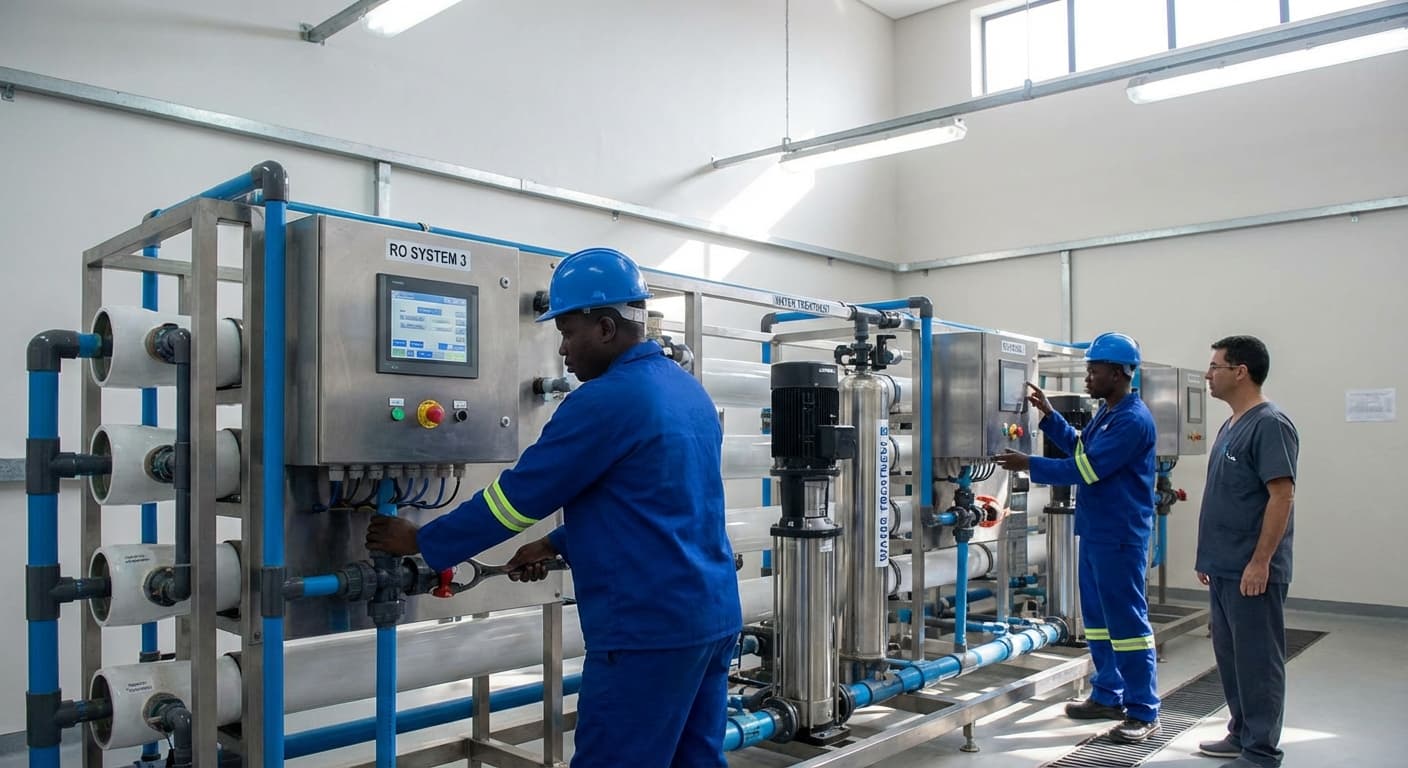
Dialysis RO/Water Treatment Plant Installation Service in Zambia
Engineering Excellence & Technical Support
Dialysis RO/Water Treatment Plant Installation Service High-standard technical execution following OEM protocols and local regulatory frameworks.
Robust RO System Design for Zambia's Water Realities
We engineer and install high-performance Reverse Osmosis (RO) systems specifically designed to tackle the unique challenges of Zambia's raw water sources, ensuring consistent purity and minimal downtime for your dialysis operations.
Seamless Regulatory Compliance & Quality Assurance
Our installation process adheres strictly to international water quality standards and Zambian health regulations, providing comprehensive validation and certification to guarantee the safety and efficacy of your dialysis water supply.
Optimized Water & Energy Efficiency for Cost Savings
Leveraging advanced water treatment technologies, our installations focus on maximizing water recovery rates and minimizing energy consumption, delivering significant operational cost savings for dialysis centers across Zambia.
What Is Dialysis Ro/water Treatment Plant Installation Service In Zambia?
Dialysis RO/Water Treatment Plant Installation Service in Zambia refers to the comprehensive process of designing, procuring, installing, commissioning, and maintaining Reverse Osmosis (RO) and associated water treatment systems specifically engineered for dialysis facilities within Zambia. These systems are critical for producing ultra-pure water, a fundamental requirement for hemodialysis treatments, ensuring patient safety by removing impurities, contaminants, and pyrogens that could cause severe adverse reactions. The service encompasses a multi-stage approach, from initial site assessment and water quality analysis to the final handover and ongoing support of a fully operational water purification plant.
| Who Needs Dialysis RO/Water Treatment Plant Installation Service? | Typical Use Cases | |||
|---|---|---|---|---|
| Dialysis Centers (Public and Private): The primary beneficiaries, requiring reliable sources of ultrapure water for hemodialysis procedures. | Hospitals with Nephrology Departments: Facilities offering dialysis services as part of their broader patient care. | New Healthcare Facility Developments: Greenfield projects incorporating dialysis units requiring integrated water treatment solutions. | Existing Facilities Undergoing Upgrades or Expansion: Centers needing to replace aging equipment, increase capacity, or comply with updated water quality standards. | Research and Development Institutions: Laboratories conducting studies related to renal care or water purification technologies where precise water quality is paramount. |
| Hemodialysis Treatment: The core application, where RO water is essential to prevent patient complications like pyrogenic reactions and electrolyte imbalances. | Peritoneal Dialysis Fluid Preparation (in some contexts): While direct RO water might not be used, the principles of water purification are relevant. | Sterilization and Disinfection Processes: High-purity water can be a component in cleaning and sterilizing medical equipment used in dialysis. | Quality Control and Monitoring: Ensuring that the water produced consistently meets stringent medical-grade standards through regular testing and calibration. |
Key Components of the Service:
- Site Assessment and Water Quality Analysis: Evaluating the existing water source (municipal, borehole, etc.) to determine its chemical and biological composition and suitability for dialysis.
- System Design and Engineering: Developing a bespoke treatment protocol and plant configuration based on water analysis, regulatory standards (e.g., ISO, local health guidelines), and the specific needs of the dialysis center (e.g., number of stations, water demand).
- Equipment Procurement and Supply: Sourcing high-quality RO membranes, pre-filters, post-filters, pumps, storage tanks, piping, control systems, and other essential components.
- Installation and Plumbing: Physically assembling and integrating all treatment units, connecting them to the water source and distribution network, ensuring proper material compatibility and leak-free connections.
- Electrical and Instrumentation Setup: Installing power supply, control panels, sensors, monitoring equipment, and automation systems for optimal operation and safety.
- Commissioning and Validation: Rigorous testing of the entire system to verify performance against design specifications, including water quality testing (e.g., conductivity, TOC, microbial load) and flow rate verification. This phase often involves validation protocols to meet regulatory compliance.
- Operator Training: Providing comprehensive training to facility staff on the operation, routine maintenance, troubleshooting, and emergency procedures for the water treatment plant.
- Ongoing Maintenance and Support: Offering scheduled preventative maintenance, emergency repair services, spare parts management, and performance monitoring to ensure consistent ultra-pure water production throughout the plant's lifespan.
Who Needs Dialysis Ro/water Treatment Plant Installation Service In Zambia?
Dialysis RO/Water Treatment Plant Installation Services are crucial for ensuring a safe and reliable supply of purified water for dialysis procedures. In Zambia, several key entities and departments rely heavily on such services to maintain the health and well-being of patients undergoing renal replacement therapy. The demand for these specialized installation services stems from the critical need for sterile, impurity-free water to prevent complications and ensure effective treatment.
| Target Customer Segment | Relevant Departments/Roles | Key Needs/Justification |
|---|---|---|
| Public Hospitals | Nephrology Department, Biomedical Engineering Department, Estates/Facilities Management, Procurement Department | High patient volume, need for cost-effective and robust solutions, adherence to national health standards, ensuring continuous operation of existing and new dialysis units. |
| Private Hospitals & Clinics | Nephrology Unit, Clinical Engineering, Operations Management, Procurement Department | Offering specialized and high-quality dialysis services, patient satisfaction, meeting international standards, expanding capacity, minimizing operational downtime. |
| Dedicated Dialysis Centers | Center Management, Head of Nursing, Biomedical Technician, Quality Assurance Department | Primary focus on dialysis, requiring specialized expertise for optimal plant performance, regulatory compliance, patient safety, and efficient water management. |
| Government Health Ministries & Agencies | Department of Clinical Services, Public Health Directorate, Infrastructure Development Unit, Procurement & Supply Chain Management | Developing and upgrading public healthcare infrastructure, ensuring equitable access to dialysis services, setting national standards, managing large-scale projects and tenders. |
| NGOs & Charitable Organizations | Program Managers, Healthcare Coordinators, Procurement Officers, Technical Advisors | Establishing and supporting dialysis facilities in underserved areas, focusing on affordability and sustainability, ensuring essential medical equipment is functional and safe. |
| Research Institutions | Principal Investigators, Clinical Research Coordinators, Laboratory Technicians, Facilities Management | Ensuring the purity and consistency of water for research protocols, maintaining the integrity of clinical trials involving dialysis, setting up new research-oriented dialysis units. |
| Tertiary Care Facilities | Specialty Care Units, Renal Services Directorate, Biomedical Services | Providing advanced medical care, requiring state-of-the-art equipment and reliable infrastructure, including water treatment for complex procedures. |
Who Needs Dialysis RO/Water Treatment Plant Installation Service in Zambia?
- Hospitals (Public and Private)
- Dialysis Centers (Standalone)
- Government Health Ministries & Agencies
- Non-Governmental Organizations (NGOs) focusing on healthcare
- Research Institutions with clinical trials involving dialysis
- Tertiary Care Facilities
- Remote Health Outposts with dialysis capabilities
Dialysis Ro/water Treatment Plant Installation Service Process In Zambia
This document outlines the comprehensive service process for the installation of Dialysis Reverse Osmosis (RO) / Water Treatment Plants in Zambia. It details the workflow from the initial client inquiry to the successful execution and handover of the installed system.
| Stage | Description | Key Activities | Deliverables/Outcomes | Timeline (Estimated) |
|---|---|---|---|---|
| The process begins when a client expresses interest in a Dialysis RO/Water Treatment Plant. | Receive inquiry, schedule initial meeting (virtual or in-person), understand client's basic requirements, discuss available technologies. | Understanding of client needs, initial assessment of project scope, introduction to service provider. | 1-3 Business Days |
| A detailed evaluation of the client's facility and specific water quality requirements. | Conduct on-site visit, collect water samples for analysis, assess existing infrastructure (power, plumbing, space), identify site-specific challenges. | Comprehensive site report, detailed water quality analysis, confirmed technical specifications for the system. | 3-7 Business Days |
| Based on the site assessment, a tailored solution is designed. | Design the RO/Water Treatment system, select appropriate components, develop technical drawings and specifications, create a detailed project proposal. | Customized system design, technical specifications, project plan, preliminary timeline. | 5-10 Business Days |
| Formalizing the project scope, cost, and terms. | Submit detailed quotation based on the proposal, negotiate terms, prepare and sign the Service Level Agreement (SLA) or contract. | Agreed-upon quotation, signed contract, payment schedule defined. | 2-5 Business Days |
| Acquiring all necessary equipment and materials. | Order and procure all components (RO membranes, pumps, filters, control panels, piping, etc.), arrange for transportation to Zambia, manage customs clearance. | All system components and materials secured, ready for shipment and delivery. | 2-6 Weeks (depending on component availability and lead times) |
| Ensuring the site is ready for installation. | Prepare the installation site (e.g., foundation, power connections, drainage), confirm utility availability, coordinate delivery schedule. | Site ready for installation, utilities confirmed, logistics for equipment delivery finalized. | 1-3 Business Days (prior to installation) |
| The physical installation of the RO/Water Treatment Plant. | Unpack and position equipment, assemble system components, connect piping and electrical systems, install control panel and instrumentation. | Physically installed RO/Water Treatment Plant, ready for testing. | 3-7 Business Days (depending on system complexity) |
| Verifying the system's functionality and performance. | Conduct rigorous testing of all components, flush the system, test water quality output against dialysis standards, calibrate instruments, troubleshoot any issues. | Fully functional and calibrated RO/Water Treatment Plant, certified water quality meeting dialysis requirements. | 2-4 Business Days |
| Empowering the client's personnel to operate and maintain the system. | Provide comprehensive training to client's technical staff on operation, routine maintenance, troubleshooting, and safety procedures. Handover of all system documentation (manuals, warranties, test reports). | Trained operational staff, complete system documentation, formal project handover. | 1-2 Business Days |
| Ongoing support to ensure optimal system performance. | Offer warranty support, schedule and perform planned preventive maintenance, provide emergency technical support, supply spare parts as needed. | Reliable and efficient operation of the RO/Water Treatment Plant, extended system lifespan, adherence to maintenance schedules. | Ongoing |
Dialysis RO/Water Treatment Plant Installation Service Process in Zambia
- Initial Inquiry & Consultation
- Site Assessment & Needs Analysis
- System Design & Proposal Development
- Quotation & Contract Agreement
- Procurement & Logistics
- Pre-Installation Preparation
- On-Site Installation
- System Testing & Commissioning
- Training & Handover
- Post-Installation Support & Maintenance
Dialysis Ro/water Treatment Plant Installation Service Cost In Zambia
The installation of a Reverse Osmosis (RO) or specialized water treatment plant for dialysis in Zambia is a critical investment for healthcare facilities. The cost of such an installation is influenced by several key factors, leading to a range of prices that can vary significantly. These factors include the capacity and type of the RO/water treatment system required, the complexity of the installation environment, the quality of components used, and the expertise of the service provider. Dialysis centers require highly purified water, free from contaminants that could be harmful to patients undergoing treatment. Therefore, the systems installed are typically multi-stage and robust, impacting the overall cost.
| System Size/Capacity (e.g., Liters/Hour) | Estimated Installation Cost Range (ZMW) | Notes |
|---|---|---|
| Small Clinic/Individual Dialysis Machine (e.g., 10-50 LPH) | 15,000 - 40,000 | Basic, single-stage RO with essential pre-treatment. May be suitable for very small setups. |
| Medium Dialysis Center (e.g., 50-200 LPH) | 40,000 - 120,000 | Multi-stage RO, robust pre-treatment, storage tank, and basic sterilization. Common for most dialysis units. |
| Large Dialysis Center/Hospital (e.g., 200-500+ LPH) | 120,000 - 350,000+ | High-capacity, advanced multi-stage RO, comprehensive pre-treatment, larger storage, advanced sterilization, and potentially automated monitoring. Costs can escalate significantly with higher capacities and specialized features. |
Key Pricing Factors for Dialysis RO/Water Treatment Plant Installation in Zambia:
- System Capacity and Type: The volume of purified water the plant needs to produce per hour or day is a primary driver of cost. Larger capacity systems, often required for larger dialysis centers or hospitals with multiple dialysis stations, will naturally be more expensive. The number of treatment stages (e.g., pre-filtration, RO membrane, post-treatment, sterilization) also affects the price.
- Water Source Quality: The initial quality of the raw water supply (e.g., municipal tap water, borehole water) will determine the complexity and number of pre-treatment stages needed. Heavily contaminated water sources will require more extensive and costly pre-treatment processes to protect the RO membranes.
- Technology and Brand of Components: Different manufacturers offer varying levels of quality, efficiency, and durability for RO membranes, pumps, filters, and control systems. Higher-end, more reliable components generally come with a higher initial cost but can offer better long-term performance and lower maintenance expenses.
- Installation Complexity and Site Preparation: The physical location of the installation plays a significant role. Factors like the accessibility of the site for equipment delivery, the need for extensive plumbing modifications, electrical work, water storage tank installation, and the overall space available can add to labor and material costs.
- Ancillary Equipment and Services: This can include the cost of water storage tanks, distribution piping, leak detection systems, UV sterilizers, water softeners, and any necessary structural modifications to the facility. Furthermore, services like system commissioning, initial calibration, and operator training are often included and impact the total price.
- Service Provider and Expertise: The reputation, experience, and warranty offered by the installation company are crucial. Reputable providers with specialized expertise in medical-grade water treatment systems may charge more, but their quality of work and after-sales support can justify the investment.
- Import Duties and Taxes: As many components for advanced water treatment systems are imported into Zambia, import duties, taxes, and shipping costs can significantly contribute to the overall installation price.
Affordable Dialysis Ro/water Treatment Plant Installation Service Options
When seeking affordable Dialysis RO/Water Treatment Plant Installation services, understanding value bundles and cost-saving strategies is crucial. These approaches allow healthcare facilities to acquire high-quality, reliable water treatment systems without compromising their budget. Value bundles often combine essential components and services into a package, offering a more streamlined and cost-effective solution than purchasing items individually. Cost-saving strategies focus on smart procurement, efficient installation, and long-term operational considerations.
| Service Component | Standard Offering | Value Bundle Inclusion | Cost-Saving Strategy |
|---|---|---|---|
| Reverse Osmosis (RO) Unit | Purchased individually | Included as a core component | Negotiate bulk discounts for multiple units; consider energy-efficient models |
| Pre-Treatment Filters (e.g., sediment, carbon) | Purchased separately | Often bundled with the RO unit | Standardize filter types for easier replacement and bulk buying |
| Storage Tanks | Purchased individually | Included in comprehensive bundles | Ensure appropriate sizing to avoid unnecessary capacity costs |
| Plumbing and Fittings | Client-sourced or separate quote | Usually part of the installation package | Utilize readily available, standard pipe materials |
| Installation and Commissioning | Separate quote, often by specialized technicians | Integral part of the service package | Engage local, certified installers; ensure site readiness to minimize labour hours |
| Water Quality Testing | May be an add-on service | Often included post-installation | Schedule regular in-house testing to supplement professional checks |
| Staff Training | May be an additional charge | Basic training often included | Prioritize comprehensive training to reduce reliance on external support |
| Warranty and Support | Varies by vendor | Standard warranty typically included | Review warranty terms carefully; consider extended maintenance plans for long-term cost predictability |
Key Considerations for Affordable Dialysis RO/Water Treatment Plant Installation
- Understanding Value Bundles: These packages are designed to offer a comprehensive solution, often including the RO unit, pre-treatment filters, storage tanks, essential plumbing, and initial installation and commissioning. They can also incorporate basic training for facility staff.
- Cost-Saving Strategies: Implementing a combination of the following can significantly reduce overall expenditure.
- Smart Procurement:
- Bulk Purchasing: If multiple units are required, negotiating bulk discounts can be highly beneficial.
- Comparing Quotes: Obtain detailed quotes from several reputable providers to identify competitive pricing.
- Standardization: Opting for standard, widely available components can reduce customisation costs and simplify future maintenance.
- Refurbished Equipment: For non-critical components or as a temporary solution, consider certified refurbished equipment from trusted vendors.
- Efficient Installation:
- Phased Installation: If budget is a significant constraint, explore the possibility of phased installation, prioritizing essential components first.
- Local Installation Partners: Engaging local, certified installers can reduce travel costs and potentially offer more competitive rates.
- Optimized Site Preparation: Ensuring the installation site is adequately prepared beforehand can minimize on-site labour time.
- Long-Term Operational Savings:
- Energy-Efficient Units: Invest in RO units with lower energy consumption to reduce electricity bills over time.
- Preventative Maintenance Contracts: While an upfront cost, a well-structured maintenance contract can prevent costly breakdowns and extend the lifespan of the equipment.
- Water Conservation Features: Choose systems that minimize water wastage during the RO process.
- Staff Training: Properly trained staff can operate and maintain the system efficiently, reducing errors and the need for external support.
- Financing Options: Explore potential financing schemes or leasing options that can spread the cost over time, making it more manageable.
Verified Providers In Zambia
In Zambia's evolving healthcare landscape, identifying reliable and skilled medical professionals is paramount for individual and family well-being. "Verified Providers in Zambia" aims to shed light on these essential healthcare resources, with a particular focus on Franance Health. This section will detail Franance Health's credentials and explain why they stand out as an exceptional choice for healthcare needs in Zambia.
| Credential/Attribute | Description | Benefit to Patients |
|---|---|---|
| Licensing and Certification | All Franance Health providers are fully licensed by the Health Professions Council of Zambia (HPCZ) and possess recognized certifications in their respective specializations. | Guarantees that practitioners meet national standards and are legally qualified to provide medical services. |
| Experience and Expertise | Franance Health meticulously evaluates the professional experience and demonstrated expertise of each provider, prioritizing those with a solid history of successful patient care. | Ensures patients are treated by skilled and knowledgeable medical professionals, leading to more accurate diagnoses and effective treatments. |
| Ethical Conduct and Professionalism | Providers are vetted for their adherence to ethical medical practices, patient confidentiality, and professional conduct. Franance Health promotes a culture of integrity. | Fosters trust and confidence between patients and healthcare providers, ensuring respectful and confidential care. |
| Patient-Centric Approach | Franance Health actively seeks providers who exhibit strong communication skills, empathy, and a commitment to understanding and addressing individual patient needs. | Leads to a more comfortable and supportive healthcare experience, with patients feeling heard and valued. |
| Specialized Training and Continuous Learning | Many Franance Health providers have undergone advanced training or fellowships in their respective fields and are committed to ongoing professional development. | Ensures patients have access to the latest medical knowledge and treatment modalities, especially for complex conditions. |
Why Franance Health Stands Out
- Rigorous Verification Process: Franance Health subjects its providers to a comprehensive vetting process, ensuring all practitioners hold valid licenses, relevant certifications, and a proven track record of ethical practice.
- Commitment to Quality Care: The organization prioritizes patient outcomes and satisfaction, actively seeking out providers who demonstrate exceptional clinical skills, empathy, and a patient-centered approach.
- Diverse Specializations: Franance Health boasts a wide network of healthcare professionals covering a broad spectrum of medical disciplines, from general practitioners to specialized surgeons and therapists.
- Accessibility and Convenience: By streamlining the process of finding verified specialists, Franance Health significantly improves access to quality healthcare for individuals across Zambia.
- Ongoing Professional Development: Providers affiliated with Franance Health are encouraged and often required to engage in continuous medical education, ensuring they remain at the forefront of medical advancements.
- Patient Testimonials and Feedback: A strong emphasis is placed on patient feedback, allowing Franance Health to continuously monitor and improve the quality of services offered by its network.
Scope Of Work For Dialysis Ro/water Treatment Plant Installation Service
This Scope of Work (SOW) outlines the requirements for the installation of a Dialysis Reverse Osmosis (RO) and Water Treatment Plant. It details the technical deliverables, standard specifications, and general requirements for a successful project, ensuring the provision of high-purity water suitable for hemodialysis procedures. The scope encompasses all necessary equipment, materials, labor, testing, commissioning, and training to deliver a fully functional and compliant water treatment system. This document serves as the basis for proposals and contract execution.
| Category | Technical Deliverables | Standard Specifications / Notes |
|---|---|---|
| RO Plant Unit | Supply and installation of a multi-stage RO unit designed for dialysis water production. | Minimum 98% salt rejection. Capable of producing the required flow rate (e.g., X Liters/Hour/Minute) to meet demand. NSF/ANSI 61 certified components. Low pressure, high efficiency membranes. Auto flush system. Pre-treatment stages (e.g., multimedia filter, activated carbon filter, water softener) integrated or to be installed separately. Automated control system with flow, pressure, and conductivity monitoring. Energy-efficient design. |
| Pre-Treatment System | Supply and installation of necessary pre-treatment filters and softeners. | Appropriate sizing for feedwater quality. Removal of suspended solids, chlorine, hardness, and other contaminants detrimental to RO membranes. Backwashable filters with automated or manual valve operation. Activated carbon filters for chlorine removal. |
| Post-Treatment System | Supply and installation of post-treatment components (e.g., UV sterilizer, bacteriostatic filters). | UV sterilizer with adequate dosage for microbial inactivation. Bacteriostatic filters to maintain water purity post-RO. NSF/ANSI 42 and 53 compliance where applicable. Correct flow rate and contact time for effectiveness. |
| Storage and Distribution | Installation of storage tanks and distribution piping. | Food-grade, opaque, and seamless storage tanks with vent filters. Material: High-density polyethylene (HDPE) or stainless steel. Pipe material: Approved for potable water and dialysis use (e.g., PEX, PVC Schedule 80, Stainless Steel). Proper insulation for temperature control if required. Leak-free connections and hygienic design to prevent biofilm formation. Loop system for continuous circulation and disinfection. |
| Monitoring and Control | Installation of sensors, controllers, and alarm systems. | Real-time monitoring of Total Dissolved Solids (TDS), conductivity, pressure, flow rate, and temperature. Programmable Logic Controller (PLC) or digital controller for automated operation. Alarms for critical parameter deviations. Remote monitoring capability (optional). Compliance with relevant water quality standards (e.g., AAMI, ISO). |
| Plumbing and Piping | Installation of all connecting pipework, fittings, and valves. | All materials to be lead-free and suitable for potable water and dialysis applications. Proper jointing techniques to ensure leak-proof connections. Color-coding of piping for easy identification of different water types (e.g., raw water, RO water, purified water). Isolation valves for maintenance and servicing. |
| Electrical and Power | Wiring, connection, and integration of all electrical components. | All electrical work to comply with local electrical codes and standards. Proper grounding and surge protection. Dedicated power supply for the RO plant. Clearly labeled control panel with emergency stop functionality. Energy-efficient motor and pump selection. |
| Testing and Commissioning | Comprehensive testing of the installed system. | Performance testing to verify water production rate and quality (TDS, conductivity, microbiological). Leak testing of all piping and connections. Operational testing of all automated features and safety interlocks. Water sampling and analysis from accredited laboratory for all parameters specified in standards. |
| Validation | System validation to confirm performance against requirements. | IQ (Installation Qualification), OQ (Operational Qualification), and PQ (Performance Qualification) documentation and execution. Verification of compliance with all design and regulatory specifications. |
| Training | Training of facility personnel on operation and maintenance. | Comprehensive training covering daily operation, routine maintenance, troubleshooting, and emergency procedures. Training materials to be provided in written format. |
| Documentation | Provision of all necessary operational and technical documentation. | As-built drawings (electrical, mechanical). Operation and maintenance manuals. Commissioning reports. Validation reports. Water quality test reports. Manufacturer's specifications for all components. |
Key Stages of Installation Service
- Site Assessment and Preparation
- Equipment Procurement and Delivery
- Installation of Water Treatment Plant Components
- Plumbing and Piping Integration
- Electrical Wiring and Controls
- Testing and Commissioning
- System Validation and Performance Verification
- Training and Handover
- Documentation and As-Built Drawings
Service Level Agreement For Dialysis Ro/water Treatment Plant Installation Service
This Service Level Agreement (SLA) outlines the response times and uptime guarantees for the installation and ongoing operational support of the Dialysis Reverse Osmosis (RO) / Water Treatment Plant services provided by [Your Company Name] to [Client Name]. This SLA is an addendum to the Master Service Agreement (MSA) dated [Date of MSA].
| Incident Severity | Response Time (within Business Hours) | Resolution Target (within Business Hours) | Uptime Guarantee (Monthly) |
|---|---|---|---|
Definitions
- {"term":"Critical Incident","definition":"An incident that renders the RO/Water Treatment Plant inoperable, posing an immediate threat to patient safety or the continuity of dialysis treatments."}
- {"term":"Major Incident","definition":"An incident that significantly degrades the performance of the RO/Water Treatment Plant, impacting the quality of treated water but not immediately halting dialysis treatments. This may include reduced water production, minor quality deviations not exceeding acceptable limits, or partial system functionality."}
- {"term":"Minor Incident","definition":"An incident that affects non-critical functions or has a minimal impact on the overall performance of the RO/Water Treatment Plant. This could include cosmetic issues, minor alert notifications, or non-essential component malfunctions."}
- {"term":"Uptime","definition":"The percentage of time the RO/Water Treatment Plant is fully operational and meeting all specified water quality parameters as defined in the system's design specifications and regulatory requirements."}
- {"term":"Scheduled Maintenance","definition":"Pre-planned maintenance activities performed on the RO/Water Treatment Plant during agreed-upon windows to ensure optimal performance and prevent future issues. Scheduled maintenance is excluded from uptime calculations."}
- {"term":"Emergency Downtime","definition":"Unplanned downtime of the RO/Water Treatment Plant due to a Critical or Major Incident."}
Frequently Asked Questions

Ready when you are
Let's scope your Dialysis RO/Water Treatment Plant Installation Service in Zambia project in Zambia.

Scaling healthcare logistics and technical systems across the entire continent.