
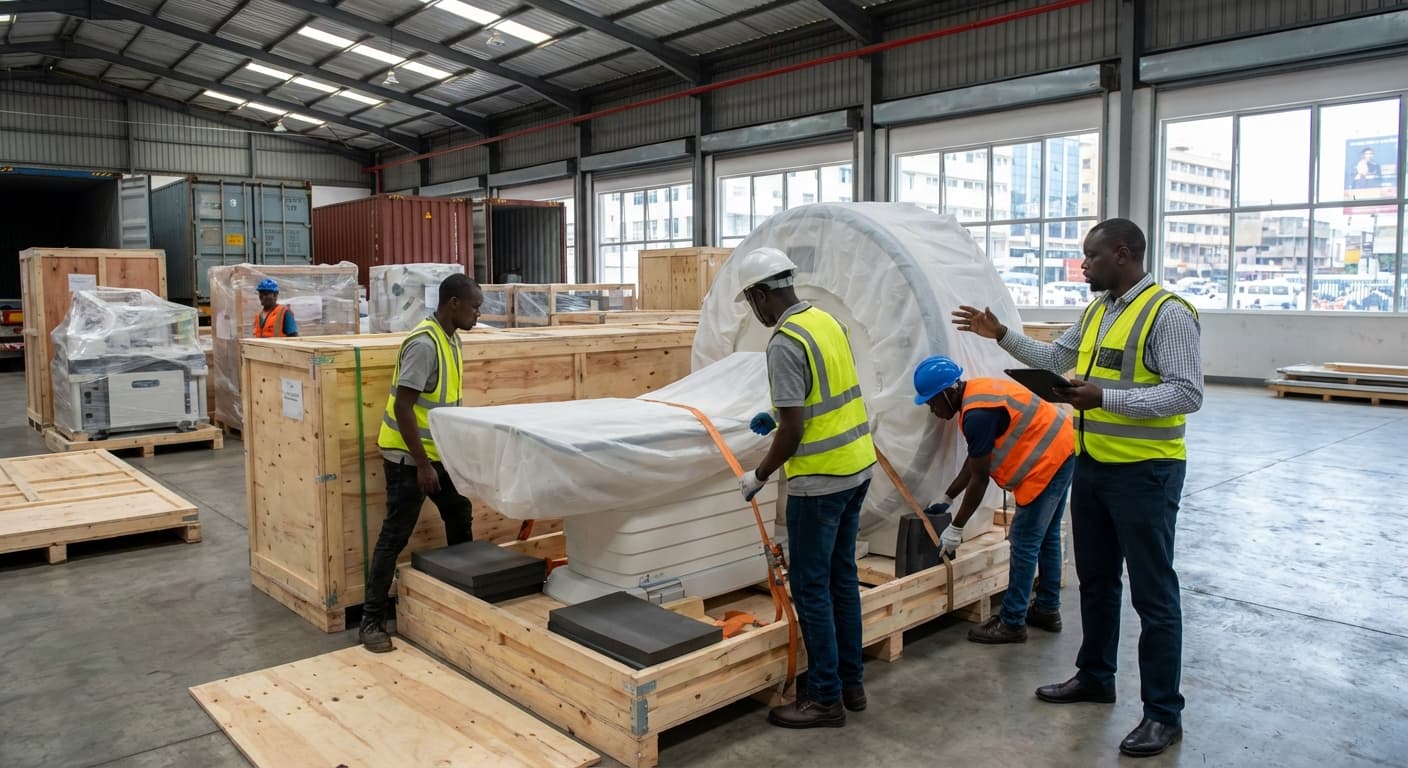
Packaging & Crating Supervision Service for Medical Equipment in Zambia
Engineering Excellence & Technical Support
Packaging & Crating Supervision Service for Medical Equipment High-standard technical execution following OEM protocols and local regulatory frameworks.
ISO 13485 Compliant Packaging Protocols
Our packaging and crating process strictly adheres to ISO 13485 standards, ensuring the integrity and sterility of sensitive medical equipment throughout the supply chain. We employ validated materials and techniques to mitigate environmental risks and maintain optimal conditions for Zambia's diverse climate.
Advanced Risk Assessment & Mitigation for Medical Devices
We conduct comprehensive risk assessments for each shipment of medical equipment, identifying potential hazards from handling, transit, and storage. Our expert supervisors implement bespoke mitigation strategies, including shock absorption, climate control integration, and tamper-evident sealing, guaranteeing safe delivery across Zambia.
Customized Crating Solutions for High-Value Equipment
Leveraging specialized knowledge of medical device construction and fragility, our team designs and builds custom crating solutions. This includes bespoke internal bracing, anti-static measures, and secure locking mechanisms, ensuring the highest level of protection for high-value, complex medical equipment during transit within Zambia and beyond.
What Is Packaging & Crating Supervision Service For Medical Equipment In Zambia?
Packaging & Crating Supervision Service for Medical Equipment in Zambia refers to a specialized oversight function ensuring that medical devices and associated materials are appropriately prepared, protected, and secured for domestic transit, international shipping, or long-term storage. This service is critical for maintaining the integrity, functionality, and compliance of sensitive medical equipment throughout its supply chain journey. It encompasses a range of activities from material selection and handling protocols to the final sealing and labeling of the packaging and crates.
| Who Needs This Service? | Typical Use Cases | |||||
|---|---|---|---|---|---|---|
| Medical Equipment Manufacturers: (Local and International) requiring secure and compliant shipment of their products to distributors, hospitals, clinics, and research institutions within Zambia or for export from Zambia. | Healthcare Facilities: (Hospitals, Clinics, Laboratories) receiving new medical equipment shipments or relocating existing sensitive instruments. | Medical Equipment Distributors and Suppliers: Managing inventory and ensuring the safe transit of equipment to end-users across Zambia. | Logistics and Freight Forwarding Companies: Specializing in the transport of high-value or sensitive goods, requiring expert oversight for medical equipment shipments. | Research Institutions and Universities: Importing or relocating specialized diagnostic, analytical, or experimental medical equipment. | Government Health Ministries and Agencies: Managing the procurement and distribution of medical equipment to public healthcare facilities nationwide. | Non-Governmental Organizations (NGOs) and Humanitarian Aid Organizations: Delivering essential medical equipment to remote or underserved areas in Zambia. |
| International Shipments: Importing complex diagnostic imaging systems (MRI, CT scanners), surgical robots, or advanced laboratory analyzers where specialized packaging is essential to prevent damage from prolonged transit and varying environmental conditions. | Domestic Transportation: Moving delicate laboratory centrifuges, incubators, or patient monitoring systems between different departments within a large hospital or from a central warehouse to a remote clinic in Zambia, requiring protection against road vibrations and handling. | Long-Term Storage: Preparing medical equipment for extended periods of inactivity, ensuring protection against dust, moisture, and potential degradation through the use of appropriate crating and environmental controls. | Relocation of Sensitive Equipment: Supervising the de-installation, packaging, and re-installation of critical medical machinery within a facility or across different sites. | Compliance with Regulatory Requirements: Ensuring that packaging meets specific import/export regulations in Zambia and destination countries, particularly concerning fumigation and material certifications for wooden crates. | High-Value Asset Protection: Safeguarding expensive and critical medical devices from theft or damage during transit, minimizing financial risk and ensuring operational readiness upon arrival. |
Key Components of Packaging & Crating Supervision for Medical Equipment
- Material Selection and Verification: Ensuring that all packaging materials (e.g., cushioning, desiccants, barriers, void fillers, crates) meet industry standards (e.g., ISTA, ASTM) and are suitable for the specific environmental conditions (temperature, humidity, vibration) and transportation modes encountered in Zambia and beyond. This includes verifying the quality and suitability of wood for crating, ensuring it is heat-treated or fumigated if required for international shipments.
- Pre-Packaging Inspection: Conducting thorough inspections of the medical equipment prior to packaging to identify any pre-existing damage, missing components, or operational defects that could be exacerbated by the packaging or transit process. This also includes ensuring that all necessary documentation (manuals, warranties, certificates) is included.
- Protective Packaging Application: Supervising the correct application of internal protective measures, such as anti-static bags, custom foam inserts, shock-absorbing materials, and moisture-control agents (e.g., silica gel), to shield the equipment from physical shock, vibration, electrostatic discharge, and environmental ingress.
- Crate Construction and Assembly: Overseeing the construction and assembly of wooden or metal crates to ensure they are robust, adequately sized, and designed to withstand the rigors of handling and transit. This includes verifying proper joinery, reinforcement, and the absence of protruding fasteners.
- Securing and Bracing: Directing and verifying the secure internal bracing and fastening of the medical equipment within the crate to prevent movement, shifting, or damage during transit. This often involves custom-fit bracing solutions tailored to the equipment's geometry.
- Sealing and Tamper Evidence: Ensuring that the packaging and crates are properly sealed using appropriate methods (e.g., heavy-duty tape, banding, screws) and that tamper-evident seals are applied where necessary to provide clear indication of unauthorized access.
- Labeling and Documentation: Verifying that all external labeling is accurate, compliant with international shipping regulations (e.g., IATA, IMDG), and clearly indicates critical information such as contents, handling instructions (e.g., 'Fragile,' 'This Way Up'), destination, consignee details, and any necessary regulatory markings.
- Load Planning and Placement: Providing guidance or supervision on the proper placement and distribution of packaged medical equipment within larger transport vehicles or shipping containers to optimize space utilization and ensure stability.
- Quality Assurance and Record Keeping: Maintaining detailed records of the packaging and crating process, including photographs, inspection checklists, and material certifications, to ensure traceability and facilitate insurance claims or investigations if any issues arise.
Who Needs Packaging & Crating Supervision Service For Medical Equipment In Zambia?
The safe and compliant transportation of medical equipment is paramount in Zambia. Packaging and crating supervision services ensure that sensitive, valuable, and often specialized medical devices are handled with the utmost care, protected from damage during transit, and meet all regulatory requirements. This is particularly crucial for a country like Zambia, where logistics can be challenging and the impact of damaged equipment can have significant consequences on healthcare delivery.
| Target Customer Group | Key Departments/Roles Involved | Specific Needs |
|---|---|---|
| Hospitals & Clinics | Procurement Department, Biomedical Engineering Department, Logistics Department, Clinical Department Heads | Safe receipt of new equipment, protection of sensitive devices during internal moves, compliance with import/export regulations, minimizing downtime due to damaged goods. |
| Medical Equipment Manufacturers & Distributors | Logistics & Supply Chain Management, Quality Assurance, Sales & Distribution Management | Ensuring product integrity upon arrival, compliance with international and local shipping standards, damage prevention during transit, customer satisfaction. |
| Government Health Ministries & Agencies | Procurement Unit, Logistics & Supply Chain Directorate, Public Health Programs | Efficient and cost-effective distribution of medical resources, ensuring equipment reaches remote areas safely, compliance with government tenders and specifications. |
| NGOs & Charities | Program Managers, Logistics Coordinators, Procurement Officers | Maximizing the impact of donated equipment, cost-effective shipping solutions, ensuring reliability of essential medical tools in resource-limited settings. |
| Research Institutions & Laboratories | Laboratory Managers, Research Leads, Facilities Management | Protecting high-value and delicate scientific instruments, maintaining calibration and functionality, safe transport for collaborative research projects. |
| 3PL Providers & Freight Forwarders | Operations Managers, Warehouse Supervisors, Customs Brokers, Compliance Officers | Expertise in handling specialized cargo, adherence to dangerous goods regulations (if applicable), providing value-added services to clients, risk mitigation. |
| Medical Equipment Repair & Maintenance Services | Service Managers, Field Technicians, Logistics Staff | Preventing further damage during transport to/from repair centers, ensuring equipment is returned to clients in working order, managing warranty-related shipments. |
Target Customers & Departments for Medical Equipment Packaging & Crating Supervision in Zambia
- {"title":"Hospitals & Clinics (Public & Private)","description":"Facilities that regularly procure, receive, and deploy new medical equipment, or that need to transport existing equipment for maintenance, upgrades, or relocation. This includes both large urban hospitals and smaller rural clinics."}
- {"title":"Medical Equipment Manufacturers & Distributors","description":"Companies that import, export, or distribute medical equipment within Zambia. They are responsible for ensuring their products reach end-users in pristine condition and comply with all shipping regulations."}
- {"title":"Government Health Ministries & Agencies","description":"Entities involved in national health programs, procurement of large-scale medical equipment for public health initiatives, and managing the logistics of medical supplies across the country."}
- {"title":"Non-Governmental Organizations (NGOs) & Charities","description":"Organizations that provide medical aid and equipment to underserved communities in Zambia. They often face budget constraints and rely on efficient, damage-free delivery to maximize their impact."}
- {"title":"Research Institutions & Laboratories","description":"Facilities that require the secure transport of specialized diagnostic, analytical, and research equipment, which can be highly sensitive and expensive."}
- {"title":"Third-Party Logistics (3PL) Providers & Freight Forwarders","description":"Companies that manage the supply chain and transportation of goods, including medical equipment, on behalf of their clients. They need specialized expertise to ensure proper handling and compliance."}
- {"title":"Medical Equipment Repair & Maintenance Services","description":"Businesses that transport equipment to and from repair facilities. Proper packaging is essential to prevent further damage during these movements."}
Packaging & Crating Supervision Service For Medical Equipment Process In Zambia
This document outlines the workflow for our Packaging & Crating Supervision Service for Medical Equipment in Zambia, from initial client inquiry through successful execution. Our service ensures that sensitive and high-value medical equipment is packaged and crated to international standards, mitigating damage risks during transit and storage within Zambia. This process is designed to be transparent, efficient, and tailored to the specific needs of each client and equipment type.
| Stage | Description | Key Activities | Deliverables | Responsible Parties | Timeline (Indicative) |
|---|---|---|---|---|---|
| Initial client contact to understand their needs for medical equipment packaging and crating in Zambia. | Receive client request, discuss equipment type, quantity, destination, and timeline. Understand specific requirements (e.g., humidity control, shock absorption). | Understanding of client requirements, initial project scope. | Client, Service Provider (Sales/Consultation) | 1-2 Business Days |
| On-site or virtual assessment of the equipment and the environment where packaging will occur. | Evaluate equipment dimensions, weight, fragility, and any special handling needs. Assess available space, accessibility for materials and personnel. Develop a detailed packaging and crating plan, including material selection and methodology. | Detailed assessment report, proposed packaging/crating plan, Bill of Materials (BOM). | Service Provider (Supervisors/Technical Team) | 2-3 Business Days (post-consultation) |
| Formal proposal outlining the scope of work, materials, labor, timeline, and costs. | Prepare a comprehensive quotation based on the assessment and plan. Submit quotation to the client for review. Negotiate terms and finalize the service agreement. | Formal Quotation, Signed Service Agreement, Payment Terms. | Service Provider (Sales/Operations), Client | 1-3 Business Days (post-assessment) |
| Procurement of materials and mobilization of the supervision team. | Order and receive all necessary packaging materials (crates, cushioning, moisture barriers, etc.). Schedule and brief the on-site supervision team. Confirm logistics and access to the site. | Procured materials, confirmed team schedule and logistics. | Service Provider (Procurement/Operations) | Variable (depends on material lead times, typically 3-7 Business Days) |
| Direct oversight and guidance of the packaging and crating process by experienced supervisors. | Supervise and guide the packing crew. Ensure adherence to the approved plan, quality standards, and safety protocols. Oversee the selection of appropriate cushioning, bracing, and sealing techniques. Ensure correct labeling and marking. | Properly packaged and crated medical equipment. | Service Provider (Supervisors), Packing Crew (as per agreement), Client (optional observer) | Variable (depends on volume and complexity, per equipment/shipment) |
| Verification of packaging integrity and comprehensive record-keeping. | Conduct final inspection of all packaged units. Take detailed photographs/videos of the process and final packaging. Document any deviations or issues encountered and their resolutions. Generate a detailed report. | Inspection checklist, photographs/videos of packaging, Final Supervision Report. | Service Provider (Supervisors/Quality Control) | Concurrent with execution and 1-2 Business Days post-execution |
| Formal handover of the packaged equipment and closing of the service engagement. | Present the Final Supervision Report and relevant documentation to the client. Address any final queries. Obtain client sign-off on the completed service. Invoice and process final payment. | Client sign-off, Final Invoice. | Service Provider (Operations/Administration), Client | 1-2 Business Days (post-documentation) |
Packaging & Crating Supervision Service Workflow
- Inquiry & Consultation
- Site Assessment & Planning
- Quotation & Agreement
- Pre-Execution Preparation
- On-Site Supervision & Execution
- Quality Assurance & Documentation
- Handover & Post-Execution
Packaging & Crating Supervision Service For Medical Equipment Cost In Zambia
The cost of packaging and crating supervision services for medical equipment in Zambia can vary significantly depending on a number of factors. This service is crucial to ensure that sensitive and often expensive medical devices are protected during transit, both domestically and internationally. Understanding these pricing determinants is key for accurate budgeting.
Key Pricing Factors:
- Equipment Value and Sensitivity: Higher value, more delicate, or specialized equipment will naturally incur higher supervision costs due to the increased attention to detail, specialized materials, and potentially more experienced supervisors required. This includes equipment like MRI machines, CT scanners, sensitive laboratory analyzers, and surgical robots.
- Volume and Number of Items: The total number of items to be packaged and the overall volume of the shipment will directly influence the time and resources needed for supervision. Larger and more complex projects will command higher fees.
- Complexity of Packaging Requirements: Some medical equipment requires custom-built crates, specialized internal cushioning, climate control measures (e.g., humidity control, temperature monitoring), or specific handling instructions. The more complex the packaging, the higher the supervision cost.
- Location and Accessibility: The geographical location of the equipment within Zambia and the accessibility of the site can impact costs. Remote locations or those with difficult access may require additional travel time, logistics, and potentially higher labor rates for supervisors.
- Distant Origin and Destination: If the supervision is required at the origin of the equipment within Zambia or at the destination before it is installed, the distance involved and the associated travel expenses for the supervisor will be a factor.
- Urgency and Timeline: Rush jobs or tight deadlines may incur premium charges for expedited supervision services.
- Level of Expertise and Experience of Supervisor: Highly specialized supervisors with extensive experience in handling medical equipment packaging will command higher rates than general packaging supervisors.
- Included Services: The scope of the "supervision" can vary. Does it include just oversight of the packaging process, or also coordination with movers, documentation, quality checks, and compliance verification? Clearly defining the scope upfront is essential.
- Duration of Service: The total time the supervisor is required on-site or engaged with the project will be a primary driver of cost. This could range from a few hours for a single item to several days or weeks for large-scale installations.
- Insurance and Liability: The extent of insurance coverage provided by the supervision service and their liability policies can also influence the overall cost.
Estimated Cost Ranges in Zambian Kwacha (ZMW):
Given the variability, providing exact figures is challenging. However, based on typical industry practices and the factors outlined above, here are some estimated ranges for packaging and crating supervision services for medical equipment in Zambia.
Disclaimer: These are indicative figures and can fluctuate based on market conditions, specific service providers, and negotiation.
- Basic Supervision (e.g., smaller, less sensitive items, straightforward packaging): ZMW 1,000 - ZMW 3,000 per day for a supervisor.
- Standard Supervision (e.g., medium-sized equipment, moderate complexity): ZMW 3,000 - ZMW 6,000 per day for a supervisor.
- Specialized/Complex Supervision (e.g., high-value, sensitive equipment, intricate crating, international standards): ZMW 6,000 - ZMW 12,000+ per day for a supervisor. This can also be quoted as a project-based fee for larger, more involved jobs.
Additional Costs to Consider (May or May Not Be Included in Supervision Fee):
- Materials: Cost of crates, padding, desiccants, vapor barriers, etc.
- Labor: Cost of the actual packaging and crating team.
- Transportation: Moving the equipment to the packaging site and from the packaging site to its next destination.
- Customs Duties & Taxes (for international shipments).
- Insurance for the equipment itself.
It is highly recommended to obtain detailed quotes from multiple reputable packaging and logistics providers in Zambia, clearly outlining the scope of services and the specific medical equipment to be handled, to get the most accurate cost assessment.
| Service Level/Complexity | Estimated Daily Cost Range (ZMW) |
|---|---|
| Basic Supervision (e.g., smaller, less sensitive items) | 1,000 - 3,000 |
| Standard Supervision (e.g., medium-sized equipment, moderate complexity) | 3,000 - 6,000 |
| Specialized/Complex Supervision (e.g., high-value, sensitive equipment) | 6,000 - 12,000+ |
Factors Influencing Packaging & Crating Supervision Costs for Medical Equipment in Zambia
- Equipment Value and Sensitivity
- Volume and Number of Items
- Complexity of Packaging Requirements
- Location and Accessibility
- Distant Origin and Destination
- Urgency and Timeline
- Level of Expertise and Experience of Supervisor
- Included Services
- Duration of Service
- Insurance and Liability
Affordable Packaging & Crating Supervision Service For Medical Equipment Options
Securing specialized packaging and crating for sensitive medical equipment is paramount to ensure its safe transport and integrity. Our affordable supervision service provides expert oversight, guaranteeing that your valuable assets are handled with the utmost care. We offer flexible value bundles designed to meet diverse needs and budget constraints, along with strategic cost-saving measures.
| Cost-Saving Strategy | Description | Benefit |
|---|---|---|
| Pre-Project Consultation | Engaging our experts early to assess equipment requirements and packaging needs before materials are procured or labor is scheduled. | Prevents over-specification or under-specification of materials, reducing waste and rework. |
| Bulk Material Sourcing Coordination | Advising on or assisting with the bulk purchase of standardized packaging materials through our network. | Leverages economies of scale for significant material cost reductions. |
| Optimized Packaging Design | Our supervision ensures packaging designs are efficient and minimize material usage while maintaining optimal protection. | Reduces material costs and shipping weight/volume. |
| On-site Training & Quality Control | Providing guidance to your in-house team or chosen vendors during the packaging process to ensure best practices are followed. | Minimizes damage during transit and reduces the need for costly repairs or replacements. |
| Bundled Service Discounts | Purchasing a value bundle that combines multiple services often comes with a reduced overall cost compared to individual service bookings. | Offers significant savings by leveraging integrated service offerings. |
| Preventative Damage Mitigation | Proactive supervision identifies potential risks and ensures proper handling procedures are followed, preventing damage that would incur higher costs later. | Avoids costly claims, delays, and loss of revenue due to damaged equipment. |
Value Bundles for Medical Equipment Packaging & Crating Supervision:
- {"title":"Essential Oversight Package","description":"Includes on-site supervision during the packaging and crating process, adherence to basic handling protocols, and a post-supervision report. Ideal for standard medical devices with moderate fragility."}
- {"title":"Advanced Protection Package","description":"Builds upon the Essential package with enhanced supervision for highly sensitive or complex equipment. Features include verification of specialized cushioning materials, environmental control checks (if applicable), and detailed photographic documentation throughout the process."}
- {"title":"Custom Solutions Package","description":"Tailored supervision plans for unique, oversized, or extremely delicate medical machinery. This package involves a pre-project consultation to define specific needs, bespoke protocol development, and dedicated senior supervision."}
- {"title":"Logistics Integration Package","description":"Combines packaging & crating supervision with coordination support for transportation and customs clearance. Maximizes efficiency and reduces potential delays for international shipments."}
Verified Providers In Zambia
In Zambia's evolving healthcare landscape, ensuring access to verified and credible medical providers is paramount. Franance Health stands out as a leading platform dedicated to connecting individuals with the highest standard of healthcare professionals. Their rigorous credentialing process and commitment to quality make them the optimal choice for anyone seeking reliable medical services.
| Credential Type | Franance Health Verification Standard | Patient Benefit |
|---|---|---|
| Medical Licenses & Certifications | Mandatory verification against official regulatory bodies (e.g., General Nursing Council of Zambia, Health Professions Council of Zambia). | Ensures providers are legally qualified and authorized to practice. |
| Educational Background | Verification of degrees and diplomas from accredited institutions. | Confirms foundational medical knowledge and training. |
| Professional Experience | Review of past work history and references. | Assesses practical skills and professional conduct. |
| Specialization & Expertise | Confirmation of specialized training and certifications. | Allows patients to find providers with specific medical knowledge. |
| Reputation & Patient Feedback | Monitoring of patient reviews and testimonials. | Provides insights into a provider's patient care and satisfaction levels. |
Why Franance Health Providers are the Best Choice
- Rigorous Vetting Process: Franance Health employs a comprehensive screening system to verify the qualifications, licenses, and professional standing of every provider on their platform. This ensures that all listed healthcare professionals are legitimate and meet stringent industry standards.
- Commitment to Quality Care: Beyond basic credentialing, Franance Health assesses providers based on their patient reviews, areas of specialization, and commitment to continuing professional development. This multi-faceted approach guarantees access to skilled and dedicated medical experts.
- Enhanced Patient Safety: By partnering exclusively with verified providers, Franance Health significantly reduces the risk of encountering unqualified practitioners, thereby prioritizing patient safety and well-being.
- Access to Specialized Expertise: The platform showcases a diverse range of specialists, making it easier for patients to find the exact medical expertise they require, from general practitioners to highly specialized surgeons.
- Streamlined Healthcare Experience: Franance Health simplifies the process of finding and booking appointments with trusted doctors, offering a convenient and efficient way to manage healthcare needs.
Scope Of Work For Packaging & Crating Supervision Service For Medical Equipment
This Scope of Work (SOW) outlines the services to be provided for the supervision of packaging and crating of medical equipment. The objective is to ensure that all medical equipment is packaged and crated in accordance with industry best practices, client-specific requirements, and relevant regulatory standards to prevent damage during transit and storage. This service will be performed by qualified and experienced packaging and crating supervisors.
| Task ID | Task Description | Deliverables | Standard Specifications / References |
|---|---|---|---|
| 1.0 | Pre-Packaging Assessment and Planning |
|
|
| 2.0 | Packaging Material Verification |
|
|
| 3.0 | Supervision of Packaging Process |
|
|
| 4.0 | Supervision of Crating Process |
|
|
| 5.0 | Marking, Labeling, and Documentation |
|
|
| 6.0 | Quality Assurance and Reporting |
|
|
| 7.0 | Client Liaison and Communication |
|
|
Key Objectives
- To ensure the safe and secure packaging of medical equipment.
- To verify compliance with all specified packaging and crating standards.
- To minimize the risk of damage to medical equipment during handling, transit, and storage.
- To provide accurate and timely reporting on packaging and crating activities.
- To ensure efficient use of packaging materials and resources.
Service Level Agreement For Packaging & Crating Supervision Service For Medical Equipment
This Service Level Agreement (SLA) outlines the response times and uptime guarantees for the Packaging & Crating Supervision Service for Medical Equipment provided by [Your Company Name] to [Client Company Name]. This SLA is an appendix to the Master Service Agreement (MSA) dated [MSA Date].
1. Service Description:
The Packaging & Crating Supervision Service ensures that medical equipment is properly packaged and crated in accordance with industry best practices and client specifications, prior to shipment or storage. This includes oversight, verification, and guidance provided by qualified supervisors. The service aims to prevent damage during transit and handling, thereby protecting the integrity and functionality of the medical equipment.
2. Definitions:
- Service Hours: [Specify Service Hours, e.g., Monday-Friday, 8:00 AM - 6:00 PM Local Time, excluding public holidays].
- Emergency: An event that poses an immediate and severe risk of damage to medical equipment during the packaging or crating process, requiring immediate intervention.
- Critical Incident: An event that significantly delays or prevents the completion of the packaging or crating process within the agreed-upon timeline, but does not pose an immediate, severe risk of damage.
- Scheduled Maintenance: Planned downtime for system updates, upgrades, or preventative maintenance, communicated in advance.
- Downtime: The period during which the Service is unavailable and not performing as expected.
3. Response Times:
[Your Company Name] commits to the following response times for critical events during Service Hours. Response time is defined as the time from when [Client Company Name] formally reports an issue through the agreed-upon communication channel until [Your Company Name] acknowledges the issue and initiates corrective actions.
4. Uptime Guarantees:
[Your Company Name] guarantees a minimum uptime for the Packaging & Crating Supervision Service. Uptime is calculated as the percentage of time the Service is available and operational during Service Hours, excluding Scheduled Maintenance.
5. Reporting and Monitoring:
[Your Company Name] will provide [Frequency, e.g., monthly] reports detailing the service performance against these SLA metrics. Client may request [Frequency, e.g., ad-hoc] reports for specific events.
6. Service Credits:
In the event that [Your Company Name] fails to meet the guaranteed response times or uptime levels, [Client Company Name] may be eligible for service credits as detailed in the MSA or a separate Service Credit Addendum. The process for claiming service credits will be outlined in the MSA.
7. Exclusions:
This SLA does not cover issues arising from:
- Client's failure to provide necessary access or information.
- Client-provided equipment or materials.
- Force Majeure events (acts of God, war, terrorism, natural disasters, etc.).
- Misuse or unauthorized modification of the Service.
- Downtime caused by third-party service providers not under [Your Company Name]'s direct control, where such downtime is outside of [Your Company Name]'s reasonable ability to influence.
8. Review and Amendments:
This SLA will be reviewed [Frequency, e.g., annually] or as needed. Amendments to this SLA must be in writing and signed by authorized representatives of both parties.
9. Governing Law:
This SLA shall be governed by and construed in accordance with the laws of [Jurisdiction].
Signatures:
[Your Company Name] Representative
Date:
[Client Company Name] Representative
Date:
| Service Category | Target Response Time | Service Level Objective (SLO) |
|---|---|---|
| Emergency (Immediate risk to equipment) | Within 1 hour of notification | 99.9% Availability during Service Hours |
| Critical Incident (Significant delay/prevention of service) | Within 4 business hours of notification | 99.8% Availability during Service Hours |
Response Times and Uptime Guarantees for Packaging & Crating Supervision Service
- Service Hours: Monday-Friday, 8:00 AM - 6:00 PM Local Time, excluding public holidays.
- Emergency Response Time: Within 1 hour of notification.
- Critical Incident Response Time: Within 4 business hours of notification.
- Scheduled Maintenance: Will be communicated at least [Number] days in advance.
- Uptime Guarantee: 99.5% during Service Hours.
- Service Credits: Applicable for failure to meet response times or uptime guarantees (refer to MSA).
- Reporting: Monthly service performance reports provided.
- Exclusions: Force Majeure, client-provided equipment, misuse, etc.
Frequently Asked Questions

Ready when you are
Let's scope your Packaging & Crating Supervision Service for Medical Equipment in Zambia project in Zambia.

Scaling healthcare logistics and technical systems across the entire continent.