
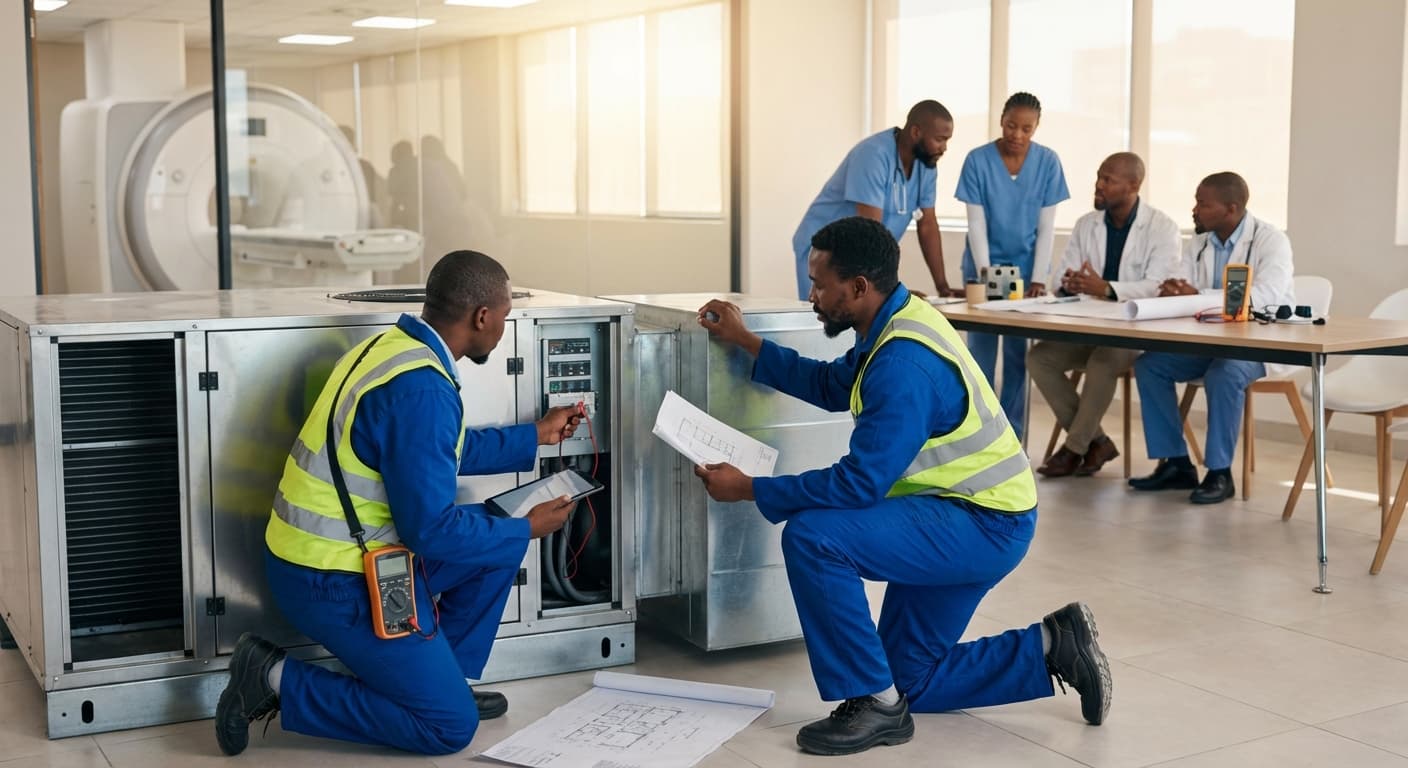
Site Readiness Assessment Service (Space/Access/HVAC/Power/Shielding) in Zambia
Engineering Excellence & Technical Support
Site Readiness Assessment Service (Space/Access/HVAC/Power/Shielding) High-standard technical execution following OEM protocols and local regulatory frameworks.
Optimized Site Selection for Space & Access
Leveraging extensive knowledge of Zambia's diverse terrain and infrastructure, we identify optimal locations ensuring adequate physical space for your technology and seamless logistical access for construction, deployment, and ongoing maintenance. This proactive approach minimizes future expansion challenges and operational disruptions.
Robust Power & HVAC Infrastructure Assessment
We conduct thorough assessments of existing power grids and potential renewable energy sources across Zambia, coupled with detailed analysis of HVAC requirements tailored to local climate conditions. Our service guarantees robust, reliable, and cost-effective power and cooling solutions for your critical infrastructure, ensuring optimal performance and longevity.
Comprehensive Shielding & Environmental Risk Evaluation
Our experts evaluate potential electromagnetic interference (EMI), radio frequency interference (RFI), and other environmental shielding needs specific to Zambia's unique geological and atmospheric conditions. We provide recommendations for effective shielding strategies to protect your sensitive equipment and ensure data integrity.
What Is Site Readiness Assessment Service (Space/access/hvac/power/shielding) In Zambia?
The Site Readiness Assessment Service (Space/Access/HVAC/Power/Shielding) in Zambia is a comprehensive technical evaluation conducted by specialized engineering and construction firms to determine the suitability and preparedness of a specific location for the installation and operation of critical infrastructure. This service meticulously scrutinizes key environmental, structural, and utility parameters to ensure the chosen site can support the intended application without compromising performance, reliability, or safety. The assessment focuses on five primary domains: Space (physical footprint, layout, and expansion potential), Access (transportation routes, ingress/egress for personnel and equipment), HVAC (heating, ventilation, and air conditioning requirements for environmental control), Power (availability, capacity, stability, and redundancy of electrical supply), and Shielding (electromagnetic interference (EMI), radiofrequency interference (RFI), and radiation shielding requirements). The objective is to identify any deficiencies or risks early in the project lifecycle, enabling proactive mitigation strategies and informed decision-making.
| Who Needs the Service? | Typical Use Cases |
|---|---|
| Telecommunications Companies: For the deployment of base stations, data centers, and network hubs. | Data Center Operators: To ensure optimal environmental control, power redundancy, and physical security for server infrastructure. |
| Healthcare Institutions: For the installation of advanced medical imaging equipment (MRI, CT scanners), laboratories, and critical care units. | Research and Development Facilities: For sensitive experimental setups requiring controlled environments and minimal interference. |
| Industrial Manufacturers: For the deployment of automated production lines, robotics, and sensitive control systems. | Government Agencies: For secure communication facilities, command centers, and sensitive electronic installations. |
| Financial Institutions: For the establishment of disaster recovery sites and secure data storage facilities. | Energy Sector Companies: For control rooms and monitoring stations for power generation and distribution. |
Key Components of the Site Readiness Assessment Service:
- Space Assessment: Evaluates available physical volume, structural load-bearing capacity, ceiling heights, floor space, and potential for future expansion. It includes analyzing the suitability of the building's existing layout for the proposed equipment and systems.
- Access Assessment: Determines the feasibility of transporting large and sensitive equipment to the site. This involves analyzing road conditions, bridge load capacities, turning radii, overhead clearances, and security protocols for ingress and egress.
- HVAC Assessment: Assesses the site's existing environmental control capabilities. This includes evaluating current cooling and heating capacities, humidity control, air filtration, air exchange rates, and the ability to meet the precise thermal and humidity requirements of sensitive equipment (e.g., data centers, laboratories).
- Power Assessment: Examines the availability, capacity, and quality of the electrical power supply. This includes assessing the primary utility feed's capacity, voltage stability, grounding integrity, potential for uninterruptible power supply (UPS) integration, and the need for redundant power sources (e.g., generators).
- Shielding Assessment: Evaluates the site's susceptibility to and potential for generating electromagnetic interference (EMI) and radiofrequency interference (RFI). It also assesses the need for radiation shielding, particularly for applications involving sensitive electronic equipment or specialized imaging technologies. This may involve analyzing the proximity of potential interference sources and the structural characteristics of the building.
Who Needs Site Readiness Assessment Service (Space/access/hvac/power/shielding) In Zambia?
Site readiness assessment is a crucial pre-construction or pre-deployment step for any organization planning to establish or expand its physical presence in Zambia, especially when it involves specialized infrastructure like data centers, telecommunication hubs, critical manufacturing facilities, or research laboratories. This service ensures that a chosen location possesses the necessary physical attributes and utilities to support the intended operation, minimizing risks of delays, cost overruns, and operational failures. The assessment typically covers essential aspects such as:
- Space: Adequacy of physical footprint for current and future needs, including building structure, layout, and expansion potential.
- Access: Ease of entry and exit for personnel, equipment, and materials, considering road infrastructure, security, and logistics.
- HVAC (Heating, Ventilation, and Air Conditioning): Capacity and reliability of cooling and ventilation systems to maintain optimal environmental conditions for sensitive equipment and personnel.
- Power: Availability of stable and sufficient electrical power, including capacity, redundancy, and quality of supply, as well as the feasibility of backup power solutions.
- Shielding: Requirements for electromagnetic shielding, RF shielding, or other protective measures depending on the nature of the operations (e.g., sensitive research, secure data storage).
| Target Customer Segment | Key Departments Involved | Specific Needs Addressed by Assessment |
|---|---|---|
| Telecommunication Companies | Network Operations, Infrastructure Planning, Real Estate | Site suitability for base stations, data centers, switching centers (space, power, cooling, access for maintenance). |
| Data Center Operators/Cloud Providers | Operations, Engineering, Site Selection, IT Infrastructure | High power availability and redundancy, robust cooling systems, physical security, ample space for servers and future expansion, ease of access for large equipment. |
| Financial Institutions | IT Operations, Security, Facilities Management, Branch Expansion | Secure locations with reliable power, cooling for servers, access for redundant systems, and sufficient space for branch operations or data centers. |
| Government Agencies (e.g., Defense, National Security, Critical Infrastructure) | IT Departments, Facilities Management, Security Operations, Project Management | Secure sites with controlled access, robust power and cooling for sensitive equipment, potential need for specialized shielding, and reliable communication links. |
| Healthcare Providers (Hospitals, Clinics) | IT Departments, Biomedical Engineering, Facilities Management, Operations | Reliable power for medical equipment, stable environmental controls for sensitive devices and data, adequate space for new equipment or expansions, and accessible locations for staff and patients. |
| Manufacturing Companies | Operations, Engineering, IT, Facilities Management | Adequate power for machinery, stable climate control for sensitive processes or materials, sufficient space for production lines and warehousing, and good logistical access. |
| Mining Companies | IT, Operations Management, Engineering, Logistics | Power and cooling for on-site data processing, control rooms, and communication systems, access for equipment, and space for supporting infrastructure in remote or challenging environments. |
| Research and Development Institutions | IT, Research Leads, Facilities Management, Procurement | Controlled environments (HVAC) for experiments, reliable power, adequate space for specialized equipment, and potential need for shielding against electromagnetic interference. |
| Energy and Utilities Sector | Operations, Engineering, IT, Facilities Management | Reliable power and cooling for control centers, data management systems, and substations; secure access and space for infrastructure. |
| IT and Technology Firms | IT Operations, Infrastructure, Facilities Management | Space for offices, labs, and server rooms; reliable power and cooling; secure access; and appropriate environmental controls. |
Target Customers and Departments in Zambia Requiring Site Readiness Assessment Services
- Telecommunication Companies
- Data Center Operators
- Cloud Service Providers
- Financial Institutions (Banks, Insurance Companies)
- Government Agencies (Defense, Critical Infrastructure)
- Healthcare Providers (Hospitals, Clinics)
- Manufacturing Companies
- Mining Companies (for control rooms, data processing)
- Research and Development Institutions
- Educational Institutions (for specialized labs, data centers)
- Logistics and Warehousing Companies
- Energy and Utilities Sector
- Pharmaceutical Companies
- IT and Technology Firms
- Organizations with Critical IT Infrastructure
Site Readiness Assessment Service (Space/access/hvac/power/shielding) Process In Zambia
The Site Readiness Assessment Service in Zambia, encompassing Space, Access, HVAC, Power, and Shielding, follows a structured workflow to ensure optimal conditions for telecommunications infrastructure deployment. This process begins with an initial client inquiry and concludes with a comprehensive readiness report, guiding clients through every critical stage.
| Assessment Area | Key Parameters Assessed | Potential Issues in Zambia | Mitigation Strategies/Recommendations | |
|---|---|---|---|---|
| Space | Available footprint, compound dimensions, equipment layout. | Limited land availability, irregular plot shapes, unapproved structures. | Detailed site planning, negotiation with landowners, acquisition of necessary permits. | Zoning regulations, property rights disputes. |
| Access | Road conditions, gate security, vehicular clearance, path to equipment location. | Poor road infrastructure, seasonal impassability (rainy season), inadequate security. | Road improvements, use of all-terrain vehicles, security fencing, clear access path designation. | Local community engagement for rights of way. |
| HVAC | Cooling capacity, air circulation, humidity control, redundancy. | Extreme ambient temperatures, dust ingress, unreliable power for cooling units. | Oversized cooling systems, dust filters, redundant units, stable power supply solutions. | Regular maintenance schedules for HVAC equipment. |
| Power | Grid stability, capacity, voltage, generator availability, UPS, solar potential. | Unstable grid power (outages, voltage fluctuations), limited generator availability, high fuel costs. | Robust generator systems with ATS, UPS for critical equipment, solar hybrid solutions, power quality monitoring. | Assessment of local energy providers and tariffs. |
| Shielding | RF/EMI interference, signal integrity, ambient noise levels. | Interference from existing broadcast towers, industrial noise, inadequate shielding in existing structures. | RF shielding materials, electromagnetic shielding enclosures, site selection away from interference sources. | Spectrum analysis and interference mapping. |
Site Readiness Assessment Workflow (Zambia)
- 1. Initial Inquiry & Scope Definition:
- Client contacts the service provider to discuss their project needs and objectives.
- Initial consultation to understand the specific site(s) and the scope of the assessment (e.g., new tower site, equipment upgrade).
- Clarification of required parameters: space availability, physical access, HVAC capacity, power supply (grid/generator/solar), and RF/EMI shielding needs.
- Discussion of timelines and budget constraints.
- Preliminary site identification and data gathering (if available).
- 2. Proposal & Agreement:
- Service provider develops a detailed proposal outlining the scope of work, methodology, deliverables, timelines, and pricing.
- Client reviews the proposal and provides feedback.
- Negotiation and finalization of terms and conditions.
- Formal agreement/contract signing.
- 3. Site Survey & Data Collection:
- Physical Site Visit(s): Experienced field engineers conduct thorough on-site inspections.
- Space Assessment: Evaluation of available physical footprint, compound dimensions, and potential equipment mounting areas.
- Access Assessment: Verification of vehicular access routes, road conditions, gate security, and any potential restrictions.
- HVAC Assessment: Measurement of existing cooling capacity, air circulation, and humidity control in shelters/rooms. Assessment of potential for new installations.
- Power Assessment: Evaluation of existing power source (grid stability, capacity, voltage). Assessment of requirements for generators, UPS, solar power, and fuel availability/storage.
- Shielding Assessment: Measurement of ambient RF noise levels, identification of potential sources of interference, and assessment of existing or required shielding for sensitive equipment.
- Environmental Factors: Recording of local climate conditions (temperature, humidity, dust), seismic activity considerations, and potential for flooding or other hazards.
- Documentation: Comprehensive photographic and video recording of the site and its surroundings. Collection of relevant site plans, utility maps, and local regulations.
- 4. Analysis & Reporting:
- Data Consolidation: Aggregation of all collected survey data.
- Gap Analysis: Comparison of existing site conditions against the client's project requirements.
- Risk Identification: Pinpointing potential challenges, deficiencies, or non-compliance issues.
- Recommendation Development: Formulation of practical and cost-effective solutions to address identified gaps and mitigate risks.
- Report Generation: Creation of a detailed Site Readiness Assessment Report.
- 5. Report Presentation & Review:
- Service provider presents the Site Readiness Assessment Report to the client.
- Detailed explanation of findings, analysis, and recommendations.
- Open forum for client questions, clarifications, and feedback.
- Discussion of next steps and potential implementation plans based on the report.
- 6. Follow-up & Project Handover:
- Post-report support and consultation as needed.
- Facilitation of any required further engineering studies or design work.
- Handoff of the readiness report to the client's implementation team.
- Optional: Oversight or management of remedial actions based on the assessment.
- 7. Closure:
- Final confirmation of client satisfaction.
- Project closure and archival of documentation.
Site Readiness Assessment Service (Space/access/hvac/power/shielding) Cost In Zambia
Assessing site readiness for projects, particularly those with specialized requirements like space, access, HVAC, power, and shielding, is a crucial first step in ensuring successful implementation in Zambia. The cost of such a service can vary significantly based on several factors. These factors influence the complexity of the assessment, the expertise required, and the time investment involved.
Key Pricing Factors:
- Scope of Assessment: The more components you need assessed (space, access, HVAC, power, shielding), the higher the cost. A comprehensive assessment covering all these areas will be more expensive than a focused assessment on just one or two.
- Site Complexity: The physical characteristics of the site play a major role. Factors like the size and layout of the existing structure, the accessibility of different areas, the current state of the HVAC and power infrastructure, and the presence of any existing shielding or the need for new shielding installation all add to the complexity and cost.
- Geographic Location: While Zambia has a relatively unified currency, the cost of travel, accommodation, and local logistics for the assessment team can vary depending on the remoteness of the site. Sites in major urban centers like Lusaka might have more readily available resources, potentially leading to slightly lower logistical costs, while more remote locations could incur higher travel expenses.
- Type and Level of Expertise: Specialized assessments, particularly for shielding or complex HVAC/power systems, may require highly skilled engineers or technicians with specific certifications and experience. The higher the level of expertise and the more specialized the skills, the higher the hourly or daily rates will be.
- Reporting Requirements: The depth and detail of the final report can influence cost. A basic report might just list findings, while a comprehensive report could include detailed schematics, risk assessments, cost estimations for remedial work, and recommendations for future upgrades. More in-depth analysis and documentation will naturally cost more.
- Urgency of the Assessment: If the assessment needs to be completed on an expedited basis, providers may charge a premium for prioritizing the work and reallocating resources.
- Provider's Reputation and Overhead: Established and reputable consulting firms may command higher fees due to their track record, client portfolio, and operational overhead. Smaller, independent consultants might offer more competitive rates.
- Regulatory and Compliance Considerations: If the site needs to meet specific industry standards or regulatory requirements (e.g., for certain types of data centers, medical facilities, or research labs), the assessment will need to factor in verifying compliance, which can add to the scope and cost.
| Assessment Component | Potential Cost Range (ZMW - Zambian Kwacha) | Notes |
|---|---|---|
| Basic Space & Access Assessment | 5,000 - 15,000 | Covers initial site visit, basic measurements, and general accessibility review. |
| HVAC System Assessment | 8,000 - 25,000 | Includes checking existing capacity, airflow, temperature/humidity control, and identifying potential upgrade needs. |
| Power Infrastructure Assessment | 10,000 - 30,000 | Evaluates current electrical capacity, voltage stability, distribution, and potential for backup power solutions. |
| Shielding Assessment (e.g., RF/EMI) | 15,000 - 50,000+ | Requires specialized equipment and expertise. Cost highly dependent on the type and extent of shielding needed (e.g., for sensitive equipment or sensitive environments). |
| Comprehensive Site Readiness Assessment (All Components) | 30,000 - 100,000+ | A combined assessment covering all the listed factors. The higher end is for large, complex sites or those with stringent requirements. |
| Consultant Daily Rate (Expert) | 2,000 - 6,000+ | This is a general range for experienced professionals. Specialized consultants may charge more. |
| Report Generation & Documentation | Included in above, or 5,000 - 20,000 (additional) | Detailed reports with recommendations and schematics will increase the overall cost. |
Site Readiness Assessment Service Cost in Zambia: Key Components and Considerations
- Space Availability & Suitability
- Access for Equipment & Personnel
- HVAC System Assessment (Capacity, Efficiency, Redundancy)
- Power Infrastructure (Capacity, Stability, Redundancy, Back-up)
- Shielding Requirements (RF, EMI, Radiation - if applicable)
Affordable Site Readiness Assessment Service (Space/access/hvac/power/shielding) Options
Our Affordable Site Readiness Assessment Service provides a comprehensive evaluation of your facility's suitability for specific technological deployments, focusing on key infrastructure elements: Space, Access, HVAC (Heating, Ventilation, and Air Conditioning), Power, and Shielding. We understand that budget constraints are critical, especially for businesses of all sizes. Therefore, we offer flexible options and value bundles designed to deliver maximum impact without breaking the bank. This service is crucial for ensuring a smooth and efficient installation process, preventing costly delays, and optimizing the performance of your equipment from day one. By proactively identifying and addressing potential infrastructure gaps, you mitigate risks and save significant resources in the long run.
| Bundle Name | Included Services | Key Benefits | Cost-Saving Strategy | Starting Price (Example) |
|---|---|---|---|---|
| Essential Readiness Basic | Space & Access Assessment | Identifies fundamental physical constraints and logistical challenges early on. | Focuses on the most common and impactful initial hurdles, reducing the need for broader, more expensive assessments if these are not issues. | $850 |
| Core Infrastructure Optimized | Space, Access, HVAC & Power Assessment | Covers the critical operational infrastructure needed for most deployments, ensuring environmental and energy stability. | Bundling these essential services together offers a discount compared to individual assessments, providing a holistic view of operational readiness. | $1,500 |
| Full Spectrum Deployment Ready | Space, Access, HVAC, Power & Shielding Assessment | A complete evaluation for demanding applications requiring specialized environmental and security considerations. | Comprehensive assessment prevents unexpected costs associated with specialized infrastructure requirements discovered late in the project. Pre-negotiated rates for combined services. | $2,200 |
| Modular Add-On Services | Individual Assessment Modules (e.g., Standalone Shielding Analysis) | Allows for targeted assessments based on specific project needs or existing known concerns. | Pay only for what you need. Ideal for clients who have already assessed some areas or have very niche requirements. | Varies based on module complexity, starting from $400 |
| Pre-Assessment Consultation | Initial 30-minute consultation to define scope and identify priority areas. | Helps tailor the assessment to your specific needs, ensuring efficiency and preventing unnecessary work. | Free with any booked assessment bundle. Allows for informed decision-making regarding service selection. | Complimentary |
Key Assessment Areas:
- Space: Evaluating available physical footprint for equipment, including future scalability.
- Access: Assessing ingress/egress routes for personnel and equipment, considering pathways and clearances.
- HVAC: Determining the adequacy of cooling, ventilation, and humidity control for equipment requirements.
- Power: Analyzing existing power capacity, distribution, and potential upgrade needs for reliability.
- Shielding: Evaluating requirements and existing capabilities for electromagnetic, RF, or physical shielding.
Verified Providers In Zambia
In Zambia's evolving healthcare landscape, identifying reliable and qualified medical providers is paramount for ensuring quality care. Franance Health stands out as a leading organization dedicated to verifying and showcasing the credentials of healthcare professionals and facilities across the nation. Their rigorous vetting process ensures that patients can access trusted medical services, making them an indispensable resource for anyone seeking verified providers. This commitment to quality and transparency positions Franance Health as the premier choice for connecting with the best in Zambian healthcare.
| Provider Type | Verification Focus | Benefit to Patients |
|---|---|---|
| Doctors (General & Specialists) | Medical License, Board Certifications, Postgraduate Training, Clinical Experience | Access to qualified and experienced physicians for accurate diagnosis and effective treatment. |
| Hospitals & Clinics | Facility Licensing, Staff Credentials, Equipment Standards, Quality of Care Metrics | Assurance of safe, well-equipped facilities with competent medical teams. |
| Dentists | Dental Board Registration, Specializations, Continuing Education | Trustworthy dental care professionals for oral health needs. |
| Nurses & Allied Health Professionals | Professional Registration, Specific Certifications, Training in their respective fields | Reliable support staff and specialists contributing to holistic patient care. |
Why Franance Health Credentials Represent the Best Choice in Zambia:
- Unparalleled Vetting Process: Franance Health employs a multi-faceted verification system that scrutinizes medical licenses, certifications, educational backgrounds, and practical experience of healthcare professionals.
- Commitment to Patient Safety: By ensuring providers meet stringent standards, Franance Health directly contributes to a safer healthcare environment for all Zambians.
- Transparency and Accessibility: Their platform provides clear and accessible information about verified providers, empowering patients to make informed decisions.
- Broad Network of Specialties: Franance Health encompasses a wide range of medical disciplines, from general practitioners to specialized surgeons and dentists, ensuring comprehensive coverage.
- Continuous Monitoring and Updates: The verification process isn't a one-time event; Franance Health actively monitors its network to ensure ongoing compliance and address any emerging concerns.
- Building Trust in Healthcare: Through their dedication, Franance Health fosters greater trust and confidence in the Zambian healthcare system.
Scope Of Work For Site Readiness Assessment Service (Space/access/hvac/power/shielding)
This document outlines the Scope of Work (SOW) for a Site Readiness Assessment Service. The service aims to evaluate the suitability of a given physical space for the installation and operation of specific equipment (e.g., data servers, specialized machinery, laboratory equipment). The assessment will cover key infrastructural elements including Space, Access, HVAC (Heating, Ventilation, and Air Conditioning), Power, and Shielding. The objective is to identify any deficiencies or requirements needed to ensure a successful and compliant installation and operation. This SOW also details the technical deliverables and standard specifications associated with the service.
| Technical Deliverable | Standard Specification | Description |
|---|---|---|
| Site Readiness Assessment Report | ISO 9001 principles applied to reporting structure | A comprehensive document detailing the findings of the assessment for Space, Access, HVAC, Power, and Shielding. Includes quantitative data, qualitative observations, and photographic evidence where applicable. |
| Space Requirements Matrix | Equipment manufacturer's specifications | A matrix comparing the physical space requirements of the intended equipment against the available space, highlighting any discrepancies. |
| Access Route Diagram | ANSI A17.1 / ASME A17.1 (for elevators) | A visual representation of the proposed access routes for equipment installation and maintenance, including dimensions and potential bottlenecks. |
| HVAC Load Calculation Report | ASHRAE standards | A report detailing the thermal load calculation for the site based on equipment requirements and ambient conditions, and an assessment of the HVAC system's capacity to meet these loads. |
| Power Distribution Diagram | NEC (National Electrical Code) / IEC standards | A schematic illustrating the existing power distribution system, identifying available circuits, capacity, and load balancing. |
| Shielding Effectiveness Measurement Report | MIL-STD-285 / IEEE 299 | If shielding is a critical requirement, this report will detail the measurements taken to assess the effectiveness of existing shielding against specified interference types. |
| Recommendations and Remediation Plan | Best practices in infrastructure management | A detailed plan outlining recommended actions to address identified deficiencies, including prioritized tasks, estimated timelines, and potential cost implications. |
Scope of Work Breakdown
- 1. Space Assessment:
- Evaluation of available physical dimensions, floor load capacity, and ceiling height.- Assessment of potential obstructions, structural integrity, and environmental factors (e.g., dust, vibration).- Verification of compliance with relevant building codes and safety regulations.- 2. Access Assessment:
- Evaluation of entry and exit points for personnel and equipment (e.g., doorways, corridors, elevators).- Assessment of accessibility for installation, maintenance, and emergency egress.- Verification of sufficient clearances for maneuvering large or heavy items.- 3. HVAC Assessment:
- Evaluation of existing cooling and heating capabilities to meet equipment thermal requirements.- Assessment of air circulation, humidity control, and filtration systems.- Verification of redundancy and capacity for future growth.- 4. Power Assessment:
- Evaluation of available power capacity (voltage, amperage, phase).- Assessment of power distribution, grounding, and surge protection.- Verification of backup power (UPS/generator) availability and capacity.- 5. Shielding Assessment:
- Evaluation of requirements for electromagnetic interference (EMI), radio frequency interference (RFI), acoustic, or radiation shielding.- Assessment of existing shielding measures and their effectiveness.- Identification of any necessary upgrades or modifications.- 6. Reporting and Recommendations:
- Comprehensive documentation of findings for each assessed area.- Identification of any gaps, risks, or non-compliance issues.- Provision of detailed recommendations for remediation and necessary upgrades.- Cost estimations for recommended upgrades (optional, depending on agreement).
Service Level Agreement For Site Readiness Assessment Service (Space/access/hvac/power/shielding)
This Service Level Agreement (SLA) outlines the performance standards and guarantees for the Site Readiness Assessment Service. The service encompasses the evaluation of critical infrastructure including Space, Access, HVAC (Heating, Ventilation, and Air Conditioning), Power, and Shielding. This SLA defines response times for reported issues and uptime guarantees for the assessment platform.
| Service Component | Response Time (Business Hours) | Uptime Guarantee (Assessment Platform) |
|---|---|---|
| Site Readiness Assessment Service (Overall) | 4 Business Hours | 99.5% Monthly |
| Space Assessment Findings | 8 Business Hours | N/A (Individual assessment, not continuous platform) |
| Access Assessment Findings | 8 Business Hours | N/A |
| HVAC Assessment Findings | 8 Business Hours | N/A |
| Power Assessment Findings | 8 Business Hours | N/A |
| Shielding Assessment Findings | 8 Business Hours | N/A |
| Critical Issue Escalation (e.g., data integrity, platform outage) | 2 Business Hours | 99.5% Monthly |
Service Components Covered
- Space: Assessment of physical dimensions, layout, and suitability.
- Access: Evaluation of entry/exit points, security, and logistical feasibility.
- HVAC: Analysis of environmental control systems (temperature, humidity).
- Power: Verification of electrical capacity, reliability, and distribution.
- Shielding: Assessment of electromagnetic interference (EMI) or other shielding requirements.
Frequently Asked Questions

Ready when you are
Let's scope your Site Readiness Assessment Service (Space/Access/HVAC/Power/Shielding) in Zambia project in Zambia.

Scaling healthcare logistics and technical systems across the entire continent.