
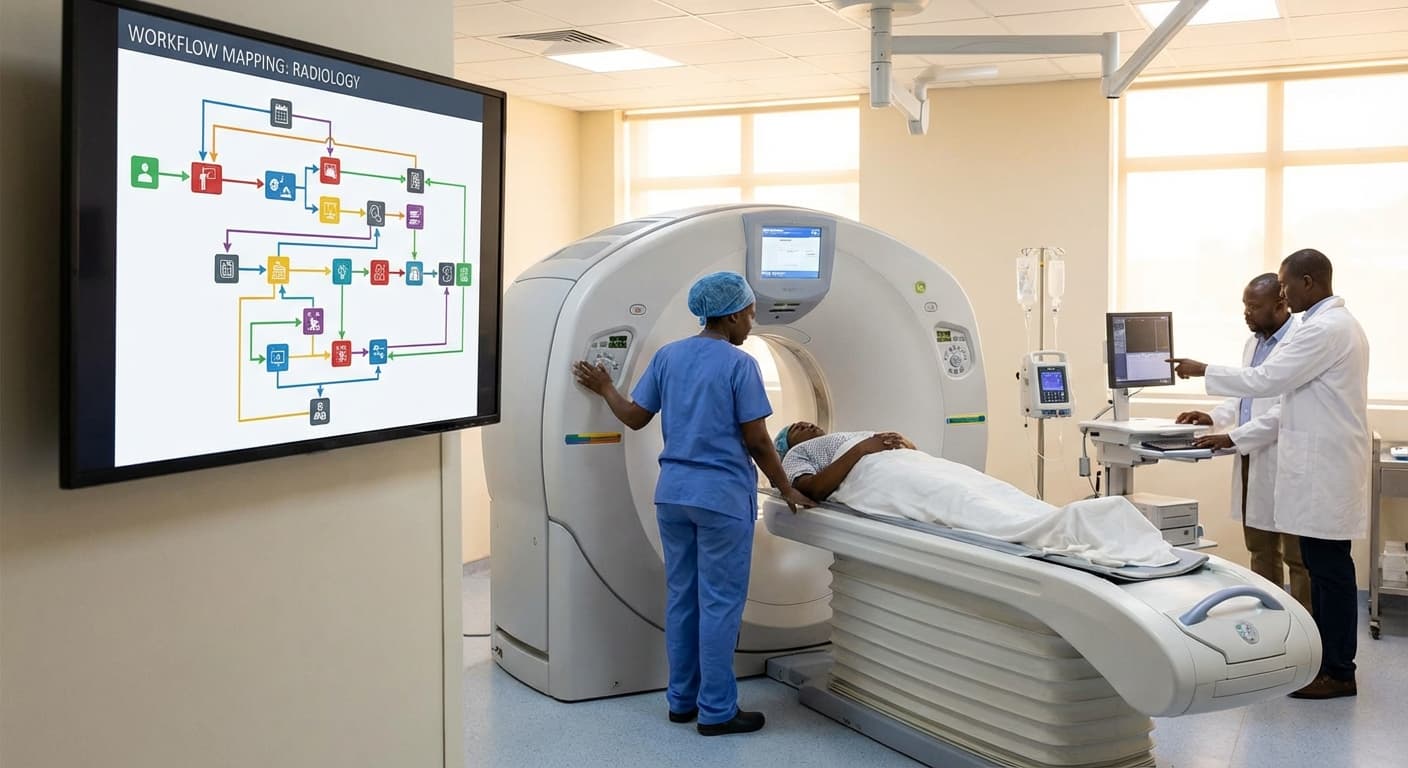
Department Workflow Mapping Service (Radiology/ICU/OT/Lab/Dialysis) in Zambia
Engineering Excellence & Technical Support
Department Workflow Mapping Service (Radiology/ICU/OT/Lab/Dialysis) High-standard technical execution following OEM protocols and local regulatory frameworks.
Streamlined Patient Pathways
Visualizing and optimizing patient journeys across Radiology, ICU, OT, Lab, and Dialysis departments in Zambian healthcare facilities, reducing wait times and improving patient flow efficiency by identifying bottlenecks and recommending best practices.
Interdepartmental Collaboration Enhancement
Mapping the intricate workflows between critical departments like ICU, OT, and the Lab in Zambian hospitals, fostering seamless communication and coordination for timely diagnostics, treatment interventions, and surgical procedures, thereby enhancing patient care outcomes.
Resource Allocation & Utilization Optimization
Analyzing and mapping the utilization of specialized equipment and personnel across Radiology, Dialysis, and OT in Zambian medical centers. Our service identifies opportunities for improved resource scheduling and allocation, leading to reduced operational costs and increased service availability.
What Is Department Workflow Mapping Service (Radiology/icu/ot/lab/dialysis) In Zambia?
Department Workflow Mapping Service (Radiology/ICU/OT/Lab/Dialysis) in Zambia refers to a systematic methodology employed to visualize, analyze, and optimize the operational processes within specific clinical departments of healthcare facilities. This service involves the detailed documentation of all steps, inputs, outputs, decision points, and resource utilization within a defined workflow, aiming to identify inefficiencies, bottlenecks, redundancies, and areas for improvement. The primary objective is to enhance patient flow, improve diagnostic turnaround times, increase resource utilization, ensure patient safety, and ultimately elevate the quality and cost-effectiveness of care delivered within these critical departments.
| Who Needs This Service? | Typical Use Cases |
|---|---|
| Healthcare Facility Management: Hospital administrators, operations managers, and chief information officers (CIOs) seeking to improve overall departmental efficiency and resource management. | Radiology Departments: Optimizing imaging request processing, patient scheduling, image acquisition protocols, interpretation workflows, and reporting turnaround times to reduce patient wait times and improve diagnostic accuracy. |
| Clinical Department Heads & Leads: Heads of Radiology, ICU, Operating Theatres (OT), Laboratories, and Dialysis units who are responsible for the day-to-day operations and performance of their respective departments. | Intensive Care Units (ICU): Streamlining patient admission and transfer processes, managing critical care resource allocation (e.g., ventilators, beds), optimizing multidisciplinary team communication, and improving patient monitoring and response protocols. |
| Quality Improvement & Patient Safety Teams: Units focused on enhancing patient care quality, reducing medical errors, and ensuring adherence to safety standards. | Operating Theatres (OT): Improving surgical scheduling, patient preparation, instrument sterilization and management, intra-operative workflow efficiency, and post-operative patient handoff procedures to maximize operating room utilization and patient outcomes. |
| IT Departments: When considering the implementation or upgrade of clinical information systems (CIS), Picture Archiving and Communication Systems (PACS), Laboratory Information Systems (LIS), or Electronic Health Records (EHRs) to ensure seamless integration with existing and optimized workflows. | Laboratories: Accelerating sample processing, optimizing test ordering and result reporting, improving quality control procedures, and managing reagent and equipment inventory to reduce turnaround times for diagnostic results. |
| External Consultants & Advisors: Organizations providing expertise in healthcare operations, process improvement, and technological implementation within the Zambian healthcare sector. | Dialysis Units: Enhancing patient scheduling for dialysis sessions, optimizing equipment cleaning and maintenance, improving medication administration workflows, and streamlining patient monitoring and outcome tracking to maximize efficiency and patient comfort. |
| Regulatory Bodies & Accreditation Agencies: While not direct users, these entities may require evidence of efficient and well-documented workflows during assessments or inspections. | Inter-Departmental Handoffs: Mapping the transition of patients and associated information between departments (e.g., Radiology to ICU, Lab to OT) to ensure seamless continuity of care and reduce the risk of critical information loss. |
Key Components of Department Workflow Mapping Service
- Process Discovery & Documentation: In-depth interviews with subject matter experts (clinicians, technicians, administrators), direct observation of activities, and review of existing Standard Operating Procedures (SOPs) to meticulously map out current workflows.
- Data Collection & Analysis: Gathering quantitative data such as patient throughput, waiting times, equipment utilization, staff allocation, and error rates to identify performance metrics and baseline performance.
- Bottleneck & Inefficiency Identification: Utilizing process mapping tools and analytical techniques to pinpoint areas where delays, excessive handoffs, or resource underutilization are occurring.
- Root Cause Analysis: Investigating the underlying reasons for identified inefficiencies, which may involve technological limitations, training gaps, communication breakdowns, or suboptimal spatial layouts.
- Process Re-engineering & Optimization: Developing and proposing revised workflows that incorporate best practices, technological advancements, and improved resource allocation to achieve desired performance improvements.
- Simulation & Modeling (Optional): Utilizing specialized software to simulate proposed workflow changes and predict their impact on key performance indicators before implementation.
- Implementation Support & Monitoring: Assisting with the rollout of new workflows, providing training, and establishing mechanisms for ongoing monitoring and evaluation of performance against defined objectives.
- Standardization & Documentation: Developing clear and comprehensive SOPs for the optimized workflows, ensuring consistency and replicability across the department and potentially other facilities.
Who Needs Department Workflow Mapping Service (Radiology/icu/ot/lab/dialysis) In Zambia?
In Zambia, a 'Department Workflow Mapping Service' is crucial for optimizing operations and improving patient care across several critical healthcare departments. This service provides a detailed, visual representation of how tasks, information, and resources flow within a department, identifying bottlenecks, inefficiencies, and areas for improvement. For healthcare providers in Zambia, especially in resource-constrained environments, understanding and streamlining these workflows is paramount to maximizing efficiency, reducing errors, and ensuring timely, high-quality patient outcomes.
| Department | Target Customers in Zambia | Why Workflow Mapping is Crucial |
|---|---|---|
| Radiology | Hospitals (all sizes), Diagnostic Imaging Centers, Specialist Clinics with imaging capabilities. | Optimizing patient scheduling for scans, reducing turnaround time for reports, efficient equipment utilization, ensuring radiographer and radiologist availability, managing image storage and retrieval. |
| Intensive Care Unit (ICU) | Hospitals with ICU facilities, Critical Care Units. | Streamlining patient admission and discharge processes, ensuring timely intervention by medical teams, efficient medication administration, managing patient monitoring equipment, improving communication between nurses, doctors, and specialists, reducing staff burnout. |
| Operating Theatre (OT) | Hospitals with surgical departments, Surgical Centers. | Optimizing surgical scheduling, efficient preparation of operating rooms, ensuring availability of surgical teams and equipment, managing sterile supplies, streamlining patient transfer to and from the OT, reducing procedure delays and cancellations. |
| Laboratory | Hospitals, Standalone Diagnostic Laboratories, Clinics with laboratory services. | Improving sample collection and handling, efficient processing of tests, reducing turnaround times for results, quality control and assurance, managing reagent inventory, ensuring adequate staffing for peak loads, streamlining reporting to clinicians. |
| Dialysis | Dialysis Centers, Hospitals with dialysis units. | Optimizing patient scheduling for dialysis sessions, efficient preparation of dialysis machines and stations, ensuring availability of trained staff, managing supplies (dialyzers, fluids), streamlining patient monitoring during and post-treatment, managing waste disposal. |
Who Needs Department Workflow Mapping Service (Radiology/ICU/OT/Lab/Dialysis) in Zambia?
- Hospitals (Public and Private)
- Specialized Clinics
- Diagnostic Centers
- Dialysis Centers
- Tertiary Care Facilities
- Medical Training Institutions seeking best practice models
Department Workflow Mapping Service (Radiology/icu/ot/lab/dialysis) Process In Zambia
This document outlines the standard workflow for the Department Workflow Mapping Service, specifically tailored for key hospital departments in Zambia: Radiology, Intensive Care Unit (ICU), Operating Theatre (OT), Laboratory, and Dialysis. The service aims to systematically analyze, document, and optimize existing departmental processes. The workflow begins with an initial inquiry from a department and culminates in the delivery of comprehensive workflow maps and recommendations.
| Step | Description | Key Activities | Responsible Party | Deliverables/Outcomes |
|---|---|---|---|---|
| A department expresses interest in workflow mapping. | Department contacts the service provider. Initial needs assessment and scope definition. | Department Manager/Head; Service Provider representative | Understanding of department's goals; confirmation of service feasibility. |
| Defining the specific processes to be mapped and the project scope. | Detailed discussion with department stakeholders. Identification of key processes (e.g., patient intake, sample processing, procedure scheduling). Development of a formal proposal outlining objectives, methodology, timeline, and costs. | Service Provider; Department Head/Management | Approved project scope; formal proposal document. |
| Gathering detailed information about current processes. | On-site observation of daily operations. Interviews with staff at all levels. Review of existing documentation (SOPs, forms, records). Identification of bottlenecks, inefficiencies, and pain points. | Service Provider team (Workflow Analysts); Department Staff | Comprehensive understanding of current workflows; documented 'as-is' process maps. |
| Creating visual representations of the current processes. | Utilizing specialized software (e.g., Visio, Lucidchart) to create detailed flowcharts, swimlane diagrams, and other visual aids. Ensuring accuracy and clarity of depicted steps, decision points, and handoffs. | Service Provider team (Workflow Analysts) | 'As-is' workflow maps. |
| Presenting the 'as-is' maps for feedback and confirmation. | Workshops and review sessions with department staff and management. Incorporating feedback to ensure maps accurately reflect reality. | Service Provider team; Department Staff & Management | Validated 'as-is' workflow maps; consensus on current state. |
| Developing improved and optimized future-state workflows. | Brainstorming sessions to identify opportunities for improvement. Designing 'to-be' workflows that address identified inefficiencies, reduce waste, and enhance patient care/service delivery. Incorporating best practices and relevant technology solutions. | Service Provider team; Department Management (with input from staff) | Proposed 'to-be' workflow maps; recommendations for improvement. |
| Formulating actionable recommendations based on the workflow analysis. | Developing detailed recommendations for process changes, technology adoption, training needs, policy updates, and resource allocation. Prioritizing recommendations based on impact and feasibility. | Service Provider team | Documented recommendations report. |
| Presenting the findings, maps, and recommendations to the department and hospital management. | Compilation of a comprehensive final report including 'as-is' and 'to-be' maps, detailed analysis, and actionable recommendations. Formal presentation to stakeholders. | Service Provider team; Department Management; Hospital Administration | Final workflow mapping report; presentation of findings and recommendations. |
| Assisting the department in implementing the recommended changes. | Providing guidance, training, and project management support during the implementation phase. Monitoring progress and addressing any challenges. | Service Provider team (if contracted); Department Management & Staff | Successful implementation of optimized workflows; improved departmental efficiency. |
| Evaluating the effectiveness of the implemented changes. | Conducting follow-up assessments to measure the impact of implemented changes against defined objectives. Identifying further areas for continuous improvement. | Service Provider team; Department Management | Evaluation report; identification of lessons learned. |
Key Departments Covered
- Radiology
- Intensive Care Unit (ICU)
- Operating Theatre (OT)
- Laboratory
- Dialysis
Department Workflow Mapping Service (Radiology/icu/ot/lab/dialysis) Cost In Zambia
The cost of a Department Workflow Mapping Service for specific healthcare departments (Radiology, ICU, OT, Lab, Dialysis) in Zambia can vary significantly. This service is crucial for optimizing patient flow, resource utilization, and overall departmental efficiency. Several factors influence the pricing, making a precise universal cost difficult to state without detailed project scope. However, we can outline the key pricing factors and provide estimated ranges in Zambian Kwacha (ZMW).
| Service Component / Department Focus | Estimated Cost Range (ZMW) |
|---|---|
| Basic Workflow Mapping (Single Department - e.g., Radiology Outpatient) | 15,000 - 30,000 |
| Comprehensive Workflow Mapping (Single Department - e.g., ICU with detailed patient journey) | 30,000 - 60,000 |
| Multi-Department Workflow Mapping (e.g., OT and Anesthesia departments) | 50,000 - 120,000+ |
| In-depth Process Analysis & Optimization (e.g., Lab turnaround times, Dialysis scheduling) | 40,000 - 90,000 per department |
| Full-Scale Workflow Re-engineering & Implementation Support (Multiple Departments) | 100,000 - 300,000+ |
| Add-on: Stakeholder Workshops & Training Development | 10,000 - 25,000 per workshop/module |
Key Pricing Factors for Department Workflow Mapping Services in Zambia:
- Department Size and Complexity: Larger departments with more intricate processes and a higher volume of patient interactions will naturally require more extensive mapping and analysis, leading to higher costs.
- Number of Departments Mapped: If the service is requested for multiple departments simultaneously, the overall cost will increase proportionally, although some economies of scale might apply.
- Scope of Work: This includes the depth of analysis, the level of detail in the mapping (e.g., identifying every single step in a process), and the inclusion of staff interviews, direct observation, data analysis, and stakeholder workshops.
- Consultant Expertise and Experience: The reputation, years of experience, and specialized knowledge of the consulting firm or individual consultant play a significant role in pricing. Highly sought-after experts will command higher fees.
- Duration of the Engagement: The length of time required to complete the mapping project, from initial assessment to final recommendations and implementation support, directly impacts the cost.
- Deliverables Required: The type and format of the final output (e.g., detailed process maps, gap analysis reports, recommendations, implementation plans, training materials) will affect the pricing.
- Data Collection Methods: The complexity of data collection (e.g., surveys, interviews, direct observation, system data extraction) can influence the resources and time needed.
- Location within Zambia: While not a primary driver for consulting fees, travel and accommodation costs for consultants might vary depending on the specific location of the healthcare facility.
- Technology and Tools Used: The use of specialized software for process mapping and analysis by the consultant might be factored into the pricing.
- Level of Customization: Highly customized mapping and analysis tailored to unique departmental needs will be more expensive than standardized approaches.
Affordable Department Workflow Mapping Service (Radiology/icu/ot/lab/dialysis) Options
Our Affordable Department Workflow Mapping Service offers a comprehensive solution for optimizing operations within critical hospital departments like Radiology, ICU, OT, Lab, and Dialysis. By meticulously analyzing your current workflows, we identify bottlenecks, inefficiencies, and areas for improvement. This leads to increased staff productivity, reduced patient wait times, improved resource utilization, and ultimately, significant cost savings.
| Value Bundle | Included Services | Target Departments | Key Cost Savings |
|---|---|---|---|
| Essential Mapping Package | Core Workflow Analysis, Bottleneck Identification | Radiology, Lab | Reduced processing times, optimized reagent usage, improved staff scheduling |
| Critical Care Optimization Bundle | Core Workflow Analysis, Bottleneck Identification, Patient Flow Improvement, Resource Utilization Assessment | ICU, OT, Dialysis | Minimized equipment downtime, efficient patient throughput, reduced overtime, better inventory management |
| Comprehensive Operational Excellence Suite | All services in Critical Care Optimization Bundle + Technology Integration Recommendations, Staff Training & Change Management Support | All Departments | Maximized ROI on technology investments, enhanced staff efficiency and morale, sustained operational improvements, reduced errors |
| Customizable Solutions | Tailored to specific departmental needs and budget constraints | All Departments | Flexible cost structure, targeted improvements leading to demonstrable ROI |
Value Bundles and Cost-Saving Strategies
- Core Workflow Analysis: In-depth mapping of existing processes, identifying key steps, decision points, and resource allocation.
- Bottleneck Identification & Optimization: Pinpointing areas of delay and proposing actionable solutions for smoother transitions.
- Resource Utilization Assessment: Analyzing equipment, staff, and supply usage to identify under or over-utilization.
- Patient Flow Improvement: Streamlining patient journeys to reduce wait times and enhance patient satisfaction.
- Technology Integration Recommendations: Suggesting appropriate technological solutions to automate tasks and improve data management.
- Staff Training & Change Management Support: Providing guidance and resources to facilitate smooth adoption of new workflows.
- Continuous Improvement Framework: Establishing mechanisms for ongoing monitoring and refinement of processes.
Verified Providers In Zambia
In Zambia's evolving healthcare landscape, identifying trusted and qualified medical practitioners is paramount. Franance Health has established itself as a leading platform committed to connecting patients with verified healthcare providers. This rigorous verification process ensures that all listed professionals meet stringent quality and ethical standards, offering patients peace of mind and confidence in their medical choices. Franance Health's dedication to transparency and excellence makes them the premier destination for finding reliable healthcare in Zambia.
| Key Verification Criteria | Franance Health's Commitment |
|---|---|
| Professional Licensing & Registration: Ensuring all providers are legally authorized to practice medicine in Zambia. | We meticulously cross-reference all licenses and registrations with relevant Zambian medical regulatory bodies. |
| Educational & Professional Qualifications: Validating degrees, certifications, and specialized training. | Franance Health confirms the authenticity of all academic and professional credentials through rigorous checks. |
| Experience & Specialization: Assessing practical experience and areas of expertise. | We review provider histories to ensure they have the necessary experience and specialization for the services they offer. |
| Reputation & Ethical Conduct: Gathering insights into professional standing and patient feedback (where applicable and ethically permissible). | While respecting privacy, we prioritize providers with a demonstrated commitment to ethical patient care and professional integrity. |
| Continued Professional Development: Encouraging and verifying ongoing learning to stay current with medical advancements. | We value providers who are dedicated to continuous learning and staying at the forefront of medical knowledge. |
Why Franance Health is Your Best Choice for Verified Providers in Zambia:
- Uncompromising Verification Process: Franance Health employs a multi-step vetting system to confirm the credentials, licenses, and professional standing of every provider. This includes verifying educational backgrounds, specialized training, and ongoing professional development.
- Focus on Patient Safety and Quality Care: Our primary goal is to ensure that Zambians have access to safe, effective, and high-quality healthcare services. By meticulously screening providers, we minimize risks and promote optimal patient outcomes.
- Comprehensive Provider Directory: Franance Health offers a diverse range of medical specialties, from general practitioners to specialists in fields like cardiology, pediatrics, dermatology, and more. This ensures you can find the right expert for your specific health needs.
- User-Friendly Platform: Our intuitive online platform allows for easy searching, filtering, and booking of appointments with verified providers. Detailed provider profiles provide essential information to help you make informed decisions.
- Commitment to Ethical Practices: We only partner with healthcare professionals who adhere to the highest ethical standards and patient care principles. This fosters a trustworthy and respectful healthcare environment.
- Empowering Patients: By providing access to verified and reliable information, Franance Health empowers individuals to take control of their health journey and make confident choices about their medical care.
Scope Of Work For Department Workflow Mapping Service (Radiology/icu/ot/lab/dialysis)
This Scope of Work (SOW) outlines the services for conducting a comprehensive workflow mapping initiative across critical hospital departments, including Radiology, Intensive Care Unit (ICU), Operating Theatre (OT), Laboratory (Lab), and Dialysis. The objective is to document current state workflows, identify inefficiencies, and propose optimized future state processes to enhance operational efficiency, patient care, and resource utilization. This SOW details the technical deliverables and their standard specifications.
| Deliverable Name | Description | Standard Specification / Format | Acceptance Criteria |
|---|---|---|---|
| Current State Workflow Maps (As-Is) | Detailed graphical representations of existing processes within each department. This includes patient flow, information flow, material flow, and decision points. | Visio Diagrams or equivalent (e.g., Lucidchart, Miro), adhering to BPMN 2.0 standards where applicable. Each map will include swimlanes for roles/departments, clear process steps, decision gateways, and start/end events. Associated narrative documents detailing each step, responsible parties, and inputs/outputs. | Maps accurately reflect observed processes. All critical steps and decision points are captured. Stakeholder validation of map accuracy for each department. |
| Process Narratives and Documentation | Written descriptions accompanying each workflow map, providing detailed context and explanation of each process step, its purpose, and associated procedures. | Microsoft Word or equivalent document. Clear, concise language. Defined terminology. Includes details on roles, responsibilities, systems used, and potential variations. | Comprehensive and unambiguous descriptions. Consistent terminology used across all documents. Easy for non-technical staff to understand. |
| Bottleneck and Inefficiency Analysis Report | A report identifying and quantifying key bottlenecks, redundancies, delays, and areas of inefficiency within the current state workflows. | Microsoft Word or PDF document. Utilizes data-driven insights where available (e.g., wait times, turnaround times). Prioritizes identified issues based on impact. | Clearly articulates identified issues with supporting evidence. Prioritization logic is sound and defensible. Covers all mapped departments. |
| Future State Workflow Maps (To-Be) | Proposed optimized workflows designed to address identified inefficiencies and improve operational performance. | Visio Diagrams or equivalent, similar to 'Current State Workflow Maps', showcasing the proposed changes. Includes updated swimlanes, steps, and decision points. Associated narrative documents. | Demonstrates clear improvements over current state. Feasible and practical to implement. Aligns with organizational goals and industry best practices. Stakeholder buy-in on proposed changes. |
| Recommendations for Improvement Report | A comprehensive report detailing actionable recommendations for process improvement, technology adoption, training needs, and change management strategies. | Microsoft Word or PDF document. Recommendations are specific, measurable, achievable, relevant, and time-bound (SMART). Includes a roadmap for implementation. | Recommendations are directly linked to identified inefficiencies. Implementation roadmap is logical and practical. Potential ROI and impact assessment included where possible. |
| Stakeholder Workshop Summaries | Minutes and key takeaways from all stakeholder engagement sessions, workshops, and validation meetings. | Microsoft Word or PDF document. Records attendance, discussion points, decisions made, and action items assigned. | Accurate reflection of discussions and decisions. Action items are clearly defined with owners and deadlines. Facilitates communication and alignment. |
| Final Workflow Mapping Report | A consolidated report integrating all deliverables, providing an executive summary, detailed analysis, proposed future state, and implementation recommendations. | Microsoft Word or PDF document. Well-structured with an executive summary, introduction, current state analysis, future state proposal, recommendations, and appendices. | Covers all aspects of the project. Presents information clearly and logically. Provides a roadmap for next steps. Approved by key stakeholders. |
Objectives
- To thoroughly document the 'as-is' state of workflows within Radiology, ICU, OT, Lab, and Dialysis departments.
- To identify bottlenecks, redundancies, and areas of potential improvement in current processes.
- To develop 'to-be' state workflows that are efficient, standardized, and aligned with best practices.
- To facilitate the identification of opportunities for technology integration and automation.
- To provide actionable recommendations for process optimization and change management.
- To ensure all mapped workflows are clear, concise, and easily understandable by all stakeholders.
Service Level Agreement For Department Workflow Mapping Service (Radiology/icu/ot/lab/dialysis)
This Service Level Agreement (SLA) outlines the guaranteed response times and uptime for the Department Workflow Mapping Service. This service is crucial for ensuring efficient and effective operations within the Radiology, Intensive Care Unit (ICU), Operating Theatre (OT), Laboratory, and Dialysis departments. This SLA applies to the continuous availability and performance of the workflow mapping tools and associated support.
| Service Component | Uptime Guarantee | Response Time (Critical Incidents) | Response Time (Non-Critical Incidents) | Escalation Protocol |
|---|---|---|---|---|
| Workflow Mapping Platform Availability | 99.9% (24/7/365) | 15 minutes | 2 business hours | Defined escalation matrix based on severity and impact |
| Real-time Data Visualization Access | 99.5% (24/7/365) | 30 minutes | 4 business hours | Defined escalation matrix based on severity and impact |
| Workflow Analytics & Reporting System | 99.0% (during business hours: 8 AM - 6 PM) | 1 hour | 8 business hours | Defined escalation matrix based on severity and impact |
| Technical Support (Critical Workflow Disruption) | N/A (Support is provided as defined below) | Within 1 hour of initial contact | N/A | Direct line to senior support staff |
| Technical Support (General Inquiries & Assistance) | N/A | N/A | Within 4 business hours of initial contact | Standard ticketing system and email support |
Scope of Service
- Workflow mapping tools and platforms
- Real-time data collection and visualization
- Performance analytics and reporting
- Technical support for workflow mapping functionalities
- Regular system updates and maintenance
Frequently Asked Questions

Ready when you are
Let's scope your Department Workflow Mapping Service (Radiology/ICU/OT/Lab/Dialysis) in Zambia project in Zambia.

Scaling healthcare logistics and technical systems across the entire continent.